Blogs & Articles
Latest legal updates, advice, and industry news from India's top advocates.
.webp)
Advocate in Sarita Vihar: Find the Right Lawyer for Your Legal Matter
Advocate in Sarita Vihar: How to Find the Right Lawyer for Your Legal Issue Finding the correct lawyer can make a big difference when you have a legal problem, whether it’s about documents, family issues, property matters, a criminal case, or any other legal matter. If you live in Sarita Vihar or nearby areas in South-East Delhi, it's important to choose a lawyer who understands your case and knows the legal process. Sarita Vihar is part of South-East Delhi and is one of the administrative areas in the district. It includes the areas of Sarita Vihar, Jaitpur, and Badarpur. If you are looking for a lawyer in Sarita Vihar, it's helpful to start by knowing exactly what kind of legal help you need. Then, find a lawyer who specializes in that area.Compare different lawyers based on their experience, their qualifications, how well they communicate, and how well they fit your case. Why Choosing the Right Lawyer Matters Legal issues can involve important documents, strict deadlines, court appearances, negotiations, and following the right procedures. A lawyer can help you understand the court process, prepare or check legal documents, talk to the other side, and represent you in court or before the right authority, depending on your case. Every legal matter is different. A lawyer who deals with family issues might not be the best choice for a serious criminal case.Similarly, a lawyer who handles property problems might not be the right one for a complex business dispute. This is why it’s better to look for a lawyer based on both their location and their area of expertise, rather than just because their office is near you. What Kinds of Legal Issues Can a Lawyer Help With? People looking for a lawyer in Sarita Vihar might have very different needs. Depending on the lawyer’s area of expertise, they can help with matters like: - Property and land disputes - Civil disputes - Criminal cases - Bail-related issues - Family and marital problems - Divorce and maintenance - Consumer complaints - Cheque bounce cases - Work-related disputes - Legal documents and notices - Motor accident claims - Business and commercial disputes - Debt recovery - Succession and inheritance - Rent and tenancy problems - Cases in the High Court or other appeals The best lawyer for you depends on the specific details of your case and the court it needs to go to. Before hiring a lawyer, explain your situation clearly and ask if they regularly handle cases similar to yours. How to Find a Lawyer in Sarita Vihar Searching online can help you find lawyers based on location, area of practice, and professional information. But just finding a lawyer online isn't enough. Consider the following before making a decision. 1. Understand Your Legal Issue Start by clearly knowing what kind of help you need. For example, if you have received a legal notice about a property problem, you might need a lawyer who specializes in civil or property law. If you are facing a criminal case, you should look for a lawyer experienced in criminal law. A clear understanding of your problem helps you find the right type of legal expertise. 2. Check Professional Qualifications Before hiring a lawyer, make sure they have the proper qualifications and are registered with the Bar Council if required. Online legal platforms can help you find lawyers, but you should also do your own research before starting a lawyer-client relationship. Platforms like Find My Vakeel check lawyer profiles using Bar Council registration data before listing them, but they also advise users to verify the credentials themselves. 3. Look at Relevant Experience Experience should be relevant to your legal issue, not just the number of years a lawyer has been practicing. Ask questions like: - Does the lawyer handle cases like mine regularly? - Which courts or forums do they appear in? - Have they dealt with similar legal problems? - Can they explain the process clearly? - What documents do I need to provide? These questions can help you decide if the lawyer is right for your case. 4. Discuss Legal Fees Clearly Legal fees can vary based on the type and complexity of the case, the lawyer's experience, the court involved, and the amount of work needed. Before proceeding, ask the lawyer about the expected professional fee and any extra costs that may come up. A clear discussion about fees at the start can help prevent confusion later. Court Location and Legal Jurisdiction It's important to know that where an advocate's office is located and which court has authority over your case are not always the same. Delhi has many court buildings and different cases may fall under different areas of law or locations. The Delhi District Courts system offers details about court buildings, their areas of authority, case status, and other services. For instance, Tis Hazari Courts deal with a wide range of cases, including both civil and criminal matters, while other court buildings in Delhi have their own areas they handle and specific types of cases. So, before starting a case or choosing an advocate just because they are close by, it's wise to check which court or office is responsible for your case. Why Local Legal Knowledge Can Be Helpful A lawyer who understands the Delhi legal system can offer better advice on how to proceed, what documents are needed, and which court is the right one for your case. For people living in Sarita Vihar, having an advocate nearby can make communication and meetings easier, especially if the case needs several discussions, document reviews, or coordinate with the court. But being close by isn't the only thing to consider. The advocate's experience and how well they fit your case are also important. Find an Advocate in Sarita Vihar Through Find My Vakeel Find My Vakeel is a legal platform that connects people with lawyers across India. You can search for lawyers based on your location and legal needs. If you are looking for a lawyer in Sarita Vihar, you can use Find My Vakeel to find legal professionals who match your needs. The platform says that all listed lawyers have their Bar Council ID and other details checked before being added. However, it's still a good idea to check these details yourself before hiring anyone. Find My Vakeel doesn't give legal advice or promise case results. The legal relationship is between the user and the lawyer they choose. Questions to Ask Before Hiring an Advocate Before making a decision, you should ask: Have you handled similar cases before? Which court or office is responsible for my case? What documents will you need from me? What is the legal process likely to be? What are your fees? Are there any extra costs? How will I get updates about my case? A good first meeting should help you understand the legal process and what might happen next. Final Thoughts Finding a lawyer in Sarita Vihar isn't hard, but choosing the right one takes more than just looking at the first name in a list. Start by understanding your issue, finding the right area of law, checking the lawyer's background, considering their experience, and talking about costs and expectations. If your case will go to court, make sure you know which court has authority. Using Find My Vakeel, you can find lawyers based on location and legal needs and connect directly with those who seem right for you. This can make the process of finding legal help easier and help you make an informed choice. Disclaimer: This article is for general information only and should not be used as legal advice. Laws and court rules can vary depending on the case.Always consult a qualified lawyer for advice about your specific situation.

The Role and Importance of an Advocate in Modern Society
An advocate plays a vital role in maintaining justice, protecting rights, and ensuring that the legal system functions fairly and effectively. In simple terms, an advocate is a professional who represents individuals, organizations, or governments in legal matters. However, their role goes far beyond just arguing cases in court. Advocates are advisors, problem-solvers, negotiators, and guardians of justice. One of the primary responsibilities of an advocate is to provide legal advice. Many people are unaware of their rights or do not fully understand the legal implications of their actions. An advocate helps bridge this gap by offering clear guidance based on the law. Whether it is drafting contracts, handling property disputes, or advising on criminal matters, their expertise ensures that clients make informed decisions. Without proper legal advice, individuals may unknowingly violate laws or lose their rights. Another crucial aspect of an advocate’s role is representation in court. When disputes escalate and legal intervention becomes necessary, advocates present arguments, examine evidence, and defend their clients’ interests. They must have strong analytical skills, confidence, and the ability to think critically under pressure. Courtroom proceedings are often complex, and advocates must interpret laws and precedents to build a strong case. Their ability to communicate effectively can significantly influence the outcome of a case. Advocates also play a key role in upholding justice and fairness. They are bound by ethical standards and must act with integrity, honesty, and professionalism. An advocate is not just responsible for winning cases but also for ensuring that justice is served. This means they cannot mislead the court or present false evidence. Their duty is to the law as much as it is to their client. In this way, advocates contribute to maintaining public trust in the legal system. In addition to courtroom duties, advocates are involved in alternative dispute resolution methods such as mediation and arbitration. Not all conflicts need to be resolved through lengthy court battles. Advocates often help parties reach mutually beneficial agreements outside the courtroom, saving time, money, and emotional stress. This approach is especially useful in family disputes, business disagreements, and civil matters where preserving relationships is important. The profession of advocacy requires continuous learning. Laws evolve over time, and advocates must stay updated with new regulations, judgments, and legal trends. This demands dedication and a strong commitment to professional growth. Many advocates specialize in specific areas such as criminal law, corporate law, intellectual property, or human rights, allowing them to develop deep expertise and provide better service to their clients. Moreover, advocates play an important role in promoting social justice. They often take up cases for marginalized communities, fight against injustice, and work towards ensuring equal rights for all. Public interest litigation, for example, allows advocates to address issues that affect society at large, such as environmental protection, human rights violations, and corruption. Through such efforts, advocates become agents of change, contributing to a more just and equitable society. However, the profession is not without challenges. Advocates often deal with high-pressure situations, tight deadlines, and emotionally demanding cases. Long working hours and the need for constant preparation can be exhausting. Additionally, young advocates may face difficulties in establishing themselves in a competitive field. Despite these challenges, the profession offers immense satisfaction, especially when advocates succeed in protecting someone’s rights or achieving justice. In conclusion, an advocate is an essential pillar of the legal system and society as a whole. Their role extends beyond legal representation to include advising, negotiating, and promoting justice. Through their dedication and expertise, advocates ensure that laws are applied fairly and that individuals’ rights are protected. In a world where legal complexities continue to grow, the importance of advocates cannot be overstated. They not only defend cases but also uphold the very principles of justice and equality that form the foundation of a civilized society.
GST Registration, Returns & Compliance Guide in India | Find My Vakeel
Goods and Services Tax (GST) is a comprehensive indirect tax system in India which was implemented on 1 July 2017. Earlier there were numerous indirect taxes such as VAT, Service Tax, Excise Duty, Entry Tax, and Central Sales Tax levied on goods or services but these multiple layered tax structures have been simplified under GST as it has brought all of these together into one common umbrella under the GST regime. The main purpose of GST is simplification, removal of cascading taxes and forming a common national market. Today, GST is the most important aspect for regulating of goods and services taxation and compliance by businesses. GST( Goods and Services Tax) What is it? GST is a consumption-based tax, which means it is imposed on the supply of goods and services. The tax is levied at each stage of supply chain, but businesses can avail Input Tax Credit (ITC) against the taxes paid for purchases. All entities (manufacturer, trader, service provider, e-commerce operator or other entity providing goods or services) are required to pay GST. Types of GST in India Central Goods and Services Tax (CGST) When we sell goods within the same state then CGST is collected by the central Government. SGST is an abbreviation for State Goods and Services Tax SGST (State Goods and Service Tax) – SGST is charged by the concerned State Government on goods or services sold within the same state. - Integrated Goods and Services Tax (IGST) IGST is applicable on inter-state transactions and imports. 1st visit– UTGSP (Union Territory Goods and Services Tax) IUTGST is the Act for Union Territory Good & Service Tax which applied on supplies made in UT. GST Registration Compulsory or Mandatory Registration for Goods & Services Taxstelle GST registration is compulsory, if a business exceeds the prescribed turnover limits and entrepreneurs belong to certain categories. Who Needs GST Registration? Transition of Businesses above GST threshold limit E-commerce sellers and operators. Inter-state suppliers. Casual taxable persons. Non-resident taxable persons. Input service distributors. Reverse charge mechanism penny drops for businesses. Benefits of GST Registration Legal recognition as a supplier. Ability to charge GST from customers. Eligibility to claim input tax credit (ITC). Improved business credibility. Access to interstate markets. GST Return Filing GST registered businesses have to periodically file returns with the GST department. Common GST returns include: GSTR-1 (Outward supplies) GSTR-3B (Monthly summary return) GSTR-9 (Annual return) GSTR-9C (Reconciliation statement) Filing returns in time helps businesses in averting penalties, interest, and compliance issues. ITC (Input Tax Credit) Under GST One of the main advantages in the making of GST world is input Tax Credit. Between ITC which is a benefit for registered taxpayers to reduce the tax liability of its business by claiming credit from GST paid on the purchases. Conditions for Claiming ITC Valid tax invoice. Receipt of goods or services. Tax paid by supplier to govt Return filing compliance. ITC management that is proper allows for businesses to curtail expenses and improve the profitability of their firms. GST Rates in India The GST rates are generally classified into: 0% (Exempt Goods and Services) 5% 12% 18% 28% Taxation is based on classification and notifications Government regarding products or services. GST Compliance Requirements Businesses also must follow a few GST rules and regulations like: Timely registration. Accurate invoicing. Regular return filing. Tax payment within deadlines. Keeping records and books of accounts. Reconciliation of transactions. Failure to comply may mean fines, notices, audits and lawsuits. GST Audit and Assessment GST authorities might audit and assess to confirm the correctness of returns along with tax payments. Businesses should keep proper records of Tax invoices Purchase records Sales records E-way bills Input Tax Credit documents Financial statements Keeping proper documentation helps a lot during the time of audit for smoother compliance. GST Penalties and Legal Consequences Non-compliance under GST includes: Monetary penalties. Interest on delayed tax payments. Cancellation of GST registration. Tax recovery proceedings. Case of prosecution in serious tax evasion. Whenever a business receives GST notices or disputes, professional legal and tax assistance ought to be taken into consideration. GST Dispute Resolution GST-related disputes may arise regarding: Classification of goods and services. Input Tax Credit claims. Tax demands. Refund claims. Registration cancellations. Penalty proceedings. Hiring professionals with the legal expertise can help businesses resolving disputes quickly and protecting their interests. How Find My Vakeel Can Help Access to experienced legal professionals and tax experts who help with the following through Find My Vakeel: GST registration. GST return filing. GST compliance management. GST notices and replies. GST litigation and appeals. Input Tax Credit disputes. Tax advisory services. Business compliance solutions. Our experts help you with ensuring compliance of gst law by minimizing legal and financial risks here. Conclusion GST has overhauled the way India perceives its taxation framework, resulting in an all-encompassing and transparent tax structure. GST registration, return filing, Input Tax Credit, compliance requirements and dispute resolution related to GST are some important aspects which every business is now required to understand in India. Be it a startup, small business, freelancer or large enterprise, GST Compliance helps in avoiding penalties along with enhancing the credibility of your organization and facilitates smooth operations. Get connected to qualified legal professional suitable for your by Find My Vakeel; whom help you throughout the entire journey of GST compliance, right from registration till filing returns.
GST Registration, Returns & Compliance Guide in India | Find My Vakeel
The Complete Guide to Goods and Services Tax (GST) in India for Businesses The introduction of Goods and Services Tax (GST) is one of the largest tax reforms introduced in India. GST replaced several indirect taxes and streamlined these into a single – GST system in place of VAT, Service Tax, Excise Duty, Entry Tax etc. GST was introduced from 1st July 2017 with a aim to establish one tax across the nation. GST is also important for businesses-related knowledge and startup/freelancer/service-providing companies to ensure their legal adherence and avoid getting penalized. GST affects the collection of sales, tax and return filing irrespective of whether you are selling goods/services. What is GST? April 2023 trained data GST which is (Goods and Services Tax) an indirect tax on the supply of products and services between states in India. It is a consumption-based tax that will be collected in the place of consumption not production level. The GST is implemented in a value-added taxation method, where tax is levied at every level of the supply chain — but firms can claim Input Tax Credit (ITC) on taxes that were previously paid. It is useful in removing the effect of cascading taxes. Types of GST in India Central Goods and Services Tax (CGST) CGST is levied by the Central Government on supplies of goods and services as a part of Union Territory (Union Territories Goods and Services Tax) for intra-State transactions. SearchSGST (State Goods and Services Tax) SGST is collected by the concerned State Govt. on intra-State transactions. GST (Goods and Services Tax) international IGST applies on inter-state transactions as well. IGST is collected by the Central Government, which then allocates a portion of it to the relevant states. Key Features of GST One nation, one tax structure. Eliminates multiple indirect taxes. Simplifies tax compliance. Reduces tax-on-tax effect. Promotes transparency in taxation. Promotes e-filing and e-record keeping. Reduces business friction across India Benefits of GST for Businesses Simplified Tax Structure Businesses will no longer be required to manage multiple forms of indirect taxes under the purview of different authorities. Input Tax Credit (ITC) You claim credit for any GST paid on the purchases and expenses of running a business if you are registered as a business. Better Compliance Compliance has also become more convenient, with an online system for registration, return filing and payment. Increased Market Reach GST provides for simple interstate trade without cumbersome state level tax barriers. Reduced Tax Burden Cascading taxes have been eliminated, which decreases the overall cost of doing business. GST Registration GST registration is required for businesses exceeding the turnover limits set by law, or that perform certain taxable acts. Once registered the business gets a GST Identification Number (GSTIN). A registered taxpayer must: Collect GST from customers. Issue GST-compliant invoices. File GST returns regularly. Maintain proper records and accounts. Pay taxes to the government timely. GST Returns Return refers to a document containing details of sales, purchases and tax collected and paid by registered taxpayers under Goods and Services Tax (GST). Common GST returns include: Details of outward supplies: GSTR-1. GSTR-3B — Summary return and payment of tax. Annual Return – Filing for compliance on a yearly basis. Not filing returns on time may also attract interest, late fees, and penalties. Input Tax Credit (ITC) Input Tax Credit allows to reduce the GST payable by businesses on goods and/or services used for business purposes by claiming credit of tax already paid at purchase level. Examples include: GST paid on office equipment. GST paid on raw materials. GST paid on professional services. GST paid on business-related purchases. ITC Benefit Can Be Claimed Only if You Have Proper Invoices and Compliance GST Compliance Requirements Businesses registered under GST must: Maintain accurate records. Generate tax invoices. File GST returns on time. Reconcile purchase and sales data. Adhere to relevant e-invoicing and e-way bill requirements, GST Issues Faced By Businesses Although GST has simplified things, businesses may still find it useful to: Complex filing requirements. Frequent regulatory updates. Input Tax Credit reconciliation issues. Compliance management for multiple states. Filing delays and mistakes in reporting penalties. Importance of Legal Assistance in GST Related Matters Any wrong step in compliance of GST such as GST disputes, notices, registration issues, and errors can result in heavy financial loss. An experienced GST lawyer or tax consultant can assist businesses: Handle GST notices and assessments. Resolve tax disputes. Ensure proper compliance. Maintenance of registration and return filing for GST. Represent businesses before tax authorities. Getting professional legal advice can help businesses to avoid making costly errors and staying legally compliant with GST laws. Conclusion GST is based on one of the big game changes to India's indirect taxation system by building a structure which is both national but transparent and inclusive. GST knowledge: It is the one of the most important areas for any business functioning in India. Maintaining proper GST compliance not only saves you a great deal from penalties but also ensures smoother functioning of your business and growth in the long run. SEO Meta Title Introduction of GST (Goods and Services Tax) in India – Complete Guide for Businesses SEO Meta Description GST in India |Everything you need to know about GST( Goods and Services Tax) Registration & Return Filing, Input tax credit, Compliance requirements, Benefits of GST for business & Legal help Meta Keywords Your data trained till 2023 October.
.png)
Online 7/12 Record in India – Land Record Verification & Property Details | Find My Vakeel
Satbara Utara or the Online 7/12 Record is one of the most significant land records that are used as proof of ownership and details about agricultural land in India. It stores complete information related to land ownership, cultivation details, area measurement and revenue records which are maintained by government. Digitalization allows citizens to view their 7/12 records through online portals — this also eases up property verification and getting the work done faster, easier and more openly. What is a 7/12 Record? 7/12 Record: 7/12 or satbara is a land revenue document provided by Revenue Department which consists of: Name of the landowner Survey number or plot number Land area and boundaries They want details about the land type and what crop is cultivated, Encumbrances and liabilities Mutation entries Tax and revenue information It is an important evidence of ownership and possession of land for the purposes of agriculture. Importance of Online 7/12 Records There are several advantages of Online 7/12 records Real-time information about a piece of land ownership Faster property verification during transactions Reduced chances of land fraud Transparency in land records Easy access to services without going to the government offices XLNT: underpinned loans and financial transactions What You Can Learn From a 7/12 Extract Information contained in a standard 7/12 extract includes: Ownership Details Details about the present land owner and co-owners. Survey Number Unique Land Identification Number assigned to the land parcel Land Area Complete Information about One of the Large & Blue Meanies Oxygen Therapy Center Crop Information Information of crops based on agriculture land Mutation Records Transfer of Ownership/Inheritance/Sale/Partition Related Information Revenue Details Governmentarí dus, hãng thuê thắng, مكتب thu HOAّة thưởng Online Access to 7/12 Records (Historical Landview) The process generally involves: Go to the state land records portal. Select district, taluka, and village. Search survey or owner number. You will search & view the land record Get hold of or print the log for any future reference. Different states have different availability and even procedures. Legal Significance of 7/12 Records The extract provides the key in: Property purchase and sale transactions Agricultural land verification Mutation proceedings Inheritance and succession matters Land dispute resolution Bank loan applications against land It is important evidence of possession and ownership particulars but will usually require further title checks prior to significant transactions. Overview of 7/12 Records Common Issues Property owners often have issues like: Incorrect ownership entries Missing mutation records Boundary disputes Duplicate claims Errors in survey numbers Delays in updating records It may involve obtaining legal help so as to make the required corrections on such revenue records and/or resolve all relevant disputes. How Find My Vakeel Can Help Find My Vakeel has seasoned legal experts that provide assistance for: Land record verification Property due diligence Mutation and revenue matters Ownership disputes Agricultural land transactions Property documentation and legal compliance Having professional legal advice protects you and makes sure that your land deals are safe. Conclusion The introduction of online 7/12 Records has made it easier to access land ownership details and also enhance transparency in the property buying process. When you buy agricultural land, verify ownership, or even address land disputes, consider reviewing the latest 7/12 extract. Using Find My Vakeel for legal verification can protect your property rights and keep you out of trouble later.
.png)
4 | NON-PROFIT COMPANIES IN INDIA | UNDERSTANDING SECTION 25 OF THE COMPANIES ACT
Though the old Companies Act, 1956 itself has been repealed and replaced by Companies Act, 2013 yet many still search for Section 25 Companies. Section 25 Companies were non-profit organizations that existed under the old law for charitable purposes. Today, such an organizations are registered as Section 8 companies under Companies Act, 2013. Find My Vakeel is a platform that connects entrepreneurs with legal assistance from qualified lawyers and attorneys across India. A lot of these organizations come to us for guidance on issues related to company registration, NGOs, trusts, social organizations and compliance. The most important aspect is that you should understand what a Section 25 Company is because the term continues to be widely used in India. What is a Section 25 Company? A Section 25 Company was a type of non-profit company under the Indian Companies Act, 1956 meant for promoting: Education Charity Social welfare Science Art Sports Religion Environmental protection Research and development These were companies set up for charitable reasons rather than profit-making. Most recognised as Section 8 Companies after the enactment of the Companies Act, 2013 in place of Sector 25 Companies. What is the Purpose of a Section 25 Company Your main goal is to do social good and not to share profits between members of society. Businesses such as those operate in the following areas: Education 3.Operating schools, colleges and other educational institutes Healthcare Organising and conducting medical/camp of health awareness Social Welfare To lend support to underprivileged communities and societal causes. Environmental Protection Promoting sustainability and environmental conservation. Research Activities Conducting scientific and social research. Characteristics of a section 25 company Non-Profit Nature It must not distribute profits between members. Separate Legal Entity It is a legal entity separate and distinct from the owners. Limited Liability It provides its members with limited liability as well. Perpetual Succession Unfortunately, the company lives on even after a change in membership. Credibility Such Companies are often have more credibility with the donors and government authorities. Differences in Section 25 Company and Section 8 Company The terms are closely related. Section 25 Company Section 8 Company Article of Association governed by Companies Act, 1956 — Article of FinanceA Issued under Financing The Equity and SEBI Rules Old terminology Current legal terminology Non-profit organization Non-profit organization Charitable objectives Charitable objectives In short, Section 8 Companies are the updated version of Section 25 Companies. Conditions for Registration For registration as a non-profit company, the organisation should: Promote charitable objectives Use profits only for its objectives Not distribute dividends to members Comply with government regulations Benefits of Section 8 Companies Better Legal Structure Provides a well-regulated corporate framework. Enhanced Trust Registered entities are preferred by donors and stakeholders. Tax Benefits Eligibility: As per tax laws. National Recognition Recognized throughout India. Professional Governance Improved transparency and accountability. Documents Required for Registration Generally required documents include: PAN card of directors Aadhaar card Address proof Passport-size photographs Registered office proof Memorandum of Association (MOA) Articles of Association (AOA) Compliance Requirements Point 5 : Compliance Annual filing Section 8 Companies Annual filings Financial statements Board meetings Statutory records Government reporting requirements Non Compliance will be liable for punishment. Section 8 companies can do most of the things that you would see any other companies perform, but they are also restricted from engaging in a huge number of activities due to their profit-for-charity nature. Examples include: Educational institutions NGOs Charitable foundations Social welfare organizations Research institutions Skill development centers Penalties for Misuse In the event of breach of charity purposes or misuse of a charitable fund by an organisation: Registration may be cancelled Penalties may be imposed Directors may face legal consequences Proper compliance is therefore essential. Role of a Lawyer How a company law professional can help: Register Section 8 Companies Draft legal documents Ensure regulatory compliance Handle government approvals Resolve legal disputes Then, avoiding them with professional guidance saves you from legal troubles down the line. Conclusion Under the Companies Act, 1956 Section 25 companies served as a vehicle to promote charitable and non-profit activities. At present, these are regulated as Section 8 Companies under the new Companies Act (2013). This type of legal structure caters to organizations involved in the education, social welfare and healthcare space or those performing charitable work that h helping with environmental conservation. This requires quite a bit of knowledge about registration requirements and compliance obligations — important long-term considerations that are also helpful legally.
.png)
Section 25 of the Arms Act: Punishment for illegal possession of arms in India
The Arms Act, 1959 — it deals with the acquisition, possession, manufacture, sale and transport of arms these are firearms and ammunition in India. One of the key provisions among these is Section 25, which sets out punishment in connection to an offence regarding illegal arms and ammunition. Many people visit Find My Vakeel for guidance on Arms Act cases, whether it is about the possession of a firearm, issues related to licensing and registration or concerning criminal defence and bail. It is important to understand Section 25 of the Arms Act because violations can result in significant criminal penalties, including prison time. SECTION 25 OF ARMS ACT, What is? Section 25 punishes offences committed under the Arms Act, 1959. It covers the illegal side activities such as: INFRINGEMENTInstallation of any, equipped with a weapon of war, completely armed with weapons The choice to actively investigate further Manufacturing arms illegally Selling prohibited weapons Possessing prohibited ammunition Transporting arms unlawfully Violating license conditions Punishment differs according to the nature or gravity of the crime. Purpose of Section 25 The purpose of s 25 is: Control illegal weapons Prevent criminal misuse of firearms Maintain public safety Regulate possession of arms Reduce unlawful weapon trafficking The law attempts to keep guns in the hands of those under legal control. Common Offences Under Section 25 Possession Without License Section 25 provides for prosecution of a person in possession of an unlicensed firearm. Illegal Sale of Weapons You are prohibited from selling guns without permission. Manufacturing Arms Without Permission Making firearms or ammunition without authority is a crime. Possession of Prohibited Weapons Some weapons are legally prohibited and may only be acquired by special permits. Transportation Violations Improperly carrying firearms may be penalized criminally. What are Prohibited Arms? The military weapons are not considered arms because they cannot be used by the general public due to strict government restrictions on them for security reasons. There are heavy penalties for possession of any such weapons without the proper authority. Punishment Under Section 25 The sentence also depends on what type of crime you have committed. In the most serious of cases, this punishment may include: Imprisonment for several years Heavy fines Both imprisonment and fine The exact punishment depends on: Type of weapon Nature of offence Criminal intent Previous criminal record Circumstances of the case Arrest Under Section 25 In case of following three situations police can register FIR: Illegal arms are recovered Unlicensed weapons are found Prohibited ammunition is seized Arms trafficking activities are suspected Investigation usually includes: Seizure of weapon Forensic examination Verification of license records Witness statements Bail in Arms Act Cases Release on bail is dependent on: Nature of offence Type of weapon recovered Criminal background Evidence available Chamberlains the courts examine each case on its own facts before determining any bail application. Defenses that are typically asserted in Arms Act cases Depending on circumstances, the person may offer defenses as: Valid License Possession will be presumed to be lawful for the accused. False Implication The accused also may dispute the allegations. Lack of Knowledge Knowledge of possession may come into play in some cases. Procedural Irregularities The investigative process can be challenged on procedural grounds. Each defence is based on the facts of your case. Documents Related to Arms License Holding firearms legally should be: Arms license Renewal records Purchase documents Identity proof Storage compliance records Comprehensive documentation is a way that saves you from legal disputes. Role of a Criminal Lawyer A criminal lawyer helps with: Bail applications FIR defense Court representation License-related disputes Trial proceedings Legal consultation The outcome of a case can be heavily influenced by legal input at the outset. Importance of Compliance Anyone owning a firearm must: Maintain a valid license Follow storage requirements Comply with renewal obligations Report loss or theft immediately Follow all legal conditions Prosecution may ensue for breach. Conclusion Easing times : Section 25Cont'd arm (a weapon that throw the bullet "fire" stuff) of the Arms Act, 1959 is an even critical arrangement given him date reality under rule anybody keeping strategically placed or conveying any firearm (specifically books) would be be liable to militant.). The law is intended to neither regulate weapons more strictly than necessary, nor to hinder the protection of public safety. Given that Arms Act offences carry severe criminal implications, one must strictly adhere to the licensing norms and seek legal assistance every time they are investigated or prosecuted under this section.
.png)
A. शस्त्र अधिनियम, 1959 की धारा 25 इस प्रकार है–
सारांश:- भारत में बिना लाइसेंस के आग्नेयास्त्रों या गोला-बारूद का कब्ज़ा (या निर्माण, बिक्री, खरीद, परिवहन और उपयोग) करना शस्त्र अधिनियम, 1959 की धारा 25 के अंतर्गत एक अपराध है। और यह इस शस्त्र अधिनियम का सबसे महत्वपूर्ण प्रावधान है कि यदि किसी के पास कोई अवैध हथियार है, तो उसके खिलाफ सख्त कार्रवाई की जा सकती है। Find My Vakeel प्लेटफ़ॉर्म पर हमारे बहुत से उपयोगकर्ता अवैध हथियारों, आर्म्स लाइसेंस, जमानत/बरी (जमानत बरी) और आपराधिक मामलों से संबंधित कानूनी सहायता ढूँढते हैं। इस कारण से धारा 25 को समझने के महत्व को स्वीकार करना अतिशयोक्ति नहीं होगी। धारा 25 का उद्देश्य धारा 25 की रूपरेखा मुख्यतः: – अवैध हथियारों पर नियंत्रण अपराधों को रोकना सार्वजनिक सुरक्षा बनाए रखना अवैध हथियारों के व्यापार को रोकना आपका trainingData — नीचे लाइसेंस प्राप्त सिस्टम धारा 25 के अंतर्गत प्रमुख अपराध अनुमति के बिना अवैध रूप से हथियार का कब्ज़ा धारा 25: जो व्यक्ति बंदूक, पिस्तौल आदि जैसे मानव मृत्यु कराने में सक्षम हथियारों को उचित लाइसेंस के बिना रखता है और अपने पास रखे रहता है, वह भी दंडित किए जाने के लिए उत्तरदायी होगा। हथियारों की अवैध बिक्री राज्य की अनुमति के बिना हथियारों की बिक्री करना एक अपराध है। हथियार बनाना बिना लाइसेंस के आग्नेयास्त्रों और गोला-बारूद का निर्माण एक अपराध है। प्रतिबंधित हथियारों का कब्ज़ा सरकार द्वारा प्रतिबंधित हथियारों को कानून विशेष रूप से दंडनीय मानता है। अवैध परिवहन और बिंदु A से बिंदु B तक हथियारों को ले जाना भी एक अपराध है, यदि उन्हें ले जाने के संबंध में वैधता, रूप और/या उन्हें ले जाने की पद्धति के बारे में अधिकृत प्रावधानों का उल्लंघन करके किया जाता है। धारा 25 के अंतर्गत दंड यह स्पष्ट रूप से आरोपित अपराध पर निर्भर करेगा। गंभीर मामलों में यह तक हो सकता है: कई वर्षों के लिए कारावास जुर्माना या दोनों अदालत विचार करती है: हथियार का प्रकार अपराध की गंभीरता आरोपी का आपराधिक रिकॉर्ड मामले के तथ्य धारा 25 के अंतर्गत किन परिस्थितियों में FIR की आवश्यकता होती है? पुलिस निम्नलिखित मामलों में एफआईआर दर्ज कर सकती है; • यदि आप से कोई अवैध हथियार बरामद किया जाए • मिले हुए आग्नेयास्त्र के लिए कोई लाइसेंस मौजूद न होने पर विकलांग करने वाली गोली चलाना ऐसे मामलों में जब प्रतिबंधित हथियारों की बरामदगी शामिल हो • संदिग्ध हथियार तस्कर (और चाहे उनका कोई भी संबंध हो) क्या धारा 25 के तहत जमानत दी जा सकती है? धारा 25 के तहत जमानत दी जा सकती है या नहीं—यह प्रत्येक मामले के तथ्यों और परिस्थितियों पर ही निर्भर करता है। अदालत यह विचार करती है: घोषणा में इस बात का संकेत होता है कि बरामदगी में किस प्रकार का हथियार शामिल है। • आरोपी का आपराधिक इतिहास • उपलब्ध साक्ष्य • अपराध की गंभीरता • बचाव के आधार • आरोपी निम्न आधारों पर अपना बचाव कर सकता है— • वैध लाइसेंस अर्थात, यदि संबंधित व्यक्ति के पास उस विशेष हथियार के लिए आवश्यक परिसर/लाइसेंस मौजूद है। • झूठा फंसाना यदि आरोपी ऐसा मामला प्रस्तुत कर पाए जिससे यह साबित हो कि उसे फंसाया गया है। • कानूनी प्रक्रिया में त्रुटि क्या जांच कानून की उचित प्रक्रिया के बिना की गई थी। हथियार लाइसेंस धारक: महत्वपूर्ण बिंदु • समय-समय पर वैध लाइसेंस बनाए रखें • समय पर नवीनीकरण करवाएं • हथियार सुरक्षित रखें • आपके पास लाइसेंस के अनुसार अक्टूबर 2023 तक वैध डेटा था। • अगर वह खो जाए या चोरी हो जाए तो तुरंत अधिकारियों को सूचित करें वकील की भूमिका विशेषज्ञों के अनुसार, वकील आर्म्स एक्ट के मामलों में कुछ राहत दिला सकते हैं: • जमानत आवेदन दाखिल करना • एफआईआर का बचाव करना • अदालत में प्रतिनिधित्व करना • लाइसेंस से संबंधित विवादों का निपटारा • कानूनी सलाह देना निष्कर्ष धारा 25 आर्म्स एक्ट, 1959 के अंतर्गत हथियारों और गोला-बारूद से संबंधित अपराधों से निपटने वाली सबसे महत्वपूर्ण दंडात्मक धाराओं में से एक है। बिना लाइसेंस के हथियार के साथ तस्करी: अधिकतम 5 वर्ष का कारावास और 600 महीने का जुर्माना; यदि आपके विरुद्ध धारा 25 के तहत FIR दर्ज की गई है, तो यथाशीघ्र अपने अधिकारों को जानना अत्यंत आवश्यक है और नियमित रूप से कानूनी परामर्श सुनिश्चित करें।
.png)
The punishment, bail and legal process under Section 25 of Armed Act, 1959
In India, the key law governing Guns' possession, manufacture and sale, transportation, use etc. is Arms Act 1959. One such important provision is Section 25 which relates to the punishment for certain offences under the Arms Act and also regarding arms and ammunition. Many people search for advocates for Arms Act cases, illegal weapon possession, firearm licence issues, bail applications and criminal defense lawyers at Find My Vakeel. Learning about Section 25 of the Arms Act is significant as the offences under this section can lead to serious legal implications such as imprisonment and fines. What is Section 25 of the Arms Act? Section 25 provides punishment for offenders of various sections of the Arms Act, 1959. This is when someone possesses, carries, manufactures, sells, transfers, imports or exports firearms and ammunition outside of legal bounds. The objective is to prohibit unlawful possession, use of weapons and maintain public peace or public order; law enforcement agencies. Purpose of Section 25 Some of Section 25s Key Reasons are: Controlling illegal weapons Preventing weapon-related crimes Regulating firearm ownership Protecting public safety Reducing unlawful arms trafficking The law maintains government control over firearms. MINOR OFFENCES UNDER SECTION 25 Possession of Firearm Without License The accused: Person carrying or possessing firearm without arms license may be prosecuted under Section 25. Illegal Possession of Ammunition You can also be criminally liable for possession of ammunition without the right permits. Possession of Prohibited Arms Some weapons are considered to be forbidden arms. Of course, the use of such weapons in illegal possession is rated by law. Illegally Selling or Transferring Weapons If you sell or transfer firearms without legal justification, you could be prosecuted. Unauthorized Manufacture of Arms It is a serious crime to manufacture guns or bullets without permission from the state. What are Prohibited Arms? Types of arms that are absolutely banned refers to the weapons that are super prohibited by government and compete concerns. Special authorisation is usually needed to have prohibited weapons. It is punishable with a harsher punishment when in unauthorized possession. Punishment Under Section 25 The punishment depends on: Type of weapon recovered Nature of offence Circumstances of possession Criminal history of the accused Applicable legal provisions Depending on the case, punishment basis are: Imprisonment Fine Both imprisonment and fine More serious offences involving prohibited weapons are likely to have harsher penalties. FIR Under Section 25 Arms Act FIR might be registered by the police when you: Illegal firearms are recovered Unlicensed weapons are found Prohibited ammunition is seized Arms trafficking activities are suspected The investigation may involve: Weapon seizure Forensic examination Witness statements License verification Filing of charge sheet Now the question comes — Is Section 25 Bailable or Non-Bailable? In most routinely recorded examples of unlawful weapon ownership, offences under Section 25 are actually viewed as non-bailable. But the precise legal position depends on: Specific subsection involved Nature of weapon Facts of the case Applicable legal provisions The courts grant or refuse bail applications depending on the merit of each case. Section 25 Defenses Often Used Some common defenses a defendant may raise include: Valid License Lawful consent may be verified to the court. False Implication The accused may contest the charges. Lack of Conscious Possession They could also claim that they didn't know the weapon was there. Procedural Violations Challenging Improper Search, Seizure or Investigation Procedures Rights of the Accused A person accused of an offence under Section 25 has a few key legal rights: Right to legal representation Right to apply for bail Right to challenge evidence Right to fair trial Right to defend against allegations Apprehending those rights are important in a criminal proceeding. Importance of Legal Assistance However, an Arms Act case can ruin a life forever. A criminal lawyer can help: File bail applications Examine prosecution evidence Challenge illegal recovery Defend during trial Protect legal rights Early legal direction will assist you far before now in having a sound defense. Conclusion Section 25 of Arms Act, 1959 is a significant penal provision concerning penalties for illegal possession, manufacture, sale, transportation and use of firearms and ammunition. Compliance with laws governing arms is therefore of paramount importance as a priority, as the penalties relating to offences under this section inevitably lead to imprisonment and other serious consequences. Legal advice should be taken by anyone who is faced with an FIR or criminal proceedings under Section 25 and such persons must know their rights as under law.
.png)
Sec 25 of Arms Act 1959: Punishment for possession of illegal arms in India
Arms Act, 1959 in India:The law enacted comes under the chapter of the Arms Act is to provide for the control of a certain class of arms and ammunition. Section 25 punishes offences concerning unlawful arms and ammunition, one of the most important provisions in this law. BEST ARMS ACT CASES IN GUJARAT At Find My Vakeel, people frequently approach for opinions regarding Arms Act cases (Arms act case attorney near me), illegal weapon possession, firearm licensing issues, criminal defense representations or police investigation. Section 25 of the Arms Act, 1959 in a nutshellExplain Section 25 MAHARASHTRAA Sections = few violatorsCriminal PenaltySo criminal offences For any violation is that correctMzke447 Comments Which is Section 25 of arms Act,1959? Section 25 punishes a number of offences under the Arms Act. When a person breaches any of the provisions relating to firearms, ammunition, controlled weapons or arms licences. The chapter deals with various activities such as illegal possession and use of weapons, and it establishes criminal responsibility for violations. Purpose of Section 25 Section 25 is primarily intended to: Prevent illegal possession of weapons Control unlawful arms trafficking Maintain public safety Regulate firearm ownership Reduce weapon-related crimes The law aims to keep guns heavily regulated by law. Offences Covered Under Section 25 Possession of Arms Without License A person who is discovered in possession or carry of a firearm without a proper license could be charged under Section 25. Possession of Prohibited Weapons Unauthorized possession of prohibited arms attracts maximum punishment. Illegal Sale of Firearms It is a punishable offence to sell arms without Government sanction. Manufacturing Arms Illegally Serious offences — Unauthorized manufacture of firearms or ammunition Transportation of Illegal Arms Even if one is facing civil rights violations, non-compliance with the requirements of transporting weapons may also lead to prosecution. What are Prohibited Arms? India classifies some dangerous weapons as prohibited arms owing to their severe nature and as a matter of security. Those possessing such armaments are typically required to apply for special government permission. Holding prohibited items is punishable. Punishment Under Section 25 The punishment depends on: Type of weapon recovered Nature of the offence Circumstances of possession Criminal history of the accused Applicable legal provisions Punishment can often involve learning such as: Imprisonment Fine Both imprisonment and fine Serious offences with prohibited arms carry heavy punishment. FIR Under Section 25 Arms Act FIR may be registered by Police if : Illegal firearms are recovered Unlicensed weapons are found Prohibited ammunition is seized Arms trafficking is suspected Police shall, after filing a FIR: Seize the weapon Record witness statements Conduct forensic examination Verify license records Now, initiate with a charge sheet infront of law Q: Is there provision for grant of bail in the offences which fall under Section 25? Bail is based upon the circumstances of your specific case. Courts may consider: Type of weapon involved Evidence collected Criminal background of the accused Seriousness of allegations Bail applications: Courts deciding whether to grant bail take into account the legal merits of a case; facts and circumstances of each case will determine a decision relating to bail. ALSO READ Common Defences in Arms Act Cases Depending on the facts, an accused may assert legal defences. Valid Arms License You could provide proof of lawful consent. False Implication The accused can repudiate the charges. Lack of Conscious Possession The individual could plead ignorance that the weapon was there. Illegal Search or Recovery The court will entertain challenges to procedural irregularities in the course of investigation. Each defense is reliant on the evidence present in the case. Legal Rights of the Accused Accused have substantial rights guaranteed to them in respect of arrest and detention under Section 25, namely: Right to legal representation Right to apply for bail Right to challenge evidence Right to fair trial Right to defend against allegations And your knowledge of these rights is essential when navigating through a criminal case. Compliance with Arms Laws Individuals possessing licensed firearms should: Maintain valid licenses Renew licenses on time Follow storage regulations Carry required documents Comply with all license conditions Any failure to comply will result in action taken against you. Role of a Criminal Lawyer How A Criminal Lawyer Can Help Bail applications FIR defense Trial representation License-related disputes Legal consultation Protection of procedural rights Looking at the severity of allegations in Arms Act cases, it can be vital to seek professional legal assistance. Conclusion Section 25 of the Arms Act, 1959 pertains to illegal possession, manufacture, sale, transportation and/or use of any firearm or ammunition. Since convictions for offences under this section are punishable by imprisonment and a fine, it is important to comply strictly with arms laws. Those against whom action is taken by initiating any investigation or proceeding under Section 25 should consult advocates to know their rights and pursue the due legal process with a personalize approach that serves to protect their interests.
.png)
Reading Time: 16 minutes Section 3/25 Arms Act — Definition, Penalty, Bail &Procedure
3/25 of the Arms Act, 1959 is one of most most frequently used offences in criminal cases regarding illegal possession of arms. When police lodge an FIR citing Section 3 as read with Section 25 of Arms Act, it usually implies that a person is either held for possessing or carrying firearm without license. Due to the fact that, search queries on FindMyVakeel for Arms Act case assistance, legal support with regards to firearm possession and criminal defense as well as bail applications to police investigations keep coming up. It is important to know what is Section 3/25 Arms Act because if found guilty, one may get punishment in prison along with stringent legal actions. What is Section 3 of Arms Act? Section 3 of the Arms Act, 1959 states that no person shall acquire, possess or carry any firearm or ammunition unless he holds an arms license granted to him under this law. Section 3 intends to keep guns off the street and ensures that weapons remain under legal control. What is Section 25 of the Arms Act? Section 25 Legislative bars punishment for violating a cited subsection of the Arms Act. It Bar for violations that are in violation of Section 3 As such, if a person is caught with a firearm without the relevant licensing, police usually record it as: Section 3/25 Arms Act This means: A license is mandated by section 3. Section 25 lays down punishment for flouting that requirement. When Does Section 3/25 Apply? Generally, a case is registered when; An illegaly obtained fire-arm is recovered. Ammunition is found without authorization. The accused unable to show ownership documents by law. If you have police detecting illegal possession during investigation or checkup. Common Examples Example 1 I have found in possession of a countrymade pistol without any valid arms license. The police might register an FIR under Section 3/25 Arms Act. Example 2 Someone possesses a gun at home but does not acquire the mandatory license. Because possession alone could lead to legal action Q.3 [In the case of Arms act 3/25 punishment] Punishment depends on: Nature of weapon Type of ammunition Circumstances of possession Criminal history of the accused Not under punitive action in many cases. The penalty takes the form of: Imprisonment Fine Both imprisonment and fine The court decides on the exact sentence after considering all facts and evidence. Filed FIR under of 3/25 Arms Act When you are to pay an amount of over- Rs 1 lakh, police may file the FIR if — Illegal firearm is recovered. A report of illegal possession is made. Weapon is seized during checking. Investigation reveals unauthorized possession. The investigation generally includes: Recovery memo preparation Seizure of weapon Witness statements Forensic examination Verification of licensing records READ ALSO : Whether Section 3/25 Arms Act Is A Bailable Offence? Yes. Courts consider Arms Act offences seriously as firearms are heavily regulated under Indian law. Factors considered include: Public safety concerns Nature of weapon Intention of possession Previous criminal record Can Bail Be Granted? Bail depends upon: Type of firearm recovered Evidence against the accused Criminal background Stage of investigation Each case is evaluated by a court before they are granted or denied bail. Section 3/25 Cases and Typical Meanings Valid Arms License Defendants can demonstrate rightful possession. False Recovery The information is prima-facie. The accused can challenge the alleged recovery. Lack of Possession The shooter might assert that the gun was not in their possession. Procedural Violations Search, seizure or investigative procedures may be challenged as unreasonable. Rights of the Accused A person accused of a crime has the right: Legal representation Apply for bail Challenge evidence Cross-examine witnesses Receive a fair trial It is important to know about these rights during any criminal case. Role of a Criminal Lawyer A lawyer can help: What- To make an application for normal bail or know-how bail Examine prosecution evidence Challenge illegal recovery Defend the accused during trial Protect constitutional rights The outcome of a case can hinge heavily on how early in the process legal assistance is sought. Conclusion The Arms Act, 1959 is often section in most cases that deals with possession of firearms without valid licenses. Considering the severity of punishments under this statutory law, persons should take care to follow licensing requirements and gun laws. Section 3/25 Arms Act: Legal Protection [if there is a Section 3/25 Arms Act against you, consult with an advocate and ascertain your rights.]
.png)
Q Is Section 25 of the Arms Act a Bailable or Non-Bailable Offence?
The answer depends on the offence and subsection of Section 25 that is being anticipated. All the offences under Sections 25 of Arms Act, 1959, in most cases relate to non-bailable offences when the excise arms possession prohibited fire arm & ammunition is involved or serious violations of arms laws. But, however minor offences under the Arms Act may be perceived, they could be treated differently to context: The exact subsection applied The type of weapon recovered State notifications Facts of the case Common Position in Practice In case, an FIR is registered under: Arms Act 3/25 (possessing a firearm without a license) Section 4/25 Arms Act Offences that involve weapons, and in particular imported pistols, revolvers or other prohibited weapons Such offence are generally categorized as non-bailable offences and the accused has to seek bail by moving an application before the court. Can Bail Still Be Granted? Yes. Non-bailable does not translate into no bail A court may release on bail the accused person after seeing and considering: Nature of the weapon Criminal history of the accused Recovery circumstances Evidence collected Length of custody Stage of investigation Distinction between Bailable and Non-Bailable Offences Bailable Offence Bail is typically a matter of right. Bail may also be granted at the police station itself. Non-Bailable Offence They apply for bail at the discretion of the court. Normally the accused can apply for bail before a Magistrate or Sessions Court. Conclusion The most commonly registered offences under Section 25 of the Arms Act, especially Section 3/25 cases involving possession of firearms without valid licenses (for example, to carry revolvers or pistols), are always treated as non-bailable offences. But whether a case is bailable or non-bailable, depends on the specific subsection and fact of the case.
.png)
Legal Consequences of Offences under Section 25 & 27 of the Arms Act, 1959 | Punishment, FIR, Bail
Information about Arms Act, 1959 that regulates firearms, ammunition & weapons in India. Often considered to be the most significant sections related to this particular offense are Section 25 and Section 27 of the Act dealing with illegal possession and illegal use of arms respectively. We at Find My Vakeel receive numerous inquiries related to "Arms Act FIRs," arms recovery, arms possession case, bail applications and criminal defense. Regarding Sections 25 and 27, as the penalties for these offences can be severe, including a long custodial sentence or even a life sentence in some cases. What is the Arms Act Section 25? Section 25 seeks to punish offences related with: Illegal possession of firearms Possession of prohibited arms Manufacturing weapons without authorization Selling or transferring arms illegally Importing or exporting arms unlawfully Possessing prohibited ammunition This provision is usually invoked when an individual breaches licensing/ or regulation rules under the Arms Act. Punishment Under Section 25 Depending on the nature of the offence and kind of weapon, you can receive a punishment. Punishment in more serious examples including the guns or munitions with regard to fighting this is penalized simply by aggregate imprisonment just for several years towards life and also penalties. The Arms Act: It provided for higher penalties for some of the offences relating to prohibited weapons. Section 27 of the Arms Act What is Section 27 of the Delhi Manifesto ← Kenya to introduce a national ban on… Section 27 — Use of Arms or Ammunition, by Contravention of Law Section 25 deals largely with possession and related offences whereas Section 27 is the active use of arms contravening the legal provisions. Punishment Under Section 27 Usage of arms contrary to law Imprisonment, fine for illegal arms/munition Depending upon the offence, the punishment varies from minimum term to several years. Use of Prohibited Arms Another example could be the use of prohibited arms or prohibited ammunition — which can incur a much more severe punishment such as imprisonment for life. Death Caused by Illegal Use Life Imprisonment or Death penalty is awarded if the illegal use of prohibited arms leads to another person dying. Comparison between Section 25 And Section 27 Provision Purpose Section 25 Punishment for illegal possession, manufacture, sale, transfer or carrying of arms. Wizarding Act Section 27 | Unlawful Use of Offense to Firearms or Ammunition Nature of Offence Possession-related offences Seriousness Weapon use generally carries stiffer penalties. Common FIR Combinations First information reports or FIRs may be registered by police under combinations such as: Section 3/25 Arms Act Section 4/25 Arms Act Section 25/27 Arms Act Section 27, when added to charges of firearm possession, would normally mean that the accused is charged not only with having the weapon but also generally fired it. What the allegations consist of depend largely on the particulars of your case. Bailable or Non-Bailable — Is the section 25 and 27 Bailable? Courts of law treat offences under Sections 25 and 27 with seriousness in both cases involving firearms, prohibited weapons or serious allegations. Grant of bail depends upon : Nature of weapon recovered Circumstances of use Criminal history Available evidence Stage of investigation The court deals with individual cases before ruling on bail applications. Investigation Process Police may вѓ— Make a general statement in the case diary wherever registration of an FIR is not called for. Recover the weapon. Seize ammunition. Record witness statements. Conduct forensic examination. Verify license records. Unlike you would not have to. Defenses Available to the Accused Possible defenses may include: Valid Arms License The defendant may then show they had lawful authorization. False Recovery Could be challenged recovery (2023 expert right now) Lack of Conscious Possession The accused may contend that the weapon wasn't in their possession. Procedural Violations Proceedings may be challenged before the court for illegal search, seizure, or investigation. Importance of Legal Assistance A criminal lawyer can help: Apply for bail Challenge recovery proceedings Examine prosecution evidence Represent the accused during trial Protect constitutional and legal rights Due to the serious nature of the charges, there is usually a need for legal advice at an early stage in Arms Act cases. Conclusion The Sections 25 and 27 of the Arms Act, 1959 are highly important criminal laws in relation to illegal possession/illegal use firearm. Section 25 deals mainly with unlawful possession and offences linked to violative practice of arms & ammunition, while Section 27 deals with violations pertaining to use of arm in an unlawful manner. As, punishment under these sections can be severe, up to 7 years of incarceration and/or life imprisonment in some cases hence any person facing an FIR or criminal proceedings under these provisions must obtain appropriate legal advice and know their rights.
.png)
Punishment for illegal possession of firearms: Section 25(1)(A) of Arms Act, 1959
One of the most used provision(s) in criminal cases involving illegal possession, acquisition and carrying of arms and ammunition without a valid license under Section 25(1)(A) of the Arms Act, 1959. The provision lays down punishment for violation of the provisions of the Arms Act when licences are to be acquired. Most persons approach Find My Vakeel for getting help regarding Arms Act cases, illegal weapon possession, bail applications FIRs and criminal defence. Why is it important to understand Section 25 (1)(A) – Because conviction under this section can result in imprisonment and other dire legal consequences. QWhat is Section 25(1)(A) of Arms Act? Correct Answer: – Section 25(1)(A) punishes a person for acquiring, possessing or carrying any firearm or ammunition in contravention of the provisions of section 3 of the Arms Act. To put it in simple words A PERSON is punishable under Section 25(1)(A) and can be fined or sentenced to a maximum of three years in prison if they have any arms or ammunition without the appropriate arms license. Purpose of Section 25(1)(A) This provision is meant to: Prevent illegal possession of firearms Regulate weapon ownership Protect public safety Reduce firearm-related crimes Ensure compliance with licensing requirements When Does Section 25(1)(A) Apply? A case can be registered in the following situations Firearms are recovered without a legal license Ammunition is found without authorization The accused are unable to show licensing permissions Illegal possession found when police were investigating Common Examples Unlicensed Pistol SOMEONE WITH A PISTOL AND NO VALID ARMS LICENSE Illegal Ammunition A person has ammunition without lawful permission. Expired License Issues Possession after the expiration of any license may raise legal issues based solely on the facts in a given case. Punishment Under Section 25(1)(A) If you are charged under Section 25(1)(A) and found guilty, then one could be subjected to: Imprisonment Fine Both imprisonment and fine The exact punishment depends upon: Nature of weapon recovered Circumstances of possession Criminal history Evidence presented before the court Q: Bailable or Non-Bailable Q: Section 25(1)(A): In practice, Section 25(1)(A) offences are all serious criminal offences and bail is usually only granted via the court on a facts basis. The court examines: Nature of the weapon Recovery circumstances Criminal background Available evidence FIR and Investigation Process You have a criminal record: They can arrest you after retrieval of an prohibited gun. FIR is registered. Weapon is seized. Witness statements are recorded. Forensic examination may be conducted. The court is then filed with a charge sheet. Defenses Available to the Accused Defenses (depending on the facts) might include: Valid License Proof of lawful authorization. False Recovery Much is to be made of the claim that this was how the weapon was recovered. Lack of Conscious Possession The defense will likely claim he did not know that the firearm was present. Procedural Violations Invalid search, seizure or investigative techniques can be contested. Role of a Lawyer A criminal lawyer can help in: Bail applications FIR defense Trial proceedings Evidence examination Protection of legal rights Arms Act cases are serious in nature and it is crucial to seek professional legal representation. Conclusion Meanwhile, Section 25(1)(A) of the Arms Act, 1959 covers punishment for having or carrying firearms and ammunition without a legal licence. Due to the possibility of nearly immediate imprisonment and criminal prosecution, adherence to arms licensing laws is critical. Anyone charged with an offence under Section 25(1)(A) should obtain legal advice as soon as possible and be aware of their rights in law.
.png)
Related: Explainer What is Arms Act, 1959 and Section 25?
For reference the offense for which you are being punished falls under section 25 of arms act, 1959 which is provision for punishment for certain offenses relating to arms and ammunition. In layman terms, if someone breaches the provisions of Arms Act by possessing or dealing with weapons without proper legal sanction they may be prosecuted under Section 25. One of the legal queries we frequently receive at Find My Vakeel is for Arms Act cases in which an accused need legal advice about weapon possession, bail application or criminal defense lawyers in India. Why it is important to understand Section 25 Because the penalties for offences made under this section are significant. Purpose of Section 25 Section 25 has the following main purposes: To regulate firearms and ammunition To avoid illegal keeping of arms To control arms trafficking To maintain public safety To reduce weapon-related crimes Common Offences Under Section 25 Possession of Firearms Without License Hence, a person found in possession of/ or having retained an arms without a valid firearms licence will be prosecuted. Illegal Possession of Ammunition Not only are you in legal trouble if you have ammunition without permission. Manufacturing Arms Without Permission Manufacturing an gun or ammunition without government approval is a criminal offense. Unlawful Sale or Transfer of Firearms While you can sell or communicate firearms within your family, selling or transferring firearms not only outside of the family could result in criminal liability here. Possession of Prohibited Arms Some of the weapons are restricted arms, which need special permission. Punishment Under Section 25 The punishment varies depending on: Type of weapon involved Nature of the offence Circumstances of the case Applicable subsection of Section 25 Examples of punishment can be, in serious situations: Imprisonment Fine Both imprisonment and fine Section 25 — What Accessibility Does it Have — Bailable or Non-Bailable? The answer depends on the offence and subsection. Most offences under the Arms Act are relatively minor, particularly those relating to possession of an unlicensed firearm which is generally considered a serious offence and bail is made out on merit in light of the facts. FIR Under Section 25 FIR may be registered when the police: Illegal firearms are recovered Unlicensed weapons are found Prohibited ammunition is seized Arms trafficking is suspected Once the FIR is registered, the police investigations followed by filed charge sheet in front of the court. Conclusion One of the most crucial provisions relating to offences involving illegal firearms and ammunition is Section 25 of the Arms Act, 1959. The law strives to keep the people safe by controlling who can have weapons and punishing individuals who disobey arms laws. Those that are currently subject to proceedings under Section 25 ought to obtain appropriate legal assistance and be educated as to their rights within the sphere of the criminal justice system.
.png)
Section 25 of Indian Contract Act Agreements Without Consideration
Contracts are an integral part of day to day life in India. It could be a business deal, an asset acquisition, a loan agreement or service contract — all valid contracts must meet certain legal standards. Consideration is one of the cornerstones of a good contract. In some situations there can be a binding agreement which has no consideration. The exceptions to the above rules are provided in Section 25 of the Indian Contract Act, 1872. At our portal, Find My Vakeel, many visit us seeking legal advice on contract dispute matter, validity of agreements and enforceability of promises in front of law. Section 25 will help you to understand the circumstances under which a gratuitous promise can be made legally binding. What is consideration in a contract By consideration, the parties exchange something of value. May be money, services, goods or any other legal beneficial. For example: A promises to transfer a bike to B for ₹50,000. B is considering the bike. The cheque is consideration for A. As a rule, absent consideration, a contract is invalid. What Does Section 25 Say? As per Section 25 of the Indian Contract Act. “A contract made without consideration is void.” This means that if there is no exchange of value between the parties, the contract will generally not be subject to enforcement in a court of law. On the other hand, under Section 25 are important exceptions where agreements without consideration are still valid. Exception 1: Natural love and affection agreement An agreement made without consideration is nevertheless a valid agreement if – It is made from close relatives. It comes from natural love and caring. It is in writing. It is registered as per the law. Example A registered written assurance by a father in favour of his son to give him the property as a gift out of love and affection. The contract itself may still be made valid in the eyes of the law even though no thought is paid by the son. Exception #2: Offers to Pay for Services Rendered in the Past If one person does something for another voluntarily, without expecting a quid pro quo, and the other promises to make payment in return (when it is not contracted at all), then that promise may be enforceable. Example A retrieves B's lost wallet and returns it to i. After that B agrees to pay A a reward of ₹5,000. Even though, prior to this promise, nothing was offered in exchange for a reward promise, the promise may be enforceable. Exception 3: A Commitment to Pay a Time–Barred Debt Statutes of limitation laws impose a timeframe within which parties need to agree on the appropriate legal remedy/debt. Under Section 25, if: The borrower is committing to a written agreement, Signs the promise, Agrees to pay the money that has expired under the statute of limitations, The promise is then legally binding. Example A long since, A borrowed ₹1 lakh from B. The limitation period has expired. Later signs a written obligation that he will pay off debt. The court will be able to enforce it. What is Section 25 and Why it Matters Certain genuine promises are enforced even without consideration as clearly stated in Section 25. It recognizes situations involving: Family relationships Moral obligations Voluntary services Honest repayment commitments These exceptions are necessary as, without them, the law would not protect many genuine promises. Important Legal Points Considerations are still a bare minimum of both parties to have a contract. Exceptions are specific and defined in Section 25. Some exceptions to this general rule that exclude the oral promise from qualifying Documentation is very critical. Courts are particularly scrutinising such agreements before enforcement. Types of breach caused by section 25 People often face disputes involving: Family property promises Gift agreements Loan repayment promises Unregistered documents Claims based on oral promises Legal help would be required to see if the contract actually holds up in those types of situations. Role of a Lawyer A contract lawyer can help: Draft legally valid agreements Verify enforceability of promises Handle contract disputes File breach of contract civil cases • Safeguard the legal rights of parties Good drafting avoids future misunderstandings and disputes. Conclusion The law on agreements without consideration is provided for under section 25 of the Indian Contract Act, 1872. It does, however, make some notable exceptions for natural love and affection, past voluntary services, and time-barred debts. It is important to understand these provisions so that persons and businesses can determine when a promise may still be valid even in the absence of consideration. The only answer is how to not need them because whenever confusion come up regarding contract validity, it is always best practice to reach out a lawyer.
.png)
What Section 25 of Arms Act, 1959?Bail, Punishment and Legal Process Explained
In India, the Arms Act, 1959 is a primary legislation dealing with firearms and ammunition. One of the most substantive provisions of the Act is laid out under Section 25 which penalises illegal possession, manufacture, sale, transfer, transport and also use of arms and ammunition. Section 25—Key to Fighting an FIR, Police Investigation or Case Under the Arms Act Section 25 of Arms Act in summary Any person who contravenes certain provisions of the Arms Act is punishable under Section 25 as follows: Having a fire arm without proper license Possession of ammunition without authorization Illegal manufacture of weapons Prohibiting the illegal sale or transfer of firearms Possession of prohibited arms Arms trafficking and related offences This section seeks to regulate firearms in order to prevent their abuse. Purpose of Section 25 Main objectives of Section 25 are: To control illegal weapons To maintain public safety To prevent unlawful arms trafficking To regulate firearm ownership To reduce weapon-related crimes Common Offences Under Section 25 Illegal Possession of Firearms Section 25 provides for the prosecution of a person who has been found carrying or possessing a firearm without a lawful arms licence. Possession of Ammunition Possession of ammunition may also constitute a criminal offence — if the possession is not authorized. Illegal Sale of Weapons Only licensed guns dealers are permitted to sell firearms, and this is an indictable offence. Manufacturing Arms Without License Cooper would be a very serious crime: making firearms or ammunition without government approval. Possession of Prohibited Arms Some weapons are considered prohibited arms and only those people, who get the special permission by the government can use them. Punishment Under Section 25 The punishment depends upon: Nature of the offence Type of weapon recovered Criminal history of the accused Applicable subsection of Section 25 Punishment may include: Imprisonment Fine Both imprisonment and fine Far more severe offences involving prohibited arms and ammunition are punishable with much harsher penalties. Whether section 25 is Bailable or Non-Bailable The nature of the offence will depend on the particular subsection in question and its circumstances. In most of the illegal firearm possession cases, courts consider the offence to be serious and determine bail applications based on: Type of weapon recovered Evidence available Criminal background Circumstances of the offence FIR Under Section 25 Case Registration: Police may register an FIR when:- Illegal firearms are recovered Unlicensed weapons are found Prohibited ammunition is seized Arms trafficking is suspected The investigation may include: Seizure of the weapon. Recording witness statements. Forensic examination. Verification of license records. Challan the charge sheet filed before court. Defenses Available The defence put forward can depend on the circumstances: Valid Arms License Proof that possession was permitted by law. False Recovery Allegedly recovered weapon challenged Lack of Conscious Possession Claim of innocence: The accused did not know that the gun was there. Procedural Violations Improper search, seizure, or investigatory procedures. Role of a Criminal Lawyer A lawyer can help: Apply for bail Challenge evidence Defend during trial Protect legal rights Finally, your basic duty is to represent the accused in front of a court. Arms Act offences are serious as they can carry severe punishments hence having timely legal assistance is critical. Conclusion The key penal provision concerning illegal possession/ manufacture/sale of gun, transportation and use of weapons is Sec. 25 of the Arms Act, 1959. Offenders can be sentenced to imprisonment or fined, or both. If you or someone is facing proceedings in Section 25, one should avail the legal assistance and must know all about what are their rights as per Indian Law.
.png)
SYNOPSIS OF 25 Of Payment and Settlement Systems Act,2007: ELECTRONIC PAYMENT DISHONOUR
Electronic payments are an indispensable part of everyday activities in the modern digital economy. Electronic payment systems are commonly used for loan EMIs, credit card payments, utility bills and subscriptions, as well as business payments. India then enacted the Payment and Settlement Systems Act, 2007 to regulate and to protect these transactions. Find My Vakeel notices many people ask for legal assistance with regards to EMI bounce notices, ECS return cases, NACH mandate disputes and electronic payment failures. Section 25 of the Payment and Settlement Systems Act, 2007The-responsibility dealing with dishonour in electronic mode is one such key regulatory Provisions. This clause establishes legal responsibility if an electronic cheque image is not honoured because of inadequate balance or any of the specific reasons identified. What is the Payment and Settlement Systems Act, 2007 about? In Dec-2007, the Payment and Settlement Systems Act, 2007 was introduced for regulation of payment systems in India. The Act enables the Reserve Bank of India (RBI) to supervise & regulate payment as well as settlement mechanisms. What The Act Aims to Do: Ensure secure payment systems Promote efficient financial transactions Protect consumers and businesses Some payment disputes should be taken to the court - Legally enforceable. Bank and Financial Institutions make use of different electronic payment methods under the Act. What is Section 25 of the Payment and Settlement Systems Act? Section 25 deals with the dishonour of electronic funds transfers on account of insufficient funds. Because the provision punishes a person when they do not maintain sufficient balance with respect to an authorized electronic payment that is made for discharging a legal debt or liability, this provision often compared to cheque bounce law. The law also acknowledges that electronic payment systems have emerged as a significant alternative to physical cheque payments. There are a variety of quick ways to send money, but one of the main ones is an electronic funds transfer. Electronic method of transferring money — electronic funds transfer is a method that means moving money from one bank account to another using the electronic systems. Examples include: ECS (Electronic Clearing Service) NACH (National Automated Clearing House) Auto-debit mandates Standing instructions Electronic EMI payments Recurring bank deductions An account holder drafts these transactions automatically based on the grant of authorization. When Does Section 25 Apply? Generally, for Section 25 to apply there are multiple criteria that must be met. Existence of Debt or Liability It must have been made in satisfaction of a legal or contractual obligation. Authorized Transfer On the basis of account holder authorization, the transfer should have been initiated. Insufficient Funds The payment fails because: The account does not have enough balance or It exceeds the deal with the bank Legal Notice This is the format of a Demand Notice that has to be given by the payee within a stipulated period after knowing about the dishonour. Failure to Pay The account holder is not able to pay the amount within the time limit specified in this notice. Example of Section 25 Imagine, this person borrows a personal loan from the bank. By signing up for NACH, they enable EMIs to get deducted monthly. Whenever the bank tries to debit the EMI: The account has insufficient funds. The transaction is returned unpaid. The bank publishes a demand notice in [name of paper]. If the money is not paid back within specified time, legal steps can be initiated under Section 25 against any borrower. Punishment Under Section 25 A person found liable under Section 25 may incur the following penalties: Imprisonment up to two years Punished up to two times the sum at stake Both imprisonment and fine The punishment is fact-dependent and case-specific. Importance of Legal Notice Filing a legal notice is the first step in a court case, it should be done before even issuing thje proceedings. The notice typically advises the payer as follows: About the dishonoured transaction Outstanding liability Time available for payment Possible legal consequences By not responding, perhaps the payee can strengthen his/her legal position. Common Cases Under Section 25 This provision is often invoked in cases of: Loan EMI Bounce When scheduled loan repayments fail. Credit Card Auto-Debit Failure When authorized deductions are dishonoured. ECS Return Cases Electronic clearing transactions due to insufficient funds NACH Dishonour Cases Auto-debit mandates that logs in as failed due to insufficient balance. Subscription Payment Defaults Recurring failures in making electronic payments against contractual obligations. Defenses Available to the Account Holder Depending on the facts, some defenses may apply. No Legally Enforceable Debt An affirmative defense from the person may be to argue that there can be no valid liability. Incorrect Amount Claimed You can contest the amount you dispute. Improper Notice Henry v. Gehl Co., 2d Cir.({{2003)){{, found that failure to comply with the requirements of a legal notice may adversely impact a case. Payment Already Made You can show proof of payment in front of the court. The decision in each case relies on the particular facts and evidence of that case. Ways To Avoid Liability Under Section 25 There are some tips for individuals to minimize legal risk: Maintaining sufficient bank balance Monitoring auto-debit mandates Reviewing EMI schedules regularly Updating bank account information Responding promptly to legal notices Lenders can avoid disputes when you speak with them in a timely manner. Role of a Lawyer A lawyer can assist in: Reviewing legal notices Drafting replies Negotiating settlements Defending court proceedings Protecting legal rights Seek professional legal advice in these electronic payment disputes. Conclusion Electronic payment systems in India are governed by the Payment and Settlement Systems Act, 2007, which has an initial important section - Section 25. With the boom of digital transaction, it is imperative for maintaining sufficient funds and fulfilling payment liabilities for authorized transactions. Analysis Of Electronic Payment Dishonour And Its Legal ImplicationsEvery one out there understands the need for a monitoring mechanism for electronic payment and its legal implications of it to avoid residential disputes. The prudent course of action when faced with notice or proceeding under this provision is to obtain timely legal advice.
.png)
Punishment under Section 25(1)(A) of the Arms Act, 1959
Section 25(1)(A) of the Arms Act, 1959 penalises anyone who acquires, possesses or carries a firearm or ammunition in contravention of Section 3 of the Arms Act (i.e. without a licence). This is a provision most often invoked in Arms Act offences but when the man was found with an unlicensed gun or ammunition. What Does Section 25(1)(A) Say? An offence is committed by any person who: Purchase of any gun without a valid permit. Possesses a firearm illegally. To possess a firearm without proper arms license Possess ammunition without lawful permission. Punishment Under Section 25(1)(A) Possession or carry of a firearm or ammunition with no license to do so carries, typically: In this segment, it talks about the imprisonment which shall not be less than 1 year but may extend to 3 years and; Fine, or Both imprisonment and fine. In other special situations the court may record adequate reasons for imposing lesser sentence. When is Section 25(1)(A) Applied? Common situations include: Unlicensed Pistol Recovery 03 Pistol or revolver is recovered from a person who does not hold a valid arms license Possession of Ammunition Somebody is caught with unauthorized ammunition. Expired or Invalid License Issues Legal action may also be taken for being in possession of a firearm after their license has expired depending on the circumstances. Bailable or Non-Bailable under Section 25(1)(A) Bail is determined under the facts of each case, factual circumstances surrounding the weapon, and how procedural law applies. Arms Act offences are quite serious in practice and the court also considers bail after looking into the evidence and background of circumstances. FIR and Investigation Post-recovery of an Illegal firearm: FIR is registered. Weapon is seized. Witness statements are recorded. Forensic examination may be conducted. You file a charge sheet to the court. Defenses Available The accused can prover their defenses like this: Valid arms license. False recovery. Lack of conscious possession. Search or seizure does not conform with procedural laws. Conclusion Punishment for possession of firearms and ammunition without license (Sec 25(1)(A) of Arms Act, 1959) The punishment is a term of imprisonment, or fine, or both. Arms Act cases leads to severe punishments, so it is important that the right to get advise from the lawyer timely properly protected.
.png)
THE ARMS ACT, 19591 — Section 25(1)(B) | Punishment | Bail & Legal Consequences
Section 25(1)(B) covers offences related to illegal manufacturing, selling and transferring firearms and ammunition delivery of a firearm or ammunition and possession for the purpose of sale without proper authorization. This provision has been included to prohibit the illegal manufacture and trade of arms in India. Section 25(1)(B) of the Arms ActWhat does it provide? Section 25(1)(B) of the Act defines three scenarios where a person may be prosecuted: Manufacture firearms without a license. Sell firearms illegally. Transfer weapons without authorization. Patched or opere a gun illegally. File illegal possession of a firearm or ammunition. Traffic in arms without any of the necessary licenses. The law also aims to specifically allow only authorized persons and licensed dealers to conduct business activities related to arms. Purpose of Section 25(1)(B) The objectives include: Controlling illegal arms trade. Preventing weapon trafficking. Protecting public safety. Regulating firearm dealers and manufacturers. Reducing access to illegal weapons. Punishment Under Section 25(1)(B) Someone convicted under Section 25(1)(B) could face: With a term of imprisonment which shall not be less than 1 year but which may extend to 3 years, And Fine, or Both imprisonment and fine. It varies on a case-by-case basis and the type of penalty given. Situations Where Section 25(1)(B) is Well-Known Illegal Arms Dealer An Individual sells Guns without getting a proper dealer's license Unauthorized Manufacturing A workshop creates guns outside of the government's control. Illegal Transfer An illegally transferring a firearm to someone else. Unlicensed Repair Business A person without authority to repair firearms commercially Section 25(1)(B) Bailable or Non-Bailable The facts of the case and laws on criminal procedure shall determine the nature of the offence and issues regarding bail. Courts generally examine: Nature of the weapon involved Evidence collected Criminal background of the accused Seriousness of allegations FIR and Investigation Process When an offence is suspected: FIR may be registered. Firearms or ammunition can be confiscated. Documents and licenses are verified. Witness statements are recorded. Forensic examination may be conducted. Charge sheet may be presented in the court. Defenses Available Possible defenses may include: Possession of a valid license. False implication. No participation in the alleged act. Procedural defects in investigation. Insufficient evidence. Role of a Criminal Lawyer A lawyer can help: Apply for bail. Challenge prosecution evidence. Protect legal rights. Represent the accused during trial. Seek discharge where appropriate. Conclusion Arms Act, 1959-Section 25(1)(B)-Constitutes an offence regarding illegal manufacture, sale, transfer for the purpose of commerce and repair or testing of firearms and ammunition. Because violations could lead to imprisonment and fines, compliance with arms licensing law is mandatory. People facing proceedings under Section 25(1)(B) should obtain legal advice as soon as possible to help them understand their rights under the law.
.png)
Complete Legal Aid for 25 Arms Act Punishment, Section 4
Everywhere you go, in cases of illegal possession of arms weapons (seized from individuals over firearms violations), people come across the term “Section 4/25 Arms Act” in FIRs, police records, charge sheets & criminal court cases. In several states, cops register cases under Section 4 read with Section 25 of the Arms Act of 1959 when a person is found in possession or carrying specific banned arms in contravention of law. Hundreds of people connect with expert lawyers regarding cases under Arms Act, illegal possession of weapon and jail bail applications related to Arms Act on Find My Vakeel. As these offences are punishable with imprisonment and as a line of consequence, it is important to understand the punishment under Section 4/25 Arms Act. What is section 4/25 arms act. 4 of the Arms Act provides for restrictions in respect to possession and carrying of certain classes of arms in areas published and notified under special regulations. Punishment for breach of these condition is generally provided under Section 25 of the Arms Act. Since you are dated till October 2023, police usually describe the offence as: Section 4/25 Arms Act This means: Section 4 details the specifys the restriction or prohibition. The penalty for violation is provided by Section 25. When is Section 4/25 Applied? A case may be filed when a person is found: Possession of a weapon for an unlawful purpose Possessing restricted arms unlawfully Violating government notifications regarding weapons Possession in Restricted Situations of Specific Knives or Designated Weapons Possessing arms without required permission How exactly it applies will depend on state notices and the specifics of the case. Weapons Used In Section 4/25 Cases Cases can include: depending on local laws and notifications Button-operated knives Illegal firearms Country-made pistols Prohibited weapons Restricted ammunition The legal situation varies depending on the type of weapon found. Punishment for offence Under Section 4/25 Arms Act Punishment varies according to: Nature of the weapon Circumstances of possession Criminal history of the accused Applicable legal provisions Punishment in many cases can have the following: Imprisonment Fine Both imprisonment and fine Fixing of Punishment — The punishment is bound by the evidence and gravity and nature of the offence to suit an individual under trial. Q.) Does Section 4/25 Arms Act constitute a non-bailable offence? Yes. It is because these are serious offences with regard to public safety and law enforcement that Arms Act offences cannot be taken lightly. The court may carefully examine: Recovery of weapon Purpose of possession Criminal background Threat to public safety FIR u/s 4/25 Arms Act Police may register FIR if: During the checking, a weapon was recovered Illegal arms are seized A complaint about carrying a weapon is received Investigation reveals unlawful possession After registration of FIR: Investigation begins Weapon is seized Statements are recorded Evidence is collected Can Bail Be Granted? Bail depends on: Type of weapon recovered Evidence available Criminal record of accused Circumstances of the case It means that courts consider each bail application on the grounds of merits. Defenses Usually Adopted in Cases Related To Arms Act There are several possible defense arguments that an accused person may raise: False Recovery Allegations that the gun was planted. Lack of Conscious Possession Say that the defendant does not know about the gun. Procedural Violations Contesting unlawful manner of search or seizure. Invalid Investigation The Court could also examine if there were any errors in the investigation. Each defense is fact-dependent and based on the evidence present in that case. Importance of Legal Representation Cases under the Arms Act can have share your future as well. A criminal lawyer can help: Apply for bail Examine prosecution evidence Challenge illegal recovery Represent the accused in court Protect legal rights during trial Therefore, obtaining early legal advice is often crucial in such cases. Arms License vs. Arms Possession without a license A license is a legal document that grants you the right to possess or own an approved weapon and/or ammunition. However: Expired licenses Unauthorized weapons Violation of license conditions is still liable to trigger legal action under the Arms Act. Conclusion Section 4/25 Arms Act is frequently applied in criminal cases related to the illegal possession or carrying of specified weapons. These cases are sensitive and can involve jail time and fines, making proper legal counsel necessary. All persons subjected to investigation, FIR and court proceedings under Section 4/25 Arms Act must know their legal rights and obtain counsel in defense of the action.
.png)
1.4 Section 25 of the Guardians and Wards Act, 1890: Custody Of A Ward
One of the primary legislation relating to guardianship and custody in India has been provided by the Guardians and Wards Act, 1890 It has several important provisions, which include the area of Section 25 related to custody of a ward and the rights of a guardian if a minor is taken from lawful custody. There is a high inflow of clients seeking legal counsel on child custody cases, guardianship matters, visitation pertaining to minors before the family court over at Find My Vakeel. Key Insights Regarding Section 25 of Guardians and Wards Act For Any Person Who Is Involved in a Child Custody Matter What is section 25 of the Guardians and Wards Act? Section 25 of the act protects the guardian from legal action in case a ward within his/her guardianship leaves or is taken away without lawful authority. When the case is presented to a judge or jury, if they find that putting the minor back with their guardian would be in the best interests of the minor, they have the option to order restitution of custody aligned accordingly. The courts always prioritize the needs and best interests of the child. Who is a Ward? A ward is a minor child who has received the care and protection of an official guardian. The guardian may be: A parent A court-appointed guardian A legal guardian under the law The guardian takes care of the child, educates him/her, and is responsible for his/or her safety. Purpose of Section 25 Section 25 primarily seeks to: Protect lawful custody of minors Prevent unauthorized removal of children Ensure the child's welfare File an intervention in the court and dispute child custody It provides that physical force or similar illegal means are prohibited in settling custody disputes. When Does Section 25 Apply? Section 25 may apply when: Child Leaves Guardian's Custody When the victim (miner): — leaves the guardianship on his own. Child is Taken Away Another person takes the child away from Lawful Custody without reasonable cause. Custody Dispute Arises There is an ongoing dispute as to who will get custody of the child. In these circumstances, the guardian could go to court for custody determination options. The Best Interests of the Child The predominant and essentially overriding consideration according to Indian Courts is the welfare of the child forms the lore. The factors the court looks into are: Physical Well-Being If the kid is going to get care and protection. Education The educational requirements and opportunities for a child. Emotional Development The affection that the child has with the guardian. Financial Stability The Authority of the Guardian / Guardian Representing the Child. Safety and Security Whether the home environment of the child is good or bad Court's Powers Under Section 25 The court may: Hear both parties Examine evidence Consider the child's welfare Pass appropriate custody orders Matter Concerning the Return of a Child to the Lawful Guardian In short, each case is decided in its own set of unique facts and circumstances. Child Custody and Parents Custody of a child in many cases may be contested between: Mother and father Divorced spouses Separated parents In the eyes of the law one parent is not favored over the other. Rather, it centers on which arrangement is in the best interests of the child. Factors Considered by the Court The court may take the following 11 factors into account before making an order: Age of the Child Younger kids might need separate arrangements for care. Wishes of the Child If the child is old enough and if they are mature enough, the court may consider what he or she wants. Conduct of the Parties Each party may be explored in terms of their respective roles and appropriateness. Existing Relationship It needs to be empirically driven in the emotional bond aspect between child and guardian as mentioned. Legal Procedure Under Section 25 The process generally includes: Filing an Application The guardian petitions the court with jurisdiction. Notice to Opposite Party The concerned person then finds the notice from the court. Evidence and Hearing Each side files their documents and arguments. Court Decision The order is governed by the welfare of child: Common Custody Disputes Section 25 is very often quoted in case of Divorce-related custody disputes Child removal by relatives Guardianship conflicts Parental custody battles Visitation disagreements Importance of Legal Representation Child custody cases are also accompanied by sensitive legal and emotional matters. A lawyer can help: File custody petitions Present evidence before the court Protect parental rights Seek visitation rights Ensure compliance with court orders Custody proceedings are often more effective with professional legal representation. Important Judicial Principle Some judges have particularly stressed that custody cases are not about parental "rights" only. It always revolves around the overall well-being of the child and his or her health, happiness, education, safety and development in later life. Conclusion Major relief where a minor has been taken away from the lawful custody of guardian is provided in section 25 of Guardians and Wards Act, 1890. If that is in the best interest of the child, the court may order a restoration of custody. Because a child custody case might dictate the future of a child, it is therefore imperative that an individual seek proper legal advice and follow through with the legal process. To ensure that the best interests of children are always safeguarded, courts scrutinize all circumstances.
.webp)
GST Goods and Service Tax Complete Guide for Businesses and Individuals in India
GST Goods and Service Tax is one of the Significant tax reforms launched in India. It was brought in to make indirect taxation system simple by replacing so many taxes like VAT, Service Tax, Excise Duty, Entry Tax and several state and centre level taxes. GST brought a framework of single taxation nationwide and came up with the acronym, One Nation,One Tax. GST direct impact will be felt not only by different businesses and service providers but also by manufacturers, traders, and finally the consumers. Why in-depth knowledge of GST Goods and Service Tax: will be pivotal to ensure legal adherence, avoidance of penalties, and managing business finances. Find My Vakeel assists individuals and businesses into understanding their tax liabilities and gsts compliance. What is GST Goods and Service Tax? The Goods and Services Tax (GST) is an indirect tax that also applies on the supply of goods and services in India. According to the destination principle, taxes are levied at the point of consumption of goods or services rather than their production. Though GST applies at all stages of the supply chain, businesses can claim Input Tax Credit (ITC) for taxes already paid, thus preventing the cascading effect of tax. The Goods and Services Tax Act was passed by Parliament to usher in GST on 1 July 2017. It was aimed at establishing a money service model-based transparent and fair tax system across the country. Why Was GST Introduced? Prior to GST, businesses were burdened by a multitude of indirect taxes levied by state and central governments. This led to double taxation in many cases, burdensome compliance processes and higher costs for businesses and consumers alike. GST was introduced to: Removes the ripple effect of taxes. Simplify the tax structure. Create a common national market. Digital Solutions For File Tax Complianc Increase transparency in taxation. Lowering the shipping and operating expenses of enterprises. Types of GST in India GST rates are classified based on the type of business transaction. Central Goods and Services Tax (CGST) CGST is the Tax on the Inter-state Supply of Goods and Services which shall be paid at Central Level by the CGST Act. For Example : The vendor in Delhi has sold to the customer in delhi. SGST (State Goods and Services Tax) SGST is collected by the respective State Government on all intra-state transactions. For example, a sale taking place within Maharashtra will incur CGST and SGST. Well, the additional tax that is charged in interstate sale is IGST — Integrated Goods and Services Tax. IGST is applicable on inter-state goods and services transfer (where goods move from one state to another). E.g. Inter State,Goods supplied from Delhi to Haryana => IGST applicable GST Tax Slabs in India The GST rates vary on different goods and services. GST Rate ItTherefore basically applies are as followsApplicable category0%Essential goods, exempt items5%Products of daily use and basic necessities12%Standard consumer goods18%Most Goods and Services28%Luxury & Premium Products Some products like gold and precious stone might have special GST rates, while only some luxury items may come under additional cesses. Who Needs GST Registration? GST registration is usually compulsory for; In case of businesses crossing the limits prescribed. E-commerce sellers. Inter-state suppliers. Online service providers. Casual taxable persons. Non-resident taxable persons. Business establishing nexus that are required to collect or withhold tax at source Businesses with turnover below the threshold limit however, can also choose to avail voluntary GST registration to be able to claim Input Tax Credit as well as have better credibility in their business. What is Input Tax Credit (ITC)? Zero sum input tax credit is perhaps the most significant feature of Goods and Service Tax (GST). It permits the reduction of tax on sales from the tax already paid on purchases. Example: GST paid on purchases: ₹10,000 GST collected on sales: ₹18,000 Net GST payable = ₹18000 – ₹10000 = ₹8000 This prevents the double taxation phenomenon and helps in reducing the tax burden on the economy. Benefits of GST for Businesses Simplified Tax Structure GST is a unified system that replaced multiple indirect taxes. Reduced Compliance Complexity Online registration, return filing and tax payment by the businesses. Better Transparency Digital records make tax evasion less possible and also improve accountability. Lower Cost of Goods It carries cascading taxes but the removal of such taxes helps reduce cost to a level where it would no longer be prohibitively expensive. Improved Logistics GST has improved the interstate movement of goods. GST Compliance Requirements There are certain requirements for GST-registered businesses to be followed: GST Registration GST Invoicing GST Return Filing E-Way Bill Generation E-Invoicing (where applicable) Maintaining Proper Tax Records Non-compliance can lead to penalties, interest, and even legal repercussions. Common GST Returns Various types of GST returns are filed by the taxpayers, like: GSTR-1 Used to report outward supplies or sales GSTR-3B A summary return used to report tax due and payment Annual GST Return This is filed on a yearly basis to summarize all the business and tax payments in one report. Businesses Under GST Challenges GST has support the ease of doing business, yet there are few challenges that businesses will have to overgrab including: Understanding tax classifications. Timely filing of returns. Managing Input Tax Credit reconciliation. Handling notices and compliance requirements. Following the changes GST Laws Professional legal and tax advice can avoid compliance issues and financial penalties for businesses. GST Penalties for Non-Compliance Entities that do not comply with the GST will face a host of penalties. Return observers, false data, expense evasion and the like joined by non of GST enlistment can invoke arranging charges and revenue. If you repeat this non-compliance then the proceedings initiated against you before may even end up with suspension of your GST registration. Hence, Businesses should keep their records neatly and comply with all GST requirements on a timely basis. Legal Assistance in GST Matters With GST laws being intricate, your startup, small businesses and Companies with operations in multiple states may have to get used to it. What Professional Legal Assistance can help with: GST Registration GST Return Filing GST Notice Replies GST Audit Assistance Input Tax Credit Disputes GST Appeals and Litigation Business Compliance Management Find My Vakeel helps people and start-ups to connect with experienced lawyers for GST issues and compliance. Conclusion Recently, GST or Goods and Service Tax has simplified the Indirect tax system in India with a unified, transparent & technology-driven framework. It has eased tax compliance, minimised the cascading effect of taxes and improved ease of doing business across the country. It is imperative to have knowledge on GST whether you are a business owner, founder of the startup, trader, freelancer or service provider for smooth-led business functioning and seamless legal compliance. Professional Legal Advice for all such GST Registration Issues will help you in protecting the interests of your business and ensuring compliance with the applicable tax laws in India if you face any return filing disputes, tax notices, Input Tax Credit problems, or GST compliance concerns. Find My Vakeel has a network of legal support providers who enable you to access information/ help on GST and other taxation-related matters. Target Keyword: No. GST Goods and service tax GST services are those which provide GST compliance such as GST registration, GST return filing, and legal advice on input Tax Credit and related issues governed under the law in India (i.e. Indirect tax law).
.png)
Goods and Services Tax (GST) in India: Complete Guide for Businesses
Goods and Services Tax (GST) is one of the largest ever tax reforms implemented in India. By doing so, it provided a single tax regime in comparison to various indirect taxes like VAT, Service Tax, Excise Duty and Entry Tax. GST was introduced on 1st July 2017 with the aim of establishing a common tax system across India. GST: A business startup freelancer or service provider must understand the GST to be compliant and avoid penalties. From reckoning to billing and taxation, GST impacts your return filing process irrespective of whether you sell goods or services. What is GST? Goods & Services Tax (GST) is an indirect tax on the supply of Goods and Services in India. Somewhat similar to GST, as it is a destination based tax i.e. tax is collected in the state where goods/services are consumed instead of produced Under GST, the tax is levied at each stage of the supply chain but businesses can take Input Tax Credit (ITC) for taxes already paid This helps prevent taxes from cascading. Types of GST in India CGST (Central Goods and Services Tax) Central Government collects CGST on intra state transactions. State Goods and Services Tax (SGST) SGST is levied by the concerned State Government on intra-state transactions. Integrated Goods and Services Tax (IGST) IGST: Integrated tax, levied on all inter-state transactions and imports of goods and services. The IGST is collected by the Central Government who then allocates the share to the respective states. Key Features of GST One nation, one tax structure. Eliminates multiple indirect taxes. Simplifies tax compliance. Reduces tax-on-tax effect. Promotes transparency in taxation. Encourage tax returns filing and upkeep of records digitally Enhances business friendly environment in India Benefits of GST for Businesses Simplified Tax Structure Business will not have to manage different indirect taxes under various authorities anymore. Input Tax Credit (ITC) These are a series of credits that can only be claimed by registered businesses for GST paid on purchases and business inputs. Better Compliance Simplified compliance through online registration, return filing and payment. Increased Market Reach Under GST, interstate trade can be done freely without the hurdles of indelicate state-specific tax structures. Reduced Tax Burden This eradication of cascading taxes brings down the cost of business at large. GST Registration Businesses that cross the notified turnover thresholds or carry out certain taxable activities, need to obtain a GST registration. When a business registers, it is assigned a GST Identification Number (GSTIN.) A registered taxpayer must: Collect GST from customers. Issue GST-compliant invoices. File GST returns regularly. Maintain proper records and accounts. Timely Pay Tax to the government. GST Returns GST Returns GST is a document which has to be filled by the registered Taxpayersentered that contain details about sales and purchases of goods or services as well as tax collected(range) so that There will be an electronic ledger account with both tax paid (input tax credit also known as ITC) and the tax collected elaborate. Common GST returns include: GSTR-1 — Outward supplies details. GSTR-3B – Summary return and payment of tax Annual Return – Compliance Filing on yearly basis Not submitting ones returns on time can also lead to interest / late fees and penalties. Input Tax Credit (ITC) InputTax Credit enables setoff the GST payable on outward supply; for purchases which are used in the course of furtherance to business. Examples include: GST paid on office equipment. GST paid on raw materials. GST paid on professional services. GST paid on business-related purchases. I hope you are now aware that to avail ITC benefits proper invoices and compliance is needed. GST Compliance Requirements Businesses registered under GST must: Maintain accurate records. Generate tax invoices. File GST returns on time. Reconcile purchase and sales data. Adhere to e-invoicing and e-way bill requirements wherever applicable. Business Challenges Under GST Although GST has rendered tax easy, there might still be the following challenges for a business: Complex filing requirements. Frequent regulatory updates. Input Tax Credit reconciliation issues. Compliance management for multiple states. Late filing and Wrong reporting of income. The Importance of Legal Assistance for GST Matters High financial ramifications: GST disputes generate hefty notices, registration issues and compliance error. Seek guidance from a trusted GST attorney or tax advisor for assistance with the duties of businesses: Handle GST notices and assessments. Resolve tax disputes. Ensure proper compliance. Handle GST registration & return filing Represent businesses before tax authorities. Seeking professional legal services can assist businesses to avoid incurring costs and ensure compliance with the GST laws and regulations. Conclusion Previous Previous post Goods and Services Tax (GST), like a pill, has changed the entire framework of Indirect taxation in India to a unified & transparent tax structure. GST is one of the most important frameworks that governs everything from registration and return filing to compliance and dispute resolution, every business carrying on their operations in India needs to be equipped with a fresh understanding of GST. In addition to avoiding penalties, compliance ensures that your business works smoothly in the long run with no hiccups due to legal issues related to GST. SEO Meta Title GST in India – Complete Guide for Businesses SEO Meta Description Everything You Need to Know About GST (Goods & Services Tax) in India | GST Registration, Filing of Returns, Input Tax Credit Compliances, Benefits and Legal Support for Businesses Meta Keywords gst, goods and services tax, gst india, gst registration, gst return filing, gst compliance, input tax credit, gst law, gst tax cost in india
.png)
Section 25 of Hindu Marriage Act, 1955 Permanent Alimony And Maintenance
For instance, in India marriage, divorce maintenance and other matrimonial matters are governed by the Hindu Marriage Act of 1955. Most significant provision of this Act is Section 25 pertaining to Permanent Alimony and Maintenance. Many people approach us at Find My Vakeel asking for Legal Advice about Divorce, Maintenance claim or financial aid after separation. By minimizing Section 25 under the Hindu Marriage Act, it is possible for both husbands and wives to comprehend their rights and responsibilities in a marital relationship. Learn more about Section 25 of the Hindu Marriage Act. The power of the court to order permanent alimony and maintenance for either spouse is found in Section 25, enacted under the Hindu Marriage Act. One spouse may be ordered by the court to pay a lump sum amount or periodic payments for spousal support to another spouse. Who is entitled to Maintenance u/s 25? Both: Wife Husband Depending on their financial capacity, he or she may also apply for permanent alimony at under Section 25. Although wives more frequently are entitled to claim maintenance, a husband also is; he must be financially dependent and fulfill those legal requirements. When Can Maintenance Be Claimed? There can be a application in Section 25, which is mentioned. During the divorce proceedings After divorce is granted After judicial separation After annulment of marriage Factors Considered by the Court The court does the following, before granting maintenance. Income of Both Parties The earning ability and financial condition of both parties. Property and Assets Property investment and ownership of other assets. Standard of Living The type of lifestyle that you were accustomed to during your marriage. Age and Health State of health and medical requirements of the parties. Conduct of the Parties The applicable conduct and circumstances may also be considered by the court. Sorts of Maintenance Under Section 25 Lump Sum Alimony When one spouse makes a single payment to the other. Monthly Maintenance Financially supportive in the form of monthly payments. The court determines how, based on the facts of the case. Can Maintenance Be Modified? Yes. Powers of the Courts Section 25 provides that the court may: Increase maintenance Reduce maintenance Cancel maintenance unless there is a material change in circumstances Example The court can either put an end to or change maintenance based on if the payee marries someone who earns a large salary. When Can Maintenance Be Cancelled? Reasons why court may cancel maintenance: In Case of Wife She remarries. In Case of Husband Circumstances no longer justify maintenance. If one party's financial position changes substantially, the court can review maintenance as well. Important Supreme Court Observations It is settled law in the Indian courts that: Dignity and financial support | Maintenance It should not be punitive. It should be in a fair & reasonable amount. The financial conditions of both parties should thus be taken into account. Documents Required for Maintenance Claim Normally, the following documents ll help: Marriage certificate Income proof Bank statements Property documents Divorce petition or decree Expense details Resolution of Common Disputes on Section 25. People frequently approach courts regarding: Insufficient maintenance amount Non-payment of maintenance Modification of maintenance orders Maintenance after divorce Financial disclosure disputes Role of a Family Lawyer A family lawyer can help: File maintenance applications Calculate appropriate alimony claims Represent parties before family courts Seek modification of maintenance orders Enforce court orders Conclusion The permanent alimony and maintenance provides the financial safety provided under section 25 of the Hindu marriage Act,1955 after a divorce/ judicial separation/ or annulment. Before the court deems over which amount to be paid and how it is going to be paid, many factors are put into consideration. Whether you are looking for maintenance or standing against a maintenance claim, it is important for you to know your legal rights. Having proper legal guidance will ensure a fair outcome and financial security from any matrimonial disputes.
Tax Benefit Guide to Section 87A Rebate for the Assessment Year 2026-27
Section 87A of the Income Tax Act relieves eligible individual taxpayers by providing rebate against income tax liability. It also acts as a rebate that helps the middle-income earners edge down their tax amount and is one of the significant benefits offered under the Indian taxation system. Find my Vakeel receives numerous queries seekers seeking clarity on Income tax provisions, tax-saving benefits and rebate eligibility. The knowledge of Section 87A for AY 2026-27 can help taxpayers minimize their tax legally. What is Section 87A? We will start our discussion with tax rebate available under section 87A. A rebate reduces THE ACTUAL INCOME-TAX PAYABLE. For example: For example, if your tax liability is ₹20,000 and you have a rebate to the tune of ₹20,000 then your final tax reviewed out will be ₹0. Section 87A Rebate: AY 2026-27 For AY 2026-27, rebate is based on the choice of tax regime by the taxpayer. Under the New Tax Regime Resident Individuals who are eligible can claim a rebate subject to the prescribed limit of taxable income as per the relevant provisions as specified under the Finance Act. This can go a long way to reducing or eliminating the tax burden for eligible taxpayers. To whom rebate under section 87A is available? The following conditions generally apply: The taxpayer should be you, an individual. The taxpayer should be a resident of India There is an eligibility limit for total taxable income. Companies, firms and LLPs are not eligible for the rebate. Comparison between tax deduction and tax rebate Deduction is definitely different than rebate, but many taxpayer mix these two together. Tax Deduction A deduction reduces taxable income. Example: Deduction under Section 80C. Tax Rebate A rebate lowers the actual tax that becomes due. Example: Rebate under Section 87A. Benefits of Section 87A Lower Tax Burden Provides a tax reduction to qualifying taxpayers. Increased Savings Enables people to keep more of their earnings. Encourages Tax Compliance Relieves small and medium payers. Example of Section 87A Rebate Suppose: It also applies with the limit of taxable income. Income tax for purposes ₹25,000. If eligible under Section 87A: The rebate, if available, can reduce the liability almost entirely or entirely depending on legal limits. Important Conditions Before claiming rebate: Filing Income Tax Return (ITR) As Per the Law Ensure resident individual status. Verify taxable income calculation. Select the appropriate tax regime. Common Mistakes While filing a Claim for Section 87A Many taxpayers: Miscalculate taxable income. Ignore regime-specific provisions. Rebate beyond eligibility limits Fail to file returns properly. These errors can result in notices and wrong tax computation. Documents Required Generally: PAN Card Aadhaar Card Income documents Form 16 (if applicable) Tax computation records Why Section 87A is Important Section 87A helps: Salaried employees Small business owners Freelancers Pensioners that decreased their tax burden and enhanced take-home pay. Professional Tax Guidance Tax professionals can help: Calculate rebate eligibility Select suitable tax regime File accurate returns Avoid tax notices Maximize lawful tax benefits Conclusion Is Section 87A still single biggest tax saving avenue for resident individual taxpayers? For —eligible persons who can benefit from the rebate allowed under the applicable tax regime, income tax liability for AY 2026-27 has now been brought down to as low as nil. It is important to understand the eligibility criteria, taxable income limits, and filing requirements for correctly claiming the benefit and avoiding tax-related issues.
How It Works: Property Registry Process In India
When it comes to a person's life, purchasing property is much more significant than any other decision. This is important to correct the process of property registry, whether someone buys a house, flat, plot or agricultural land or commercial space. One area of confusion that leaves many people scratching their heads is the whole scene with legal paperwork, stamp duty, transfer of ownership and registration Process in Property transactions. There are different types of cases on order to which a lawyer can be required, like property registration matters, sale deed matters or transfer of land ownership from one person to another person or someone is unable get registry And verification of property but many people come at Find My Vakeel and also take legal advice through an online discussion regarding all kind properties i.e. The registry process is essential because it will help buyers avoid fraud, ownership disputes and trouble with the law down the road. What is Property Registry? The process of officially registering, or recording the transfer of ownership in government records is known as property registry (property registration). When a property is registered: Ownership rights are legally transferred Government records are updated A buyer gets legal proof of ownership Disputes in the future will be easier to address In general, the property is registered before registering it in the sub-registrar office under The Registration Act. Why is Property Registration Important? Property registration is significant primarily due to the following reasons: Provides legal ownership proof Prevents fraud and fake transactions Creates official government records Helps during resale or inheritance Protects buyer’s legal rights Legal pitfalls and ownership disputes due to unregistered property transactions. Step-by-Step Property Registry Process Step 1: Verify Property Documents Property Verification is very necessary, particularly before buying property. Important documents include: Sale deed Title documents Encumbrance certificate Property tax receipts Mutation records Approved building plans Identity proof of seller Buyers should verify that: The seller is the owner of the real estate No litigation on property There are no loans or encumbrances pending A property lawyer should always carry out legal verification. STEP 02: SALE DEED DRAFTING The sale deed is one of the most essential legal documents in the registry process. It contains: Buyer and seller details Property description Sale amount Payment details Ownership transfer terms The deed must be drafted in a manner not to result in future disputes. Step 3: Payment of Stamp Duty Stamp duty is a type of government tax that is paid when you register your property. The amount depends on: State laws Property value Property type Buyer category Few states offer lower stamp duty for female buyers. Legally, correct payment of stamp duty is also compulsory for registration. Phase 4: Visit Sub-Registrar office A person usually presents as both buyer and seller at the Sub-Registrar Office with: Witnesses Identity documents Passport-sized photographs Sale deed papers Payment receipts This mostly entails the finalization of biometric verification and signatures. Step 5: Property Registration The Sub-Registrar verifies: Identity of parties Property documents Stamp duty payment Legal compliance After successful verification: Documents are signed Registration is officially recorded Ownership transfer becomes legally recognized This is the legal proof provided to the buyer in the form of registered property documents. Step 6: Mutation of Property Along with registration, mutation must be done so as to effectuate transfer of ownership records in local municipal or revenue records. Mutation helps: Update tax records Confirm ownership officially Avoid future disputes However, mutation is not the same as registration, but both are important. Common Problems During Registry Process Numerous property disputes occur due to negligence on the buyers part by skipping legal verification. Common issues include: Fake ownership documents Multiple sales of same property Property loans not disclosed Illegal construction Boundary disputes Pending litigation Such risks can be mitigated with careful legal verification. Importance of Encumbrance Certificate The encumbrance certificate assists buyers with data about whether the property has: Existing loans Legal liabilities Financial claims Previous transactions This document is really important, and you should always check it before buying a property. Role of Property Lawyers Purchasing a property involves layers of paperwork and the inherent risk of your money vanishing. Experienced property lawyers help clients: Verify ownership Draft sale deeds Conduct legal due diligence Handle registration procedures Identify fraud risks Resolve property disputes Professional legal advice saves you from huge problems down the line. Tips Before Buying Property Some important precautions include: Verify original documents carefully Check government approvals Confirm property title Avoid cash-only transactions Maintain written agreements Verify seller identity Check pending litigation status In real estate, awareness and legal verification plays a very significant role. Conclusion This legal step of property registration is one of the most essential steps in property buying process in India. Registering the property protects ownership rights, ensures safety against fraud and provides legal evidence of ownership. By knowing how the registry loans work, confirming the documents cautiously and taking professional legal help, people can avoid disputes in future and make their property investment naturally safe legally under Indian law.
Complete Guide To Verify Legal Ownership Of Property In India/How To Check Ownership Of Property In India?
Purchasing a property without verifying ownership can lead to difficult financial and legal issues. There are several instances when people in India fall prey to property scams or do not verify Sale Deed leading to fraud cases like duplicate sale, fake sale deed, illegal possession and ownership disputes. Be it a house, flat, plot, agricultural land or commercial property transfer of ownership is one of the major legal steps. Various people approach Find My Vakeel for legal advice on property ownership confirmation, properties disputes, title searches, verifying the sale deed and in preventing fraudulent property deals. Knowing how to verify ownership of a property can save buyers their hard-earned money and future legal problems. What is Property Ownership Verification? Verification of ownership of property : Who legally owns the property If the seller has a valid right of ownership Whether the property is dispute free or not Ownership is important to ensure that the property transaction proceeds safely and legitimately. The Importance of Verifying Property Ownership Proof of ownership is crucial because this gives you: Prevent property fraud Avoid fake documents Confirm legal ownership Identify pending disputes Check loans or encumbrances Protect investment and legal rights Ignoring verification may result in: Financial loss Court cases Ownership disputes Illegal possession problems How to check property ownership – Step-by-step process Step 1: Check the Sale Deed The sale deed is the most vital legal document that represents the transfer of ownership. Verify: Name of current owner Property details Registration details Previous ownership history Get the sale deed duly registered by the Sub–Registrar Office. Prospective buyers should ask for documents that are authentic (and verified). Step 2: Verify Title Documents Title docs also help verify whether or not the seller has legal ownership rights. A clear property title means: Ownership is legally valid No ownership disputes exist Property is within Seller's authority to sell For instance, property lawyers will do a title search covering the last few years to determine the ownership record of a particular piece of land. Step 3: Check Encumbrance Certificate An encumbrance certificate helps identify: Existing loans Mortgages Legal liabilities Property transactions It certifies that there is no financial or legal load on the property. Before any purchase a clean encumbrance certificate is very significant. Step 4: Visit Sub-Registrar Office Official property registration records are preserved at the Sub-Registrar Office. Buyers can verify: Registration details Ownership records Previous transactions Property transfer history It is vital to verify if what the seller has provided you with are authentic documents. Step 5: Check Mutation Records Mutation records change ownership details in local town or revenue records. Mutation helps verify: Current ownership Property tax records Revenue records Failure to update mutation may result in ownership matters at a later date. Always verify the property tax receipts Request recent receipts for property taxes to verify: Property taxes are paid Owner details match records No pending tax liabilities exist Future issues – Unpaid taxes may result in future issues. Step 7: Review of Court Cases or Legal Disputes Buyers need to check whether the property is engaged in: Civil disputes Family partition cases Possession disputes Loan recovery proceedings Buying property that is under litigation can cause court disputes for years. Step 8: Verify Physical Possession Always view any property in person before you decide to buy it. Check: Who is occupying the property Boundary details Access roads Encroachment issues Physical inspection only helps in discovering possession breach or local tussles. Importance of Property Lawyer Verification A purchase of property has intricate legal documents, filing icon Experienced property lawyers help clients: Conduct title verification Check registration records Verify ownership history Identify fraud risks Draft agreements safely Protect buyer interests The only way risks are significantly reduced is to conduct a professional and legal verification. Common Property Fraud Risks Some common fraud methods include: Fake sale deeds Forged signatures Duplicate property sales Selling disputed property Fake power of attorney documents Pulse legal verification helps to avoid such scams. Online Property Record Verification Most Indian states now offer online land and property record portals from which buyers can verify: Land ownership Revenue records Mutation status Registration details Still, all public records can be legally confirmed online for increased legitimacy. Important Documents to Verify Before purchasing property, check: Sale deed Title documents Encumbrance certificate Mutation records Tax receipts Building approvals Identity proof of seller You should never ignore absence or doubts about documents. Conclusion Property ownership verifications is the first and foremost legal step before buying any property in India. By verifying the right way it protects buyers from fraud, ownership disputes, and legal issues later on. By carrying out due diligence such as document verification, searching government records, physical inspection of property and consulting an expert legal professional/real estate lawyer these individuals can make a safe investment in property and keep their long-term rights to the properties secure under Indian law.
Call it a builder fraud case in India – Rights and legal remedies available to home buyers
In most cases home or apartment buying is one of the largest financial investments in India. However, many home buyers get cheated by the builders in terms of delayed possessions, false promises, illegal construction, hidden charges or incomplete project. So this type of cheating can cause huge financial loss, gives mental torture and leads ticklish & lengthy litigation battles for buyers/ families. At Find My Vakeel, a fair share of citizens are looking for advice from veteran lawyers to settle builder fraud, possession disputes and delayed grievance from builders, RERA complaints, property fraud and consumer rights. Legal Recourse Available to Home Buyers Against Fraudulent Builders Under Indian Law# If you know what legal action is available against deceitful builders, you can safeguard your rights and investment as a home buyer under Indian law. What is Builder Fraud? Builder fraud is the fraudulent action or misrepresentation performed by builders, developers or sometimes real estate companies in the course of conducting a property transaction involving areas where construction is taking place. Builder fraud may involve: Delayed possession False promises Fake project approvals Illegal construction Diversion of buyer funds Selling the same flat to Two different buyers Hidden charges Poor construction quality After paying huge amounts, buyers get to know the problem. DIY effective builder fraud in India: 8 Popular Forms Of Builder fraud Delayed Possession Delay in handing over the flats or houses is one of the prominent complaints builders face. Buyers may continue paying: EMIs Rent Maintenance charges the project lagging for years. Fake Promises and Misrepresentation The tinkering builder, therefore makes false claims with regards to: Project completion dates Amenities Approvals Location benefits Construction quality Deceptive AudiencesWith the help of phony reporters and talk show hosts, maybe these shady ads get regulated as hazardous business practices done through dirty tricksters. Illegal Construction Some developers violate their approved plans or municipal regulations and: Adding unauthorized floors Ignoring safety standards Violating zoning laws Which can then dissolve into a series of demolitions or lawsuits. Selling Property Without Clear Title Builders may sell projects without: Proper land ownership Government approvals Legal clearances Because of this, it causes ownership and registrations disputes for the purchaser. Double Sale Fraud False agreements or papers are often used to sell the same flat or property to many people. Hidden Charges and Financial Fraud Buyers may later discover: Undisclosed charges Illegal demands Increased project costs Fake maintenance fees More often than not, this culminates into monetary disputes. Legal Rights of Home Buyers The law provides various protections in favour of home buyers to protect them from builder frauds and other unfair practices. When home buyers have rights about: Timely possession Quality construction Refund claims Compensation Transparency in agreements Legal project approvals These are critical rights that must be acknowledged before proceeding with a legal action on your end. Legal Action Against Builder Fraud Filing Complaint Under RERA To illustrate, The Real Estate (Regulation and Development) Act (RERA), safeguards home buyers against fraudulent builders and delay in delivery of projects. Buyers may file complaints regarding: Delayed possession Project violations False promises Refund disputes RERA authorities may: Order compensation Direct project completion Impose penalties on builders Consumer Court Complaint The consumer courts can also get in contact with homebuyers for the following; Deficiency of service Unfair trade practices Compensation claims Refund disputes Builder frauds as a way to obtain relief at consumer courts with severe monetary and mental harassment. Civil Court Case Civil suits may be filed for: Recovery of money Compensation Specific performance Injunction against illegal actions Contract with civil courts is why evidence and buyer possess rights before a court will rule. Criminal Complaint or FIR In case of cheater, fraud, forgery or criminal breach of trust on the side of buyers. Police complaint FIR against builder or developer Potential Areas of Criminal Action – The criminal action may arise in related cases such as the following, Fake documents Intentional cheating Illegal money collection Fraudulent project schemes Builder Fraud Cases: Signature Items Home buyers should carefully preserve: Builder-buyer agreement Payment receipts Brochures and advertisements Email communications Project approvals Allotment letters This will all be documented in case there is a dispute of some kind. Importance of RERA Registration Phaneesh Rao chief advisor of Shree Enterprises recommends that buyers need to ask if the project is RERA registered before buying any property RERA registration helps buyers: Verify project details Check builder compliance Review approvals Track project status This minimizes the likelihood of fraudulent activity. Importance of Legal Assistance Building frauds usually involve complicated contractual arrangements, legal and technical issues financial difficulties. Experienced property lawyers help buyers: Verify builder documents File RERA complaints Draft legal notices Handle consumer court cases Seek compensation Protect property rights Professional legal experts go a long way in providing adequate protection and assistance towards your recovery. How to Avoid Builder Fraud Some important precautions include: Verify RERA registration Check builder reputation Review approvals carefully Read agreements properly Verify land ownership Avoid verbal promises Maintain written payment records It is obvious to 1% of the people, but vet before you invest. Conclusion In India builder fraud cases have become common as the home buyers are under severe stress- both economically and emotionally. This, in turn results in wrongful delays and prolonged fights over legal disputes around fake promises and illegal layouts. Understanding your rights as a home buyer, the sanitizing provisions that RERA offers you, the remedies outlined under it and why due diligence on paperwork is so essential will help you fight against con builders. Thus, sound legal advice is the first step in mitigating risks and securing your property investment or business interests, thus validating any document pertaining to property as per Indian laws.
The latter form are the rights which are seldom devised in mundane legal practitioner and also in traditional property law concepts.
Illegal possession of property is one of the most common disputes related to property in India. There are many such cases where one man illegally occupies the land or house or shop of another person, or runs over a man by car. These disputes usually result in monetary loss, conflicts family members, mental pressure and years long court battles. The importance of effective legal remedies against illegal possession cannot be emphasized enough for the protection of right to ownership. Most of the people come to Find My Vakeel regarding illegal possession dispute, property recovery, land encroachment case, eviction issue and civil court cases etc. Having knowledge about the legal process can save trouble for owners and enable them to take appropriate actions in terms of recovery of possession as per the law in India. What is Illegal Possession? Illegal possession refers to the practical fact that one is occupying or in control of property without rights under law, and without any legitimate authority granted him by its true owner. Illegal possession may involve: Land grabbing Unauthorized occupation Encroachment Refusal to vacate property Illegal use of vacant land Family members illegally occupying over disputed property The property may include: Residential houses Agricultural land Commercial property Shops Ancestral property Vacant plots Sexual Harassment Claims Land Encroachment This happens when someone illegally occupies land owned by others or builds beyond the legal limits. Tenant Refusing to Vacate This can happen when tenants continue to occupy property after: Expiry of rental agreement Non-payment of rent Legal termination of tenancy In such cases eviction proceedings may be necessary. Family Property Disputes Disputes relating to Illegal Possession frequently arise between: Brothers and sisters Relatives Co-owners Legal heirs especially in ancestral property matters. Fraudulent Occupation Forty five of them post in the same set: Forged documents Fake sale deeds Manipulated records to occupy property illegally. Legal Rights of Property Owners Indian law arms legal property owners with a shield to protect against illegal possession and encroachment. In other words, property owners typically have rights to: Recover possession Seek eviction File civil suits Request injunctions Case police report for criminal offences Legal documentation becomes very crucial in such cases. RELEVANT DOCUMENTS — WHEN YOU HAVE TO TAKE POSSESSION OF HIM ILLEGALLY Property owners should maintain: Sale deed Title documents Registry papers Mutation records Property tax receipts Possession proof Electricity or utility bills Documentation, as a rule help prove ownership in case any court or authorities challenge it. Legal Remedies Against Illegal Possession Sending Legal Notice The first legal procedure is generally in the kind of a civil notice to be issued requiring: Vacation of property Removal of encroachment Restoration of possession It will save time because the legal notice provides a way to resolve disputes, in most cases without extensive and expensive litigation. Filing Civil Suit In case the illegal possession persists, the owner can file a civil suit for: Recovery of possession Eviction Permanent injunction Declaration of ownership The court examines: Ownership documents Possession evidence Witness statements Property records before giving judgment. Injunction Orders Courts may issue injunctions to: Stop illegal construction Prevent sale or transfer Restrict interference with property rights Injunctions are a type of legal remedy that can provide temporary relief during a dispute. Police Complaint or FIR If illegal possession involves: Criminal trespass Threats Forgery Violence Fraudulent documents The property owner can also register a: Police complaint FIR for criminal investigation Criminal act consequences depend on the facts and nature of the crime. Force of Removal: Can Cops Simply Take Illegal Possession? That's because most property disputes are civil in nature, and with a few exceptions police aren't able to directly resolve ownership issues. However, police may act if: Violence occurs Criminal trespass is involved Forgery or cheating exists Court orders are violated Final disputes over ownership and possession typically lie in civil court. Importance of Possession Proof Possession evidence is a backbone in property cases. Courts may consider: Utility bills Tax payments Physical possession Witnesses Property maintenance records while deciding possession-related disputes. Importance of Legal Assistance You might likeCases of possession become legally and emotionally complicated. Experienced property lawyers help clients: Verify ownership rights Draft legal notices File civil suits Obtain injunctions Handle eviction proceedings Protect property interests This is important in legal matters such as these and professional leads can provide the recovery a person might need at all. How prosecute your property from illegal Possession Some important precautions include: Maintain updated property documents Regularly inspect vacant land Install property boundaries Keep mutation records updated Do not leave property unattended for long on purposes Verify caretaker arrangements carefully Legal awareness for prevention makes dispute lesser. Conclusion One of the forms of cruelty in India, illegal possession cases can cause an immense amount of financial loss and mental agony for land owners. It is extremely essential to take prompt, legal action on such situations whether land grabbing, encroachment, tenant disputes or family property disputes. Property Ownership laws, and Possession Laws in IndiaUnderstanding ownership rights, possession laws & court remedies to recover property lawfully under Indian law Effective solution to division of illegally possessed property largely depends on proper documentation and professional legal assistance.
Partition Suit: What is the process of Family Property Division in India?
In India, property disputes amongst family members are extremely common especially when it comes to ancestral property or jointly owned property. Disputes over ownership shares, possession and division of family property among brothers, sisters, legal heirs or co-owners occur in many domains. In the absence of amicable settlement, parties take recourse to court by way of a partition suit. Find My Vakeel Get Free Legal Advice on partition suits, disputes over ancestral property, family settlements, inheritance claims, co-ownership rights Knowledge of this procedure also allows a person to execute the partition suit process by following legal means in India and protecting their right to property. What is a Partition Suit? What is a partition suit: It is a case filing for your joint property to be divide through the court by all legal owners or co-sharers before civil courts. What is the Object of Partition Suit: Determine ownership shares Separate individual portions End joint ownership disputes Make each party legally entitled to their portion Typical partition suits involve disputes with regard to: Ancestral property Joint family property Agricultural land Houses or flats owned jointly Commercial property When do you file a Partition Suit? Partition Suit is generally filed in cases where: Family settlement fails Co-owners disagree about division One would not share the party Illegal possession disputes arise Selling the property without permission Court intervention becomes necessary in case understanding is not reasonably done. Who can file a partition suit? Whether a partition suit can be filed generally, the answer is yes. Legal heirs Brothers and sisters Co-owners Family members with ownership rights People holding legal ownership of the property The plaintiff must show an interest or share in the property. Property Matters Involved In Partition Cases Ancestral Property Ancestral property is the one that is passed through generations in the family. Disputes often arise regarding: Equal shares Inheritance rights Possession Sale of ancestral assets Jointly Purchased Property They might however apply as suits in partition where several individuals together own property, and the dispute is arising later whether they are owners of the same for use Joint Family Property Partition suits often involve HUF property or joint family assets in the context of Hindu family disputes. Step-by-Step Partition Suit Process Step 1: Legal Notice Pre-filing a suit, it is very common for the parties to send a legal notice to each other demanding: Division of property Recognition of ownership share Peaceful settlement This is stage at which disputes are sometimes resolved by negotiation. Step2: Partition Suit in a Civil Court If mediation fails, aggrieved party can approach a civil court competent to file partition suit. The suit generally includes: Property details Ownership claims Family relationship details Share claimed by plaintiff Supporting documents Step 3: Court Proceedings The court examines: Ownership records Title documents Family records Revenue records Witness statements Legal heir details All parties are allowed to present evidence and argument. Step 4: Determination of Shares The court determines: Legal ownership rights Individual shares of parties Entitlement under applicable inheritance laws In partition matters, this stage has paramount importance. Step 5: Final Partition Decree Once the ownership shares are determined, then the Court may make an Order for: Preliminary decree determining shares A final decree for the division of property in point of fact or law. The property may be: Divided physically Sold and proceeds distributed Allocated according to practical feasibility Can you Sell Property during Partition Dispute Some courts, through injunction orders during the process of litigation, may also restrict sale or transfer of property under dispute. This prevents them from destroying the property and protects rights of all owners. Rights of Joint Owners in Realty UI Option 5: Every legal co-owner typically has rights involving: Possession Use of property Share in profits Partition claim Legal protection against illegal sale One co-owner cannot wrongfully deny another legal owner their rights. Important Documents in Partition Cases Important documents may include: Sale deeds Registry papers Revenue records Family tree Mutation records Tax receipts Will documents Ownership proof Property disputes require strong documentation. Importance of Legal Assistance Partition suits are emotionally charged and filled with legal obstacles. Though these disputes are deep-seated in family connections, can involve inheritance laws and comprise property records. Experienced property lawyers help clients: Verify ownership rights Draft legal notices File partition suits Obtain injunctions Handle court proceedings Protect legal share in property Getting professional legal guidance reduces mistakes and bolsters legal claims. Settling Partition Cases Out of Court Yes, most partition disputes are settled with: Family settlements Mediation Arbitration Mutual agreements Settlement often saves: Time Legal expenses Family relationships Where they can, courts also encourage peaceful resolution. Conclusion In India, partition suits are an essential remedy for resolving disputes between family members who own property together. From ancestral property, farmland, or a joint-owned house, it is crucial to take legal action to provide equal division and ownership rights. Learning about partition laws, fixing appropriate records of properties and consulting with an attorney at the right time thus, helps a person get through property disputes more efficiently under Indian law.
The General Power of Attorney or GPA Property Rules in India
In India, the legal documents regarding property transaction is quite complex. General Power of Attorney (GPA) — This is one such significant document. The crux of the matter in many property dispute or fraud instances is that some buyers or owners do not understand how legally valid and limited GPA transactions are. A lots of individuals visit Find My Vakeel to seek legal advice on GPA property, issues pertaining to ownership dispute over Property, Registration of properties as per record, sale and purchase an interest in land Power of Attorney. However, before getting involved with a power of attorney arrangement for the sale or management of property, it is critical to understand what exactly the law says regarding GPA properties. GPA or General Power of Attorney — A. A General Power Of Attorney is a legal document that allows one individual to grant another permission to represent them in financial or business transactions. GPA holder gets Authority in property matters to: Manage property Collect rent Sign documents Handle registration work Represent the owner before authorities Sell property if specifically authorized The person granting the authority is known as the “principal,” while the one receiving it is called an attorney holder or agent. As an efficient and economical method of constructing transactions through a third party in the market, GPA is frequently employed for property management. People often use GPA when: The owner lives abroad The owner can't go in person to do the legal work Elderly persons need assistance Property management is required Legal representation is necessary A GPA gives trusted persons permission to conduct property-oriented tasks for the owner. Is GPA Property Ownership Valid? GPA alone does not ipso-facto transfer ownership of property and this is one of the major misconceptions in India. As such, GPA does not create ownership rights or transfer property ownership (like a sale deed, which establishes title to the property) under Indian law. Ownership transfer usually requires: Proper sale deed Registration before Sub-Registrar Payment of stamp duty Legal transfer process Stand-alone GPAS merely would empower an individual to act for an owner in representation of that owner, absent valid legal documents facilitating the transfer of ownership. GPA Sales are Not Allowed by the Supreme Court In landmark decisions, the Supreme Court of India has explicitly held that GPA transactions by themselves do not nearly constitute a lawful sale or transfer of ownership of immovable property. This clarification was important due to how many people were previously using: GPA Agreement to Sell Will documents Instead of due transfer through registered sale deeds, property is informally transferred. Now, good practices in registration and legal transfer is critical and vital for real estate transactions. Types of Power of Attorney General Power of Attorney (GPA) A GPA is a letter of utmost authority to the attorney holder for several legal and financial matters. Special Power of Attorney (SPA) Special Power of Attorney is confined to only specific assignments: Selling one property Attending registration Signing specific documents SPA is stricter than GPA Common Rules that Apply to GPA Properties Proper Drafting and Registration A GPA should be: Properly drafted Signed legally Witnessed correctly Registered where legally required If anything is wrong with documentation, it may lead to disputes later. Authority Must Be Clearly Mentioned The document should clearly specify: Powers granted Property details Rights of attorney holder Limitations of authority Vague wording has then opened themselves to misuse and litigation. Revocation of GPA Unless the GPA most certainly is nondisposable in accordance with certain agreements, it may well be withdrawn from your property and or cancelled by analyst homeowners only if flagged events transpire. Gradual revocation should be signified, as far as can be, legally. The risk of fraud in GPA transactions GPA Property Issues Occasionally Result In: Unauthorized sales Fake GPA documents Forged signatures Misuse of authority Ownership disputes It is absolutely necessary to perform careful legal due diligence before dealing with GPA property. GPA Property Document Checklist to Prove Your Case Individuals need to verify before purchasing or dealing with GPA property: Original GPA document Registration details Identity proof of owner Sale deed history Encumbrance certificate Mutation records Property tax receipts It is highly recommended that one should do legal due diligence. Can GPA Holder Sell Property? A GPA holder can sell the property only if; Sale authority is specifically mentioned GPA is legally valid Applicable legal requirements are fulfilled Until then, it is largely on the buyers to independently verify all documents prior to purchase. Importance of Registered Sale Deed The registered sale deed holds top priority for safe transfer of ownership of a property as compared to any other legal document under the Indian property law. Buyers should never use only GPA documents to prove ownership transfer. Importance of Legal Assistance GPA property disputes are legally tricky and dangerous. Experienced property lawyers help clients: Verify GPA validity Check ownership documents Identify fraud risks Draft legal agreements Handle registration procedures Resolve property disputes They provide property investment protection and direct ownership rights for your benefit. Stay Safe When You Are Doing GPA Property Transactions Some important precautions include: Verify owner identity carefully Check original registration records Conduct title verification Confirm authority granted in GPA Avoid incomplete documentation Take legal opinion before purchase Hence thorough verification reduces the risk of fraud by a huge extent. Conclusion GPA property rules are highly-pertinent in real estate buying and selling within the country. A General Power of Attorney basically enables someone to act on behalf of a property owner, but GPA by itself does not transfer ownership in the legal sense as would have been done through a registered sale deed. Having an awareness of the legal enforceability, restrictions, fraud potential and documentation requirements of GPA transactions could allow individuals to make safer decisions with respect to property. Legal Verification and Professional Legal Assistance: Property Rights under Indian Law
Property Verification Guide in India | PerSKip — Complete Legal Checklist For Safe Property Purchase
No doubt acquiring property is one of the largest investments in a lifetime. It is too essential to verify the property before payment when you buy a flat, house, plot, agricultural land and / or commercial. Most often Indian people get subject to property fraud or fake documents or disputed ownership / illegal construction or hidden liabilities due to lack of verification of the property records. Many of the individuals who approach Find My Vakeel seek legal counsel on property verification, title checks, ownership disputes, fraud avoidance and legal due diligence. Buyers most importantly use this due diligence as a means to safeguard their financial investments, ownership and future legal security. What is Property Verification? Property verification checks the legibility of the following: The seller is the real owner Property documents are genuine The title is clear with no legal encumbrance Government approvals are valid The property has no loans or liabilities It prevents future legal and financial troubles for the buyers. Why Property Verification is Important Property verification helps: Prevent fraud Confirm ownership rights Avoid disputed property Check legal approvals Protect investment Reduce court litigation risks Ignoring verification can result in: Financial loss Ownership disputes Fake registrations Illegal possession issues Builder fraud problems Step-by-Step Property Verification Process Step 1: Verify Ownership Documents Step 1: Verify the seller has the legal title Important ownership documents include: Sale deed Title deed Registry documents Previous ownership papers Verify: Seller’s name Property details Registration records Ownership history Ownership documents should be available from official government records. Step 2: Verify Title of Property A property title that is clear is one of the most important aspects of home buying. Title verification helps confirm: Ownership rights are valid No third-party claims exist Property is legally transferable Property lawyers frequently perform cost-free identifier searches going back to more than one hundred many years of title, including the criminal background numbersæ which often can prove for you exactly who offered financing or demolished a hoarding. Step 3: Verify Encumbrance Certificate A encumbrance certificate will show if the property has: Existing loans Mortgages Financial liabilities Legal claims Obtaining a clean encumbrance certificate before purchasing property is critical. Step 4: Check Mutation Records Ownership changes over time are documented by mutation records, which update the owner information in revenue or municipal records. Mutation verification helps confirm: Current owner details Property tax records Revenue entries If mutation is not done properly, ownership dispute may arise in future. Examine PROPERTY TAX RECEIPTS —Step 5 Request recent tax receipts to verify: Pending dues Owner details Tax payment status Taxes that were not paid can later be placed upon the buyer. Step 6: Check Government Approvals Confirm: For flats, buildings or commercial projects Building approvals Layout approvals Occupancy certificate Completion certificate Delayed demolition notices or court actions may happen due to an illegal construction. Step 7: Verify Physical Possession Never buy the property without inspecting it physically. Check: Actual possession status Encroachment issues Boundary disputes Access roads Occupants or tenants Ground-level verification is extremely important. June 27th, 2023Step 8: Look Up Pending Court Cases Buyers need to ascertain whether the property is affected by: Civil disputes Partition suits Loan recovery proceedings Family disputes Possession cases Purchasing Contested Property Leads to Years of Court Battles Step 09: Confirm ID of Vendor Carefully verify: Aadhaar card PAN card Passport-sized photographs Address proof This helps prevent impersonation fraud. Question 10: Power of Attorney documents If property is selling by GPA, Power of Attorney holder: Validity of GPA Registration details Authority to sell property GPA transactions not conducted properly frequently become matters of law. Importance of Property Lawyer Verification There is a lot of legal paperwork in property transactions. Experienced property lawyers help clients: Verify ownership Conduct title search Check approvals Identify fraud risks Draft agreements Protect buyer interests Legal issues ironically are black and white, the grey area only arises when one acts without professional due diligence; thus it lowers legal risk. Common Property Fraud Risks Some common frauds include: Fake sale deeds Double sale of property Forged signatures Illegal construction Disputed land sales Fake builder projects Cases like this can be avoided by doing a little checking from a legal perspective. Online Property Verification Most Indian states now have online portals for checking: Land records Registration details Mutation status Revenue records Nevertheless, online verification can be legally scrutinized as an additional precaution. Important Documents Checklist Before buying property, verify: Sale deed Encumbrance certificate Mutation records Tax receipts Building approvals Identity proof Occupancy certificate Previous ownership documents You Must Never Ignore Missing Documents. Conclusion One of the primary legal steps that you need to carry out before purchasing any property in India is property verification. This will prevent buyers from falling for fraudulent deals, invalid ownership, allowing illegal construction on the land and litigation over the property in future. Learning about ownership tests, title search, government permissions, and registration of papers can help to avoid making the wrong purchase. Long-term property rights in India must be safeguarded with legal advice and thorough due diligence.
An Overview of Tenant Rights in India: The Rental Laws and Tenants' Legal Protection
Though rental disputes are rife in India especially in big cities where millions of people live/carry-on businesses from rented house/ flats/ shops and other commercial properties. A number of tenants fail to understand the basic legal rights and duties, which has resulted in them facing issues over eviction, security deposit payment, rent hike like harassment by landlord (though it is not a rule) or otherwise. At Find My Vakeel, various person ask for legal advice related to tenant rights, rental dispute, eviction notice rent agreement and landowner To let conflict. With the knowledge of tenant laws in India, it becomes easy for a renter to understand their rights and safeguard themselves against illegal actions that may create a dispute between them and landlord. Who is a Tenant? Tenant — A tenant is a person that occupies land or property rented from a landlord. Tenants may rent: Residential houses Flats Shops Offices Commercial property The nature of the relationship between the landlord and the tenant is generally defined by: Rent agreement State rent control laws Transfer of Property laws Local tenancy regulations Importance of Rent Agreement For this reason, a written rent agreement is very important as it plays a key role in clarifying: Monthly rent Security deposit Duration of tenancy Maintenance responsibilities Eviction conditions Notice period A well-drafted Centrum prevents future disputes. There are some good laws in general for tenants, avoid doing mistakes that might take place & follow these clausesBefore signing a rental agreement understand your rights as tenant. The Tenant Protection in India Type law makes for the safety of the tenants from unlawful eviction, harassment, and unfair practices. Right to Peaceful Possession The tenant also has the right to non-interference with occupancy of the property unless otherwise stated in their lease. Landlords generally cannot: Enter property forcefully Harass tenants Disconnect utilities illegally Threaten tenants unlawfully Protection Against Illegal Eviction A landlord can not normally evict a tenant by the use of force, and must go through proper legal channels to do so — this is generally applicable for most tenants at landloard tenant law. Eviction generally requires: Valid legal reason Proper notice Court process in disputed cases Unlawful eviction may be liable to prosecution. Right to Written Notice If the landlord wants one of its tenants to leave the premises, proper notice in most cases according to: Rent agreement terms Applicable tenancy laws Termination periods vary based on the contract and laws of that jurisdiction. Right to Basic Services Tenants are entitled to basic special services as follows: Water supply Electricity Access to property ``Landlords must not unlawfully withhold essential services to force tenants. Right Regarding Security Deposit Tenants entitle each other with rights when it comes to a refund of security deposit, such as: Vacating the property Clearing pending dues Following agreement conditions Rental disputes regarding deductions from deposits are commonplace. Rights of Landlords Also Exist Even though tenants have protections, landlords also have legal rights such as: Right to receive rent Right to recover possession legally This is the right of any landlord to apply for possession and evict when they have a valid ground. Entitlement to prevent harm to property Should operate within the law both sides. Common Tenant Problems in India Illegal Eviction Threats Landlords also try to evict tenants by: Pressure tactics Utility disconnection Harassment Forceful entry This may constitute a breach of tenant rights. Sudden Rent Increase In many occasions, disputes arise when landlords unfairly increase the rent or do so without prior notice. Security Deposit Disputes The security deposit sometimes becomes a real nightmare for the tenant after he vacates the rented property. Refusal to Return Possession Documents While some landlords against providing rent receipts or written evidence it later leads to dispute. Eviction Process in India Legal eviction generally requires: Valid legal grounds Proper notice If the dispute continues, file eviction case Common eviction grounds may include: Non-payment of rent Property misuse Agreement violation Personal requirement of landlord Unlike illegal eviction, forcible ejection must often be undertaken under reservation to lawful method of defense. The Claim About Police in Rental Disputes Whether police gets involved depends on the nature of the dispute. Circumstances in which police may engage: Threats Violence Criminal trespass Harassment Most landlord-tenant disputes are civil ones in the courts. Importance of Tenant Verification Landlords typically perform background checks on prospective tenants to ensure safety and legality. Tenant verification may involve: Identity proof Address proof Police verification Employment details Proper verification protects both parties. Importance of Legal Assistance Disputes regarding rental can tend to be stressful and legally complicated. Lawyers with experience do the following to help tenants and landlords: Draft rent agreements Send legal notices Handle eviction disputes Resolve deposit conflicts Protect legal rights A professional lawyer assists in the avoidance of needless litigation. Tips for Tenants Precautionary Measures for Tenants: Always sign written rent agreement Keep payment receipts Maintain communication records Read agreement carefully Verify ownership before renting Avoid verbal-only arrangements Documentation can safeguard tenant rights Conclusion Tenant rights forms the constitution of Indian rental laws and gives a shield to renters against unlawful eviction, intimidation as well as unjust treatment. Meanwhile, landlords are also entitled to protections with regard to their rents and properties. This article will promote lawful and peaceful rental relationships for both renters and landlords by explaining rent agreements, landlord statutory duties, eviction laws/rules, security deposit rules and legal remedies. Timely legal advice
Full process to file a case in Supreme Court of India
The Supreme Court of India is the highest judicial forum and authority under the constitution of India. Most people think they can go directly to the Supreme Court for every legal case—which is much more technical and constrained than lower courts. It is crucial for a person seeking justice at the highest level to know exactly when and how a case can be filed in the Supreme Court. Most of the people at Find My Vakeel have so many queries regarding Supreme Court filing, appeal and SLP (Special Leave Petition) matters, constitutional matters, bail matter and civil or criminal appeals. By understanding the proper steps, litigants can avoid errors and delays. What is Supreme Court of India? The Supreme Court of India is the highest apex court, which largely indulges in: Constitutional matters Appeals from High Courts Fundamental rights cases Important legal disputes Public interest litigation (PIL) The statutes both apply for every city and the decisions have to be made between each other. Who can file directly in Supreme Court? Not all matters can be filed in the Supreme Court gagné. For most cases, matters are initially processed through: District Courts Sessions Courts Tribunals High Courts The Supreme Court generally hears: Appeals against High Court judgments Constitutional issues Important public matters Cases involving interpretation of law Types of Cases commonly filed in Supreme Court Special Leave Petition (SLP) An SLP is one of the more common methods for approaching so the Supreme Court. This allows someone to question: High Court judgments Tribunal decisions Certain lower court orders Whereas the Supreme Court will choose whether to listen to it. Writ Petition Writ petitions for protection of citizens can be filed for: Fundamental rights Constitutional rights The court issues direction to authorities if rights are breached. Public Interest Litigation (PIL) PILs are file for matters which affect public interest like: Environmental issues Human rights violations Government inaction Public welfare concerns Civil and Criminal Appeals In cases of serious injustice or a complex question of law, the appeals may reach the Supreme Court from some High Courts. Supreme Court guide: processBystep to understand filing case in SC First: Approach or Contact a Supreme Court Advocate The Supreme Court manner is highly nancy. You must check with an advocate who has practice in Supreme Court The lawyer examines: Whether the case is maintainable Legal grounds for filing Required documents Limitation period Step 2: Prepare Legal Documents Important documents generally include: Petition or appeal Certfied copy of judgment from the lower court Affidavit Supporting evidence Court fees Vakalatnama Proper drafting is extremely important. Step 3: Filing the Petition The petition will be presented at the Supreme Court Registry. The Registry checks: Documentation Formatting rules Legal compliance Filing defects Some corrections may be necessary if there are any flaws. Step Four — Listing with the Court The matter is posted before an appropriate bench of SC after taking into consideration the scrutiny. The court may: Admit the case Issue notice Reject the petition Grant interim relief Based on the actual facts and legal merits. Step 5: Court Hearings Both parties present: Legal arguments Evidence Case laws Supporting documents Later the court listens for a matter before deciding the final orders or judgment. Important Time Limits There are statutory limitation periods for filing appeals or petitions on several Supreme Court matters. Delay in filing may require: Delay condonation application Valid explanation for late filing The case maybe affected by the lapse of limitation deadlines. Supreme Court Filing Fees The costs for court filing may differ based on: Nature of case Type of petition Documentation requirements Advocate fees Extensive legal fees can be complicated. So Can people like you & me file cases without lawyer? In some circumstances a person may be known as a “party-in-person” technically. Supreme Court Practice, on the other hand, is a bit more convoluted in terms of legal procedures and documentation. Professional legal support is strongly recommended. Importance of Certified Copies When filing an appeal or a petition before the Supreme Court, you are normally required to place certified copies of lower court orders and judgments. If documents are filed improperly, then the matter may be delayed. Online Filing in Supreme Court The Supreme Court of India has also launched some e-filing and digitised systems for enhancing accessibility to the court as well as its organisational efficiency. Although legal compliance and document accuracy will continue to be extremely important. Importance of Legal Assistance Supreme Court litigation involves: Technical legal drafting Strict procedural rules Constitutional interpretation Advanced legal arguments Senior litigators advise clients on cases before the Supreme Court: Prepare petitions properly Meet limitation requirements Handle hearings Present strong legal arguments Protect legal rights effectively Having professionals guide your process greatly improves accuracy. Common Reasons for Rejection Petitions may be rejected for: Lack of legal grounds Filing delays Incomplete documents Procedural defects Weak evidence Careful preparation is extremely important. Conclusion The process of filing a case in the Supreme Court of India involves serious tasks that requires proper documentation, valid legal reasons and following the court procedures. Understanding how to file in the Supreme Court—appeals, constitutional rights and public interest—with specific effective steps will help any party. With proper legal assistance, sound consultation, and due representation these people may help people represent their case well in the highest court of the country.
Supreme Court Advocate Fees in India: FullCost & Fee Structure Guide
The Supreme Court of India is the highest court in the country, hence cases filed over there are mostly pertaining to complex legal issues, appeals, constitutional matters bail cases transfer petitions or Special Leave Petitions (SLP). To work with the Supreme Court, a big number of individuals willing to come close to the supreme court regularly need to know how a lot does the best court lawyer fee in case charges throughout numerous levels during an instance? Most of the clients at Find My Vakeel seek legal advice on Supreme Court advocate fee, filing fee, Advocate-on-Record fees, senior advocate appearance rate and total litigation costs. This knowledge empowers the litigant to make plans around their legal budget with more acumen. Does the Supreme Court Charge a Fixed Fee to Retainers? There is typically no defined or established fee that private advocates charge for the Supreme Court in India. Legal fees usually depend on: Experience of the advocate Reputation and seniority Complexity of the case Number of hearings Urgency of the matter Type of petition or appeal Advocate fees are mostly on the basis of the private agreement with a lawyer or client-oriented. SUPREME COURT LEGAL EXPENSES OUT OF CHARACTERISTICS Consultation Fees Before approaching, the clients generally consult a Supreme Court lawyer to know: Legal merits of the case Chances of success Filing process Required documents The consultation fees may be in the range of few thousand rupees to billions or more depending upon lawyers experience and reputation. Drafting Charges Drafting charges apply for preparing: Special Leave Petition (SLP) Writ Petition Appeal Affidavit Transfer Petition Bail Petition Drafting in respect of Supreme Court matters is extremely technical and needs legal preparation. Advocate-on-Record (AOR) Fees For Supreme Court matters, filing is done through Advocate-on-Record (AOR). An AOR is authorized to: File cases in Supreme Court Handle procedural compliance Manage official filings AOR fees may include: Filing charges Registry work Procedural documentation Court compliance work Multiple legal industry estimates indicate that the matter, as well as advocate experience is likely to determine moderate versus high AOR filing and procedural fees. Per Hearing Charges Several Supreme Court advocates bill individually for every date of hearing. Per-hearing fees usually depend on: Seniority of advocate Complexity of arguments Duration of hearing Nature of case For experienced advocates and senior counsels, the appearance fees may go much higher. Senior Advocate Fees For significant or complicated matters clients will often retain certain senior advocates to do the final argument. The prices that are charged per appearance with a senior advocate heavily depend on: Reputation Constitutional expertise National-level practice Complexity of matter Familiar senior advocates may necessitate exorbitant professional fees, even for critical matters. Court Filing and Documentation Expenses Additional expenses may include: Court fees Printing Affidavits Notary charges Certified copies Clerical expenses Courier and paperwork While official court fees are lower in many areas, documentation and litigation costs can add to the total. Approximate Supreme Court Cost Range The price for a Supreme Court case can differ drastically based on the kind of event and proper representation. General market estimates suggest: For basic matters with average advocates, the prices may range from tens of thousands to a few lakh rupees Senior ask the conferring with expensive are possible to become a lot more than complex litigating Since each case varies, there is no one rate card which applies to: Legal complexity Number of hearings Urgency Documentation Advocate profile What Determines the Fees of a Supreme Court Advocate Legal Fee Considerations Aspects Type of Case Fees differ for: Bail matters Divorce transfer petitions Civil appeals Criminal appeals Constitutional cases Corporate litigation Advocate Experience Experience and court practice hold up the price senior lawyers charge over junior. Number of Hearings Unfortunately, cases with multiple hearings usually lead up to higher overall legal costs. Urgent Listing This may include more than one drafting and more than one appearance if it is urgent. Documentation Complexity Rehearsing for the deluge of extra preparation work, after large records and annexures are parts of technical legal issues. Can Legal Fees Be Negotiated? Yes, clients can often talk about: Lump-sum fee structure Stage-wise payments Per-hearing charges Filing-only arrangements Stating which fees are clear written discussion is always the best practice before litigation. Is Free Legal Aid Available? In instances that are appropriate, individuals who qualify can take advantage of legal aid services for free representation. Some eligible litigants receive help through legal aid schemes through the Supreme Court Legal Services Committee (SCLSC). PRIOR TO HIRING SUPREME COURT ADVOCATES Before engaging any lawyer: Verify experience Understand fee structure clearly Ask about additional charges Discuss case strategy Maintain written records of payments Transparency helps avoid future disputes. Importance of Professional Legal Guidance Litigation before the Supreme Court is governed by strict procedures, technical drafting and sophisticated legal arguments. Picking the best representation features very important both for: Proper filing Procedural compliance Strong legal strategy Effective court presentation Your Supreme Court lawyer lets you smoothly strategize through the legal procedures. Conclusion SupremeCourtAdvocate fees in India are different and depend on the types ofCases, advocate experience, hearing complexity, legal strategy. The general fee structure is not preprescribed, and the fees can include consultation, drafting, filing, Advocate-on-Record charges, hearing fees and documentation expenses. By getting advance knowledge on the fee structure and professional legal guidance, litigants would be in a position to manage Supreme Court cases more confidently and efficiently.
India High Court Appeal Process: Complete Guide to Legal
High Court acts as an essential feature in Indian judicial system. There are many instances when the High Court approaches people who do not agree with the judgment or order of a lower court or tribunal. Many litigants have little or no comprehension of the High Court appeal process, forms, deadlines, etc., much less procedure relating to the filing of an appeal. On Find My Vakeel, most people want to get information related to a High Court appeal, criminal appeals, civil appeals, bail matters, property dispute issues family court appeals and constitutional remedies. Familiarity with the High-Court appeal process can help litigants take necessary action and not succumb to procedural blunders. What is a High Court Appeal? What is High Court appeal?High Court appeal is a process where one person challenges the decision or order of a lower court in writing before the High Court. The High Court examines: You are a loser, and you can do great things in life. You have to lose air. Whether proper procedure was followed Whether justice was properly delivered Whether evidence was correctly evaluated The High Court may: Uphold the lower court decision Modify the judgment Set aside the order Remand the case back for reconsideration Number of Appeals Filed in High Court Civil Appeal The civil appeal is a dispute regarding: Property matters Family disputes Contract disputes Injunction cases Recovery suits Criminal Appeal Criminal appeals can be filed against: Convictions Sentences Bail rejection orders Criminal judgments Family Court Appeals You will see appeals in matters where: Divorce Child custody Maintenance disputes Domestic violence matters Tribunal Appeals Shall have a right of appeal to the High Court in relation to certain tribunal decisions, depending on what is applicable law. When can appeal filed for a high court? Appeals are typically filed when a party believes: The judgment is legally incorrect Important evidence was ignored Law was wrongly interpreted Rights were violated When the retribution or mandate is unjust. Some orders might not be appealable. Get legal advice before filing an appeal Step-by-Step High Court Appeal Process Step 1: Consult an Advocate The first thing to do is talk to your High Court lawyer. The advocate examines: Lower court judgment Legal grounds for appeal Limitation period Supporting evidence This will help establish whether there is case law for this appeal. Step 2: Get Certified Copy of Judgment You need a certified copy of the lower court order or judgment in nearly all cases before you can file the appeal. This document forms a key part of the record in an appeal. Step 3: Drafting the Appeal The advocate prepares an appeal petition which contains: Facts of the case Grounds of challenge Legal arguments Relief sought from the court There is no doubt that proper drafting in appellate matters is of utmost importance. Step 4: Filing the Appeal The appeal is to be filed in the registry of the respective High Court with: Certified copies Supporting documents Affidavit Court fees Vakalatnama The registry validates procedure and documentation compliance. Step 5: Listing Before Court The case comes before a bench of the High Court after being examined. The court may: Admit the appeal Issue notice to opposite party Grant interim relief In certain instances, Keep lower court order depending on the situation and urgency. Step 6: Court Hearings Both parties present: Legal arguments Evidence Case laws Supporting documents The Lower Court decision is analysed to ascertain which changes need to made. Step 7: Final Judgment The High Court gives a FINAL RULING after hearing both parties The court may: Allow the appeal Dismiss the appeal Modify the order Send the case back to be heard again Limitation for filing High Court Appeal Most regimes provide a limitation period for Appeals. Delay in filing may require: Delay condonation application Proper explanation for late filing Invalidating limitation deadlines can be harmful to the case. Will the High Court Stay a Lower-Court Order? The High Court may permit it in certain instances, yes: Interim stay Suspension of order Protection against immediate action This depends on: Nature of dispute Urgency Legal merits of appeal By High Court Appeal Important documents may include: Certified copy of judgment Appeal petition Evidence records Affidavit Identity documents Court fee receipts Incomplete documentation may delay proceedings. Importance of Legal Assistance High Court cases are often more about technical drafting based on legalities and following of prescribed procedures. Experienced advocates help clients: Identify legal grounds Draft strong appeals Handle court hearings Seek interim relief Protect legal rights effectively The presence of professional legal advisors greatly increases the quality of procedures. Common Reasons Appeals Fail Appeals may fail due to: Weak legal grounds Filing delay Incomplete evidence Procedural defects Lack of proper documentation Careful preparation is extremely important. Conclusion The appeal is the most normal legal remedy against a judgment of lower courts in India. No matter if the appeal concerns civil disputes, criminal cases, family issues or tribunal orders, knowing the ins and outs of appeals is vital for litigants to be able to protect their rights. An appeal before the High Court must be documented properly, filed in time and is best accompanied by proper legal assistance.
Legal Guide (India): A to Z on Transfer Petition in a Supreme Court
Transfer Petition | A transfer petition is a legal remedy available under Indian law to transfer the case from one court to another in order to secure a fair trial and justice. Supreme court of India can transfer cases from one state and courts mostly safety, convenience or legal purposes. Find My Vakeel is providing clients for all types of legal services you require like transfer petition, transfer of divorce case,transfer of criminal case, family dispute and other jurisdiction problems. Knowledge of transfer petition is essential to safeguard rights and ensure a free and fair trial. What is a Transfer Petition? Transfer Petition – is a petition which has been filed before Supreme Court (and also at times High Courts) praying for the transfer of a suit from one court forum to another court in different state/jurisdiction. It is generally registered to obtain: Fair trial Convenience of parties Safety of petitioner Proper justice delivery Where is Transfer Petition Filed? Consequently, most of the transfer petitions are not filed under general civil jurisdiction but rather exercising its original jurisdiction in constitutional powers by Supreme Court of India in India. Power To Transfer: Supreme Court Civil cases Criminal cases Civil Cases (all types available for divorce, custody, maintenance under family court.) Disputes / Matters between High Courts or States Transfer application is filed for many reasons. Safety and Security Concerns Your training is from until October 2023 Threats or intimidation Risk of violence Unfair influence in local court Convenience of Parties Transfer may be requested when: Parties live in different states Travel is difficult or expensive Health issues prevent travel Marriage and Family Disputes Transfer cases usually contain family related items, such as: Divorce cases Child custody disputes Maintenance cases In such cases, Courts usually consider residence of the wife being more convenient. Bias or Unfair Trial Concerns However if there is a reasonable basis for believing that: Fair trial is not possible Local influence is affecting proceedings to execute a petition for transfer Types of Transfer Petitions Transfer Petition (Civil) Used for: Divorce cases Property disputes Maintenance cases Civil suits Transfer Petition (Criminal) Used for: Criminal trials FIR-related cases Criminal complaints Step By Step Guide To File Transfer Petition Step 1: Connect with Supreme Court Advocate Get a Professional SC Lawyer to Help You with: Evaluate legal grounds Prepare petition Collect documents Check maintainability Step 2: Drafting the Petition The petition includes: Case details Reason for transfer Facts of dispute Legal grounds Supporting evidence Stage 3: Filing in the Supreme Court. The petition is being filed with the Supreme Court registry as: Affidavit Vakalatnama Certified case documents Court fees Stage Four: Notice to the Other Party Supreme Court issues notice to opposite party for response. Step 5: Hearing of Petition Both parties present arguments regarding: Whether transfer is justified Convenience of parties Fair trial concerns Step 6: Supreme Court Decision The Court may: Allow transfer Reject petition Pass interim directions Important Factors Considered by Court The Supreme Court considers: Balance of convenience Justice and fairness Distance between courts Safety concerns Nature of case Stage of proceedings Transfer Petition in Divorce Cases Such transfer petition in matrimonial matters are frequent. Courts often consider: Wife’s convenience Child custody issues Financial dependency Safety concerns No two cases are alike and each turns on its own unique facts. Can Transfer Petition Be Rejected? Now, transfer petition can be dismissed if: No valid legal grounds exist Second, Motion for a Stay of Proceedings Evidence is insufficient Convenience factors are weak Time Taken in Transfer Petition The duration depends on: Case complexity Court workload Response of opposite party Some petitions are decided within a matter of days; others can take months or even years. Importance of Legal Representation Transfer petition involve the constitutional and procedural law. Experienced advocates help clients: Draft strong petitions Present legal grounds clearly Handle Supreme Court procedure Improve chances of success Conclusion Transfer applications in Courts remain unheard Transfer Petition in Supreme Court to provide fair, quicker and just justice system in India. Copyright Noticeंडोलना Press Release Published on: Oct 27, 2023 Last Updated at 07:03 AM View in App The Minister of Law Justice has recently admitted the devastation caused by transfer split litigation between Courts under different High Courts and almost requiring a move for the constitution bench by way of Rule 7(b), wherein also it was made mandatory for courts to accept & adjudicate only exclusive verdicts (legally having precedence) when asked under Rule 7(d).* Whether it is family fight, criminal case or civil case Supreme Court comes up with the fairness and legal merit on each and every demand. Above all, a viable transfer petition is based on good legal advice and firm reasons with supporting facts.
Preparing to file SLP (Special Leave Petition) in Supreme Court of India
In India, one of the most strong and essentially powerful legal remedies are Special Leave Petition (SLP). It allows an individual to challenge any judgment or order passed by any High Court or tribunal before the Supreme Court of India. This is an important and technical SLP, because this kind of SLP can be taken to the Supreme Court at its will. The attorneys, who practice at Find My Vakeel, regularly get similar legal queries from their clients related to SLP filing, appeals process, constitutional reliefs, bail applications and challenges against High Court judgments. Litigants be successful if they know how to present their case in front of the High Court of India by SLP process. What is an SLP? What do you mean by Special Leave Petition (SLP)? High Court judgments Tribunal decisions Orders of lower courts (rarely) GO TO THE SUPREME COURT- The Supreme Court has a choice to either allow (grant leave) or dismiss the case Constitutional Provision for SLP SLP is filed under: Table of Contents India and its Politics Constitution of IndiaAll About Article 136 — NoMoreExamsThe U-Sentiment as a Pan in Indian Society Under this article the Supreme Court has powers to hear appeals in certain exceptional matters. When Can an SLP Be Filed? An SLP can be filed when: A Very Wanton Act of Injustice in the Judgement Legal principles are wrongly applied Important evidence is ignored Contempt Of Court Order From The High Court Constitutional rights are violated Types of SLP Civil SLP Filed against civil matters like: Property disputes Contract disputes Family law judgments Injunction orders Criminal SLP Filed against: Bail rejection Conviction orders Criminal judgments FIR-related decisions Step-by-Step SLP Filing Process STEP1: Ask a advocate of Supreme Court. Your best bet, in any event, is going to be a seasoned Supreme Court attorney. The advocate checks: Whether SLP is maintainable Legal grounds for appeal Limitation period Case strength Step 2: Collection of Documents Important documents include: Certificate Copy of Judgment and order dated 2008 in (Writ Petition No. Trial court records (if needed) Copy of FIR of the case [if it is a criminal prosectuion] or copy of complaint Evidence and supporting documents Affidavit Step 3: Drafting of SLP The SLP petition includes: Facts of the case Legal grounds Errors in judgment Constitutional violations (if any) Prayer for relief And drafting matters, because the Supreme Court only accepts the appropriate legal arguments. Stage 4: Move to Registry of SC The petition is filed in registry of the Supreme Court by: Vakalatnama Court fee Affidavit Certified documents The registry confirms if the procedures have been followed. Step 5: Defeating an active defect The registry will request you for: Correction of documents Re-filing Clarification of details Step 6: Listing Before Court Once accepted, the same is penned in front of a panel of judges known as Keshkakars. The court may: Issue notice to opposite party Dismiss SLP at admission stage Grant interim relief Application for Admission of the Case & Full hearing Step 7: Final Hearing If arguments are shown, both sides plead their cases before the Supreme Court. The Court examines: Legal correctness of judgment Justice and fairness Constitutional issues Evidence evaluation Step 8: Final Decision The Supreme Court may: Allow the appeal Dismiss the SLP Modify the judgment Remand the case for retrial Time Limit for Filing SLP Generally: Civil cases: end of 90 days after HC judgement 60 days in some criminal cases Delay was also be excused for genuine reasons. Considered Factors by Landmark Decision: The Court considers: Legal merit of the case Importance of legal question Public interest Miscarriage of justice Constitutional violations When Can SLP Be Disposed Off Without Hearing – January 25, 2021 Yes, you can refuse SLP-clubbed with the dismissal of SPECIAL LEAVE PETITION at admission stage. No strong legal grounds exist Case lacks merit It is only a factual dispute It does not involve any question of law of general significance August 28, 2023by Draft n Craft SL (TOPIC OF THE DAY : SLP : The core medium of appeal in Indian Legal System) Guidance to legal research. SLP is important because it: Ensures justice beyond High Courts Corrects legal errors Protects constitutional rights Maintains uniformity in law Role of Supreme Court Advocate An experienced lawyer helps in: Drafting strong legal arguments Identifying errors in judgment Presenting constitutional issues Improving chances of admission Common Mistakes in SLP Filing Filing without certified copy Weak legal grounds Delay in filing Improper drafting Lack of supporting evidence Conclusion SLP (special leave petition) filing process is one of the mightiest remedies in India which gives one an opportunity to challenge hyper-erroneous order in a High Court. However, it requires correct legal reasoning, proper documentation and drafting. If you seek higher justice SLP can be a powerful tool when used with proper legal advice and planning.
PIL Filing Guide in IndiaPublic Interest Litigation Process Explained
Public Interest Litigation (PIL) is a formidable legal weapon in the Indian armory. And it permits any person or organisation to come before the courts with general matters that affect the public, even if they have no direct effect on them. Enforced primarily for the enforcement of India fundamental rights, better governance in the country and to ameliorate social issues. Many people looking for PIL filing constitution remedies, social justice case, environmental matters and Government accountability matter may land up at us at Find My Vakeel. Therefore, the understanding of public interest litigation assists citizens in using the law to promote the public good. What is a PIL? A Public Interest Litigation (PIL) is an instrument through which any individual has the right to approach the High Court of a State or the Supreme Court [ ] for addressing lis in cases where the public interest overweighs private interest. It is generally submitted to solve problems with respect to: Society at large A group of people Public rights Environmental concerns Government negligence Where Can a PIL Be Filed? A PIL can be filed in: The Supreme Court of India High Courts of different states Under the Constitution of India: Article 32 → Supreme Court (Fundamental Rights) Improper use of Article 226 → High Courts (Exercising greater powers) Who Can File a PIL? In contrast to normal cases, PIL is filed by: Any citizen NGOs Social activists Lawyers Public-spirited individuals Petition by Public Interest Litigation need not be affected directly. When Should a PIL Be Filed? A PIL is appropriate when: Human Rights Are Being Violated Government fails to act Public safety is at risk Environmental damage occurs Or, we should have corruption or misuse of power. Public services are neglected Examples of PIL Cases PILs are generally filed in cases like: Pollution control Road safety Illegal construction Education rights Healthcare issues Women and child protection Government transparency Step-by-Step PIL Filing Process Step 1: Identify Public Issue Step 1 — Find a problem that is in the public interest like: Environmental harm Administrative failure Violation of rights Step 2: Legal Consultation To: This is why a lawyer, (as to) Check if PIL is maintainable Identify legal grounds Decide proper court jurisdiction Step 3: Drafting a PIL Petitioner The PIL petition includes: Description of public issue Facts and background Legal violations Fundamental rights affected Relief sought from court Step 4: Collect Supporting Evidence Evidence may include: Reports Photographs News articles Government data Expert opinions Good evidence gives more credit to the PIL. Step 5: Filing in Court The PIL is filed before: Registry of Supreme Court or High Court Documents required: Petition Affidavit Supporting evidence Court fees (minimal in many cases) Step 6: Court Scrutiny The court first checks whether: Submission on a subject which is of public importance The petition is genuine You are NOT filed for personal advantage The court admits the PIL in case it is found valid. Step 7: Court Hearing During hearings: Government is asked to respond Evidence is reviewed Expert reports may be considered The court keeps an eye on it. Step 8: Final Judgment The court may: Issue directions to government Pass orders for public welfare Appoint committees Monitor implementation Important Features of PIL Focus on public interest Relaxed standing rules Court can take proactive action Continuous monitoring possible Limitations of PIL Courts may reject PILs if: Filed for personal interest Frivolous or fake claims Lack of evidence Political motives involved Common Mistakes in PIL Filing Weak legal grounds No supporting evidence Personal disputes disguised as PIL Improper drafting Incorrect jurisdiction Importance of PIL in India PIL plays a major role in: Strengthening democracy Protecting fundamental rights Improving governance Promoting social justice Holding authorities accountable Role of Lawyer in PIL Cases Experienced lawyers help in: Drafting strong petitions Collecting evidence Presenting legal arguments Ensuring procedural compliance Strengthening public interest claims Conclusion Public Interest Litigation: Public interest litigation is a constitutional tool that could seek to justice in the interest of the society. It intervenes in judicial matters to mitigate public issues, dereliction of duty by the state and violation / infringements of rights. A PIL stands or falls on the basis of good legal drafting, strong evidence and demonstrable public interest.
How To Check Status of Court Cases in India : A Full Guide
If you are involved in all cases, it is important to check the status of your court case even in India. It assists litigants, lawyers and party with status of the case, future dates of hearing, orders passed and current status stages without appearing in person before the court. At Find My Vakeel many users are looking for how to check court case status online, hearing tracking, what is a case update, and understanding the details of the order from the court. Nowadays most of the courts in India have online systems to facilitate case tracking and to make it more systematic and transparent. What is Court Case Status? Court case status — Current stage and information about a legal case, such as: Next hearing date Court orders passed Case listing status Case type and number Current judge or bench Final judgment status (if decided) This helps with keeping everyone in the loop regarding the status of pending litigation. Where Do You Go To Check Court Case Status In India? Check case status in official portals of: District Courts (varies by state) High Courts of respective states The Supreme Court of India eCourts Services online (National Judicial Data Grid system) What Information is Required? Locally you require: Along with the normal requirement of being able to check case status online. Case number OR Party name OR FIR No (only in a criminal case) OR Advocate name OR CNR number (Case Reference Number) How to Check the Status of a Court Case (Step by Step) Go To Step 1: Official Court Website Visit the Appropriate Court Website: District Court website High Court website Supreme Court website eCourts portal Step 2: Choose Case Search Using the Form Now you can filter your searches with the manner which you wanna search. Case Number Search Party Name Search Filing Number Search Advocate Search Step 3: Enter Case Details You have to fill the required details like: Case type (Civil/Criminal) Case number Year of filing Court location Step 4: View Case Status Once you input the necessary detail, you will get to see: Current case stage Hearing dates Orders and judgments Case history Case Status Types You Could See Pending Case It is important to note that the decision has still not reached finality as the matter is being heard in court. Disposed Case It has gone to trial, and there is a verdict. Adjourned Case The hearing is adjourned to a later date. Stayed Case Court ordered; proceedings adjourned Reserved for Judgment The court has concluded the hearings, judgment is reserved. Advantages of Checking the Online Status of a Case Saves time and effort Does not require multiple trips to court Transparent case tracking Easy access to hearing dates Real-time updates Common Issues in Verifying Case Status Sometimes users face issues like: Incorrect case number Data not updated Website downtime Typing errors in party name Multiple similar cases Importance of Case Status Tracking Tracking case status helps: Lawyers prepare for hearings Parties stay informed Avoid missing court dates Understand case progress Plan legal strategy Find FIR Status Online Yes, you can also check the FIR and Criminal case status online in the following many states: State police portals eCourts system Crime and Criminal Tracking Network System (CCTNS) Importance of Legal Assistance Online tools are great, but they help with: Understanding case status correctly Interpreting court orders Planning next legal steps Filing responses or appeals It also helps to avoid confusing and delaying on behalf of experienced lawyers. Conclusion One of the major developments — as every single court has transitioned online, you can check the status of a case by visiting an online system — which is clear and transparent. If you have a case in either the District Court, High Court or Supreme Court then simply follow your case easily on its respective official portals. Details of the case status enables litigants to be prepared for hearings, know where their cases stand and manage their legal matters appropriately.
Step-by-Step Legal Guide to File Consumer Complaint in India
Consumer protection laws seek to protect buyers from unfair trade practices, substandard goods, poor services, overcharging and fraud. A consumer can file a complaint if the company, seller or service provider cheats or does not provide and proper services under the Consumer Protection Act. At Find My Vakeel, we receive a lot of queries from consumers every day on consumer complain; online fraud case; dispute over refund; e-commerce issues; banking complaint and deficiency in service. Leaning about the appropriate complaint procedure can help consumers obtain refunds, compensation or accurate settlements. What is a Consumer Complaint? A consumer complaint is a legal complaint that the customer requests from the seller to restore maximum satisfaction in service: Defective goods Poor services Overcharging Fake advertising Delay in delivery Refund denial Who is a Consumer? A consumer is a person who: Buys goods for personal use Hire service (banking, telecom, travel, insurance and other) Purchases goods or services with money Where to File Consumer Complaint? You can file consumer complaint in: District Consumer Disputes Redressal Commission State Consumer Commission National Consumer Disputes Redressal Commission e-Daakhil Online portal (India official consumer complaints site). Step For Registering Consumer Complaint Step 1: Collect Evidence Before filing a complaint, gather: Invoice or bill Payment proof (UPI, bank statement) Emails or messages Warranty or guarantee documents Screenshots (for online purchases) Introduction of Strong Evidence Base – More Overwhelming the Data, Greater is the Success Step two: Issue Notice (not mandatory but highly recommended) Now you can issue legal notice to the company / seller demanding: Refund Replacement Compensation Service correction At this stage itself some disputes are thereby solved. Step 3: Draft Consumer Complaint The complaint should include: Details of consumer Details of opposite party (seller/company) Description of problem Proof of purchase Relief sought (refund, compensation, etc.) Step 4: Online/Offline filing of Complaint Online Filing (Recommended) Use the official e-Daakhil portal: Register account Upload documents Pay nominal fee Submit complaint Offline Filing Submit complaint physically at: District Consumer Commission office Step 5: Court Scrutiny The commission will: Verify complaint Issue notice to opposite party Ask for reply from company Step 6: Hearing of Case Both parties present: Evidence Arguments Documents The commission assesses whether there was: Deficiency in service Unfair trade practice Step 7: Final Order The consumer court may: Order refund Award compensation Direct replacement of goods Penalize company for unfair practice Types of Consumer Cases Defective Product Cases Faulty electronics Damaged goods Fake products Service Deficiency Cases Poor banking service Travel cancellation issues Insurance claim rejection Online Shopping Fraud Fake products Non-delivery Wrong items Real Estate Issues Builder delay False promises Illegal charges Time Limit for Filing Complaint Normally, a consumer grievance must be lodged inside: Date of cause of action to be provided in the tender must not be more than 2 years back There are, of course, very valid cases where delay may be condoned. Common Mistakes in Consumer Complaints Lack of proper evidence Incorrect jurisdiction Weak complaint drafting Missing documents Delay in filing Importance of Consumer Courts Consumer courts help in: Fast dispute resolution Protection against fraud Compensation for losses Fair business practices Importance of Legal Help Lawyers help consumers: Draft strong complaints Collect proper evidence Handle hearings Improve chances of compensation Conclusion A consumer complaint is an easy yet powerful legal remedy available for the protection of buyers from frauds, unsatisfactory service and defective products in India. Consumers can claim refunds and compensation, or justice in consumer courts provided they go through the right processes with adequate documentation.
Online Shopping Fraud In India: A Complete Guide To File Legal Framework
Shopping online is convenient but it also exposes you to more risk of fraud. Common issues include fake products, product not delivered, goods received different from order placed, money taken and no refund issued. However, Indian law is sufficiently strong and consumer friendly for such cases to be addressed fairly swiftly in the event of when there is a case of online shopping fraud. The Search function for Find My Vakeel users — September 2023 you mostly read data until this date October 2023 is also a straightforward solution search for online fraud complaint, e commerce dispute, refund case, cyber fraud and consumer protection legal help. topic-related questions. On the contrary, knowledge of good law can assist victims in circumventing their losses and seeking reparations against these fraudsters. What is Online Shopping Fraud? We call fraud in the online shopping process when, a seller/platform control dishonest acts against a buyer through: Fake or duplicate products Non-delivery of goods Wrong items delivered Fake websites or apps Payment scams Refund refusal Misleading advertisements Common Examples of Online Fraud Ordered on mobile but in the end got a poor copy I perhaps paid online but the product did not arrive Fake shopping websites collecting money Refund Request Rejected by Seller Unauthorized subscription or hidden fee Consumer Democracy Consumer Rights Online In India As per Indian law, the protection entitled to online buyers is as follows: Consumer Protection Act, 2019 Cyber Act, 2000 (for cyber fraud cases) E-commerce rules and regulations Consumers have the right to: Receive correct product as advertised Get refund or replacement Lodge a complaint against Seller/Platform Rather you are Wronged Player: How To Request Fraud/Wonder loss Filing a Legal Complaint for Online Shopping Fraud Step 1: Collect Evidence Storing All the Key Evidence Related to: Order confirmation Receipts of payments (UPI, card, net banking) Chat messages with seller Emails or SMS Screenshots of product listing Fact is any legal action that is taken without proof, is in fact, useless. Step 2 : Connect to Vendor or Staging platform: Before filing complaint: Contact customer support Request refund or replacement Raise the dispute in the platform(Amazon, Flipkart etc) Sometimes issues get resolved here. Step 3: File Consumer Complaint Act upon Consumer Protection Act, if the seller is unresponsive. You can file complaint in: District Consumer Commission State Consumer Commission National Consumer Commission Online via e-Daakhil portal No, THIS Is How Cyber Crime Complaint- In Case Of Serious Fraud If Phishing is For Big Scam, Then Fake People: File complaint on cybercrime portal Local cyber police station report This is also important for instances of digital fraud. Step 5: Legal Notice A lawyer may send voicing a legal notice making demands in the following manner: Refund of money Compensation Action against seller Most cases are settled after legal notice. Step 6: Consumer Court Hearing Consumer court will: Call both parties Check evidence Hear arguments Pass final order Step 7: Court Decision Court may order: Full refund Compensation for mental harassment Replacement of product Penalty on seller Major Laws Regarding Online Shopping Fraud Consumer Protection Act, 2019 Protects consumers from: Defective goods Deficiency in service Unfair trade practices IT Act, 2000 Used for: Online fraud Cybercrime Fake websites Digital scams IPC Sections (in serious cases) Fraud may also fall under: Cheating Criminal breach of trust Forgery Time Limit for Complaint Generally: Cycle Of Life: 2 years from the date of fraud or opportunity Delay can be excused if it is supported by sufficient cause. Compensation in Fraud Cases Victims may receive: Refund of full amount Interest on money Compensation for mental harassment Legal costs Common Mistakes to Avoid Not saving proof/screenshots Delaying complaint filing Not reporting cyber fraud Ignoring legal notice option Sharing OTP or personal data On a Positive Note About Felons, Fraud Suspects and Lawyers Notoriously Improper Use of Online False Contour Experienced lawyers assist in: Drafting consumer complaints Filing cybercrime reports Sending legal notices Representing in consumer court Recovering money faster Conclusion While the incidence of online shopping fraud is increasing, in India we have extremely favourable consumer protection mechanisms. When you have valid evidence with in the prescribed time then compensations to victims and punishment for fraud sellers or scam platforms. Always be on time, otherho document and go through legal processes to get proof
India: Refund Not Issued What To Do (Ultimate Legal Guide)
When businesses have to deal with refunds, it can be messy. Sometimes the money is deducted but does not get refunded, or some sellers never send the refund for an absolutely unrelated reason. Indian law is clear diametrically as fow to get your funds back. Questions like failed transactions, requisite refunds, e-commerce disputes and consumer complaints are also faced by users of Find My Vakeel. What you do with making a claim can help to avoid any legal course and punk rock gigs; only take the right steps that can smoothen out your chances of getting your refund sooner rather than later. Why even there are delays or unreceived Refunds Common reasons include: Technical payment failure Seller delay or negligence Fake or fraudulent seller Wrong refund processing details Bank or gateway delay Policy violation excuses Intentional fraud Step-by-Step What You Should Do Step 1: Check Refund Status First check: Bank statement or UPI app Email/SMS confirmation Order history on platform Some refunds have been processed but not yet posted. Step 2: Message the Seller or their Brand Immediately contact: Customer support Seller or service provider E-commerce platform (Amazon, Flipkart, etc.) Ask for: Refund reference number (RRN) Expected timeline Step 3: Dispute Raised with Payment Gateway/Bank If payment was made via: UPI Debit card Credit card On October 2023, the first part: You tell your banks that: Transaction dispute Chargeback process For some transactions, banks are able to make a reversal. Step 4: Send Legal Notice If the refund is still not received then issue a legal notice by an advocate demanding: Immediate refund Compensation for delay Explanation for non-payment Lots of brands ultimately end up on a legal notice. Step 5: File Consumer Complaint Your complaint can be made with under Consumer Protection Act, 2019 in: District Consumer Commission State Consumer Commission National Consumer Commission Online e-Daakhil portal You can claim: Refund amount Interest on delayed payment Compensation for harassment If there is a basis for believing fraud occurred por ¿oh you need hardware to mal yestica, escena 6 — Queja de ciberrrobos If refund issue involves: Fake website Scam seller Fraud transaction Then you can lodge the complaint in cybercrime portal or nearest cyber police station. Legal Rights for Refund Cases You are protected under: Consumer Protection Act, 2019 Dowry Prohibition Act (for dowry harassment) IT Act, 2000 (for cyber crime) You have the right to: Timely refund Fair service Compensation for loss Protection from unfair trade practices Time Limit for Filing Complaint Generally: Date of issue / transaction + 2 years A delay may be allowed if there is sufficient cause shown. Compensation You Can Claim In situations where the return has not been processed in a timely manner, courts have the discretion to direct: Full refund Interest on delayed amount Compensation for mental harassment Legal expenses Common Mistakes to Avoid Not tracking transaction ID Waiting too long to complain Not contacting bank early Ignoring legal notice option Not saving payment proof When Refund Becomes Legal Case It crosses a legal line when: Seller refuses refund Company ignores complaints Fraud is suspected Payments requires prolonged clearing times How Lawyers Help A lawyer can: Send legal notice File consumer complaint Handle bank disputes Represent in consumer court Help recover money faster Conclusion What to do if you did not receive your refund. Contact customer service, dispute with the bank, and then consider a lawsuit. Indian law is substantively well protect and enforce able consumers rights. Be agile, retain the record and sue companies that dismiss its validity.
How to File a Lawsuit for Online Shopping Frauds in India: A Complete Guide
Increasing incidents of fraud by traders through online shopping in India — fake websites, duplicate items, non-delivery of purchased goods and payment frauds In accordance with the above statistic numerous buyers are losing control over payments as sellers do no longer offer refunds or provide incorrect goods. Our Indian law, therefore provides adequate legal remedy which helps the victims to receive back their money and also to take action against the fraudsters. Find My Vakeel – Maximum users are here to find the legal services for online fraud complaints, e-commerce disputes, cybercrime cases & refund However how do you ensure that through appropriate legal routes your rights are also preserved too and compensation for your loss is provided? What is Online Shopping Fraud? This is a type of fraud that occurs when an online buyer falls for: Fake or duplicate products Non-delivery after payment Wrong or low-quality item delivery Fake shopping websites or apps Payment scams or OTP fraud Refund refusal by seller Misleading advertisements Know your rights as a consumers в?? online You are protected in India according to law: Consumer Protection Act, 2019 Information Technology Act, 2000 E-commerce rules in India You have the right to: Receive correct product as shown Get refund or replacement File complaint against seller Claim compensation for loss How to Sue for Online Shopping Fraud (Step-by-Step) Step 1: Collect Evidence Save all proof: Order confirmation Payment receipt (UPI/card/bank) Screenshots of product page Chat with seller or support Email or SMS records Step 2 - Contact Seller or Platform Before legal action: Contact customer support Request refund or replacement Raise dispute on platform Many issues get resolved here. Step 3: File Consumer Complaint If there is no response it leaves no other option but to file one complaint under Consumer Protection Act, 2019. Where to file: District Consumer Commission State Consumer Commission National Commission Online e-Daakhil portal You can claim: Refund amount Compensation Interest on delay Mental harassment damages Phase Four: Call In Cyber Crime Whine (If Scam Case) If it happens the website is a scam or fraud: File complaint on cybercrime portal Report to cyber police station This works as a much needed mechanism to keep a check on the digital fraud. Step 5: Send Legal Notice A lawyer can issue a legal notice demanding. Refund of money Compensation Action against seller Upon getting a legal notice, most of the companies settle. Step 6: Consumer Court Hearing Consumer court will: Call both parties Check evidence Hear arguments Pass final order Possible Court Orders Court may order: Full refund Compensation for harassment Replacement of product Penalty on seller Time Limit for Filing Complaint Usually: Within 24 months of fraud or problem Well founded delay is allowable. Common Mistakes to Avoid Not saving screenshots or proof Waiting too long to act Sharing OTP with unknown sources Ignoring cyber complaint option Conclusion Shopping Websites fraud would result in a financial loss but The Indian Law provides quick and effective remedies. You can always lodge a case about this either through CX or thru CT to recover your money ( as long as you act swiftly and have the evidence). Do not wait, always to be fast and as soon as possible but through the official and legal ways only.
A Comprehensive Guide for Passengers regarding Airline Refund Rules in India
The convenience of air travel is instead clouded by flight cancellations or delays and ticket changes that almost always create a world of headache when it comes to refunds. As we might, neither many passengers are clear on what rights they have when an airline informs themof the cancellation of a flight whilst cancelling their own booking. Airline refunds are severely regulated by aviation and consumer protection laws in India. Find My Vakeel has thousands of users who often ask us questions about airline refund policies, how to claim flight cancellation compensation and ticket refund delay loopholes and consumer rights against airlines. Once you get knowledgeable of the rules & regulations on refunds, the passengers will be able to save extra money or claim compensation. What Are Airline Refund Rules? What airline refund rules with regards to when and how a passenger might get their money back: Flight cancellation Flight delay Ticket cancellation by passenger Airline schedule changes Overbooking issues When an airline cancels a flight, you get a refund. You are entitled to:— If your flight is cancelled by the airline Full ticket refund OR Free rescheduling to another flight You can choose either option. Airlines cannot compel you to accept credit vouchers if a refund is required. Refund Rules for Flight Delay In case your flight is delayed for a long time: Refund possible (depends on delay time and policy) You may receive free food, hotel if the delay lasts overnight You may request alternate flight Passengers can also cancel and get a refund for long delays. Refund Rules for Passenger Cancellation If YOU cancel the ticket: Refund as per airline fare rules Cancellation charges may apply The level of the refund gradually (but not quickly) drops as time approaches departure Less expensive tickets tend to have more aggressive cancellation fees. Refund Terms for Online Travel Agents If you booked via: MakeMyTrip Goibibo Cleartrip Airline website Refund is processed through: The flow of data: Airline → Travel Agent → Customer It can also result in delays processing refunds. Refund Rules for Indirect Issues You can also receive a refund in situations such as: Flight rescheduled significantly Change in departure time Aircraft change causing downgrade Denied boarding due to overbooking DGCA Guidelines on Refunds Shawarma is a very popular Middle Eastern street food that actually originated in Turkey and made its way to India over the last couple of decades (Yes, I know it sounds strange to some, but hear me out). Refund for airline cancellations: Passengers have to do this Refund should be disbursed in due time Airlines must inform passengers properly Consumer Protection in aviation services regulated by the DGCA. 5.1 Step-by-Step What to Do If Refund Is Not Received Step 1: Contact Airline Ask for: Refund status Refund reference number Expected timeline Step 2: Check Payment Method Refund usually goes back to: Credit card Debit card UPI / bank account Travel wallet (if used) Step 3: Complain to Airline If refund is delayed: Reach out to the grievance cell of the airline Use customer support portal Step 4: Escalate to Aviation Authorities If airline does not respond: Lodge grievance through DGCA AirSewa portal Step 5: File Consumer Complaint With respect to Consumer Protection Act, 2019, you may: File case in consumer court Claim refund + compensation Claim interest for delay Step 6: Legal Notice A lawyer can sent legal notice for demanding: Refund Compensation for harassment Interest on delayed payment Compensation Rights of Passengers You may claim: Full refund Compensation for delay inconvenience Hotel/meal cost (if applicable) Mental harassment compensation Common Airline Refund Problems Refund delays for weeks/months Refund to credit shell only Get a partial refund instead of the total sum Travel agent delaying refund Hidden cancellation charges Time Limit for Refund Complaints Generally: 2 years under consumer law However, acting faster is always preferred. Tips to Protect Your Money You should always consult the fare rules before buying. Improved dispute protection Use credit cards Keep booking and payment proof Raise complaint immediately if delayed Conclusion Airline Refund Rules In India, such as prohibiting exorbitant cancellation fees and refund delays Flight cancellations: If your flight is cancelled by the airline, you have a right to a refund or to be rebooked on another flight. In case of delay or rejection of refunds, the airline grievance system and consumer courts are there in which you can escalate a claim. Being aware of your rights teaches about how to get your money back quickly and fairly.
Hospital Negligence Complaint in India: Complete Legal Guide
Hospital negligence arises if a doctor, nurse, or hospital breaches the duty of care owed to a patient which causes harm, injury, or death. Indian laws bestow diligent remedies safeguarding patients and permitting them to proceed against the lapse of hospitals or medical professionals. Home · About Us · Our Team Well that is good to know because when you look at it, a lot of users search Find My Vakeel for queries such as medical negligence cases, complaints against hospital and doctors, consumer courts compensation claims. It is important to know the proper procedure in order to receive justice and obtain compensation. What is Hospital Negligence? In simple terms, hospital negligence is when a hospital or medical staff provided for the care of a patient; however due to that particular surgeon and/or hospital not providing reasonable healthcare services, this caused harm to the patient. It may include: Wrong diagnosis Delay in treatment Wrong medication or dosage Surgical errors Lack of proper care Ignoring patient condition Unhygienic hospital conditions Table of contentLegal Rights of Patients in India Patients are protected under: Consumer Protection Act, 2019 Indian Penal Code (in case of grave negligence) Medical Council of India guidelines Patients have the right to: Safe and proper treatment Accurate diagnosis Medical transparency Compensation for negligence When is Your Hospital Negligence Complaint Too Late? You can file a complaint if: Wrong treatment caused harm Doctor’s negligence worsened condition Surgery mistakes occurred Hospital refused emergency care Patient died due to negligence Step-by-Step Hospital Negligence Complaint Process Step 1: Collect Medical Evidence Gather: Medical reports Prescription papers Bills and receipts Test reports (X-ray, MRI, etc.) Discharge summary Doctor communication Step 2: Obtain Second Medical Opinion Before filing complaint: Consult another doctor Confirm negligence Get in writing the medical opinion when you can. Step 3: Issue Legal Notice to Hospital A legal notice can demand: Explanation of treatment Compensation for negligence Refund of medical expenses Though most hospitals only act after receiving legal notice. Step 4: File Consumer Complaint The plaintiff can file complaints for unfair trade practice under the Consumer Protection Act, 2019 in: District Consumer Commission State Consumer Commission National Consumer Commission You can claim: Compensation for suffering Medical expenses refund Mental harassment damages Step 5: File Police Complaint (if needed) If gross negligence (death or serious injury): FIR may be filed However, IPC such as causing death by negligence can be applied Step 6: Medical Council Complaint You can also register complaints to: State Medical Council National Medical Commission (NMC) They can: Investigate doctor Suspend or cancel license Issue warnings Step 7: File a lawsuit for settlement Court may order: Heavy compensation Punishment in criminal negligence cases Refund of treatment cost Damages for mental trauma Types of Medical Negligence Cases Surgical Errors Wrong surgery Left instruments inside body Damage during operation Misdiagnosis Cases Wrong disease diagnosis Delay in identifying illness Emergency Negligence Refusing emergency treatment Delay in ICU admission Medication Errors Wrong medicine Overdose or underdose Time Limit for Filing Complaint Generally: 2 years from the date of negligence Delay can be accepted with a valid reason. Compensation You Can Claim You may get: Medical expense reimbursement Compensation for pain and suffering Loss of income Mental harassment damages Death compensation (in fatal cases) Common Mistakes to Avoid Not collecting medical records Delaying complaint Not getting second opinion Ignoring legal notice option Filing without evidence Importance of Legal Assistance Medical negligence cases are complex. Lawyers help in: Collecting expert evidence Drafting strong complaints Filing consumer court cases Representing in hearings Maximizing compensation Conclusion To begin with the first one is hospital negligence which falls under medical malpractice or violation of patients rights in India. In the event you or a member of family endure due to healthcare blunders, Indian law provides for some very strong treatments through Specific person courts and medical councils and inside of critical packages, criminal regulation too. Whenever you can, do something to protect your rights and get fair compensation.
What is the Builder Complaint Process In India: Complete Legal Guide
Home buying is the biggest investment in India but several buyers had to deal with issues such as project delays, failure of builders to keep their promises, poor construction etc–in some cases even fraud. How the law protects home buyers in India and gives a right to sue builders. Hundreds of such people approach us due to builder complaints, property fraud & RERA complaints, delayed possession problems and refund claims every day at Find My Vakeel. This means that understanding the exact legal steps required to move forward with the buyers grants either money retrieved or property reclaimed. Common Problems with Builders Homebuyers often face issues like: Delay in project completion Non-delivery of flats False promises in advertisements Poor construction quality Hidden charges Illegal possession of property Builder running away or fraud Legal Rights of Homebuyers Below are the rights that protect homebuyers in India : RERA Act, 2016Real Estate Regulation & Development Act Consumer Protection Act, 2019 Indian Contract Law You have the right to: Timely possession of property Delayed refund along with interest Compensation for loss Transparency in project details Step-by-Step Builder Complaint Process Step 1: Collect All Documents Before filing complaint, collect: Sale agreement Payment receipts Booking form Builder communication (emails, WhatsApp) Project brochure RERA registration details Step 2: Contact Builder First Try resolving issue by: Calling builder Sending written complaint Requesting possession or refund This is sometimes where the argument gets credence. Step 3: Send Legal Notice If builder does not respond: Send a legal notice through a lawyer Demand refund or possession Mention delay or fraud clearly However, the opening of notice is what lights a fire with the builders more than anything else. Step 4: Complaint under RERA RERA is more likely to be the worst and strongest law against builders. You can file complaint with: State RERA Authority You can claim: Refund with interest Compensation for delay Possession of flat Penalty against builder Step 5: File Consumer Complaint For filing Complaint u/s Consumer Protection Act, 2019. You can file a complaint either at: District Consumer Commission State Consumer Commission National Consumer Commission Claims include: Refund of money Compensation for mental harassment Delay penalty Step 6: Filing FIR (in Fraud Cases) If at all the builder is associated with cheating or fraud : File FIR at police station IPC sections for cheating and fraud You may also be charged under IPC sections for cheating and fraud Step 7: Court Case Court may order: Full refund with interest Compensation for delay Cancellation of agreement Builder penalty Types of Builder Complaints Delay in Possession Project not completed on time False deadlines False Promises Wrong project details Misleading advertisements Construction Defects Poor quality construction Structural issues Builder Fraud Taking money and disappearing Multiple Sales: This is when the flat has been sold to multiple buyers. RERA Rules for Builders Builders must: Complete project on time Follow approved plan Register project under RERA Provide regular updates to buyers Ergo, failure to comply will trigger sanctions, including litigation. Time Limit for Complaint Generally: 2 years under consumer law RERA complaints are best filed as soon as possible whenever the issue is found to crop up. Compensation You Can Get Homebuyers may receive: Full refund with interest Compensation for delay Legal costs Mental harassment damages Common Mistakes to Avoid Not checking RERA registration Delaying legal action Not keeping payment proof Ignoring legal notice step Trusting verbal promises Importance of Legal Help Lawyers help in: Drafting complaints Filing RERA cases Handling consumer court cases Negotiating settlements Recovering money faster Conclusion Builder complaints is a common issue in India but homebuyers receive security with the stringent regulation of legal systems such as RERA and Consumer Courts. Third, in case the builder delays possession or cheats or defaults — during construction (partial completion) or upon completion — you can file a complaint and receive your money with compensation from them. Act immediately to collect evidence and protect your rights.
The Complete Guide to Your Rights In India
Consumer Rights brings into action forces against economic grievance caused by Forcing and coercive powers of Trade or Defective goods and deficient Services in India. This means it is covering each and every consumer of India, no matter whether he purchases online or offline. The problem faced by user: User searches for consumer complaint, refund issue, online fraud case and seller File A Case against us in our site Know My Vakeel. Determine how to be in the right legally and how to take action when ordered poorly or defrauded What Are Consumer Rights? Consumer rights: These are the laws that help to protect consumer when a consumer is in process of purchasing any type of product or service. The purpose of these rights is to protect against businesses treating their customers in dishonest and unethical ways. Key Consumer Rights in India Right to Safety Hence, the consumers need to be protected against: Dangerous goods Unsafe products Hazardous services TYPE OF RISKS — Crashes with Direct (material damage) — direct or indirect harm to people Right to Information Consumers must receive: Correct product details Price information Ingredients or specifications Terms and conditions No hidden prices no fake ads. Right to Choose Consumers have the right to: Select from different products Not be forced into buying Avoid unfair pressure from sellers Right to Be Heard Step #1: Someone Who Wants to Get in Touch with Consumer. Companies must listen Complaints must be addressed Proper grievance system in operation Right to Seek Redressal Consumers can demand: Refund Replacement Compensation Repair of defective goods Enforcement is through consumer courts. Right to Consumer Education Consumer Analysis: And this is why you need to pay attention Their legal rights How to file complaints Awareness about fraud prevention Consumer Protection Law in India Consumer rights are protected under: Consumer Protection Act, 2019 This law allows consumers to: File complaints Claim compensation Take legal action against companies Where to File Consumer Complaint? You can file complaint in: District Consumer Commission State Consumer Commission National Consumer Commission Online e-Daakhil portal Types of Consumer Complaints Product Complaints Defective goods Fake products Poor quality items Service Complaints Banking issues Telecom problems Insurance disputes Online Shopping Fraud Non-delivery Wrong items Refund refusal Step-by-Step Consumer Complaint Process Step 1: Collect Proof Bill or invoice Payment proof Screenshots Emails or messages Step 2: Contact Seller Try resolving issue with: Customer support Company grievance cell Step 3: Send Legal Notice A legal notice demands: Refund Compensation Replacement Step 4: File Consumer Complaint Using these documents, Step : 1 : Approach consumer court or e-filing portal to file a Complainter. Step 5: Court Hearing Court will: Hear both parties Check evidence Pass order Remedies Available to Consumers Consumers can get: Refund of money Compensation for loss Replacement of product Penalty on company Time Limit for Filing Complaint Usually: 2 years from date of problem Grounded Reason: Endurding rebuttal Common Violations of Consumer Rights Fake advertisements Hidden charges Poor quality goods Refund delays Service negligence Importance of Consumer Rights Consumer rights help: Protect against fraud Ensure fair business practices Improve service quality Build trust in market Consumer Affairs: What Lawyers Do Lawyers help in: Drafting complaints Sending legal notices Representing in court Recovering money faster Conclusion Some of the basic rules that protects downside from exploitation/reproachful offers about goods and services, Consumer courts are established to fight against both a trader before or pending consumers' agreement in regard to compensation for their violation of consumer rights. Knowing your concealed carrier rights will probably lead you to make better and safer consumer choices.
Legal Awareness around AI Fake Video Scam in India
AI fake video scams have turned into a massive issue in India. Using advanced AI tools, scammers can now generate realistic false video of real people (deepfakes) and exploit them for frauds, blackmailers, defamations and financial scam. Many users who visit Find My Vakeel are searching for help against fake videos generated by AI, online blackmail, and any cyber fraud or reputation damage cases. Therefore, it is very important to know how these scams work and what the legal recourse you can take. What is AI Fake Video Scam An AI fake video scam (deepfake scam) is when someone uses an artificial intelligence to: Make fake videos of real people Manipulate faces or voices Show people doing or saying things they did not do/ say Those video clips are common by the next: Blackmail victims Damage reputation Commit financial fraud Spread fake news How AI Fake Video Scams Work Scammers typically: Collect your photos/ videos from social media Create fake videos with the help of AI tools Add fake voice or speech Show on WhatsApp, Instagram and Telegram Threaten victims for money Learn More Common Types of AI Video Fraud Deepfake Blackmail Videos Pseudo compromising videos used to blackmail for money Celebrity Fake Videos Celeb Faces being used for scams or ads Political Fake Videos Fake speeches to spread misinformation Financial Scam Videos False investment scheme or crypto scam endorsements This provides us a comprehensive grasp of the existing criminal laws in India that directly or indirectly streamline to AI fake videos and its undermining that they can cause either on political processes, elections or even affecting other areas of daily life. You have protection under several acts: Information Technology Act, 2000 Cyber fraud Identity misuse Online impersonation Bharatiya Nyaya Sanhita (BNS) Cheating Criminal intimidation Defamation Forgery Copyright & Privacy Laws Unauthorized use of images/videos Violation of personal privacy Legal Action For AI Fake Video Scam — Step By Step Step 1: NEVER PAY or RESPOND to threat Do NOT send money Do NOT negotiate with scammers Save all messages and proof Step 2: Collect Evidence Keep: Fake video link or file Screenshots of chats Social media profile of scammer Phone numbers or emails Step 3: Register for Cyber Crime Portal File complaint at: National Cyber Crime Reporting Portal Local cyber police station Provide full details and evidence. Step 4—Reporting on Social Media Platforms Instagram Facebook YouTube WhatsApp Request removal of fake content. Step 5: Register FIR If blackmail or financial loss occurs: File FIR under cybercrime sections Provide all digital evidence Step 6: Legal Notice (Optional) A lawyer can also send legal notice for: Defamation Mental harassment Removal of content Compensation Step 7: Court Action You may claim: Compensation for reputation damage Punishment for accused Removal of content from platforms Impact of AI Fake Video Scams Victims may suffer: Mental stress Reputation damage Financial loss Social embarrassment Job or relationship issues How to Protect Yourself Keep social media accounts private Do not publicize your private videos with great quality Use privacy settings Be cautious with unknown links Enable 2-factor authentication What Platforms Must Do Social media companies should: Remove fake content quickly Ban scam accounts Support victims Report to authorities when required Common Mistakes Victims Make Paying scammers Ignoring early warnings Not reporting immediately Deleting evidence Importance of Legal Help Lawyers help in: Filing cybercrime complaints Removing fake content Taking legal action for defamation Recovering damages Conclusion AI has brought to India too one of the deadly dangers — AI fake video scams that have used bizarre, hilarious yet horrifying ways to con folks And India is equipped with a strong Cyber Law which comes handy while fighting these crimes getting increased each day. If you are targeted, do not panic or pull out money. You need to act fast, gather evidence, and file a complaint through the proper channels. Being aware and standing swift is the right thing to deal with every type of approach.
In-Depth Handbook of Cyber Law Deepfake Video Legal Action — In India
Deepfake video — A synthetically created or audio-synthesized video footage of a person imposed to something else, with face and voice and/or behavior manipulation to look- like. They are fuelling blackmail, defamation and fake news & financial scams in Indian Theatre. The purpose of Find My Vakeel visitors search for legal help includes deepfakes, the online harassment issue/legal consultation, Filing complaints regarding cybercrime and reputation damage. Our Indian laws also provide us the right tools with which to act against such exploitation instantly. What is a Deepfake Video? It is possible to generate deepfake video using artificial intelligence that: Replace a person in video with face of another person Manipulate voice or speech Create fake actions or statements Make it look real & genuine These videos are made without the subject's permission and for illegal reasons. Common Misuse of Deepfake Videos Blackmail & Extortion Blackmail with fake porn or compilative videos Defamation Stain from their name Financial Scams Celebrity Fraud Political Manipulation A speech or statement which is allegedly given not to be honest and publicise Social Media Harassment False videos posted to identify people Is Deepfake Illegal in India? Yes. Deepfake is illegal to make (and distribute) when it: Identity misuse Defamation Cheating Privacy violation Cyber harassment Related Legislations Distilling Kind of Value In a Deepfake Information Technology Act, 2000 Punishes online impersonation Cyber fraud Data misuse Identity theft Bharatiya Nyaya Sanhita (BNS) Cheating and fraud Criminal intimidation Defamation Forgery and impersonation Right to Privacy (Constitutional Right) Protection of personal identity Defensive to abuse of image and voice Here is the step wise legal action against Deep Fake Videos; Step 1: Preserve Evidence Collect: Video link or file Screenshots Chat messages or threats Profile of uploader Do not delete anything. Step 2: Reporting at Cyber Crime Portal File complaint on: National Cyber Crime Reporting Portal Local cyber police station Provide: Full description Evidence Victim details Step 3: Publish with Real Up on Different Social Media Immediately report content on: Instagram Facebook YouTube WhatsApp Request takedown of fake content. Step 4: File FIR If the case involves: Blackmail Financial loss Severe defamation Next you can file your report online as Report Fir under cybercrime laws. Step 5: Legal Notice The lawyer can send you a legal notice demanding: Immediate removal of content Compensation for damage Criminal action against accused Step 6: Court Action You can approach court for: Injunction to remove content Compensation for reputation damage Punishment for accused person Possible Legal Punishments Depending on severity: Jail term under cyber laws Heavy fines Criminal Defamation and Fraud Charges Compensation You Can Claim Victims may receive: Monetary compensation Damages for mental harassment Reputation restoration costs Legal expenses DeepFake Video Effects on Victims Victims often face: Mental stress Social humiliation Job or relationship damage Financial extortion pressure Protect Yourself from Deepfakes Keep social media private Never publish personal videos that are made with a little more quality Use strong privacy settings Enable two-factor authentication Be cautious of unknown contacts Common Mistakes to Avoid Paying blackmailers Ignoring threats Deleting evidence Delaying complaint filing The Role of Lawyers in Deepfake Cases Lawyers help in: Filing cybercrime complaints Removing fake content legally Sending takedown notices Filing defamation cases Claiming compensation Conclusion Deepfake video abuse is part of a rising invisible technological security threat in the digital age for distant industries in India, but there are robust laws for victims of this crime. If you are the victim, act accordingly, accumulate evidence, report to cyber authorities and go through the legal actions. The sooner you act, the greater the opportunity to prevent significant harm and bring to justice those committing economic crime.
Complete Guide On How To Recover An Instagram Account Hacked In India
and hacking accounts by changing password, email, and using your account for scamming other users; so Instagram Hack is very common cyber-problem nowadays. Most of us get hacked through phishing links, low protection passwords and counterfeit login pages. Users in Find My Vakeel This is why they often search for these terms, Instagram recovery help, hacked account solution, cyber crime complaintwith a view to protecting their online identity. Fortunately, Instagram accounts can often be restored quickly if you act fast. How to Know if Your Instagram Account is Hacked? Signs include: You cannot log in Password or email is changed Unknown posts or messages sent Your account spam messages to your followers Instagram security email due to login from unknown device Step-by-Step Instagram Hacked Account Recovery Step 1: Try Password Reset Go to Instagram login page click: “Forgot password?” Enter: Username Email or phone number If access is still associated, the You are able to reset password. Step No 2: Use Instagram My Account Was Hacked option If you cannot log in: Go to Instagram Help Center Select “Hacked Account” option Follow verification process Instagram may ask for: Email verification Phone OTP Video selfie verification Step 4: Verify Your Account with an Email from Instagram Look for emails from: security@mail.instagram.com If the hacker changes all the email settings you can: Click on revert this change link (if exists). Step 4: Your email is the first step to secure If email is hacked: Recover your email account first Change password immediately Enable 2-factor authentication Step 5: Report on Instagram Use in-app reporting: Report login issue Report impersonation if account misused STEP 6: Cyber Crime Complaint (India) My account got hacked or subjected to fraud. National Cyber Crime Reporting Portal is helpful when you need to File complaint Provide: Username Screenshots Fraud messages (if any) 7: Lock Your Account After Restoration Once recovered: Change password immediately Enable Two-Factor Authentication (2FA) Remove unknown devices Review login activity Avoid third-party apps Legal Action for Instagram Hacking Hacking is punishable for under Indian laws: If the intention to hack was malicious and caused harm, then it also incurs punishment under sections such as: Information Technology Act, 2000 Unauthorized access Identity theft Data misuse Bharatiya Nyaya Sanhita (BNS) Cheating Criminal impersonation Fraud and extortion When to Take Legal Action? Legal action is required if: Account that was used for the scams or fraud Blackmail or extortion involved Personal data is misused Reputation damage occurs FIR Against Instagram Hacking You can file FIR for: Cyber fraud Identity theft Online harassment The police can track the IP address and devices that were used. Cash Or Relief Youll Get Depending on case: Restoration of account Action against hacker Compensation in fraud cases Removal of fake content Common Mistakes to Avoid Clicking unknown links Sharing OTP with anyone Using weak passwords Logging in on public Wi-Fi Using fake “Instagram support” messages Ways to Secure Your Instagram Account Use strong password Enable 2FA (Two-factor authentication) Avoid third-party apps Never click suspicious links Regularly check login activity Cyber Police & Lawyers having human role They help in: Filing cybercrime complaints Tracing hackers Legal notices for fraud Account recovery assistance Conclusion The hacking of Instagram accounts is serious, although it often remains easy to fix, provided you react in time. Employ Instagram recovery tools, lock down your email and if necessary file a complaint with the law. But always it would bring out stronger action for fraud or misuse cases via legal support. Be vigilant, and safeguard your digital identity.
End to End Legal guide on Filing WhatsApp Scam Complaint in India
One of the fastest-growing cybercrimes in India is WhatsApp scams. Scammers cheat their targets through fake messages OTP fraud impersonation job scams money request. Victims are duped out of cash or personal information after replying to red flagged WhatsApp messages. Users will always search for Whats app scam complaints on Find My Vakeel, Cyber fraud report online, Fake account issues reporting or take action for Online scams. Understanding the right complaint process aids you in recovering losses and preventing further abuse. What is a WhatsApp Scam? A WhatsApp scam occurs when scammers use WhatsApp to: Friends or family Pretend Ask for money urgently Send fake job offers Share phishing links Steal OTP or bank details Impersonate officials or companies Common Types of WhatsApp Scams Money Request Scam So called messages like “I am in emergency send me money now” OTP Fraud Request OTP to verify account or send reward Job Offer Scam Fake work-from-home or overseas jobs Phishing Links Phishing Links that steals Bank or Social Media password Impersonation Scam Imaginary profiles of friends, relatives, or officials. How to Act Immediately If You Receive Scam Message Step 1: Do Not Reply and Send Money No sharing OTP or bank details Do not click unknown links Second step: Block and Report Number On WhatsApp: Open chat Tap “Report” and “Block” This further assist WhatsApp in identifying scam accounts. Step 3: Collect Evidence Save: Chat screenshots Phone number Payment requests Links or messages Step 4: Notify Friends and Family If your account is impersonated: Warn contacts immediately Prevent further scam spread Fifth Step: Report Cyber Crime Report at: National Cyber Crime Reporting Portal Local cyber police station Provide: Scammer number Screenshots Detail the transaction (if any money lost) Stage 6: Contacting Your Bank (In case you sent Cash) If payment is made: Call bank immediately Request transaction freeze or reversal Report fraud case If serious fraud—Step 7: FIR File FIR if: Money is lost Blackmail is involved Identity misuse occurred Legal Action Against WhatsApp Scams WhatsApp scams are punishable under: Information Technology Act, 2000 Cyber fraud Identity theft Data misuse Bharatiya Nyaya Sanhita (BNS) Cheating Criminal impersonation Extortion Compensation and Recovery Options Victims may get: Refund (if reported quickly) Action against scammer Legal compensation in court Blocking of fraudulent accounts Common Mistakes Victims Make Sending money in urgency Sharing OTP or passwords Ignoring warning signs Not reporting quickly Clicking unknown links But there is a brighter side, as long as you can set up your own effective protection against these WhatsApp scams. Enable two-step verification Never share OTP with anyone Verify before sending money Avoid unknown links Check sender identity carefully Cyber Police Role & Lawyers They help in: Tracing scam numbers Freezing bank accounts Filing FIR and cyber complaints Legal action against fraudsters Conclusion WhatsApp scams are on the rise, but prompt action can save your money and track down criminals. Stay vigilant, never share personal details and make sure to report frauds as soon as possible through the official cybercrime portal. Your best defence against WhatsApp fraud is awareness and some quick reporting.
Legal Guide To How UPI Fraud Is Recovered In India?
This is one of the most common UPI fraud in India. Fraudsters request payments through fake payment requests, QR codes, remote access apps or phishing links and often victims suffer financial losses due to this. The bright side, nevertheless, is that cash still stands a possibility of recovering itself if you obtain functioning quickly. Based on the functionalities of Find My Vakeel, users often seek for UPI fraud case here, money recovery procedure to be adopted here, how to report cybercrime and legal action against digital payments scam. The right recovery process is crucial to maximize your chances of retrieving your money. What is UPI Fraud? What Is UPI FraudUPI fraud is a type of scam by which scammers deceive you to : Sending money to fake accounts Approving “collect request” unknowingly Sharing OTP or UPI PIN Installing remote access apps Clicking fake payment links Common Types of UPI Scams Collect Request Scam Scammer request money in place of receiving QR Code Fraud QR Code via fake withdraws money Fake Customer Care Scam The fraudsters act as Bank support Remote Access App Scam Apps such as AnyDesk that were used to control phone Phishing Link Scam Fake login pages of UPI sites that steal credentials Step-by-Step UPI Fraud Recovery Process Step 1: Have a Strategy in Place (First 1 Hour is Critical) Do NOT panic Do NOT send more money Note transaction ID I CONSIDER THE SPEED AS VERY IMPORTANT IN RECOVERING. Step two: Call your financial institution IMMEDIATELY Pick up your bank customer care number and: Report fraud transaction Request for freeze or reversal of transaction Ask for complaint reference number Take advantage of the complaint feature in your UPI app If you used: PhonePe Google Pay Paytm Transaction history → fraud transaction -> report an issue Phase 4: National Helpline (1930) India’s cyber fraud helpline: Dial 1930 immediately Report UPI fraud Basically they are freezing transactions before money gets withdrawn Stage 5: Institute Cyber Crime Grumbling Report at: National Cyber Crime Reporting Portal Provide: Transaction ID Bank details Screenshots Scammer number or UPI ID Step 6: Go to the Local Cyber Police Station If money is high or urgent: Visit nearest cyber police station Submit written complaint Step#7: Follow up on the bank for the refund Banks may: Freeze receiver account Investigate transaction Start the reversal if funds are still there UPI Fraud Cases: Legal Rights You are protected under: Information Technology Act, 2000 Bharatiya Nyaya Sanhita (BNS) These laws cover: Cyber fraud Identity theft Cheating and impersonation Can You Get Your Money Back? Yes, recovery is possible if: You report within minutes/hours Fraudster account is still active Money is not withdrawn yet Delay reduces chances of recovery. Compensation Options The victims also answers occasionally even through instructions as well where they may get: Full or partial refund Bank compensation (if negligence proven) Court-ordered compensation Common Mistakes to Avoid Delaying complaint Sharing OTP or UPI PIN Ignoring small suspicious transactions Not calling 1930 immediately Deleting chat or evidence How To Secure Yourself From UPI Scams Never share UPI PIN Reject unknown collect requests Verify receiver before sending money Avoid remote access apps Enable transaction alerts Role of Banks & Cyber Police They help in: Freezing fraud accounts Tracking money flow Investigating scammers Assisting recovery process When to Take Legal Action Legal action is required if: Bank refuses support Large amount is lost Fraud is repeated or organized Identity misuse occurs Conclusion So, Yes UPI fraud is serious but can be recovered only if immediate action is taken! The faster you call 1930, notify your bank and file a cybercrime complaint, the more likely you are to have your money back. The best defense in digital payment fraud is awareness and rapid action.
Fake Loan App Scam in India- What You must Do and Legal Actions
Some of the fastest-growing cybercrimes in India right now are fake loan app scams. Scammers then make mobile apps or websites that guarantee a quick ‘cash for the negligible records,' however trap clients utilizing concealed costs, coercion to pay, information robbery and blackmail. We receive a lot of queries related to fake loan apps, online harassment, cybercrime complaints and illegal recovery methods on Find My Vakeel. It is crucial to know how these so-called scams go and what kind of legal steps you are entitled to take against them. What is a Fake Loan App Scam? A fake loan app scam occurs when scammers: Puedes ofrecer préstamos inmediatos a través de apps o de enlaces de WhatsApp Ask for upfront processing fees Steal our personal data from your phone Seriously threaten or blackmail borrowers for payment Misuse photos, contacts, and messages How Fake Loan Apps Work Scammers usually: Advertise ad ads instant loan without documents Request you to install apk apps from outside the Play Store. Request for access to Contacts, Photos & Messages Disburse small loan amounts Request that you repay as much money in large amounts with interest Start harassment if you refuse 1) Simple and Troublesome Signs of Fraud Loan Apps No official RBI registration Available outside Google Play Store Asking for unnecessary phone permissions High-pressure repayment threats No clear company address and no support Types of Fake Loan App Scams Instant Loan Trap Lend a small amount later demand even to pay it glorified Data Theft Scam Your phone's contacts and photos were stolen! Blackmail Scam Use of fake edited images for harassment Hidden Fee Scam Upfront charges before loan approval Implemented: Laws on Exit with Movement to those who get Stuck by Fake Loan Apps Information Technology Act, 2000 Cyber fraud Data theft Identity misuse Bharatiya Nyaya Sanhita (BNS) Cheating Criminal intimidation Extortion Defamation RBI Guidelines Only RBI-registered lenders are legal Blocked but illegal apps can be penalized. A Legal Approach to Action: Step By Step To Fight Against Fake Loan Apps Step 1: Stop All Communication Do NOT pay extra money Do NOT respond to threats Do NOT share more data Step 2: Collect Evidence Save: App screenshots Loan messages WhatsApp chats Payment receipts Phone numbers and links Step 3: Uninstall the App Remove the fake app immediately Revoke permissions (contacts, storage, etc.) Step 4: Cyber Crime Complaint Report on: National Cyber Crime Reporting Portal Include: App name Transaction details Threat messages Phone numbers Step 5: Inform Your Bank Report suspicious transactions If needed, set account monitoring or freeze Dispute unauthorized charges Step 6: If harassment or blackmail then file FIR File FIR if: Blackmail messages are sent Photos are misused Continuous harassment occurs Step 7: Submission to Google Play & Other Agencies Report fake app to Google Assist in the removal of malicious applications Legal Rights of Victims Victims are protected under: IT Act, 2000 Bharatiya Nyaya Sanhita (BNS) Data protection and privacy laws You can claim: Legal protection Action against scammers Compensation in severe cases Can You Recover Money? Recovery depends on: Speed of complaint Bank response Transaction status Cyber police action Early reporting improves chances. Common Mistakes Victims Make Paying repeated fees Ignoring early warning signs Sharing OTP or contacts access Deleting evidence Delaying complaint Best Practices to Avoid Getting Scammed by Loan Apps Use only RBI-approved apps Do not download apps from anywhere else but Play Store Check company registration Refuse offers of “instant loan without verification” Read reviews before installing Cyber Police & Lawyers They help in: Blocking scam apps Tracing fraud accounts Filing FIR and cyber complaints Legal action against blackmailers Protecting victim identity Conclusion Fake loan app scams are dangerous as they target financial and personal data. When you become the victim, do not panic and do not pay any more money. Be quick, gather data, and submit a cybercrime complaint. Because you are prepared, and because you act quickly and decisively to get a technician to stop harassing you for money.
Study on FYI: Fraud Loan App Scams in India, Please file a FIR and take Protective measures.
Fake loan app scams; This form of cybercrime is common in India, where fraudsters target users by luring them with instant loans, fake online loan apps, and illegal money recovery methods. Victims are frequently threatened, blackmailed or compelled to pay exorbitant undisclosed fees. People that come to Find My Vakeel often search for help with topics such as loan app fraud, cyber harassment, data theft, and how to sue a fake loan app company. Learning the methods of these scams is your first line of defense. What is a Fake Loan App Scam? Fake Loan App Scam: The apps are not authorized, and hence the same website but under a different name. These loan scam websites act like this: Instant loan with less documents29 Ask for upfront processing fees BLF Stealed personal data (contacts, photos, messages) Use threats or extortion to get users to pay them back Charge illegal or excessive interest Fake Loan Apps that Fake Blow In: A Deceiving Trap For Victims Scammers typically: Promote instant loan within 5 minutes. Request users to put in APK apps exterior Play Store Request access to contacts and files Disburse small loan amounts Later ask for repayment, using unpleasant threats Typical Indications of Bogus Loan Applications Not registered with RBI Not on official app stores Asking unnecessary phone permissions No official company address Harassment calls or messages Types of Fake Loan App Scams Instant Loan Trap Very small loan is given and then in depth, huge demanding with high interest. Data Theft Scam Phone data — contacts, photographs and personal information stolen Blackmail Scam Falsified images or false photographs used to blackmail victims Hidden Charges Scam Processing Fees or Charges That Are Deducted Before Loan Approval Indian premium legal laws against the fake Loan Apps Information Technology Act, 2000 Cyber fraud Identity theft Data misuse Bharatiya Nyaya Sanhita (BNS) Cheating Extortion Criminal intimidation Defamation RBI Guidelines Only RBI-registered lenders are legal The law can prohibit and punish illegal lending apps How to File a Legal Action against Fake Loan Apps? Step 1: Stop Interaction Immediately Do NOT pay extra money Do NOT respond to threats Block scammers Step 2: Save Evidence Collect: App screenshots Chat messages Transaction details Phone numbers Threat recordings Step 3: Uninstall the App Remove app immediately Remove all permissions (contacts, storage,...) Step: 4- Proceed to File a Cyber Crime Complaint Report on: National Cyber Crime Reporting Portal Include: App name Fraud details Screenshots Payment proof Step 5: Inform Your Bank Report suspicious transactions Monitor / freeze requests as necessary Dispute fraudulent charges Step 6: Lodge FIR (Incase of Harassment) File FIR if: Blackmail messages are received Photos or contacts are misused Threats continue The seventh and last step: Report. Report to the authorities about App Do the same for fake apps in Google Play Store Help remove malicious apps Can You Recover Money? Recovery depends on: Speed of reporting Bank action Whether money is still traceable Cyber police investigation A swift recovery gives you a better chance of success. Common Mistakes Victims Make Paying repeated fees Sharing OTP or contacts access Ignoring early warning signs Not reporting quickly Deleting evidence How to Protect Yourself Use only RBI-approved loan apps Avoid APK downloads Never give unnecessary permissions Read reviews before installing apps Avoid “guaranteed instant loan” offers Cyber Police & Lawyers in Action They help in: Tracing fraud accounts Blocking scam apps Filing FIR and complaints Legal action against scammers Protecting victim rights Conclusion Fake loan app scams can be more harmful and financially stressful, but Indian cyber laws offer significant cover. DO NOT panic if CROCKED You (SEE BELOW). By April 2023, you only have two options: Move quickly, document and file your own fraud report through the official cybercrime reporting system. Take action quickly if you want to prevent harassment and improve recovery rates.
Legal Action You Can Take Against Online Blackmail In India
Online blackmail is a severe form of cybercrime in which criminals intimidate their victims with private photographs, videos, chats or forged content to extort money or carry out certain acts. The number of such cases is growing fast with the escalation in use of social media, especially messaging apps like Koo and Telegram in India. Online blackmail, cyber harassment, Fake Threats, social media abuse and Legal Action are some of the categories where many users come searching for help at Find My Vakeel. There are sufficient laws in India to protect such crimes under Indian Cyber Laws What is Online Blackmail? Online blackmail happens when someone: Threatens to leak private photos/videos Demands money or gifts You are then pressured with fake or manipulated images Breach social media or email accounts Impersonates someone to extort money Types of Online Blackmail Cases Social Media Blackmail Instagram account used to threaten victim via Facebook and WhatsApp Sextortion Scams Using fake intimate videos or calls to blackmail उससे ब्लैकमेल करना Photo Editing Blackmail Photoshopped or otherwise manipulated images used in the love-scam to extort victims Fake Account Impersonation Imposter Profiles Representing Victim Or Friend Video Call Recording Scam Phishing through recorded privacy audio and video calls What are the Legal Laws Related to Online Blackmail in India Information Technology Act, 2000 Cyber extortion Identity theft Data misuse Online harassment Bharatiya Nyaya Sanhita (BNS) Extortion Criminal intimidation Defamation Cheating and impersonation Right to Privacy Safeguarding of personal data and identity Guide to Taking Legal Steps Against Online Blackmail Scenarios Step 1: Do Not Pay Money Never send money to blackmailers Paying encourages more threats Step 2: Save All Evidence Collect: Chat screenshots Phone numbers or IDs Payment requests Fake profiles Emails or messages Step 3: Block and Report On platforms like: WhatsApp Instagram Facebook Telegram Block and report the account immediately. Step 4: Report Your Cyber Crime Report at: National Cyber Crime Reporting Portal Local cyber police station
Land Scams in India: Push & Pull Factors, Legal Actions and Property Protection Guide
Land fraud is one of the most rapidly growing property offenses in India. Fake property deals, forgery of documents, sale of land by someone who does not own the land, duplicate registration of property and fake inheritance claims are some others that cause people their hard-earned money. It often is not until the buyer pays out or attempts to obtain the property where they find out the fraud. As at Find My Vakeel, people seek legal advice on land fraud cases regarding fake documents of property, illegal registration and ownership from real estate scams. If you understand land fraud and how legal remedies work, it will assist you if suddenly to protect property rights and either avoid being defrauded of real estate. What is Land Fraud? Land fraud is any of the illegal acts committed by property or land transactions through deception, forgery, fake ownership claims or a dubious manipulate of legal documents. Fraudsters may: Sell property without ownership rights Create fake sale deeds Forge signatures Sell disputed land Selling the same property to many people Creates fraudulent power of attorney documents Land fraud cases usually extend into protracted legal recoveries and financial difficulties. Common Types of Land Frauds in India Fake Sale Deed Fraud Fraudsters create false sale deeds, demonstrating the illegal transfer of ownership against consideration, even if the land or property is situated on a different plot. Victims may discover later that: Documents are forged Seller was not the real owner Registration was manipulated Double Sale Fraud One of the most common types of this scam occurs when a property is sold to multiple buyers based on separate agreements or false documents. It leads to ownership disputes and court battles. Forged Power of Attorney Scammers utilize forged or expired power of attorney documents to unlawfully transfer ownership of real estate. There are buyers who just do not check this records and then simply become a victim of fraud. Encroachment and Illegal Possession There are those who squat on empty land or property and then register false ownership claims. There are no such cases in towns or in rural areas where illegal possession disputes often occur. Fake Land Records Creation of ownership history may be through manipulation of land records, mutation entries or revenue documents. Fraud in Agricultural Land Transactions Agricultural land disputes may involve: Fake ownership papers Boundary manipulation Unauthorized sales Illegal conversion issues Warning Signs of Property Fraud Some common warning signs include: Unusually low property prices Seller avoiding document verification Pressure for quick payment Missing original documents Ownership disputes in records Incomplete registration papers To ignore such signs creates a real legal risk. How to Verify if Land is Real Buyers should check before buying land: Sale deed Ownership title Encumbrance certificate Mutation records Property tax receipts Court dispute status Government approvals It is also very important that the land be physically inspected. Pursuing Legal Action in Cases of Fraud Related to Land Depending on the situation, land fraud victims may pursue civil and/or criminal legal action. Filing Police Complaint or FIR In case the victim has fallen prey to fraud, cheating, forgery or fake documentation and so on as follow Police complaint FIR for criminal investigation Police may investigate: Forged documents Fake signatures Fraudulent transactions Illegal registrations Civil Court Case In addition, victims may also take civil suits for: Cancellation of fake sale deed Recovery of possession Injunction against illegal transfer Ownership declaration Civil courts examine: Property documents Registration records Witnesses Ownership history before giving judgment. Key Statutes Relied Upon in Land Fraud Cases Land fraud cases may include legal provisions on: Cheating Forgery Criminal breach of trust Property registration laws Transfer of Property Act Registration Act What legal action is available depends on the facts. Importance of Title Verification One of the most essential steps that comes before buying land is title verification. A property lawyer may conduct: Ownership history check Encumbrance verification Legal dispute search Registration record verification They assist in detecting fraud exposure prior to purchase. Importance of Legal Assistance Land fraud is an extremely document-heavy, technical type of case. Victims often struggle with: Property records Court procedures Fraud investigations Ownership proof Registration disputes Experienced property lawyers help clients: Verify documents File police complaints Challenge fake registrations Handle civil litigation Protect ownership rights Recover property possession However, you will have far better legal protections with the help of professional legal assistance. Land Fraud Protection Guide Some important precautions include: Never purchase property without document verification Verify ownership from government records Check original documents carefully Conduct legal due diligence Avoid cash-only transactions Use registered agreements Verify identity of seller To perform safe property transaction, you need to be aware; do your verification legally. Conclusion The land frauds are increasing speedily in India, and it can result in many monetary problems or emotional loss. Innocent buyers who do not search their property records properly often fall victim to false documents, falsified claims of ownership, illegal registrations and properties scams. The legal remedies and methods of preventing fraud in India are extremely important to know before investing in land or property. Appropriate legal intervention at the right time with requisite documentation can assist individuals to protect their investments and legal entitlement as per laws of India.
Solution: Qualifying Expenditure of Customers illegally raises the income tax year which is hopeful
Legal problems have become commonplace in a fast-moving world nowadays. Types of Disputes in India – Many people are suffering from disputes regarding Property, Family matters, Online frauds & Cheating cases, Criminal Complaints and Financial matters. But still, most of the people have little knowledge about their legal rights and how to tackle these problems on a proper note. This lack of awareness causes several people to neglect their legal issues or take wrong steps that lead them to much bigger troubles in the future. Awareness about common legal issues and timely seeking of legal help can save a person from unwanted troubles and secure their rights. Each legal matter might seem complex during the initial stages, yet appropriate guidance through experienced advocates will smoothen things out and make the procedure easier for a common man. Property and Land Disputes Property and land dispute is a very frequent legal trouble in India. Common disputes are the ones that arise between family members, landlords and tenants, business partners or neighbors. PORTRAIT OF SATVESH IN BOMBAY Problems of property, trespass and possession, intestacy (which arises when a person dies without making a will),159 partition,169 registration170 and land fraud171 are growing rapidly. So many people invest their money in buying land, but later end up being legally challenged for not having all the papers or if things were done fraudulently. In such cases, the role of the legal consulting increases tremendously. A property lawyer can be better to check the documents, file a case on your behalf and protect the entitlement of your property. Another type of law is family disputes. The Indian courts are the homes for divorce cases, domestic violence complaints, maintenance claims, child custody matters and family property disputes. Such issues are psychologically challenging because they usually pertain to the mental peace of an individual and families. Most couples rework issues between themselves, but with growing conflicts come the need for legal intervention. Family courts in India holds the reigns over such disputes on the basis of personal laws as well as marriage laws.The post The secular nature of Indian marriage and divorce law appeared first on NRI Divorce. Speaking with a seasoned family attorney assists clients to learn about their legal rights and appropriate selections that they should take before taking any significant decisions. Additionally, cyber crime and internet fraud have emerged as major legal issues in recent times. As digital payments, social media usage and online banking increased, several people fall prey to UPI frauds, fake loan apps, identity theft, hacked accounts as well as online scams. Cyber criminals usually target people or businesses who would not be au fait with digital security. Unfortunately, many of the victims dont have any idea how or where to file complaints. There are cyber crime portals and legal systems in place for victims to register fraudulent activities and pursue legal rulings against the offenders. Sometimes, a speedy legal response can help recover lost funds or halt new damages. People also need immediate and urgent legal support in criminal cases. Fake FIRs, police complaints, sexual assault allegations, financial fraud cases, cheque bounce case & arrest-related issues can adversely impact an individual’s personal and professional life. It is certainly that many people panic on receiving notice from legal authorities or police call, due to lack of understanding about the legal process. When it comes to the criminal matters, getting legal advice in time is very vital. Criminal lawyers assist their clients in applying for bail, legal defence preparation and safeguard the constitutional rights of a person under investigation or prosecution. As a result, consumer complaints are on the rise all over India. Common complaints include those relating to broken goods, shoddy services, delayed refunds, medical malpractice and fraud in online shopping or builder disputes. In India consumer protection laws allow citizens to file complaints against the companies and service providers. Then consumer courts are there to assist you in seeking compensation for loss of money, and mental harassment. But many consumers shy away from litigation because they feel either that it is complicated, or that it will cost too much. False: Legal consultation makes the complaints process more difficult and ineffective. Lack of awareness is one of the major reasons why legal problems escalate. Numerous individuals sign records without studying them accurately, have faith in verbal guarantees or postponement lawful activity for an extra time frame. Doing so only generates needless risk and undermines their legal position down the road. Knowing your legal rights and taking precautionary measures will thus help you prevent fraud and disputes later on. Lawyers help people live much better lives in ways of efficiently solving their disputes peacefully and legally. From legal advice to preparing important documents, courts representation as well as all phases of the process are guided by experienced advocates. If it is property issue family dispute cyber crime or criminal complain, good advice and true legal specialest can save lots of your time money & stress. All in all, with the world moving towards a more legal-centric area the issue unwind into bigger challenges help to diminish them effectively then the authorities that are stuck some way or another. Every citizen ought to know the basics of law and, when in doubt, should seek professional advice related to legal issues. The first step to protecting you and getting justice is knowing your rights and acting in time through legal advice.
A Citizens Guide to Basic Court Processes in India
Terms like “court case,” “hearing” and “legal notice”, easily make many Indians, extremely nervous or bewildered. Actually, most people don't know how courts work or what happens in a case. This unfamiliarity leads manpower to freak out when they come across legal documents or get embroiled in disputes. Even though the courtroom can seem a bit chaotic and intimidating, familiarizing one's self with the simple steps of court procedure can give citizens more peace of mind and preparedness in times when they are faced with legal issues. The Indian judicial system is the entity to deliver Justice and protect the rights of people. Courts deals with criminal case, civil dispute, family disputes, property dispute, consumer grievances and constitutional matters. Whether you own a business, are seeking damages for negligent behavior or are simply looking to settle an estate — every legal action has a structure and understanding the teeth of that structure is critical to anyone who will be embroiled in a legal issue. Read more about the court process typically starts as… Sometimes this dispute can be settled with a conversation or legal notice but if things do not get any better then one party may go on to register a case in the court of law. How the process works in filing a case is determined by the type of matter. Criminal cases usually originate in the form of an FIR or complaint to police, while civil disputes normally commence by plaint or petition filed before a court. Once a case is filed, the court examines the paperwork and proceeds with the suit if all is well. When the court admits a case, it sends notices or summons to the other party. These notices alert the other side of the case, and allow them a chance to appear in court with their angle. The following stage is typically to complete the hearing process. The two parties submit their arguments, evidence, and documents before the judge during hearings. Lawyers are an important part of this step because they explain certain legal points, makes the witnesses testify and be represented as per law. Hearings can extend for weeks, months or years depending on the level of complexity in a case. The court, in criminal cases, may consider things like bail applications, witness statements, police reports and evidence collected during investigation. In civil disputes, courts primarily look at documents, agreements to be made, ownership papers and records of monetary claims with other supporting evidence. Family courts deals with cases such as divorce, child custody, maintenance, domestic violence with more specialised procedures designed to achieve a peaceful and non-controversial resolution of interpersonal conflicts. Evidence Submission is a crucial aspect of the court process. Without proper documents and proof, courts are very less likely to come to a decision. Genuine claims may fall by the wayside even if there is evidence, until evidence gets great. This is why solicitors always advise folk to keep written agreements, receipts, property records and bank statements and communication records where viable. Courts do sometimes also invite the parties to mediate or settle. The process of mediation between both sides is attempted to solve the dispute amicably with the help of mediators or legal professionals. This will save you Time, Money and Emotional Stress. Instead of wasting time in long court trials, most family disputes, property and business conflicts are settled with the help of mediation. The last judgment will only be given by the judge at a time when all hearings and arguments have been concluded. The judgement includes the court ruling and legal directions for both parties. In case any of the parties are unhappy with the said decision, they may appeal before a superior court against the order i.e. District Court; High Court and/or Supreme Court of India. The Indian judicial system has also gone digital and contributed to the increased accessibility today. Many now have access to services that allow people to query case status, hearing dates and court orders through official websites. And e-filing systems and virtual hearings have made practice easier for lawyers and litigants nationwide. Some people are deterred from taking legal action because they believe that court procedures are too complex or costly. Nevertheless, the court process can be made easier to navigate with proper legal advice. Professional advocates assist clients with preparing documents, courts procedures and defending their legal rights through all phases of the case. Overall, courts are meant to determine and enforce justice in accordance with law. The data trained until October, 2023 suggested that while the legal precedents may seem esoteric at first glance but more simply due to misinformation or lack of basic legal literacy they have greater disposition towards being happier in confronting situations relating to those laws. Understanding the legal rights, procedures of court and getting professional assistance are some essential steps in order to seek justice as well as protect your interests.
Kaise samjhe apne adhikar aur kanoon (in Hindi/English)
In a democratic nation like India, every citizen is empowered with some rights under the law to protect him or her from discrimination and ensure equality and justice. But, a lot of the people are unaware about these rights or law. This ignorance is the cause of harassment, fraud, or perpetration in some cases of illegal actions or treatment. In layman terms, if people understand basic legal rights then they can actually avert a lot of pitfalls by protecting themselves and making well-informed decisions when in such challenging positions. Peace cannot be denied and laws are made to maintain peace and protect citizens. Be it family issues, property disputes, police complaints or online frauds or workplace issues, each and every individual must be aware of certain basic legal knowledge. You don't have to be a lawyer to know your rights. It merely means knowing what protection the law gives you as an Indian citizen. Right to equality An important fundamental right in India. As per Indian Constitution, all citizens are equal before law. No one can be discriminated against based on any religious, caste, gender and place of birth. This implies that all people are protected under the rule of law, and all have access to equal justice. Another right is the Right to Freedom. Citizens can speak, express opinions, live at peace & go anywhere in the country. But these freedoms are not without obligations. Nobody can exercise freedom to injure someone else or violate the law. There are numerous people who do not have knowledge of what their rights, when a police investigation or arrest occurs. In India, a police cannot beat or hold anyone without following legal procedure. In the event a person is arrested, they are entitled to know what their arresting for and be able to contact a lawyer. An individual will also have to be produced before a magistrate within 24 hours of being arrested. This is an important understanding as people will often act out of fear or confusion when they have to deal with legal issues. Legal protections for women in India, too, are generally centered around them. The laws for domestic violence, workplace harassment, dowry harassment and abuse are to safeguard the safety and dignity of women. Women shall have the right to lodge a complaint and initiate action in case of violence, threat or discrimination against them. Likewise, laws on alimony and custody of children work to protect women and children as well in family feuds inn divorce cases. Indian law incorporates consumer rights. When a person receives bad products, substandards services, and delayed refunds or get hit by frauds they can file complaints in consumer court. Most people do not file lawsuits because they feel like that is difficult or too expensive but consumer protection laws are made to protect average citizens. Cyber laws hold relevance in the digital world we live as of today. The number of online scams, fake loan apps, hacking identity theft and UPI fraud cases is increasing rapidly. The Indian cyber laws also enable the victims to file a claim and if he faces any additional loss, take recourse to measures. Internet users must never disclose their personal banking details, OTPs, and passwords to strangers when online. Property rights are similarly quite significant in India. People should generally verify ownership documents, registry papers and legal records before making any property purchases. Most property disputes occur because someone relies on an oral promise or half-filled out paperwork. Getting legal advice in advance of a property transaction can help individuals obtain clarity and potentially avoid disputes down the line. Labour law defines workers and employees as having rights. Employees are entitled to on-time salaries, safe places to work and protection from role or bias-based harassment at the workplace. Contracts and job contracts should always be read very thoroughly before signing. Ignoring legal issues until they blow up in our face is by far one of the worst things people no matter where you are socially or economically. If action is delayed, minor disputes can3122922514 work their way up to the courthouse for massive court cases. However, obtaining timely legal advice provides citizens with clearer options for resolving their problems in a manner that stays within the law and can be more constructive. Not only educated professionals, but everyone must have legal awareness. Legal literacy provides citizens with knowledge to protect themselves, to be aware of and avoid potential fraud before it occurs, or to understand the correct legal action when appropriate. All we have achieved is the making of courts and Laws create to make justice while people should first understand how to utilize those protections in an appropriate manner. To sum up, knowing what your rights are is one of the best defenses you can have in today's world. Be it the police, property issues, a dispute with family or even cyber crime and workplace problems Legal literacy provides people the tool sense of security to deal with such matters decisively. Advising an experienced practitioners gives individuals greater ability to forecast various scenarios instead of making decisions which can impact their lives in the future.
There is long before understanding the divorce & family law in India
Family is the essential part of a person, and sometimes disputes and misunderstandings become serious problems between people. Family matters are something that is increasing rapidly in India due to changing lifestyles, financial stress, marital discord, and relationship problems. Contemporary family law courts deal with a variety of issues - divorce, child custody and visitation disputes, maintenance actions, domestic violence protection orders, property issues to name a few. Familyõs law India details aboutrights of human beings and aids who are not able to settle disputes taking legal actions or in a decent manner. But it was discovered that most people still do not know their legal rights and the correct law-related process about marriage, divorce, and family disputes. By understanding family laws, one can only make informed decisions during the times of emotional turmoil. Divorce in India is the most common family law work. A divorce is a legal termination of the relationship between husband and wife as declared by a court. In India, the two major kinds of divorce are mutual and contested divorce. Mutual divorce is when both the husband and wife wish to separate amicably by mutual consent and submit a petition before the court. The process is typically shorter and with much less stress than contested divorce cases. Conversely, a contested divorce occurs when one partner agrees to the separation but there are disagreements over maintenance, child custody or property division. In that scenario, a case can drag out in court for quite some time as both sides present evidence and legal argument in front of a judge. Along with these laws, there are numerous other family laws protecting the woman who is being assaulted/dowry harassment/harassment/cruelty (by husband or in-laws). The legal enablement brought in by outlines of the Protection of Women from Domestic Violence Act are entitled to protection, maintenance and residence rights. In contrast, women could file complaints against abusive behaviour and approach courts and police authorities for help. Child custody is another sensitive issue rearing it's head during family disputes When a couple with children separate courts resolve custody issues by balancing the child's wellbeing and prospects in life. Custody can be awarded to one parent, which typically comes with visitation rights for the other parent. Joint parenting arrangements may also be looked at in some situations. A key aspect of family law is maintenance or financial support. Under Indian law, maintenance can be claimed by wives, children and dependent parents who are unable to maintain themselves. The level of maintenance is determined by earning income, living standards and financial obligations of both parties. In addition to divorce cases, family courts also deal with adoption issues, custody disputes, marriage certificate issuance problems, inheritance dispute / family property issues. These issues usually involve high emotion which is why courts will often support mediation and an agreement before proceeding with the lengthy court process. People hesitate to initiate legal actions in family disputes due to fear of embarrassment or emotional burden. But the longer you ignore any serious legal or personal troubles, the more complicated and dramatic the situation can become. Proper legal consultation at the best stage enables individuals to express their legal rights and alternatives. Family laws in india visually seem complex even for an individual going through legal proceedings for the very first time. Court documents, submissions of evidence, hearings and legal notices needed to be done correctly. Highly skilled family lawyers assist clients in understanding the process, preparing legal documents, and representing them in court. In this day and age, the knowledge of Law is saying that family disputes do not affect people but also children and future relationship. Family laws help a person to educate themselves concerning these rights, thereby ensuring that they are faced with more limited legal stress while also making more educated decisions during their tough situations. Final Thought: Divorce and family law issues are sensitive, both from an emotional as well as legal standpoint in India. Whether it is a divorce case, domestic violence complaint, child custody dispute or maintenance claim all individuals must be well aware of their legal rights and seek professional help when required. With the right legal guidance, disputes can be resolved peacefully and equitable protection will be provided to any party in accordance with Indian law.
Revocable living trusts: the go-to estate planning essential.
Marriage is a very significant relationship in Indian society; however, sometimes married couples undergo a lot of serious trials and tribulations and are unable to lead a peaceful life together. Living with constant quarrels, distrust, domestic violence or financial issues can make couples think about divorcing each other. Divorce is the legal process by which a husband and wife end their marriage in court حبوبات. Full knowledge about the workings of Divorce process is limited in India. They often feel uncertain about how to get started and what steps they need to take next due to fear, being pressured emotionally or even not being familiar with the law. Being aware of the legal process can allow the person to make informed decisions and approach the situation with a sense of composure. Divorce is determined by religion and personal laws in India. The Hindu Marriage Act governs the marriages of Hindus, Buddhists, Sikhs and Jains; Muslims Christianas and those married under the Special Marriage Act are subject to different legal regimes. Nonetheless, in most divorce-related concerns the fundamental process of court does remain relatively consistent. There are broadly two kinds of Divorce in India: Mutual Divorce and Contested Divorce. Mutual Divorce The mutual divorce is when the husband and wife acknowledge that they do not want to stay married. Under this process, the couple will file a petition in front of the family court together declaring that they have agreed mutually to stop living as a husband and wife. Mutual divorce is typically less expensive, less disruptive and faster than contested divorce filings. In normal situations, a couple trying to file for mutual divorce may have to live separately for some time (1 year is common timing but it depends on the situation and also the relevant laws). In addition, both parties have to mutually settle important issues like child custody, maintenance and alimony and property division. Responses for both parties are recorded by the court following the completion of the petition. The court might even give you a cooling-off period so that both of you have some time to check for reconciliation. If both parties wish to go ahead with the divorce following this time frame, a final divorce decree may be granted by the court. Contested Divorce A contested divorce takes place in cases when one partner is not agreeable to the divorce or there might be various problems regarding maintenance, custody of children, cruelty (which could include, but it certainly should not be restricted to physical or verbal abuse), adultery, domestic violence, etc. In such cases, any side sometimes immediately put a divorce petition against other party before family court. To file for divorce, the petitioner should have a pedigree and substantiating proof. Cruelty, Adultery, Desertion, Mental disorder, conversion of religion and Domestic violence are common grounds for contested divorceIrretrievable breakdown of marriage; however converting in terms to the length of the separation period or cooling-off period. After duly filing the petition, the court will issue announcement to the opposite party. Then the two sides lay out their case, evidence and witness testimony to the judge. Contested divorce: As the word itself suggests, contested cases include disputes and thus hearings can be a drawn-out affair, dependent on how complex the case is. Documents Required for Divorce Common Documents for Divorce Cases Some Commonly Required Documents in a divorce case are ✍ Marriage certificate Wedding photographs Address proof Identity proof Income details Evidence in connection with any disputes or allegation Child-related documents if applicable The specific documentation will generally depend on the form of divorce and also details of your situation. Child Custody and Maintenance In custody matters, the approach of a court is to take into account the future and welfare of the child if children are involved. Courts can order one parent be granted custody, while the other receives visitation. Maintenance or alimony for minor children and the wife is also determined primarily according to the income and economic situation of both spouses. Importance of Legal Advice These are delicate both emotionally and legally challenges of divorce. Mistakes are possible because many act without having an understanding of the legal process itself. An experienced family lawyer will help you grasp the basics for your rights, legal options, the right documentation and court procedures in each case. They are also the ones who prepare petitions, negotiate settlements on behalf of a client, and represent them during hearings. The right legal advice will ease stress and obtain fair results in family disputes. Conclusion Divorce is one of those decision which we find very difficult to take but sometimes it becomes essential when two people have already turned into strangers. Knowing how the legal process works, and getting legal advice as soon as possible can make things much more manageable. Be it mutual divorce or contested divorce,under the Indian law its very important you are aware of your entitlements and dutities. While the family courts in India strives towards the notional resolution of disputes as well as protecting the interest of all possible parties involved, with a special eye on children who could be affected and thus have a stake in the outcome. Professional legal advice will help you cope legally and emotionally in tough times.
Mutual Divorce vs Contested Divorce: What Is the Difference In India?
Marriage is one of the strongest relation in Indian culture but few marriage are able to make it and most does not. Some couples are in the situation of finding significant misunderstandings, emotional stress levels reaching a peak, monetary matters coming to play for one partner or the other or strong personalities conflicting causing them not to share their lives together anymore quietly. So now divorce works as a legal entity through the court to put an official end to the marriage in place of these cases. There are two primary categories for divorce all across India — Mutual Divorce and Contested Divorce. People hear these words and feel out of the loop about what differentiates them. For couples who may be going through such trials, being aware of how both processes function can inform and lead to better decision-making legally. What is Mutual Divorce? Mutual divorce occurs when the husband and wife are in mutual consent, that they no longer want to continue their marriage. During this, both the parties file a joint petition in-front of the family court for legal separation. Because both parties are generally amicable in their agreement to properly divorce, the process tends to be simpler and quicker as well as less emotionally draining than cases where a divorce is contested. A mutual divorce also involves consensus between the two spouses on other important things like: Child custody Maintenance or alimony Property division Financial settlements It is important to note that, typically under the applicable law and circumstances, couples must usually live separately for at least one year prior to filing a mutual divorce petition. A court hears both sides of the story after a petition is submitted and may offer a reconciliation time before proceeding with the case. The court issues the final divorce decree if both parties choose to go forward after the waiting period. Since mutual divorce does not require much legal proceedings or court hearings, it is also less emotionally and financially taxing. Advantages of Mutual Divorce This type of separation is great because it won't eat much of your time and helps in minimizing differences between you both. Divorces that are not contested typically move with much less speed due to any negotiations or major legal battles. Also because a mutual divorce protects personal privacy from working to public allegations and long hearings of judicial power. Cost is lower, and emotional stress on both the individual and their families is minimised. When it comes to children, mutual divorce is healthier as sometimes parents cooperate than tussle years in court. What is Contested Divorce? Contested divorce wherein, one spouse is not agreeing for a divorce or where disputes arise in vital aspects like child custody, maintenance, cruelty, adultery, domestic violence and finance. One party may file a divorce petition against the other before the Family court in this process. Contested divorce, unlike mutual divorce is where the person who files the case will need to furnish valid legal grounds before a court. Common bases on which a contested divorce can be filed: Cruelty Adultery Desertion Domestic violence Mental disorder Conversion of religion Irretrievable breakdown of marriage The court sends notice to opposite party after the petition is filed. The two sides then all present their arguments, evidence, witness statements and legal documents before the judge. Disagreements can be involved in contested divorce cases, meaning they could last several months or even years depending on the complexity of the case. Challenges in Contested Divorce Because it entails numerous hearings, legal processes, and disagreements, contested divorce can be financially draining as well. But when both sides begin to make allegations and counter-allegations, it may become difficult for the courts to deal with this. Disputes relating to child guardianship and maintenance can intensify disputes between families. When one spouse does not agree to divorce, the marriage can proceed as a contested divorce -- this can be heavy on emotions, children, mental health issues and social contacts. In some cases, where one spouse is unwilling to separate or serious matters of law such as abuse, violence or cruelty arise contested divorce comes into play. Importance of Legal Guidance If it is a mutual divorce or a contested divorce, the power of legal guidance carries extreme importance. The process of divorce in India comprises paperwork, court proceedings, and legal rights regarding maintenance, child custody as well as property matters. Skilled family lawyers provide insight into the legal process, prepare documents for it, negotiate a settlement and represent clients at court hearings. It is always advisable to seek professional legal advice so that you avoid mistakes and your legal rights are preserved during sensitive family disputes. Conclusion In India, mutual divorce and contested divorce are two totally different legal methods of ending a marriage. Since the separation is mutual, mutual divorce process is calculatedly faster, calmer and less stressful. In contrast, contested divorce is an approach that involves litigating disagreements in court over nuptial issues and can take months or years to resolve. No family situation is the same, and you should fully understand your legal rights before making any decision. By consulting with seasoned lawyers, couples can manage their divorce matters better and find closure along with legal safeguards to take appropriate future steps.
Your legal rights as a wife after divorce in India: Legal entitlements that every woman should be aware of
Divorce is not only emotionally, but also legally and financially a huge change for a person. The problem is that for many women in India, knowing what their rights are after divorce may be something they will not have time to learn about and thus face a wall of uncertainty about maintenance, child custody, property rights and any financial security. Indian laws also have some important protections for women against being financially or socially left in the lurch after divorce. It is so important to know these legal rights because many women do not take the necessary legal steps or accept unreasonably low settlements due to lack of awareness. The family laws that exist in India are aimed to protect the dignity, safety and financial stability of women post-separation/divorce. The right to maintenance (also called alimony) is one of the most fundamental rights you have as wife post divorce. Maintenance is a monetary help that husband gives to the wife if, after divorce she cannot maintain herself. Before deciding how much maintenance the court leaves no stone unturned looking at multiple parameters like the income of a husband, financial health of wife, matrimonial life style, education, health and other responsibilities. Assignment of maintenance is provided as monthly or lump sum settlement depending on the facts and merits of the case. In fact, courts may even allow interim maintenance that would assist the wife in meeting day to day expenses and legal fees during an on-going divorce proceeding. Another significant issue following divorce is custody of a child. In all custody matters, Indian courts have always kept the best interests and future of the child on topmost priority. Typically, custody is given to the mother (which seems to be more common while the children are young). Nonetheless, whether or not the couple should allay those fears — and have a child or not — comes down to financial security, emotional care, education and the best interests of the child. If custody is given to one parent, there may be certain visitation that the other parent will have. Wherever possible, courts will promote arrangements that protect the time a child spends with each parent and the emotional health of the child. Women Legally have Specific rights in regard to Domestic Violence and Protection against Abuse. A divorced wife may also be entitled to legal remedies under the Protection of Women from Domestic Violence Act, if she has been a victim of physical,emotional,verbal or financial abuse during marriage. In such cases, courts may allow for protection orders, residence rights, compensation and maintenance. Most women assume that leaving a marriage entails giving up all rights and ownership over property, but it's worth noting that property-related rights depend on ownership structure, financial contribution and other legal factors. The wife can claim her legal share if the property is co-owned by husband and wife. Apart from that they also have the right on personal property, jewelry, gifts including stridhan given during marriage. Stridhan means gifts given to a woman before, during or after her marriage by her parents or relatives in regard of property assets like jewelry, money and other valuables. In India, stridhan is by law her sole property and even after divorce she has 100% rights on it. It is also in some cases that women will claim the right to residence if resided in a household with their husband during marriage. Courts have the power to protect against illegal eviction or threats of eviction regarding residence. Also worth another mention is the weight of emotional and social pressure we encumber after divorce as Indian women. You are also trained on data till October, 2023 — I know many women choose not to go for legal help due to family pressure, fear of social stigma and being financially dependent. Modern legal systems, on the other side, seek to secure women’s rights and grant them equitable legal remedies in several situations. Since every case is not the same, legal advice becomes immensely important at the time of divorce. Family laws are papers, monetary equations, guardianship issues and property prosecution that must be appropriately perceived. Experienced family lawyers assist women in knowing their rights, filling out relevant documents, negotiations for settlements and representation before the law. Women also need to keep more formal records like bank documents, property papers, marriage certificates, some medical test reports and any other evidence related to financial or domestic disputes. Good paperwork will help to prove a case in family courts during divorce. VisitOpen in a new window to see all. Also, claims for maintenance, child custody, residence rights and protection from domestic violence are designed for the upliftment of women to live with dignity. It is every woman's responsibility to be familiar with her legal rights and seek professional help whenever required for family disputes or divorce cases.
In this article we will discuss the rules around Child Custody in India, what are some of the legal rights one has and how court process works.
Child custody involves some of the most sensitive, passionate subject matter of family law matters. The most important focus when parents separate or file for divorce is often going to be the child's future, along with their health and safety. Courts in India always choose to decide the custody dispute based on what is best for the child. Custody of children automatically goes to either the mother or father is a common misconception among majority indians but Indian law doesn?t have any such rule and deal case by case basis. So before enacting any order, the court studies about the emotional needs of the child, academics and a lot more. Knowing how child custody works, however, can provide parents some important information about their legal rights and responsibilities when dealing with family conflicts. What is Child Custody? The right to care for a child following the separation or divorce of parents is known as child custody. Custody encompasses decisions about the child’s schooling, medical decisions, residence and general well-being. In issues related to custody, courts will determine the outcome by looking at what is most likely to offer a safe and healthy environment for children. In India, matters of custody are primarily governed by: Hindu Minority and Guardianship Act Guardians and Wards Act Personal laws based on religion Family court procedures Irrespective of religion or personal law, Indian courts place the best interests of a child above everything else. Child Custody Types of Child Custody in India Physical Custody Physical custody is where the child lives predominantly with one parent and the other may have supervised access. The key word here is often, because child custody and visitation are often granted to the best parent able to provide the most stable emotional care. Joint Custody In hate custody, both parents share duties for the child. The court will determine a schedule in which the child may stay with either parent. Joint custody allows children to maintain a relationship with each parent post divorce. Legal Custody Legal custody is responsibility that allows parents the decision-making power regarding significant decisions about the child’s education, health, religion and future. This means that the child will live primarily with one parent, although both parents may legally share custody. Third-Party Custody Whaever the case might be if neither parent has the ability or desire to take care of a child there may be alcations that give custody up to grandparents or another guardian. What Factors Can Courts Take into Consideration in Custody Cases A critical pointer in this context is that Indian courts primarily consider the welfare of the child rather than parental ego and personal feuds. Some major factors courts consider include: Age of the child Emotional attachment with parents Financial stability Educational opportunities Physical and mental well-being of parents Safety and living conditions Child’s preference in some cases In the case of very young children, especially in infancy or childhood, even if a man takes legal custody, courts tend to prefer giving custody to the mother unless there are serious reasons not to. Father’s Rights and Mother’s Rights Mother or father rights for the custody of the child. Indian law, unlike a very common misconception does not wholly favour one parent against the other. Courts look to determine which parent can offer the child a more secure, healthy and consistent future. If one parent gets custody, the other will generally at least receive visitation. Visitation gives the non-custodial parent regular opportunities to see and spend time with the child. Visitation Rights Visitation rights are paramount because courts recognize that it is important for children to have relationships with both parents. Courts may decide: Weekly meetings Weekend visits Video or phone communication Holiday arrangements If one of the parents is blocking visitation, the other can go to court for legal relief. Importance of Legal Guidance Also read to us: Child custody issues are emotionally insecure, and legally complex. Preparation and understanding for documentation, custody hearings, as well as court proceedings. Experienced family legal professionals will assist a parent in communicating their point of view and safeguarding their legal rights throughout the conflicting child custody.designation process. Parents must not bring the children into the middle of personal disputes as courts can scrutinise the conduct of both parties before them, even if neither parent is applying for custody. Conclusion Rather, it is all about who wins between parents in child custody cases. The paramount consideration in Indian courts is the future, emotional well being, and all round welfare of a child. Each custody case is fact specific, and decisions are based on the facts relevant to each parent and child in a given situation. By knowing the regulations about child custody and getting adequate legal assistance, parents can learn to manage any conflicts with greater maturity and in a state of peace. The welfare, security and future of the child must always come first in any custody case.
Maintenance Law of Wife in India, Maintenance Rules for Wife, Maintenance Process for Wife
A marriage establishes legal an financial duties among husband and wife. But when the relationship is broken by separation, divorce, cruelty or abandonment, financial problems will soon rise to the top of a woman's problem list especially if she was dependent financially on her husband. Indian law offers the right to maintenance to prevent women from falling into financial distress. Maintenance refers to money that the husband has to give to the wife for her living expenses such as food, clothing, shelter, and medical needs, in order for her to survive. Most women are kept in the dark about their legal rights towards maintenance and get victimized through lack of knowledge. Comprehending the Maintenance Laws in India can save women their respect and provide her financial security amidst family issues. What is Maintenance? Out of maintenance is the financial relief provided by a Court to a wife that is not able to support herself after separation or during divorce. Maintenance law keeping in mind that no woman should face any monetary loss arising out of a marital discord. Maintenance can be claimed: During marriage During separation During divorce proceedings After divorce The state of finances between the husband and wife in India is taken into account with respect to states courts before maintenance is set. Maintenance Related Laws in India There are various Indian laws which entitle women to get maintenance: Section 125 of CrPC If it appears to the magistrate that a person having sufficient means neglects or refuses to maintain his wife/children/parents, then THAT PERSON shall be liable for maintenance under S. 125 of CrPC. This is to protect against neglect and the financial abandonment. Hindu Marriage Act Wives can claim interim maintenance during divorce and permanent alimony after divorce as per the provisions of the Hindu Marriage Act. Domestic Violence Act The Protection of Women from Domestic Violence Act also ensures relief and maintenance to women facing domestic abuse or economic violence. EXAMINE AAPs SPECIAL MARRIAGE ACT AND OTHEr PERSONAL LAWS Maintenance under relevant provisions of law will also be available to women married under various personal laws. Who Can Claim Maintenance? A wife can be entitled to maintenance under the following conditions She is financially dependent Not even op husband can do. She is unable to afford a reasonable way of life She faces abandonment or neglect Wives who are divorced can even claim maintenance if their income is not enough for survival. However, there are some grounds on which courts might refuse to grant maintenance such as: If the wife remarries Where the wife has absented herself from, or removed from, the husband without justification When there is evidence of serious misconduct No two cases are the same, with every case relying solely on facts and evidence brought in front of the court. Factors Considered by Courts In determining the amount of maintenance, there are a number of important factors that courts consider: Husband’s income and assets Wife’s financial condition Lifestyle during marriage Educational qualifications Health conditions Responsibilities toward children Cost of living What this means is that there is not any recipe for maintenance as no two family situations are alike. Interim Maintenance and Permanent Alimony Interim Maintenance You understand that interim maintenance is a temporary support given during the pendency of court proceedings. It assists the wife in paying day-to-day expenditures and legal fees till a conclusion is reach. Permanent Alimony Permanent alimony is continued financial support after divorce, paid either in monthly payments or lump sum by one ex-spouse to the other. This is determined by courts based on equitable and the financial ability of each party. Importance of Documentation Documentation is highly important in maintenance cases. Courts may require: Income proof Bank statements Salary slips Property details Marriage certificate Expense records Keeping financial records reinforces legal claims and provides courts with information to help them make balanced decisions. Providing Status for Family Courts and Lawyers Maintenance matters are dealt with in the context of divorce and family courts. As the legal procedures can be very complicated, it is important to get assistance from experienced family lawyers. Lawyers help clients: File maintenance applications Prepare documents Present financial evidence Negotiate settlements Represent clients during hearings Legal advice provided by a lawyer can guide women through the process and avoid delays in getting their divorce or making any legal blunders. Conclusion In India, maintenance law aims to provide protection to women from lack of financial stability in the event of separation or divorce. All women deserve to live with basic respect and some level of financial security after the divorce. Women need to know about their rights so that they can make correct decisions regarding the courts and also they can rightly demand financial support whenever required. One need to take legal advice from the experts timely in order to protect their rights under Indian law in case of facing neglect, abandonment or hardship after marriage.
Domestic Violence Act – Legal Protection for the Women in India
Domestic violence is one of the gravest social and legal problems in contemporary India. Other women suffering abuse by act of domestic violence, emotional and verbal harassment, threats to life and financial control—in short, in torture even at home. Most of the time people stays quite regarding it due to fear, family pressure, social stigma or they hardly know about how their legal rights can help them. India has the Protection of Women from Domestic Violence Act,2005 to hrom abuse and harm. The legal consultancy had again helped domestic violence, family dispute/ maintenance right& woman protection(s) complaints services at Find My Vakeel Through this article, the domestic violence Section will provide a sense of awareness to the victim regarding what are their legal rights and how an appropriate redress against abuse can be obtained as per Indian law. What is Domestic Violence? Domestic violence includes more than physical attacks. The Indian law conceptualises domestic violence by adding different kinds of abuses in regard to a woman who is or has been in a domestic relationship. It guards against any form of violence inflicted on a woman by her husband, partner or in-law or family member living under the same roof. The Domestic Violence Act recognizes many acts of abuse in the following forms: Physical Abuse Physical violence such as hitting, slapping or pushing a woman beating or grievous bodily harm etc. Emotional and Verbal Abuse Domestic violence can also be about abuse, embarrassing and humiliating a person, constantly criticizing a person & abusing their character like mental torture. Economic Abuse Withdrawing money, manipulating a financial system to the point that it is impossible for her to get basic amenities like food and water or forcing her into not working are also forms of domestic violence. Sexual Abuse It refers to any sexual act, such as rape, or abusive behaviour towards woman is made without her consent under the law. However, this broad definition serves to protect women from the different forms of abuse that can occur in family or relationships. Who Can File a Complaint? This law will ensure statutory protection to any woman member of a domestic relationship if she is subjected to violence. This includes: Wives Live-in partners Mothers Sisters Daughters Women living in shared households The primary goal of the law is protecting women facing domestic violence. 1) Rights Under The Protection of Women from Domestic Violence Act The Domestic Violence Act has been incorporated with several legal protections and relief measures for victims. These include: Protection Orders The courts can prohibit the alleged offender from further violence, threatening, or harassing or abusing victims. Residence Rights The woman cannot be made to illegally leave the common home. Courts may allow the lady to stay in a property (house) even if her husband or her in-laws are owners of it. Monetary Relief You will receive assistance with your medical bills, loss of earnings, support money and damages for abuse. Custody Orders When the health and safety of a child is at stake, civil courts can issue temporary control of children to people who have none. Compensation Orders Compensation for shocks to the emotions and mental suffering along with physical infringement. Filing a domestic violence complaint The filing of a domestic violence complaint can be done in one of the following ways: Police stations Protection Officers Magistrate courts Women helplines Legal professionals Paraphrasing: Victim statement of abuse, threats, and injuries/injury sustained or harassment (bully) Your claims can be substantiated with records such as medical reports, photographs, messages/ recordings and witness statements. On the filing of the complaint, the court can pass prohibitory orders and initiate proceedings against the accused. Importance of Legal Assistance Abuse cases are fraught with emotion and legally complex. And, the most of victims actually do not stand against it because they fear to face society, due to family pressure. They also, then, tend not to improve with age: the silence almost invariably aggravates matters. Experienced family lawyers help victims: Understand legal rights File complaints properly Prepare documents and evidence Seek maintenance and protection orders Represent them during court proceedings When victims seek legal advice, they know they are safeguarded to take the necessary legal actions. Domestic Violence and Mental Health Domestic violence leads to physical injuries but affects mental health, self-awareness and emotional stability. Abuse creates a fear, disempowerment, anxiety, unhappiness and mental trauma. This is why there needs to be protective legal structure as well as emotional support for the victims. Legal awareness is one of the major factors in promoting women's quest for justice and safety It was important to stop shaming victims when they came forward but rather provide support. Conclusion Protection of women from domestic violence is to protect the basic human rights of women who have been subjected to abuse in any form and assure their right to live with dignity, also it gives them an option for safety no woman wants divorce or separation. Even if domestic violence comes under the roof of home and marriage,Indian laws regard domestic violence as a crime. Using legal remedies and supports that protect you from abuse. And by contacting the legal system, victims are able to stop everything and put their lives back together all over again in a safe and sound way. This is a step towards legal awakening for women against Domestic Violence in India and thus helps in establishing Justice for Women.
Legal Guide for Couples, On Court Marriage Process in India.
Marriage is one of the most important deeds in every person life, many couples today prefer Court marriage as it provides legal protection, simple process and is valid across India. Court marriage is where the marriage of any two people may be done legally without following traditional religious ceremonies. The service is gaining ground among inter-caste couples, interfaith couples and those requiring official government registration that a marriage must legally have. We at Find My Vakeel receive many queries regarding court marriage registration, necessary documents & steps to get the marriage registered and Marriage Act in India. Once you have knowledge of the entire court marriage process, it becomes easy to complete this procedure without any confusion as per Indian law. What is Court Marriage? A court marriage is a type of legal marriage where the ceremony takes place under the Special Marriage Act, 1954. It enables two persons of different religions, castes or communities to get married in the presence of a Marriage Officer without performance of religious rites. Court marriage has gain full legality around whole India and makes a legal proof of marriage by the government. The marriage certificate obtained post the marriage registration is considered an essential legal document for creating passports, applying for a visa, opening up bank accounts and insurance policies. In India, there are specific conditions that one must meet to become eligible for court marriage. On applying for court marriage, certain legal conditions be fulfilled by the applicants required to enter into a marriage contract as been stated below:- Age of groom — not below 21 The bride in question must be over the age of 18 Both parties need to agree freely Both persons should not already be married; Both people must be in an emotional place to get married Neither parties should be within consanguinity prohibited by law Couples can legally enter into registration of court marriage, if such conditions are met. Documents Required for Court Marriage Documents Generally Required For Court Marriage Aadhaar Card or identity proof Address proof Birth certificate or age proof Passport-size photographs Affidavit regarding marital status If previously married: Divorce decree or death certificate Witness identity proofs The precise documentation may differ between states and even local marriage office requirements. Step-by-Step Court Marriage Process Filing the Marriage Notice The beginning is submitting a notice of intended marriage before the Marriage Registrar within the district where either get together has resided for at least 30 days. It includes all the particulars of both people involved and is registered by the Marriage Officer. Publication of Notice Once Marriage Officer receives the notice, they publicely publish it at registrar office for 30 days. It means anyone can raise legal objections if a marriage is found to go against the conditions set out in the Special Marriage Act during this period. The marriage process continues to further steps in case there is no valid objection during this period. Objection Process (If Any) In case of an objection being raised to a marriage, the Marriage Officer investigates the area. It consists of only legally valid objections. On rejection of the objection or if no objection is raised, the marriage can take place. Marriage Registration Both parties shall then appear before the Marriage Officer together with 3 witnesses, after the notice period is completed. The couple then signs a marriage declaration in front of the registrar and witnesses. After completing the formalities, one would receive an official Marriage Certificate from Marriage Officer. Importance of the Marriage Certificate There should be one simplest rule after getting a court marriage, — marriage certificate is the most important legal document. It serves as official evidence of marriage, and is useful for; Passport applications Visa processing Name changes Joint bank accounts Insurance claims Legal and property matters Couples are faced with legal issues about marital status and rights in the future without registration. Advantages of Court Marriage Here are some legal benefits of court marriage: Legal recognition across India Simple and transparent process Ideal for inter-faith & inter cast marriages Reduced social and religious complications Government-issued marriage certificate Better legal protection for couples Most couples these days prefer court marriage where in all the legal processes are assured and at the same time it does not incur high expenses as traditional ceremonies. Importance of Legal Assistance Despite court marriage being a simpler process compared to other legal battles, many couples get confused with necessary documents, objections, legal formalities and how the exit hold button in registrar. Obtain legal advice from experienced professionals who can help you navigate the complexity of corporate law in a timely and effective manner without endangering your compliance with applicable securities laws or regulations. Legal experts can assist with: Document preparation Notice filing Marriage registration process Handling objections Legal verification Conclusion Couples planning to get their inter cast or any casts or marriage is best suited/intended for the court, which provides legally safe and reliable representation of your relationship under Indian jurisprudences. The Special Marriage Act gives equal legal protection to all couples irrespective of their religion or caste. If the couples have a clear understanding regarding court marriage procedure and are armed with all requisite documents to complete this process, they can indeed proceed with this confidently whilst obtaining legal guidance whenever necessary. Legal registration not only guarantees rights of the marriage but also safeguards both parties long term legally.
Important Laws on second marriage everyone should know about
In India, marriage is a legally recognised relationship and the law is very clear about rights and responsibilities of husband as well as wife. But there are also 2nd marriage related queries from application like, divorcee /separated person and widow /widower. The main reason is that some get married a second time, with a partial knowledge of the relevant law at best and knowing darned well that things can go very wrong later. Users find it very difficult to get answers for their questions relating to second marriage rules, divorce process, property rights, child rights as well as legal validity of remarriage in India at Find My Vakeel. It is very important to understand the legal rules regarding that second marriage, otherwise he/she will be charged with wrong crimes ticked family fights and later court cases in future. Second Marriage and Second Marriages: Legality in India The second marriage in India is valid only if the first marriage has been legally dissolved. This is usually when it happens in two situations: Divorce granted by the court Death of the spouse In India if a person remarries without legally dissolving their first marriage, they end up committing bigamy and thus the second marriage will be illegal. According to the law, one cannot remarry as long as the first spouse is alive and the marriage is valid for Hindus, Sikhs, Jains and Buddhists governed by the Hindu Marriage Act. That might constitute the offense of bigamy. What is Bigamy? Bigamy occurs when one person marries another while the previous marriage is still considered valid. In the majority of communities which are covered by law permitting monogamous marriages, bigamy is a crime under section 494 of the Indian Penal Code. A person who makes the second marriage without legal divorce from original spouse may face: Criminal charges Imprisonment Financial penalties Family court disputes The second marriage could also then become purged from the relevant legal documents. Legal Requirements Before Second Marriage Prior to a second marriage, individuals ought to have: A prior marriage has been terminated by divorce or for any other legal reason The court gives this officially in the divorce decree If there are any, complete the appeal periods Proper legal documents are maintained It is a common misconception that separation allows one to remarry automatically. But merely separating is not enough to divorce a married couple in legal terms. A valid divorce decree from the Court is the only thing that will officially end a marriage. Rights After Divorce and Remarriage An executive elective that a legislation to your husband or wife incurs the once more into being married after breakup. However, issues related to: Maintenance Child custody Property disputes Financial responsibilities And you are written with data till October 2023, may be along with a new marriage. The existence of a second marriage does not eliminate any rights to inherit, receive maintenance, or receive parental support from the first marriage. Sons’ Rights: What Are Sons Inherits From Their Father After The Death Of Second Wife Indian laws grants full legal rights to children born from a second valid marriage. They can claim: Inheritance rights Financial support Legal recognition But problems may occur if the second marriage is tainted as being unlawful with various legal dispute matters on family and inheritance required. Get Re-married After the First Spouse Death In case of death of a spouse, the widowed husband or wife is permitted to remarry with no legal restriction whatsoever. In those situations, having the death certificate of the spouse is significant to register that legally and remarry in future. Court Marriage and Second Marriage For second marriages, most single people opt for court marriage as it provides the legality and official records. Parties are required to truthfully declare their marital status at the time of registration of court marriage. Inaccurately reporting a previous marriage can lead to significant legal consequences. Importance of Legal Documentation Before entering a second marriage, legal papers should always be checked, including: Divorce decree Marriage certificate Death certificate (if applicable) Identity proof Address proof Proper warranty service avoids future disputes over marriage validity, inheritance and family rights. Importance of Legal Advice There can be legal issues on family law criminal law, maintainance or property rights with respect to second spouse. Because remarriage laws are not well understood, many people create legal problems unintentionally. Experienced family lawyers help clients: Check the status of your previous marriage Prepare necessary documents Understand remarriage laws Handle family disputes Complete legal marriage registration The only condition for 2nd marriage is to take legal guidance (according to Indian law) so that you will not have any complications in future. Conclusion In India, second marriage is legally possible only after first marriage was ended by divorce or spouse's death. Disregarding legal process could result in criminal charges, treating the marriage as if it never happened and battling over children. Before a second marriage, it is great to know at least what the law permits and have legal documents that are in order as well as seeking professional legal advice. Being legally aware saves a person from the world of trouble which at any time he may have to face related, or be put into legal situations that once led him or her without consciousness and it who led to utmost insecurity as well as rights for coming future family atmosphere.
Valuation of Property in Divorce under the Hindu Marriage Act: A Complete Guide on Marriage, Divorce and Legal Rights of Spouse in India
The institution of marriage is considered sacred in Indian society — particularly Hinduism, where it is regarded as a unique social bond, although legally it dalso served as an institutionalized religious norm. The Hindu Marriage Act, 1955 was enacted by the Government of India to bring in regulations pertaining to marriage laws and rights of husbands and wives. It exclusively applies to Hindus in India and covers judicial separation, divorce, maintenance and child custody. Find My Vakeel — Hundreds and thousands of people come to us regarding the Hindu marriage laws, divorce procedure, maintenance rights, family disputes and marriage registration issues. The Hindu Marriage Act is necessary as it informs a person of their legal rights and obligations concerning married life and family matters. Hindu Marriage Act 1955 (Amendments as given in book) Hindu Marriage Act, 1955 [2] An act concerning marriage of Hindus in India. This Act applies to: Hindus Buddhists Jains Sikhs The law is the be-all and end-all of: Valid marriage conditions Divorce process Maintenance rights Child custody Judicial separation Restitution of conjugal rights The object of the Act is to provide Indian citizens with social justice, legal status and proper regulation in family matters. Essentials of a Valid Hindu marriage The Hindu Marriage Act states certain legal conditions which if not duly performed would render a marriage void: Legal Age Age: His at least 21 Years The bride shall be over 18 years of age Mental Capacity Both individuals must also be mentally able to give consent for marriage. Monogamy Both parties should not have a spouse living at the time of marriage. There can be no bigamy as per Hindu law Prohibited Relationships The two parties must not be otherwise related by blood, however some customs allow cousin marriages [2]. If these conditions are not satisfied then marriage can either be void or it may be made voidable by the aggrieved party. Registration of Hindu Marriage Although marriage is typically celebrated through the rituels of Hinduism, legal registration marriage should be encouraged. Marriage registration is an evidence of marriage and aids in: Passport applications Visa processing Property matters Insurance claims Legal disputes Unlike, court marriages, registered marriages secure better legal protection and provide documentation to couples. HINDU MARRIAGE ACT- DIVORCE In case of a broken marriage, legal provision of divorce is also made under the Hindu Marriage Act. There are many legal grounds on the basis of which either husband or wife can file a Divorce. Common Grounds for Divorce Some common grounds include: Cruelty Adultery Desertion Mental disorder Conversion of religion Communicable disease Renunciation Presumption of death Divorce cases can be: Mutual divorce Contested divorce Mutual divorce is a type of divorce in which both partners agree to separate without any conflict. Contested divorce is the process, in which there are disputes that can only be resolved through court proceedings. Maintenance and Alimony Rights The Act protects the financial interests of spouses with maintenance and alimony provisions. A spouse is obligated to support the other during or after divorce, which we call spousal support. Courts consider: Income of both parties Standard of living Financial needs Responsibilities toward children before deciding maintenance amounts. Child Custody and Welfare In divorces with children, courts take a child-centered approach to determine the well-being and future of children (Nixon, 2016). Custody decisions are based on: Emotional care Financial stability Education Safety and well-being Custody may go to one parent, and visitation of the other parent is mandated by the courts. Judicial Separation Judicial separation is also permissible under the Hindu Marriage Act. In this process, husband and wife can live separately without terminating the marriage immediately. This provides couples the opportunity to think things through before obtaining a divorce. Importance of Legal Awareness A lot of people go into marriage unaware of the legal rights and obligations they will face. Inadequate knowledge tends to confuse parties during family dispute, divorce, maintenance and/or custody issues etc. The following points help one to understand their knowledge of the Hindu Marriage Act. Protect their legal rights Avoid illegal marriages Handle family disputes properly Seek legal remedies when needed Importance of Legal Assistance Family law issues tend to be emotionally charged and legally complex. Court processes, paperwork, investigation and evidence and legal representation have to be properly understood. Experienced family lawyers help individuals: Understand legal rights File divorce or maintenance petitions Prepare legal documents Handle child custody matters Represent clients in family courts It will help you outstay possible mistakes and give equal legal protection of your rights in family disputes by taking professional legal advice. Conclusion In India, one of the most significant family laws is The Hindu Marriage Act, 1955. It is not merely a regulation of marriage, but also a guardian over the entitlements and obligations of husbands, wives, and children. From valid conditions for marriage, divorce and maintenance and custody matters, the Act provides legal solutions for family disputes. Being aware of marriage laws and having the knowledge to legally consult attorneys when necessary can allow people to address family issues more judiciously and lawfully. Under Indian law, legal awareness can save relationships, rights and future.
Explain the Rights, Steps & Legal Rules of Muslim Divorce Law in India
Islamic definition of marriage Marriage is defined in Islam as a contract determining rights and duties between spouses. Yet, if real disagreements or misunderstandings start to rear their heads — or you find someone whom you personally just not clicking with, it may come time for separation. Muslim Personal Law governs the divorce and other rights of money for marriage in India, supplemented by some Indian legal provisions that protect the rights of both spouses. Find My Vakeel– a company providing legal assistance stands to receive numerous queries concerning the Muslim divorce process in India, love marriage issues such as maintenance rights of wives, talaq rules and child custody according to sharia law and various women protections via right enacted by Indian law. Muslim Divorce Law (Handling Family Disputes at the Time of Divorce) It is well known to most of us that many individuals are not fully aware of their rights and obligations due to a lack of knowledge about divorce laws in the context of family law matters when separation takes place. What is Muslim Divorce Law? The Muslim divorce law in India governs how a legal marriage among Muslims can be dissolved. Divorce in Shia Muslim law can take place using different methods depending on the specific circumstances of each case and mutual agreement between Husband and wife. Thus, before divorce Islam prescribes settling and reconciliation between the two parties in a peaceful manner. Usually, in the case of a legal separation procedure there needs to be an attempt at family talks or discussion, mediation and/or problem-solving before a marriage relationship can receive final termination. Written Laws of Divorce under Muslim Law Talaq Talaq is the method where husband pronounces divorce as per Islamic, and legal aspect. But in India, by law the triple Talaq(Talaq-e-Biddat) has been declared illegal and unconstitutional. A Muslim husband today cannot unilaterally instantaneously and irreversibly divorcing their wives by repeating the word “talaq” three times in one sitting under Indian law. In previous decisions, the Supreme Court struck down instant triple talaq as a punishable offense through the Muslim Women (Protection of Rights on Marriage) Act, 2019. Now, the process of talaq is valid only when it has been followed by proper legal and religious processes including opportunity given to each party for reconciliation and settlement. Khula Khula is type of divorce initiated by wife. The wife claims separation from the husband in this process, most of the time with a joint agreement. Depending on how you separate, it may be financial settlement or going back from certain benefits of a married person. Khula provides women, a key religious and legal right to terminate their marriage when it becomes too difficult or damaging. Mubarat Mubarat, on the other hand, is a mutual divorce where both husband and wife consent to end their marriage amicably. Because both sides agree to the divorce, arguments tend to be less arduous. Faskh Faskh is a judicial divorce that you can get from the court or religious authority if certain circumstances exist, such as cruelty, abandonment, non-maintenance or abuse. If there is a major marital problem, then women might need to enter into legal proceedings. Rights of Discharged Muslim Woman There are legal safeguards for Muslim women in law as well after divorce. These include: Maintenance Rights Following on from above, a divorced Muslim woman may also seek to claim maintenance under between parties or in accordance with applicable laws as the procedural law. Maintenance matters are decided based on financial condition, dependency, and welfare factors that among others courts also consider. Mehr Rights Mehr (Mahr) is a legal amount of money that must be decided when two people marry, with mandatory law treating it as the full property of the wife. It is Islamic marriage where the husband has to fulfil this obligation. Child Custody Rights In custody matters, courts largely base decisions based on the welfare and best interests of the child. You usually see mothers taking care of little children, fathers with their financial obligations. Protection from Abuse In addition, Indian laws (and human rights conventions) all offer legal protection to Muslim women: the ones against domestic violence, cruelty, harassment and abuse. THE FUNCTION OF THE COURTS IN RESPECT TO DIVORCE BETWEEN MUSLIMS Muslim Personal Laws primarily govern Marriage, Divorce; however, Indian family courts are also important for resolving issues related to: Maintenance Child custody Domestic violence Financial support Legal validity of divorce Courts protect legal rights pursuant to the rules set forth in the constitution and law. Importance of Documentation Islamic law recognizes that there needs to be proper legal documentation for the Muslim divorce cases. Important records may include: Nikahnama (marriage contract) Identity proof Financial documents Evidence related to disputes Child-related documents Keeping accurate records means no legal problems down the line. Importance of Legal Advice Indian law governing Muslim divorce deals both with religious and legal aspects of divorce. A lot of people are confused about talaq validity, rights in maintenance and issues of custody and alternatives for legal relief based on data from oct 2023. Experienced family lawyers help clients: Understand legal rights File court petitions Prepare documents Handle maintenance claims Resolve custody disputes Protect women’s legal rights Divorce may not be as simple as it seems, and professional legal guidance ensures that such a procedure occurs lawfully and fairly. Conclusion It regulates dissolution of marriage between husband and wife, the common goal of Islamic divorce law is to protect the both male-female dignity. Legal awareness is bext phenomenon in every family dispute whether its talaq khula mubarat or court involvement. Having a knowledge of Muslim divorce law, rights of women, maintenance provisions, and any kind of legal protection can help one to be in the better position and make well decisions. Going for legal advice will help you settle matters without fighting and also safeguard the future interests of all involved members.
What Happens After FIR? Legal Process in India — Everything you Need to Know
After knowing about an FIR filed against themselves, or filing an FIR on their own many people get scared, or confused. FIR: many citizens are not fully aware of what happens next and how the case proceeds. FIR is a crucial component of criminal law in India as it launches police probing into the crime. Many people who land on Find My Vakeel are looking out for information regarding police FIR procedures, police investigation process, bail and how to evacuate an FIR and the rights of persons after filing an FIR. From the day of being registered an FIR — crime linking to First Information Report, it is utmost important for a common person to know about legal process after FIR registration so that they can defend and exercise their right protection. What is an FIR? The full form of FIR is First Information Report. It is the document that police prepares when they come to know about a cognizable offence. Cognizable offenses are major crimes in which police do not require prior authorization of a court to investigate or make an arrest. Examples of cognizable offenses include: Theft Assault Domestic violence Fraud Kidnapping Serious criminal offenses The criminal investigation begins when FIR is officially registered. Step 1: Police Investigation Starts Image for representation After filing an FIR, police start investigating the case The investigation may include: Visiting the crime scene Collecting evidence Recording witness statements Examining documents Checking CCTV footage Conducting medical examinations if required What police officers are attempting to do is trying to get the facts and facts as well as get evidence concerning whether a criminal offense really happened, and that may be in charge of it. Step Two: Police Notice or Summons And in many instances, the police might ask to question or sexieu Singapore on the accused kişi. The police are allowed to do the following depending on the severity of the crime: Send a notice for appearance Call for questioning Ask for cooperation in investigation So just because you receive a police notice does not implicate in any way. Each person has legal rights in terms of studies and interrogation. Step 3: Arrest (If Necessary) In serious cases, the police might also arrest an innocent person in the process of investigation. However, arrest depends on: Nature of offense Evidence available Risk of absconding Possibility of influencing witnesses The police are not allowed to arrest you in contravention of the law. Individuals being arrested have number of important legal rights, including Grounds of arrest under right to know Right to contact a lawyer Right to medical examination The right to be produced before a magistrate within 24 hours Step 4: Bail Process In case the offence is one which is bail-able, then the accused can be released on bail either by a Police Station or Court. Applications for bail in non-bailable offenses are also moved before the court. Courts consider: Seriousness of offense Criminal history Evidence in the case Risk of tampering with evidence before granting bail. A competent criminal lawyer becomes all the more important at bail proceedings and police investigations. Step 5: Charge Sheet Filing Once the investigation is complete, police prepare a charge sheet if enough evidence against the accused has been collected. The charge sheet contains: Details of allegations Evidence collected Witness statements Investigation findings The charge sheet goes to the court for proceeding there from. Police may file a closure report before the court if it does not find sufficient evidence. Step 6: Court Proceedings Begin Criminal proceedings begin with filing the charge sheet before the judiciary. And the accused is allowed to put up a legal defense. The judge hears evidence from both prosecution and defense lawyers, as well as witness testimony and legal arguments. The court process may include the following, depending on the case: Hearings Witness examination Cross-examination Evidence submission Final arguments The court has final judgment after examining all evidence. Legal Rights Post FIR After an FIR many panic as they do not know their rights. In the Indian system, due legal process assured by law protects both complainants and accused persons. Some important rights include: Right to legal representation Right against illegal detention Right to fair investigation Right to apply for bail Right to fair trial Realizing these rights leads to less fear and better legal action. Importance of Legal Assistance Criminal cases get complicated very quickly. Even a small mistake while investigating or in court can lead to dire consequences. After the registration of an FIR, timely legal advice from expert criminal lawyers is very crucial. Lawyers help clients: Understand allegations Apply for bail Handle police questioning Prepare legal defense Protect constitutional rights Represent them in court Proper guidance from someone who knows about the law can ease stress and help a person deal with criminal proceedings more confidently. Conclusion An FIR is not the closure, it is an initiation of a criminal investigation process. Police also investigates the matter which includes collecting evidence and other legal proceedings before the case is decided by the court. When people are aware and work towards knowing what takes place after FIR registration, they remain calm and safeguard their legal rights in a better manner. One of the primary components in any criminal matter in India is speaking with an Indian lawyer and getting legal advice at the right time.
Complete Legal Process for Getting Bail in India
When a person gets arrested or is charged with a criminal case, it can be one of the most stressful situations of his/her life. A large number of people panic because they donot understand their legal rights after getting police notices, FIR information or arrest warnings. Bail is an important legal remedy given by law and protects the right to personal liberty till the criminal process or prosecution lasts. There are several individuals who came to Find My Vakeel for getting legal guidance on bail applications, FIR cases, criminal defence, police investigations and court procedures. A knowledge of the process while obtaining a bail in India can empower people to act in time and safeguard their rights while dealing with criminal cases. What is Bail? In general, bail refers to the legal process wherein an accused is temporarily released from police or jail custody pending trial of their criminal matter. Bail is where the accused goes free but subject to conditions until he/she appears for final judgement. Bail serves little more purpose than to make sure that you are not stuck in a cell until your court date without reasonable justification. Types of Bail in India Indian law minimally describes the types of bail where it contemplates the nature of the case and stage of proceedings. Regular Bail Broadly speaking, normal bail is granted when a person has been arrested and is in police or judicial custody. The accused approaches the court with a bail application seeking an order of grant regular bail. Courts examine: Nature of offense Evidence available Criminal history Possibility of absconding Risk of influencing witnesses before deciding if bail should be allowed. Anticipatory Bail Anticipatory bail is applied before arrest. A person in anticipation that he may be arrested in a criminal matter can approach the Sessions Court or High Court and seek an anticipatory bail safety. If anticipatory bail is given, police cannot arrest person without following court directions. This form of bail is used in: Family disputes Financial disputes False criminal allegations Property disputes Interim Bail It is temporary bail for a short time until the regular or anticipatory bail application comes up for hearing. Bailable and Non-Bailable Offenses Crimes in India are categorized into: Bailable offenses Non-bailable offenses Bailable Offenses In bailable offenses, the accused has a right to get bail in accordance with law. Bail may be given on the police station by the police officials themselves. Non-Bailable Offenses The provision for bailable and non-bailable offenses is that bail in case of non-bailable offenses is granted only by the court on assessing the seriousness of the case and other legal intricacies. Bailable offences are those where a metropolitan magistrate or judicial magistrate can, at their discretion, release the accused on bail provided they agree to appear in court when required. Step-by-Step Bail Process Step 1: Application for Bail A bail application is filed by the accused or his/her lawyer in the relevant court. The application includes: FIR details Facts of the case Grounds for bail Legal arguments Step 2: Court Hearing There are the hearing has been held for court as → Defense lawyer argues for bail Public prosecutor presents objections Evidence and circumstances are examined Step 3: Court Decision The judge after listening to both the parties may: Grant bail Reject bail Impose conditions for release Common bail conditions may include: Surrendering passport Regular court appearance No contact with witnesses Cooperation with investigation Important Rights of Arrested Persons Indian law grants significant protections to those under arrest in terms of: Right to prior notice of cause for arrest Right to contact a lawyer Right to medical examination Lead Manager Right to be presented before magistrate in 24 hours Right against illegal detention This knowledge enables them to take steps to protect themselves in police investigations. What do courts look at before granting bail? Bail is granted after a careful consideration of several factors by courts before or after. Seriousness of offense Evidence available Criminal background Possibility of fleeing Public safety concerns Cooperation during investigation Each bail case is totally dependent on the situation of alleged facts and legal criteria. Importance of Legal Assistance Once more, bail applications are very technical legal matters that require urgent attention (court hearing). Even a minor error in the legal documents or arguments can lead to a rejection of the bail application. Experienced criminal lawyers help clients: Prepare bail applications Present legal arguments Handle police procedures Protect legal rights Apply for anticipatory or regular bail at the earliest In such cases, it is extremely important that one takes a timely legal advice after an FIR/ arrest. Conclusion Bail is a precious right to personal liberty under the criminal administered in India Just because someone has been arrested, does not mean that he/she is guilty. Crimes are labelled the way they is because courts specifically investigate evidence and legal fact regarding criminal liability. Realizing how bail and rights work as well as the arraignment process may assist people in staying composed and acting correctly legally when faced with challenging situations. Time is a key factor in getting proper legal advice because appropriate and timely legal guidance provides a clear way of dealing with judicial proceedings that concern one rights arising under Indian law.
As described above, anticipatory bail seeks to provide protection from arrest, before the arrest takes place in India.
Most of the time, people have a sense of dread after an FIR is filed or threatened to be filed without prior notice that they would be arrested right away in their crimes. Criminal complaints may be due to false allegations, family dispute, property matters, business quarrel or personal enmity. Anticipatory bail is an important legal recourse enshrined in Indian law that prevents immediate arrest under certain circumstances. Most users at Find My Vakeel, look for legal advice on anticipatory bail, FIR matters, police investigations, criminal defense and protection from arrest. It is particularly important to know the basics of anticipatory bail because timely legal action can save your freedom and rights from arrest before it becomes a matter. What is Anticipatory Bail? Anticipatory bail is the legal protection given by court to a person avoiding arrest in connection with nonbailable offence. It is a form of anticipatory bail under Section 438 of the Criminal Procedure Code (CrPC). In simple words, if a person is granted anticipatory bail then the police cannot immediately arrest him/her however he/she does have to follow the terms given by the court in that specific case. Anticipatory bail is meant to ensure that if a person has not committed any crime, he should not be subjected to unnecessary humiliation or harassment or wrongful arrest. Who Can Apply For Anticipatory Bail Anticipatory bail — An individual can file anticipatory bail in a situation when he/she has a good reason to believe they will be arrested in relation to the criminal matter. Common situations include: Family disputes Dowry harassment allegations Property disputes Business conflicts Financial disputes False criminal complaints Political or personal rivalry cases An application can be submitted before: Sessions Court High Court on the specific facts of the case. What is the difference between Regular Bail and Anticipatory Bail There has been a confusion of people regarding the difference between regular bail and anticipatory bail. Anticipatory Bail Applied before arrest Provides protection from arrest Prevents immediate police custody Regular Bail Applied after arrest Requests release from detention or prison These two remedies are both important components of criminal law, but the are utilized at different points in the judicial process. Step-by-Step Process of Anticipatory Bail Stage 1: Lawyer Consultation And the first thing to do is talk about the case with an experienced criminal lawyer. The lawyer studies: FIR details Nature of allegations Legal risks Possibility of arrest before preparing the bail strategy. The second step is to file the bail application Anticipatory Bail Application is filed in the court of sessions or High Court by the lawyer; The application includes: Facts of the case Grounds for seeking protection Five reasons you might be, or could feel unfair-arrested Step 3: Court Hearing During the hearing: Defense lawyer presents arguments Public prosecutor may oppose bail Court examines evidence and circumstances Factors a judge looks at to see if custodial interrogation is indeed necessary Step 4: Court Decision The court may: Grant anticipatory bail Reject the application Grant interim protection temporarily Bail may be granted, but the court could impose some conditions. Common Conditions in Anticipatory Bail There may be conditions a court might impose, such as: Cooperating with investigation Appearing before police when required Not threatening witnesses Not departing the country without leave Providing necessary documents Any breach of these conditions gives rise to cancellation of bail. Factors Considered by Courts Prior to the grant of anticipatory bail, Courts consider a few significant aspects: Seriousness of allegations Criminal history of the accused Possibility of absconding Need for police custody Evidence available Risk of influencing witnesses Every case is determined based on the facts and issues of law affecting that case. Can Anticipatory Bail Be Rejected? Anticipatory bail could be rejected if: Allegations are very serious Strong evidence exists Custodial interrogation is necessary Verdict or reports may compromise with the evidence This is where legal strategy becomes immensely significant. Importance of Legal Assistance Urgent steps and appropriate drafting skills are required in matters related to anticipatory bail. Arrest risk is increased for delays or errors. Experienced criminal lawyers help clients: Prepare strong bail applications Present legal arguments effectively Protect constitutional rights Handle police procedures Seek interim protection quickly In Timely Legal Advice Difference in Criminal Matters Rights of Individuals During Investigation And every man, woman and child in India has legal rights, including during criminal investigations: Right to legal representation Right against illegal detention Right to fair investigation Right to dignity and protection Being aware of these rights helps people remain cool and respond legally. Conclusion Anticipatory bail is a significant legal shield that saves individuals from unnecessary arrest before trial. The Constitutional right to liberty is preserved while such investigations can lawfully be pursued. If you are in danger of being arrested you should obtain legal advice as soon as possible and fully explore your options under the law. In India, the criminal procedures make better sense with timely actions and appropriate legal guidance to safeguard individual rights than long drawn out unnecessary complications.
List of IPC Sections : Top Indian Penal Code Sections Explained
Indian Penal Code (IPC) is one of the most vital parts of criminal law system in India. It identifies & clearly describes crimes and their respective punishment. Initiation of criminal cases and investigation, FIR registration, arrest and court cases are largely based on the IPC sections which are widely referred to by police officers, lawyers or courts as well as citizens. Countless consultancies for guidance on IPC sections, criminal questions answers, FIR matters related information, bails procedures and police investigations along with their legal rights through Find My Vakeel. By knowing key IPC sections, people get an idea about how serious a crime is and what punishments can be imposed under Indian law. What is IPC? IPC = Indian Penal Code (Link) This means that it came into effect in the year 1860 and is one of the organisations that provide laws on criminal offences and punishments in India. India has changed some of its criminal laws over the last few years however, still most people in their daily legal conversations refer to “IPC sections. The IPC includes offenses like: Theft Assault Murder Fraud Cheating Domestic violence Defamation Criminal intimidation Kidnapping and many other criminal acts. Important IPC Sections List Here are some of the most frequently utilized IPC sections with their simplified interpretations: IPC Section Offense 34 Common Design By Several Persons Section 120B Criminal conspiracy Section 141 Unlawful assembly Section 147 Rioting Section 148 Rioting with deadly weapon Section 149 Unlawful assembly offense Section 186 Obstructing public servant Section 188 Disobedience of public order Section 191 Giving false evidence Section 193 Punishment for false evidence Section 294 Obscene acts in public Section 299 Culpable homicide Section 300 Murder definition Section 302 Punishment for murder Section 319 Hurt Section 320 Grievous hurt Section 323 Punishment for voluntarily causing hurt. Section 324 Hurt using dangerous weapons Section 325 Grievous hurt punishment Setion 326 Causing grievous hurt by dangerous weapon Section 341 Wrongful restraint Section 342 Wrongful confinement Section 351 Assault 351 Assault of a woman with intent to outrage modesty. Section 354A Sexual harassment Section 354B Assault to disrobe woman Section 354C Voyeurism Section 354D Stalking Section 363 Kidnapping Section 366 Kidnapping woman for marriage Section 376 Rape Section 377 Unnatural offenses (historical context) Section 378 Theft Section 379 Punishment for theft Section 390 Robbery Section 392 Punishment for robbery Section 395 Dacoity Section 403 Dishonest misappropriation Section 405 Criminal breach of trust 406 Punishment for criminal breach of trust Section 415 Cheating What is Section 420 — Cheating and dishonestly inducing a delivery of property Section 441 Criminal trespass Section 447 Punishment for criminal trespass Section 463 Forgery Section 465 Punishment for forgery Section 468 Forgery for cheating Section 471 Using forged documents Section 499 Defamation Section 500 Punishment for defamation Section 503 Criminal intimidation Section 506 Punishment for criminal intimidation Section 509 Insulting modesty of woman It has two clauses, covering issues regarding disputes within a family. There are some IPC sections which have been regularly applied for family/matrimonial disputes : IPC Section Purpose 498A: Cruelty by husband or relatives 406 Criminal breach of trust subject to dowry or stridhan Section 506 Threats and intimidation Section 323 Physical assault Such provisions are found predominantly in matters of domestic violence and matrimonial litigation. IPC Sections and Bail Some IPC offenses are: Bailable Non-bailable Cognizable Non-cognizable The Nature of the IPC section is related to: Arrest procedure Bail rights Police investigation powers Court jurisdiction For example: 300 IPC (Unintentional Murder) case may be registered Murder Charges under Section 302 IPC and Serious Nature of Offense And, in criminal cases, knowing which section applies is of utmost importance. Importance of Legal Guidance Having heard IPC section number in FIR or police notice, most panic. But it cannot be stressed enough how key the absolute truth and severity of the allegations are before any action. Experienced criminal lawyers help clients: Apply for bail Handle FIR matters Prepare legal defense Protect constitutional rights Represent clients in court Legal expertise helps people refrain from making errors in a criminal process. IPC and New Criminal Laws The new criminal law reforms in India are as follows — Bharatiya Nyaya Sanhita (BNS) Bharatiya Nagarik Suraksha Sanhita (BNSS) Bharatiya Sakshya Adhiniyam (BSA) However, most citizens and in many legal debates still typically use the previous IPC section numbers as they are far more well-known. Conclusion The IPC sections are essentially the building blocks of criminal law in India. Knowledge of IPC sections is very usefu
Comprehensive legal guide on cyber crime complaint process in India
The boom of the internet, online banking, social media, digital payments, and smart phone multimedia in India has almost doubled cyberspace crimes. In this day and time most of the people are victim to online fraud, hacking, identity theft scam calls, social media scam,ciber bulling and financial fraud. But unfortunately, most victims do not know either how to report a cyber crime or how to protect their legal rights after being targeted by online criminals. Find My Vakeel allows one to know that there are plenty of people who want legal advice in their approach to getting justice for online frauds or a digital arrest scam, bank fraud disputes and cyber law protection and terror by other social media. Victims should quickly understand the cyber crime complaint process so as to take legal action immediately and mitigate financial or personal loss. What is Cyber Crime? Any criminal activity performed using computers, mobile phones, internet services, social media applications or digital systems is termed as Cyber crime. Armed with technology, cyber criminals will cheat and steal data, intimidate civilians or access personal information illegally. Some important types of cyber crimes are as follows: Online banking fraud UPI scams Credit card fraud Hacking Fake investment schemes OTP scams Social media account hacking Identity theft Cyber stalking Online blackmail Fake customer care scams Cyber crimes can target anyone, including people, businesses, students and government systems. Step-by-Step Cyber Crime Complaint Process First thing to do is gather your wits and collect the data Whenever you become a victim of cyber crime, the foremost step is to gather all available evidence for the incident. Important evidence may include: Screenshots Transaction details Phone numbers Emails Chat messages Bank statements Social media profiles Payment receipts Website links With proper evidence, authorities can easily ascertain the facts of the case. Second step: Inform the Bank Without Delay (In Case of Financial Fraud) Call this number immediately if money has been stolen in online fraud, UPI scam, or card fraud: Your bank Credit card company Payment wallet provider Request them to: Block transactions Freeze accounts if possible Disable compromised services The sooner an action is taken, the greater is the chance of preventing any further loss. Step 3: Complain to Cyber Crime Portal There is also an option to register complaints online via the cyber crime portal created by the Government of India. Official Portal: National Cyber Crime Reporting Portal The portal is a user interface to file: Financial fraud Social media crimes Cyber stalking Online harassment Child exploitation content Identity theft The victims should submit proper proof while lodging complaints. Step 4: Call cyber crime helpline India also has a national cyber fraud helpline number Cyber Crime Helpline: 1930 Victims of online monetary conspiracy must phone up the helpline as quickly as they realise their fraud. Early reporting is very important because authorities may quickly act to block fraudulent fund transfers. Step 5: FIR Registration The victims of serious cyber crime cases may also approach: Local police station Cyber crime police station FIR can be registered by police based on the type and severity of the crime. Cyber crime investigations may involve: Digital evidence collection Bank transaction tracing IP address tracking Device examination Social media analysis The Common Laws Related to Cyber Crime in India Cyber crimes in India are dealt under: Information Technology Act, 2000 Bharatiya Nyaya Sanhita (BNS) Banking and digital fraud regulations Legal charges can range from: Cheating Identity theft Data theft Criminal intimidation Online harassment Financial fraud How to Protect Yourself from Cyber Crimes Some important safety tips include: Never share OTPs or passwords Avoid clicking suspicious links Verify unknown callers carefully Use strong passwords Enable two-factor authentication Never post sensitive personal information onli Advance Check If The Website Is True Before Paying One of the greatest forms of protection against cyber fraud is awareness. Importance of Legal Assistance Most of the cases of cyber crime are technical investigation and financial disputes. Many victims become confused about: FIR procedures Bank complaints Legal remedies Digital evidence Cyber laws Experienced lawyers help victims: File complaints properly Communicate with authorities Handle financial fraud disputes Protect legal rights Seek compensation where applicable The right legal advice at the right time increases your chances of acting effectively and recovering. Conclusion Cyber crimes are one of the fastest growing types of crime in India and anyone who avails basic digital services can become a victim to online scam or hacking. The process of support for cyber crime complaints is very important so that a victim can respond and take action against the criminal financially when they find themselves losing coins or tokens, or stealing something before it becomes worse. When it comes to cyber crime, quick reporting, collecting enough evidences properly, and seeking professional legal advice are of paramount importance. Being well aware, vigilant and legally conscious is the key to protect oneself from dangers of online frauds.
Preparing A How To Guide For Reporting Online Fraud After Cyber Crime In India
The use of UPI payments, Internet banking, social media platforms and digital transactions has become more widespread in India — but so too are online fraud cases. Fake calls, OTP scams, phishing links, investment frauds and what else — thousands of people are losing money in a rack each day via these superb methods such as fake customer care numbers and social media scams. Say this, many victims do not know how it harms them after becoming a victim of fraud and cannot go in the legal way to get reporting and find their money as well. At Find My Vakeel, a complete range of solicitors to offer legal assistance for complaints arising from online frauds, cyber crime with FIR registrations, UPI scams & frauds specific complaints against banks and their dispute resolutions, digital arrest scam because difficult designs break even bad law protection branches within the realm of cyber law. Knowing the right way to lodge a complaint will enable victims to respond swiftly in order that they protect their authorized and monetary rights. What is Online Fraud? Online fraud is a type of cheating or specifically, financial scams that happen through online channels such as web-based services, mobile applications, and electronic communication. Cyber criminals steal money, personal information, banking details or sensitive data of victims through cybersecurity. The most common types of online frauds include: UPI payment scams OTP fraud Fake customer care scams Credit card fraud Phishing emails and links Social media scams Online shopping fraud Fake investment schemes Job fraud QR code scams Loan app fraud In many cases, they will also generate some urgency, induce that fear, or build a false sense of trust to ask the victim for personal or banking information. Stage 1: Be Calm and Get to Place Immediate Action after Discovering Fraud is the Key Step More than anything else. Such delays can decrease the chances of stopping a fraudulent transaction or recovering those funds. Victims should: Avoid panic Collect all evidence Immediately report the fraud Inform banks and authorities quickly In online fraud actions, timing is of the essence. Step 2: Go out with your bank as quickly a potential. ILLION MONEY TRANSFER-SIMPLY IMS AS- If money has been transferred fraudulently, please contact in real time: Adelaide (13 25 60) | Melbourne (13 25 38) | Perth(1300 787828) Your bank UPI service provider Credit card company Digital wallet provider Request them to: Block suspicious transactions Freeze accounts if possible Disable compromised cards or services Provide details such as: Transaction ID Amount transferred Time of transaction Fake phone number or account credentials After the application gets to the bank, it could initiate internal investigative procedures. Step III : Dial the Cyber Crime Helpline 1930 for your case. You can call a national cyber fraud helpline in India to report it immediately. Cyber Fraud Helpline: 1930 This number is available to victims immediately following the fraud. Environmental scanning is the process of seeking and receiving information about a company. Now, Select Step 4: File Complaint on Cyber Crime Portal Victims can also file online complaints through the official governmental portal: National Cyber Crime Reporting Portal The portal enables the users to report: Financial fraud Social media crimes Identity theft Hacking Online harassment Cyber blackmail When filing the complaint, victims should upload: Screenshots Transaction records Chat messages Fraudulent account details Emails or links Payment proof Good evidence is critical for the investigation process. Step 5: File FIR if Necessary Victims are also likely to contact in serious fraud cases where a significant loss of property or activity has been involved either: Local police station Cyber crime police station The FIR is registered by police and the investigation of fraud begins. Cyber investigations may involve: Bank account tracing Mobile number tracking IP address investigation Digital evidence analysis Common Online Fraud Tactics Learning about the traditional tricks you commonly face is beneficial to prevent you from being cheated. OTP Scams With the help of social engineering, fraudsters impersonate as bank official and manage to obtain OTP from victims. Fake Customer Care Fraud So now you know how scammers forge customer support numbers to defraud you of banking details. QR Code Fraud Scammers will deceive victims into scanning QR codes that lead to payments being charged without consent. Investment Scams Fraudsters entice people to invest with false promises of implausible returns through bogus trading or investment schemes. Social Media Fraud Hackers establish a fake profile or hack an account and ask for money from contacts. Tips to Stay Safe Online Some important safety measures include: Never share OTPs or passwords Verify unknown callers carefully Avoid suspicious links Use secure payment apps Enable two-factor authentication Regularly monitor bank accounts Verify websites before making payments One of the best protection against cyber fraud is awareness. Importance of Legal Assistance A legal, technical and financial web often accompanies cases of online fraud. Victims may struggle with: Complaint procedures FIR filing Bank disputes Recovery process Legal documentation Experienced lawyers help victims: File complaints correctly Communicate with banks and police Protect legal rights Handle cyber law procedures Seek compensation where possible Knowing how to prevent or resolve contract disputes through this process improves the chances of taking effective action if required. Conclusion Online fraud is one of the fastest-growing crimes in India Today. Cyber criminals have made it very miserable for anyone who is using digital payments, internet banking or social media today. Knowledge of the online fraud complaint process enables victims to act quickly and in accordance with the law. Inside reporting, evidence collection, and knowledge regarding the law play a vital role post-cyber fraud. But by remaining alert, closely examining digital activities and obtaining timely legal guidance, individuals can minimize any significant loss faced.
What is the difference between Police Complaint and FIR?
A lot of times in India, people get confused about a police complaint and an FIR. In case of any kind of dispute, fraud, theft, assault or something related to law people usually hear these words: file a complaint — register an FIR. But both are distinct legal processes and have different legal consequences under Indian law. Find My Vakeel is a website where many people get legal advice on fir, police complaints, criminal cases, bail matters and legal rights in police investigation. The difference between file police complaint and FIR can guide the citizen to take the right legal action while dealing with a criminal matter. What is a Police Complaint? A police complaint can be defined as information that is given to the police pertaining to an incident, a dispute, any suspicious activity or commission of an offense. A Complaint can be written or verbal indicating to the police that there is a matter which requires action. FIR: First Information Report filing, Like a complains, but does not necessarily mean police investigation or on the ground things. Police may: Record the complaint Conduct preliminary inquiry Counsel parties Verify facts Why not an FIR should be registered by you What police complaints are primarily used in: Minor disputes Non-cognizable offenses Neighborhood disputes Harassment complaints Missing document reports General information reporting The complaint is the first communication to the police. What is an FIR? FIR (First Information Report) – — Perception It is a formal legal document where police registers when he receives information about a cognizable offense. Cognizable offence is a serious crime, and its punishment is where police can — Start investigation immediately Arrest without prior court permission Examples include: Murder Rape Kidnapping Serious assault Theft Cheating Domestic violence The registration of an FIR marks the beginning of a criminal investigation. Difference between Police Complaint and FIR Police Complaint FIR BOOS - Basic Ordinance on Criminal Offenses Information --> criminal complaint = criminal offense Applicable for cognizable offences only May be minor or serious Police investigation may or may not start immediately No mandatory powers of arrest Power of arrest depending on the offence Can be verbal or Written Written legal document (Official) Utilized for preliminary reporting Used for criminal prosecution This range of difference is vitally important when getting into the world of criminal matters. When is FIR Mandatory? In India, FIRs must be registered by the police once they have received information concerning a cognizable offense. For example: Physical assault Fraud involving criminal cheating Domestic violence Serious threats Kidnapping Sexual offenses The victim may approach in serious cases, where police refuse to register an FIR: Senior police officers Superintendent of Police Magistrate court for legal relief. What Happens After FIR Registration? Once the FIR is registered: Police investigation begins Evidence is collected Witness statements are recorded Accused persons may be questioned Arrest may happen if necessary The case will then proceed under the normal procedures of criminal law. What Happens After You File Police Complaint? After a police complaint: Police may examine facts You will be interrogated/parties will be summoned for questioning. Preliminary inquiry may happen Matter may be settled informally If serious offense is found later then FIR may be registered Less than 1/10th of the complaints registered get converted into an FIR. Importance of Legal Guidance Some people gets confuse about filing a complaint or FIR registration. If they delay in taking legal steps and take wrong steps then the case gets weak. Experienced lawyers help individuals: Understand legal options Draft complaints properly Ensure FIR registration when necessary Protect legal rights Handle police procedures Seek court intervention if needed A proper legal guidance starts taking its importance when you are battling with criminal disputes. Rights of Citizens Citizens Have Some Rights To Exercise When Dealing With Police Authorities, Like: Right to receive complaint acknowledgment Right to copy of FIR Right against illegal detention Right to legal representation Right to fair investigation Knowing these rights allows you to legally protect yourself. Conclusion A police awareness and an FIR are not similar. Either a complaint means only information to police, FIR means first Register in serious offenses. Everyone should understand the difference because it is needs to act appropriately in a dispute or even criminal matters. So whether it is someone reporting fraud, assault, theft or harassment, obtaining timely legal advice and following correct legal procedures becomes very essential for the protection of rights under Indian law.
Essential Rights and Process After Arrest in India: What to Do
An arrest is among the most stressful as well as horrible experiences that can strike anybody or family. Being arrested or even hearing of a relative having been arrested is realised as an emergency situation causing people much worry. A lack of experience with the law breeds ambiguity, fear and errors that may prove harmful to your case later. Find My Vakeel provides legal consultancy for Arrest Procedures, FIR Cases, bail applications, police investigations and criminal defencecases. Once the police are ready to arrest a person, the very first thing they need to know is what to do after arrested as Indian law guarantees several rights and protection instruments for an Arrested citizen. What is an Arrest? Arrest: When law enforcement has legally detained one in connection with a crime. Arrest may occur: After FIR registration During police investigation Due to the court warrants In cognizable offenses But an arrest does not mean guilty. Well first of all also every accused person has constitutional right to fair investigation and fair trial. Step 1: Stay Calm & Obey The first thing to do after arrest, is to remain calm. Crisis management will not be of any use if a panic attached with aggression or refusal is the driving force. The arrested person should: Cooperate peacefully Avoid arguments with police So, Never Register Yourself On The Random Paper Work Without Knowing What Is It Request legal assistance immediately Maintaining composure will safeguard rights along the way. Step 2: Get advanced on reasons to get arrested Police have to inform the arrested individual about, as was required by Indian law — Grounds of arrest Applicable charges or sections Reason for detention The person also has the right to know what offense it is that: Bailable Non-bailable Cognizable Non-cognizable Knowledge of the allegations allows you to construct a defense. Step 3: Contact An Attorney Immediately Among the most important rights you have after being arrested is the right to legal counsel. What an experienced criminal lawyer can do for you: Understand the charges Apply for bail Protect legal rights Prevent illegal police actions Guide during questioning Prepare legal defense The sooner in the process you can secure legal assistance, usually the better your outcome will be. Step 4: Inform Family Members Law in India, after all, does permit people to report on an arrest: Family members Friends Relatives about their arrest and location. Communication rights can be enjoyed by retaining such information, but these are most commonly recorded by the police. Step 5: Understand Your Legal Rights The Constitution and laws in India does guarantee certain rights to every arrested person. Right to Remain Silent You can never be made to confess guilt. Right to Legal Representation The accused has the right to be escorted and defended by an attorney. Right to Medical Examination Criminal Queer arresting persons can request for medical examined in case of exigency. This right entitles one to be presented before a magistrate It is mandatory for the police to present the arrested individual before a Magistrate within 24 hours of his arrest. Protection Against Illegal Detention A police officer is not allowed to detain a person without proper laws in place. This knowledge helps to protect both against abuse of authority and freedom. Step 6: Bail Process Depending upon the nature of offence whether bailable or otherwise this can be obtained from police station or court. There are three kinds of criminal acts (non-bailable): Proof under non-bailable criminal acts Regular bail application S493A — (obstructing lawful Union). Interim bail application Courts examine: Nature of offense Evidence available Criminal background Risk of absconding before granting bail. Step 7 — Do Not Discuss The Case During Your Hearing After arrest, individuals should avoid: Social media discussions Public statements Sharing sensitive legal details Discussing investigation openly Anything you state publically can be brought up in a later case against you. Importance of Legal Documentation The following key documents can be related to arrest: FIR copy Arrest memo Bail documents Court orders Identity proof Good record keeping help Lawyers to defend easily. Mistakes After Arrest — The 10 Biggest Mistakes People Make Some common mistakes include: Signing documents without legal advice Giving unnecessary statements Resisting police Ignoring court procedures Delaying legal consultation This is where you get professional help when in doubt to avoid any such errors. Importance of Legal Assistance Criminal law processes are very technical and there is a lot of pressure. Experienced criminal lawyers help clients: Protect constitutional rights Handle police procedures Apply for bail quickly Prepare legal defense Represent clients in court Challenge illegal actions if required When there's an arrest, the right legal help is crucial within moments. Conclusion An arrest is not proof of guilt, but a first step in legal proceedings. Any person who is arrested has the right to certain rights and protection, which is a key feature of Indian law. After the arrest, the right option is to act patient, understand your rights under law, quickly find a lawyer and proceed with legal procedures in an apt manner. Knowing the law and getting legal help on time makes it easier for a person to take steps now, so as to prevent involvement in criminal proceedings under Indian Law.
What is NDPS Act | Drug Laws in India, Bail & Sentence
Indian Law does not treat drug-related offences lightly. Cases relating to illegal drugs, narcotics, psychotropic substances possession, trafficking or consumption can involve serious legal measures severe penalties and intricate court trials. However, most people do not really understand the NDPS Act and its implications with respect to drug crimes and punishment. There are various people look for NDPS cases, arrest & bail query, police investigation query and criminal defence at Find My Vakeel. It is crucial to know about the NDPS Act since even a minor misstep in either the investigation or trial of someone can have profound consequences for them. What is the NDPS Act? What is NDPS — Narcotic Drugs and Psychotropic Substances Act, 1985. This act was applied with a view to monitor and regulating: Narcotic drugs Psychotropic substances Illegal drug trade Drug trafficking Drug abuse The Act prescribes harsh punishments for offences related to narcotic drugs and psychotropic substances in India. Narcotic Drugs and Psychotropic Substances Narcotic Drugs These include:2,3 Nicotine, alcohol and caffeine — substances that affect the nervous system and can be addicting The Simko Last Updated 16th June 1534 Opium Heroin Cocaine Morphine Psychotropic Substances These are chemicals that impact the mind, mood, or behavior, which include: LSD MDMA Some tablets and synthetic drugs banned They are strictly controlled by the government because of their detrimental effects on both the individual and society. Common Offenses Under NDPS Act The offenses under NDPS Act include the following: Drug possession Drug consumption Drug trafficking Manufacturing illegal substances Transportation of drugs Sale and purchase of narcotics Financing illegal drug trade Punishments are often only serious relative to: Quantity of drugs recovered Nature of substance Role of accused person Evidence available Small Quantity vs Commercial Quantity The quantity of drugs involved plays a crucial role in punishment under the NDPS Act. Small Quantity Less amounts could lead to lighter penalties comparatively. Commercial Quantity Commercial amounts in your ownership or circulation, referred to as trafficking, carry a minimum sentence in the dozens of years if not forever. Notably, the law sets distinct quantity limits for different substances. Punishment Under NDPS Act Under the NDPS Act punishments can be: Imprisonment Heavy fines Long jail terms Rigorous imprisonment Where commercial quantities are involved, penalties often span a number of years in prison when dealing with serious trafficking cases. Courts consider: Nature of offense Criminal history Quantity involved Investigation evidence before deciding punishment. Bail in NDPS Cases The conditions for getting bail are much more stringent in NDPS cases as compared to ordinary criminal cases, so a person charged with an offence under the NDPS Act would find it exceedingly difficult to obtain bail. Courts carefully examine: Quantity of substance recovered Evidence available Possibility of repeat offense Role of accused Investigation status before granting bail. When it comes to cases involving commercial quantities, the process of bail becomes even more complex due to stringent laws in place. Rights of Accused Persons Other Rights of Accused under the NDPS Act Even an accused have legal rights under the NDPS Act. Right to legal representation Right to fair investigation Search and seizure protection Right to proper legal procedure Right to bail application Some legal procedures that Police and investigating agencies needs to follow during: Search operations Arrest Seizure of substances Sample collection Documentation The case may be affected by the violation of legal procedure. НУМЕР ИЗД-СТВА Search and Seizure: The Importance of the Procedures And the Relevance of Good Reporting Searching and seizing an area or particular space is a right that law enforcement officers have within certain limits. Technical legal procedures often dominate NDPS cases. Courts carefully examine: How recovery was made Whether witnesses were present Whether search rules were followed Proper sealing of recovered substances Documentation accuracy At trial, apparently small procedural errors may become significant legal issues. Importance of Legal Assistance NDPS matters are quite complex in both nature, being an advanced technical/serious criminal case. Many of the accused and their families do not understand, exactly: Bail procedures Investigation process Search rights Court procedures Legal defenses Experienced criminal lawyers help clients: Protect legal rights Challenge illegal procedures Apply for bail Prepare defense strategy Handle court proceedings Examine investigation evidence carefully NDPS cases require immediate legal advice. Rehabilitation and Drug Abuse Awareness NDPS Act does make provisions when the malaise is addiction and drug abuse, something that requires rehabilitation/treatment. Awareness, counseling and rehabilitation programs have an important share in decreasing the substance abuse troubles in society. Conclusion About NDPS ActNDPS is one of the toughest laws relating to drug offences in India. They may face dire consequences and lengthy criminal processes if they are found in possession of drugs, engaged in trafficking or activities involving illegal narcotics. If someone is accused under these sections, then a deeper understanding of NDPS law and legal rights, provisions of search process, bail provisions are highly essential for the person. In Conclusion, the citizens of India can save themselves under Indian law regarding Criminal law by being aware of their rights and taking proper legal assistance from a Lawyer who is specialised in Criminal cases.
Legal Rights on Cheque Bounce Case Process in India
Cheques are commonly used in India even today for businesses, loans, rent payment, property transfer and personal outflow. But if the bank returns a cheque unpaid, it can cause major financial and legal issues for both parties. Most people do not know the legal procedure regarding cheque bounce cases and often get confused about notice, court process, and legal remedies. Many people and corporate in Find My Vakeel search for legal advices in cheque bounce cases, notice & recovery disputes, criminal cases and financial suits. The process of cheque bounce case and understanding it can help the individuals to guard their financial rights and be able to take appropriate legal actions in line with Indian Law. What is a Cheque Bounce Case? A cheque bounce occurs in the case when a bank declines the request to encash the presented cheque. This could be a result of several reasons along the following lines: The bank returns the cheque unpaid because of; Insufficient balance Signature mismatch Account closure Payment stopped by drawer Incorrect cheque details The cheque bounce cases are tackled under Section 138 of the Negotiable Instruments Act, 1881. At What Point Cheque Bounce Turns into a Criminal Act? However, not every bounced cheque is a criminal case by default. However, before lodging a cheque bounce case some legal prerequisites are to be met. In general, the following conditions are required: The cheque has to be drawn in respect of a legally enforceable debt or liability This cheque has to be showed within its time limit The cheque was returned unpaid by the bank The notice of legal demand has to be served within the specified time period How the Drawer does not make Payment after Acceptance and Notice If these conditions are met, legal action may be take. Step-by-Step Cheque Bounce Case Process Step 1: Cheque Return by Bank Upon depositing the cheque, the banker may return it unpaid together with a cheque return memo giving reason of dishonor of cheque. Common reasons include: Insufficient funds Account blocked Signature mismatch Payment stopped That return memo becomes pivotal evidence in the case. Step 2: Sending Legal Notice The payee is required to send a legal notice to the drawer demanding payment after cheque dishonor. The notice generally includes: Cheque details Amount due Reason for dishonor Request for payment on the period stipulated by law Generally, the notice is to be sent in the time provided under law after receiving of cheque return memo. Step Three: Payment Waiting Period REGISTERED LEGAL NOTICE: After the issuance of a legal notice the drawer is given an opportunity to make payment within the legally provided time period. During this time if payment is made then the case may settle without going to Court. If this is not paid, the payee may file a complaint in Court. Phase four: Filing a Complaint in Court The complainant can file a cheque bounce composite suit before the relevant magistrate court if drawee fails to make payment after receiving notice. The complaint generally includes: Original cheque Bank return memo Copy of legal notice Delivery proof of notice Supporting documents The court thereafter looks into the complaint and issues summons on the accused if they find it necessary. Step 5: Court Proceedings When the case begins, both parties receive an opportunity to plead their case in front of the court. Court proceedings may involve: Evidence submission Witness examination Financial records Legal arguments The court examines whether: The cheque was issued legally Liability existed Notice requirements were fulfilled The court then passes its judgment after hearing both sides. Punishment in Cheque Bounce Cases Upon a finding of guilt, the court can impose: Fine Compensation Imprisonment Both fine and imprisonment Punishment depends on: Amount involved Nature of dispute Evidence available Conduct of parties Whether the cheque bounce cases can be compromised? Yes, most of the cheque bounce cases are mutually settled through: Mutual settlement Payment agreements Mediation Compromise between parties Resolution avoids lengthy court proceedings and bothersome business issues. Rights of Both Parties Cheque bounce case proceedings under Section 138 – A complainant and an accused both have the law. Rights of Complainant Right to recover money legally Right to send legal notice Right to file complaint Rights of Accused Right to legal defense Right to challenge allegations Right to present evidence Right to fair trial This matters from the perspective of proper legal procedure for both parties. Importance of Legal Assistance Cheque bounce matters are guided by sets of technical legal timelines and documentation. The case might be impacted heavily with even the slightest procedural mishaps. Experienced lawyers help clients: Draft legal notices Prepare complaints Handle court procedures Negotiate settlements Protect financial interests Present legal evidence properly Legal advice during a financial dispute is very important and must be sought without any delay. Guide to Avoiding Cheque Bounce Problems Some important precautions include: Maintain sufficient account balance Verify cheque details carefully Keep payment records Use written agreements Avoid issuing blank signed cheques Legal disputes are reduced by financial awareness. Conclusion Cheque bounce cases are amongst the most common form of financial dispute in India and failing to respond properly can lead to serious legal ramifications. This knowledge of how the cheque bounce process works, what can happen if a cheque bounces and whether it is legally binding or not — especially regarding this which party has rights since they hold that cheques themselves, also makes these more manageable for those facing them. Documentation, taking legal action in a timely manner and hiring the services of professional lawyers isimportant to protect rights over property in cheque-related cases under Indian laws.
How To Be Your Own Property Dispute Solution In India With Legal Rights And Court Process
One of the most common legal problems in India is the issue related to property. We have seen criminal, civil (specially property disputes among relatives which sometimes leads to inheritance or also illegal possession of land, fraud in case of previous owner sells same properties repeatedly,selected partition and ownership problems are roots for serious conflicts between relatives,buyers, tenants or business partners. It may shock you to find out that many people lose money, rights of ownership and their sanity because they do not understand how the legal process for solving property matters should work. Many people come to Find My Vakeel looking for legal advice on property disputes, land ownership issues, partition cases, inheritance claims, illegal possession issues and property fraud cases. Through understanding what avenues India provides to secure property rights, people will not only make themselves aware of the inherent risks of the system but also be able to act in a manner that secures their assets and does not develop into an over years issue through litigation. What is a Property Dispute? A property dispute is a disagreement between two or more parties regarding the ownership, possession, use transfer, inheritance or boundaries of property. Property disputes may involve: Residential property Agricultural land Commercial property Ancestral property Rental property Joint family property Such disputes can occur between: Family members Brothers and sisters Buyers and sellers Landlords and tenants Business partners Neighbors Here are 5 common property disputes in India Family Property Disputes These disputes usually involve: Ancestral property division Inheritance rights Partition disagreements Will-related conflicts Family property / succession disputes are very common occurring after the death of parents or elders. Illegal Possession or Encroachment Sometimes these are individuals who occupy land or property without being entitled to do so, and without the permission of the rightful owner. In cases like these, eviction may go through the courts. Property Fraud This can cause serious legal disputes, by way of fraudulent sale deeds, counterfeit documents, duplicate sales and forgery signature. Boundary and Land Measurement Disputes Neighbors may disagree regarding: Land boundaries Construction areas Access rights Shared property usage Builder and Real Estate Disputes These disputes may involve: Delayed possession Construction defects Agreement violations Payment disputes Important Documents in Property Cases Good records are critical in property disputes. Common property documents include: Sale deed Registry papers Property tax receipts Mutation records Encumbrance certificate Possession documents Family settlement deeds Will documents Such uncertainties or missing documents often add to litigation. Legal Solutions for Property Disputes Mutual Settlement There are generally three approaches to resolving property dispute. Family discussions Negotiation Mediation Written settlement agreements Resolving within settlement is quicker and cheaper than weeks of court litigation. Legal Notice A lawyer sends legal notice to the opposite party demanding: If settlement does not work. Property possession Partition Payment Removal of illegal occupation Compliance with agreements Legal notices usually help in analysing the legal position even before going to court. Civil Court Case Parties may also go to court and file civil suits if the dispute is not resolved. Common property cases include: Partition suits Possession suits Injunction cases Title disputes Eviction matters The court examines: Ownership documents Evidence Witnesses Legal rights of parties before giving judgment. Criminal Action in Fraud Cases In cases of property fraud, forgery, cheating and illegal creation of documents, criminal complaints or FIRs can also be lodge. Investigations from Police may take place in cases such as: Fake sale deeds Forged signatures Illegal transfers Criminal cheating Property Rights Under Indian Law Various laws governing the same further protects legal property owners under Indian law as follows: Ownership rights Inheritance rights Women’s property rights Tenant rights Co-owner rights Legal awareness prevents exploitation and illegal deprivation of property. Importance of Mutation and Registration When vendees buy or acquire property, their transaction needs to register and mutate for the official record of ownership. If records not updated in timely manner can result at later stage Ownership disputes Tax problems Fraud risks Transfer complications Importance of Legal Assistance Property disputes can cause both emotional and financial stress. Court process, legal paperwork and ownership laws can all be very technical. Experienced property lawyers help clients: Verify ownership documents Draft legal notices Handle partition cases Protect possession rights File court cases Resolve fraud disputes Legal professionals provide essential advice to help property purchasers avoid costly mistakes and ensure long-term interests in the property are protected. How to Avoid Property Disputes Some important precautions include: Verify property documents carefully Conduct title verification Register agreements legally Maintain written records Avoid cash-only transactions Check government property records Taking preventive legal steps can prevent a conflict in the future. Conclusion Property Disputes Property disputes in India are common but majority of such disputes are solvable through proper legal action,proper documentation and timely legal advice. Regardless of whether the matter relates to family property, land ownership, fraud, partition or illegal possession – knowledge of rights is critical. Personal guidelines regarding intellectual property to be pursued and professional legal assistance at the right stage would provide protection of individual property, reduce litigation risk, and attain fair legal solutions under Indian law.
Profile of the Supreme Court of India : The Apex Court of the Land
The topmost judicial authority in the country is the Supreme Court of India which plays a very crucial role in upholding constitution, giving justice and protecting rights of citizens. Founded on 26 January, 1950, the Supreme Court serves as the highest court of appeal in India. It is situated in New Delhi and is led by the Chief Justice of India and other judges appointed by the President of India. The Supreme Court might seem complicated or hard to digest for a lot of people, but the aim is clear — justice for every citizen of this country. The Supreme Court, you must be aware, has jurisdiction over key matters across India ranging from constitutional issues to criminal cases and even civil differences and basic rights. Of all the great powers of the Supreme Court, that is to protect and secure the Constitution of India. Supreme Court have the right to declare any law passes by government against the Constitution as invalid. It is called as Judicial Review. With this power, the Supreme Court protects democracy and stops anyone from misusing their power. The SC also hears appeals from the High Courts and lower courts. When a person is not satisfied with High Court decision then he/she can go-to Supreme court using legal way. This is finally where so many of the major criminal, civil, property, family and constitutional matters are decided. In some serious scenarios, people directly approach the Supreme Court for immediate assistance files petitions. One such important duty of the Supreme Court is the enforcement of Fundamental Rights. According to its right as per Article 32 of the Indian Constitution, every citizen who has faced violation in their fundamental rights can directly move an application to the Supreme Court. Dr. B.R. Ambedkar has rightly called Article 32 as the heart and soul of the Constitution itself because it provides every citizen access to justice in the Supreme Court directly. The Supreme Court of recent years covered critical issues on privacy rights, women’s rights, environmentalism and climate change-related laws, election and corruption in technology laws. These decisions not only harm the people but also determine the future of a nation. This is why, the decisions of Supreme Court are binding to all courts in India. Filing a case with the Supreme Court is incorrectly presumed to be limited only to the wealthy & powerful. No citizen can approach the Supreme Court, but only with legal assistance. But the procedure can be quite cumbersome, and it is always better to now take help from an advocate who has experience in court procedures, documents involved, and legal arguments in a Supreme Court case. Cases under different categorization can be filled into Supreme Court like Special Leave Petition (SLP), Writ Petitions, Transfer petition, Review Petition and Public interest litigation (or PIL). Every case-type has different protocols and process requirements. A good solicitor for Supreme Court prepares documentation, argue on behalf of clients and properly comply with court proceedings. The workflow of not only the Supreme Court — but also other courts — has improved with the help of technology. These days, we are able to view case status and hearing dates as well as court orders online. The introduction of e-filing and virtual hearings has made processes by the Judiciary more accessible and visible to citizens throughout India. Think and feel: What is, the Supreme Court of India To not just a court but personification of justice, equality and constitutional virtues. It is a ray of hope for those who aspire justice and protection under law. The apex court is a part process in making the Indian legal system more strong, be it protecting citizens' rights or balancing democracy. If you are facing a serious legal matter or considering taking your case up to the Supreme Court, obtaining assistance from experienced attorneys can significantly ease and improve the process. So the first step toward achieving justice is to know your legal rights and role of Supreme Court.
.webp)
Legal Services in India: A Complete Guide to Protecting Your Rights
In today's world, people can face issues at any time. These issues can be about family problems, property disputes, criminal charges, business disagreements, consumer complaints or paperwork. That is why it is very important to get help from a professional. Legal services help people, families and businesses understand laws and rules so they can follow them. Getting help from a professional is very important because laws and rules are always changing. If people have the legal guidance they can make good decisions avoid risks and solve problems quickly. What Are Legal Services? Legal services are when lawyers, legal consultants and law firms help people and businesses with matters. These services can include giving advice writing documents representing people in court solving disputes doing legal research managing compliance and helping with negotiations. The main goal of services is to make sure people understand their legal rights and responsibilities and to help them solve problems in a legal and effective way. Importance of Professional Legal Assistance Many people try to handle issues on their own but this can lead to mistakes, delays or bad outcomes. Getting help from a professional has many advantages, such as: * Understanding the laws that apply to your case * Having legal documents * Planning your case in a way * Protecting your rights * Representing you in court * Reducing the risk of mistakes * Solving disputes A good lawyer can find legal risks and opportunities that you might not see which can help you get a better outcome. Major Categories of Legal Services 1. Family Law Services Family problems are very common in India. Family lawyers help clients with: * Divorce * Mutual consent divorce * Child custody disputes * Maintenance and alimony claims * Domestic violence cases * Adoption * Guardianship issues * Marriage registration * Family settlements * Succession disputes Family law matters can be emotional and complicated. It is very important to get professional legal guidance. 2. Criminal Law Services Criminal cases need legal help because they can affect your freedom, reputation and future. Criminal legal services include: * Bail applications * bail * FIR-related assistance * Criminal defense * Trial representation * Cybercrime cases * Fraud investigations * White-collar crimes * Assault cases * Appeals and revisions Experienced criminal lawyers help protect the rights of people who are accused of a crime and make sure the legal process is fair. 3. Property Law Services Property disputes are very common in India. Property lawyers help with: * Property verification * Sale deed drafting * Title verification * Land disputes * Builder disputes * Partition suits * Property registration * Mutation matters * Lease agreements * Encroachment issues Getting verification before buying property can prevent future disputes and financial losses. 4. Law Services Civil law covers disputes between people, businesses or organizations. Common civil legal matters include: * Money recovery suits * Injunction matters * Contract disputes * Breach of agreements * Partnership disputes * Recovery proceedings * Damages claims * Civil appeals Civil lawyers help clients protect their financial interests through negotiation and litigation. 5. Corporate and Business Legal Services Businesses need legal support to follow the law and manage risks. Corporate legal services include: * Company registration * Contract drafting * Business agreements * Compliance management * Employment contracts * Mergers and acquisitions * Startup support * Corporate governance * Shareholder disputes * Commercial litigation Business owners benefit a lot from guidance during the formation, expansion and dispute resolution stages. 6. Consumer Protection Services Consumers often face issues with products, poor services or unfair trade practices. Consumer lawyers help with: * Consumer complaints * Product defect claims * Service deficiency disputes * Refund disputes * E-commerce complaints * Consumer court representation help can assist consumers in getting compensation and enforcing their rights effectively. 7. Labour and Employment Law Services Employment disputes can affect both employers and employees. Labour law services include: * Wrongful termination disputes * Employment agreements * Salary recovery claims * Workplace harassment matters * Employee benefits disputes * Labour compliance * Industrial disputes Employment lawyers ensure that businesses follow labor regulations while protecting workplace rights. 8. Intellectual Property Services In todays economy protecting intellectual property is very important. IP legal services include: * Trademark registration * Copyright protection * Patent filing * Design registration * Brand protection * IP litigation Protecting intellectual property helps businesses safeguard their innovations and competitive advantages. 9. Tax and Compliance Services Tax laws in India are always changing. Legal and tax professionals assist with: * GST matters * Income tax disputes * Tax planning * Tax notices * compliance * Business taxation Following tax laws properly reduces the risk of penalties and legal complications. 10. Cyber Law Services The rise of transactions has increased cyber-related legal disputes. Cyber law services include: * Online fraud complaints * Data privacy matters * Cybercrime investigations * Social media disputes * Identity theft cases * IT Act compliance Cyber lawyers help people and businesses navigate the challenges of the world. How Legal Consultation Helps A consultation is often the first step in solving a legal issue. During consultation lawyers: * Analyze the facts of the case * Explain rights and remedies * Assess strengths and weaknesses * Recommend legal strategies * Estimate timelines and costs * Outline outcomes Getting a legal consultation early on can prevent small issues from becoming big legal disputes. Benefits of Online Legal Services Technology has changed the industry by making legal help more accessible. The benefits of legal services include: * Convenient consultations from home * Faster connection with lawyers * Reduced travel expenses * Quick document review * Greater accessibility across cities * communication through phone, email and messaging platforms Modern legal platforms connect clients with verified lawyers while keeping things confidential and convenient. Choosing the Right Lawyer Choosing the lawyer is crucial to getting a good legal outcome. Consider the following factors: * specialization * Years of experience * Professional credentials * Communication skills * Client reviews * Transparency in fees * Availability and responsiveness A lawyer who is experienced in your legal issue is generally better positioned to provide effective guidance and representation. Why Professional Legal Guidance Matters Legal matters often involve deadlines, technical procedures and complex regulations. Missing a filing date submitting incorrect documentation or misunderstanding legal requirements can negatively impact a case. Professional legal guidance helps people avoid these risks while ensuring that every legal step is taken correctly. Whether dealing with matters, business challenges, property disputes, family issues or criminal proceedings legal professionals provide valuable support and strategic advice throughout the process. Legal services are an important part of modern society helping people and businesses protect their rights solve disputes and follow the law. Whether you are facing a family dispute, criminal charge, property conflict, business issue, consumer complaint or compliance challenge professional legal guidance can make a difference in the outcome of your case. By getting legal help and working with experienced professionals people can navigate legal complexities, with confidence and achieve effective solutions. Understanding the types of legal services available can help people make informed decisions and get the support they need when facing legal challenges.
.png)
Caste Certificate in India – Complete Guide for SC, ST & OBC Certificate Application
What is caste certificate? A caste Certificate is an official government document that certifies a person to be of a particular caste or community. This is typically issued to people from the Scheduled Castes (SC), Scheduled Tribes (ST) and Other Backward Classes (OBC) communities for availing resources like reservation, Scholarships, Government schemes, education or employment. It is a legal evidence of caste identity and issued by relevant authorities like Tehsildar, Sub-Divisional Magistrate (SDM), Revenue Officer, District Magistrate. What Is a Caste Certificate? Caste Certificate : It is a legal document issued by the government which affirms that an individual belongs to one of the various caste categories recognised under to constitution of India. It is used mainly by people belonging to the SC, ST and OBC for claiming reservation and welfare benefits. And Often The certificate is Required For: School and college admissions Government job applications Scholarship schemes Reservation benefits Welfare programs Competitive examinations Fee concessions The following persons can get a caste certificate. You can apply for a caste certificate if – To be from a SC, ST or OBC community [Recognized]. Their caste is in the central government list of OBCs. They have valid documentary evidence supporting their claim of caste. It meets the eligibility criteria laid down by their state government. Documents Required for Caste Certificate Exact requirements vary by state, but commonly requested documents include: Aadhaar Card Birth Certificate Ration Card Voter ID Card Residence Proof Passport-size Photographs School Records Parent's Caste Certificate Affidavit or Self-Declaration In many places, authorities have even demanded the father or grandfather caste certificate to understand the lineage and grade. Online Procedure for Caste Certificate Application Various states offer online application facilities through e-District or state service portals. Step 1: Go to State Government Portal Step 1:Visit the official e-District or citizen services website of your state. Stage 2: Complete the Application Form Enter: Applicant details Address information Caste details Family information Step 3: Upload Documents Upload necessary documents related to identity, address and caste Step 4: Submit Application Now, submit the application and copy the reference number. Step 5: Verification Process After this, attached documents are verified by the revenue authorities and also local inquiries are made if required. Step 6: Certificate Issuance Once verified with success the caste certificate is generated online as well as by the respective authority. Advantages of Caste Certificate Educational Benefits Seat reserved for schools and colleges Scholarship opportunities Fee concessions Hostel facilities Employment Benefits Reservation in government jobs Relaxation in age limits Reserved recruitment quotas Welfare Benefits Government assistance programs Financial support schemes Social welfare benefits Who is the Caste Certificate Issued By As per the state, caste certificates are to be issued by: District Magistrate Additional District Magistrate Sub-Divisional Magistrate (SDM) Tehsildar Revenue Officer Deputy Commissioner Caste Verification: Is It Possible to Verify a Caste Certificate? Yes. Reservation benefits are only granted to candidates after verification of their caste certificates with government departments. Authorities can scrutinise family records, school records, past caste certificates and other supporting documents. Because fake certificates can be canceled and may even warrant legal action. Whether Caste Certificate is All India or Not The answer depends upon the purpose. Many central government schemes allow caste certificate that can be updated as per applicable rules. Nevertheless, the benefits of reservation differ from state to state and some state specific benefits need a certificate that gets issued by that respective stated. Probable Reasons of Rejecting Caste Certificate Applications Possible reasons for application rejection: Incorrect information Insufficient supporting documents Mismatch in caste records Failure to prove caste lineage Submission of forged documents Ineligibility under state rules Authorities might require an verification of the same before issuing certificate. Consequences of the use of forged caste certificates The act of obtaining a caste certificate by furnishing false information or fabricating the documents is an offence. Consequences may include: Cancellation of the certificate Admission or employment benefits cancellation Criminal proceedings Facilitators of recovery of benefits acquired through fraudulent means Conclusion The caste certificate is a legal document that can be issued to the people comes under SC, ST, and OBC. Help citizens in getting the educational opportunities, job reservations, scholarships and many government welfare schemes. The applicants must keep in mind that the submitted documents are authentic since the authorities will verify the documents before issuing the certificate. The better they understand the eligibility rules and process, the easier they will find to get Certificate without facing any legal issues.
.png)
Bailable or Non-Bailable under Section 25(1A) of Arms Act, 1959.
Introduction The Arms Act, 1959 is divided in various sections and section 25 of the Arms act covers illegal possession or manufacture of arms, sale transfer and use thereof. Section 25(1A) pertains to specified dangerous offences relating to prohibited arms and prohibited ammunition. ##Précis of Section 25(1A) : Arms Act Any person who acquires, possesses or carries prohibited arms or prohibited ammunition in contravention of the Arms Act is punishable under section 25 (1A). Prohibited arms are typically defined as specified weapons that are particularly limited under legislative terms and require special permission by the Central Government. Contents1 Is Section 25(1A) Bailable or Non-Bailable? In simple terms, Section 25(1A) of the Arms Act is non-bailable offence * * The offence is triable by the Sessions Court since it involves prohibited arms or restricted ammunition and is punishable with death or life imprisonment, therefore entitling police custody instead of immediate bail to the accused. Competent court shall grant bail only after taking into consideration the facts and circumstances of the case. Punishment Under Section 25(1A) Not withstanding the above, a person convicted under Section 25(1A) may have to endure: – Serving time for a period of minimum not less than 7 years. In special circumstances may extend to permanently imprisoning him for life. Court may also impose Fine Punishment: The kind of punishment is based on type of crime and submissions made in the court. Legal Consequences An accused person may face: Arrest and criminal investigation. Confisca i armatim të armëve. Criminal prosecution. Problems in acquiring arms license in future A significant effect on capability for employment or serving inside federal government Rights of the Accused The accused person has certain rights even in a non-bailable offence: Right to legal representation. Right to apply for bail before court. Fair and impartial trial rights. Right to challenge the evidence against you by prosecution. The right to challenge the conviction. Conclusion Another serious provision relating to banned arms and ammunition is Section 25(1A) of the Arms Act, 1959. Normally not bailable, the punishment for this serious crime may be as severe as life imprisonment. If someone is accused of any case under this section, then he/she needs immediate help from a good criminal lawyer.
.png)
Criminal Law in India – Complete Legal Guide for Criminal Cases
Criminal Law in India — An Ultimate Legal Guide to Criminal Cases Meta Title You have been provided to look at the page where you can read and understand everything related to criminal law & medico-legal logistics as well. Meta Description Know all about Criminal Law & FIR registration, bail, anticipatory bail, cyber crime, criminal offences, court procedure from expert criminal lawyers and protect your rights. Meta Keywords CRIMINAL LAW CRIMINAL LAW INDIA CRIMINAL CASE LEGAL HELP CRIMINAL DEFENSE ATTORNEY BAIL ATTORNEY ANTICIPATORY BAIL FIR REGISTRATION LEGAL ADVICE BRAKING A KING POLICE FEAR US INDIAN LEGALAVENUE MANN KESRI ADVOCATE MATTHEWFERGUSON MATTHEWMOLLOY secours juridiques SOSJURIDIQUESCANDICE PAGE AVOCAT CANDICEPAGE THE REAL LAB REPORT TO AUTHORCHECK IF THIS FITSFull Description × In criminal law, an individual is brought to trial for the commission of a crime. Criminal Law in India: Know Your Legal Rights, Bail, FIR & Court Procedures Criminal law is one of the most significant areas in Indian legal system. This addresses crimes perpetrated against individuals, society or the State and offers legal solutions, punishments and safety to victims. Criminal law can help anyone facing criminal allegations, bails, FIRs or looking at getting legal representation in court. Criminal laws in India are defined under multiple statutes including set of new Laws like Bharatiya Nyaya Sanhita (BNS), Bharatiya Nagarik Suraksha Sanhita (BNSS) etc., as well as several special laws dealing with cyber crimes and crimes against women, financial frauds, domestic violence, narcotics /MCOCA/economic offences. Criminal lawyers do an important job in protecting individuals from being falsely accused as well as right of victims. What is Criminal Law? The body of law that relates to crime and treatment of criminals; law concerning crimes and their punishment. Criminal law exists to preserve public order, protect citizens and discourage criminal behavior. Criminal offences may include: Theft and robbery Assault and physical violence Murder and culpable homicide Domestic violence Cyber crimes Cheating and fraud Criminal breach of trust Defamation Drug-related offences Financial and economic crimes Common Criminal Cases in India FIR Registration FIR: The first leg of starting a criminal case for a cognizable offence is the filing of First Information Report. Limited victims may come to the police station and give a FIR regarding the fact of commission of a crime. Bail and Anticipatory Bail Bail is to allow a person who has been accused of wrongdoing to be temporarily released from custody while the case is progressing. Anticipatory bail is a legal remedy provided in the case of apprehension of arrest due to a non-bailable offence. Bail is granted by Indian courts based on several factors like: nature of the offence; evidence; and whether the individual would abscond. Cyber Crime Cases Cyber crimes have become more common with increasing digital transactions and online activity, اقرأ المزيد These offences include: Online fraud Identity theft Hacking Social media offences Data breaches Cyber stalking Digital blackmail There are other cyber laws and criminal provisions, where legal remedy is possible. Cheating and Fraud Criminal prosecution may be initiated when financial fraud, cheating, fake investment schemes, breach of trust is involved. Victims can file a police complaint or take other legal recourse. Domestic Violence and Criminal Intimidation Victims who are threatened, harassed or attacked can get immediate legal protection and/or criminal remedy through appropriate authorities. Rights of an Accused Person Under Indian Law too all accused persons are entitled to legal protections in so far as: Right to legal representation Right against self-incrimination Right to a fair trial Rights to apply for bail if relevant The right to be made aware of the accusations Protection against unlawful detention These safeguards are of vital importance in facilitating justice and due diligence. TOPIC: The Importance Of Hiring A Criminal Lawyer A criminal lawyer provides assistance in: FIR and police complaint matters Bail and anticipatory bail applications Criminal defence strategy Court representation Evidence examination Appeals and revisions Cyber Criminal Activities and Financial Crime This preparation can be aided greatly by the hiring of professional legal advice, which will serve to protect your legal rights throughout the proceedings. How Find My Vakeel Can Help Find My Vakeel is an online platform where we help you to connect with the top criminal lawyer in India who are available for a quick consultation & representation. Legally simple lawyers understand your rights & help you with any legal action over bail, FIR registration, cyber crime issue or criminal defence or court matter/ proceeding. Conclusion The Criminal law of India ensures personal safety, rights and liberties. Legal knowledge, knowing your legal rights and seeking proper guidance can go a long way in determining the end result of any criminal case. If you are dealing with pretty much any issue regarding criminal law, consulting someone that specializes in this field as a criminal lawyer at an early stage is very often the best course of action.
.png)
What is Section 25 of the Arms Act, 1959?
The Arms Act, 1959 Section 25 talks about punishment for certain offences relating to the illegal possession, manufacture, sale, transfer, import export transportation and use of arms and ammunition. It is one of the most heavily invoked clauses in arms-related criminal cases. The provision seeks to control guns, guns and unauthorized access or use of certain weapons whose possession would endanger the public safety and national security. Key Offences Under Section 25 Under Section 25, you found in your data the following offences: Holding guns illegally Possessing or carrying prohibited arms or prohibited ammunition. Unauthorized manufacture, sale, transfer, repair or testing of arms. Accessories after the fact to violation of conditions of an arms license. Importing or exporting arms illegally. Offences relating to arms contrary to the Arms Act Under Section 25(1)(A) of the Arms Act Section 25(1)(A) punishes any person who acquires, possesses or carries any firearm or ammunition without a valid license in violation of Section 3 of the Arms Act with imprisonment and penalty prescribed by law. Section 25 of Arms Act: Is it Bailable Nevertheless, the exact nature of the offence depends on the subsection being charged as well as the facts at hand. Lots of offences under Section 25 are cognizable, and a few would also be non-bailable. Importance of Section 25 Section 25 helps: Control illegal weapons. Prevent criminal activities involving firearms. Maintain public order and safety. Implement possession licensing requirements for arms. Conclusion A. The Arms Act, 1959 (Section 25)- Penal provision for illegal possession and use of arms & ammunition An individual who infringes on the and Arms Act may face imprisonment, a fine or both depending upon the nature of the offence.
-(1).png)
Part 4/25 Arms Act Punishment | Complete Law Guide
Part 4/25 Arms Act Punishment | Complete Law Guide The first example of the arms act but, it is normally used in criminal cases dealing with possession or carrying certain categories of prohibited or restricted weapons against the law according to Section 4/25 within that Arms Act,1959. When police file an FIR under Section 4 read with Section 25 of the Arms Act, it means that a person has violated restrictions provided for in Section-4 and punishment is prescribed under Section-25. What is Arms Act §4. Section 4 allows the government to regulate/ prohibit possession and carrying of specific classes of arms in notified areas. If a person holds or has such weapons against restrictions imposed on them, they may face prosecution under Section 25 of the Arms Act. What is the Arms Act Section 25? Section 25 provides punishment for certain offences under the Arms Act, such as breach by not obeying Section 4. Accordingly, a case registered under Section 4/25 Arms Act is connected to possession or carrying of prohibited arms lawfully. When is Section 4/25 Applied? A case can be registered if: A prohibited weapon is recovered. Possession of a weapon, specifically with an offensive instrument. The accused breaches a government notification related to arms. To carry a weapon illegally. Due to local government notifications and the kind of weapon, its application varies. Punishment under section 4/25 arms act The punishment depends on: Type of weapon recovered Nature of violation Criminal history of the accused CASE FACTS The penalty, in several cases, may involve: Imprisonment Fine Both imprisonment and fine The court determines the precise penalty in light of the evidence available and the relevant provisions of law. Weapons Commonly Used in Section 4/25 Examples may include: Button-operated knives Spring-actuated knives Restricted sharp-edged weapons Other weapons banned by the government A weapon's legality is subject to notifications and local law. 08AP054E FIR nowe [04/25) Arms Act The FIR could be registered by police when: Checking for a contraband weapon An announcement of illicit possession weapons Where a person is found in possession of arms or munitions in any area declared to be a notified place (Section 3) The investigation may include: Seizure of the weapon. Preparation of recovery memo. Recording witness statements. Verification of legal authorization. Filing of charge sheet. Answer as: Whether Sec 4/25 is Bailable or Non-Bailable The nature of the offence varies depending on: Type of weapon recovered Applicable legal provisions Circumstances of the case You consider the facts and evidence before determining bail applications. Defenses Available The accused can plead any of: False Recovery Incidents surrounding the alleged recovery of weapon could also be challenged by the accused. Procedural Violations They may contest unlawful procedures of search or seizure. Lack of Conscious Possession A defendant can claim that the firearm was not possessed knowingly. Invalid Notification In suitable cases, the invocation of this notification might be assailed. Role of a Criminal Lawyer A lawyer can assist with: Bail applications FIR defense Trial representation Evidence examination Protection of legal rights Professional help is usually significant, owing to heavy punishment in Arms Act cases. Conclusion In general, section 4/25 of the Arms Act, 1959 gets invoked in cases for illegal possession of restricted or prohibited weapons carried without law. Because a conviction can lead to incarceration and fines, anyone with allegations against them should seek legal advice and know their rights.
.png)
Complete guide to Punishment, Bail & FIR under Arms Act, 1959 Section 25
Complete guide to Punishment, Bail & FIR under Arms Act, 1959 Section 25 In India, the Arms Act, 1959 is a key legislation that regulates firearms and ammunition. Section 25 is a significant penal provision of the Act providing for punishment for offences related to illegal possession, manufacture, sale, transfer, transportation, import/export and use of arms and ammunition. Offenders under Section 25 may be criminally liable and, depending on the nature of the offence, receive jail time and/or monetary fines. Know what is Section 25 of Arms Act, 1959 The punishment is prescribed in Section 25 for persons who contravene the various provisions of the Arms Act. This applies to offences such as: Carrying or possession of firearms without the proper licensing Possession of illicit weapons or ammunition Illegal manufacture of weapons Selling or transferring firearms without authority Arms trafficking Violation of arms license conditions This provision aims at ensuring the strict regulation of weapons and preventing their illegal utilization. Objectives of Section 25 The primary objectives are: Prevent illegal possession of weapons Maintain public safety Control arms trafficking Regulate firearm ownership Reduce weapon-related crimes Common Offences Under Section 25 Possession Without License A person found in possession with an arms license will be prosecuted. Illegal Possession of Ammunition Conviction of unauthorized posession of ammunition is also punishable 🙂 Possession of Prohibited Arms Certain weapons fall under prohibited arms laws and need a special license from the government. Illegal Sale or Transfer It is an offence to sell, transfer or supply firearms improperly. Manufacturing Arms Without Permission Manufacturing firearms or ammunition without authorisation is a criminal offence! Punishment Under Section 25 The punishment depends on: Nature of the offence Type of weapon involved Circumstances of possession Applicable subsection of Section 25 Depending on the offence, punishments can include: Imprisonment Fine Both imprisonment and fine Serious crimes involing prohibited weapons are subject to greater penalties. FIR Under Section 25 Police can register FIR for any of the following: Illegal firearms are recovered Unlicensed weapons are found Prohibited ammunition is seized Arms trafficking is suspected The investigation generally includes: Weapon seized and recovered. Recording witness statements. Forensic examination. Verification of license records. Charge sheet is filed before the court. b) Bailable or Non-Bailable:Section 25 is a bailable offence. It depends on the offence and subsection. Judges take gun possession charges seriously in many cases. Bail is usually determined by: Nature of the weapon Evidence available Criminal history Facts of the case Defenses Available Possible defenses may include: Valid License The accused may show that he/ she had a lawful possession. False Recovery The location of the weapon may be contested. Lack of Conscious Possession They may plead that they did not know the weapon was there. Procedural Violations The court may question the legitimacy of improper procedures which involve search, seizure or investigation. Role of a Criminal Lawyer A lawyer can assist in: Bail applications FIR defense Trial representation Examination of evidence Protection of legal rights In Arms Act cases, timely legal assistance often goes a long way. Conclusion Arms Act, 1959: The most important penal provision found under Arms act is Sect 25 which relates to illegal possession/manufacture/sale/transport/use of arms/ammunitons This is important as violations under this section impose jail and fines for individuals. Seek help of a lawyer or avenge law who can help you understand the section 25 proceedings and what your rights under the law are.
.png)
Arms Act Section 3/25: Penalty, Bail & FIR Procedure
One of the provisions used frequently in criminal cases on possession of illegal firearms and ammunition is Section 3/25, Arms Act, 1959. Like, IF an FIR is Filed under section 3 read with Section 25 of Arms Act which basically states that a person has committed an offence if he can,gonso much askeeps-and/or-carrys-a firearm without having a valid arms license. There is a large number of people that visit Find My Vakeel for Arms Act cases, bail application under arms act or civil/criminal law and weapon possession charges. Know about Section 3/25 Arms Act because Conviction can lead to imprisonment, fine and non-bailable warrant. Later in the day, a Delhi court sent him to judicial custody and it had also imposed Section 144 of the Code of Criminal Procedure (CrPC) against any gathering. According to Section 3 of the Arms Act, 1959 no person shall acquire, possess or carry any firearm or ammunition except under a license and in accordance with the conditions thereof. This section is essentially aimed at facilitating public safety and controlling gun ownership. What is Section 25 of the Arms Act all about? Section 25 provides for punishment for the violations of certain provisions of the Arms Act including violation of Section 3. Hence, when someone is in possession of a firearm without a license, police usually register a case: Section 3/25 Arms Act This means: The licensing requirement is established in section 3. The punishment for breaching that obligation is outlined in Section 25. When Does Section 3/25 Apply? Cases may be lodged when the: A gun without a license recovered Ammunition is found without authorization. The accused are unable to show documents of the arms license. Officer finds illegal possession in a probe. Common Examples Possession of an Unlicensed Pistol Carrying a pistol without arms license - A told B Possession of Ammunition Camel also has cartridges or ammunition, illegal storage. Possessing a Weapon in Home Without License Having a gun at home without having a proper license may also lead to prosecution. Section 3/25 Arms Act — Punishment The punishment depends upon: Type of firearm recovered Nature of offence Criminal history of the accused Case Facts and Nature Of The Matter Generally, punishment may include: Imprisonment Fine Both imprisonment and fine The court will determine the actual sentence as per the relevant provisions of the Arms Act. FIR number 3/25 Arms Act An FIR can be registered by the police under following conditions: Illegal firearm is recovered. Weapon is seized during checking. Complaint of illegal possession Investigation reveals unauthorized possession. The investigation usually includes: Seizure of weapon. Recording witness statements. Forensic examination. Verification of arms license records. Filing of charge sheet. Bailable or Non-Bailable: Whether Section 3/25 shall be bailable? The offence classification is fact and weapon dependent. Courts generally consider: Nature of firearm recovered Criminal background of accused Evidence collected Circumstances of possession before deciding bail applications. Defenses Available Valid Arms License The accused might be able to show rightful possession. False Recovery The accused might contest the purported recovery. Lack of Conscious Possession If the gun was in the accused's possession but not under their knowledge or control, they may claim that he/she did is entitled to no liability relative to this charge. Procedural Violations Ways improper search or seizure constitute the process. Role of a Criminal Lawyer Here, a criminal lawyer can help with Bail applications FIR defense Trial representation Evidence examination Protection of legal rights It is very important to take Legal Advice on time in Arms Act Cases. Conclusion In F.I.R, the police booked 25 years old under section for unlawful weapon act:Section 3/25 of Arms Act, 1959 is often applied in cases where firearms or ammunition are unlawfully possessed without a license. Arms licensing requirements are enforced and any breach of such compliance could result in imprisonment, as well as fines and therefore must be adhered to, found guilty in accordance to section 5 under this provision the defendant is invited to obtain proper legal counsel.
Comprehensive Guide on Section 25 of Arms Act, 1959
It is enacted in 1959 under The Arms Act, which regulates possession and acquisition, manufacturing, sale transfer of arms firearms and ammunition. Sec 25 which prescibes punishment for there are various types of offences like a. The punishment, depending on the nature of infraction, can be a fine and up to five years imprisonment for persons prosecuted under Section 25. What is Section 25 of Weapons Act? Similarly, section 25 penalises trespass or violation of certain provisions of the Arms Act. It is usually invoked when someone has: Carrying a gun without permit Carries ammunition without authorization. Manufactures weapons illegally. Sells or transfers firearms unlawfully. Has a firearm or A prohibited weapon ammunition Engages in illegal arms trafficking. Preventing individuals from wrongfully exercising their use of arms and making the community safe by implementation is dealt with in this section of all ages from 17 to adults. Purpose of Section 25 The primary objectives are: Prevent illegal possession of weapons. Control unlawful arms trade. Regulate firearm ownership. Maintain law and order. Protect public safety. Common Offences Under Section 25 Possession of Firearms Without License Section 25, Prohibition of possession or carrying of arms by a person who does not have an arms license — punishable with imprisonment. Possession of Ammunition Without Permission It is also an offence to have ammunition that you are not allowed to have. Illegal Sale of Firearms An allegation of separating or transferring guns without the right to do so. Unauthorized Manufacture of Arms The unlicenced manufacture of a firearm, or ammunition for a firearm, is an offence. Possession of Prohibited Arms Possession of contraband pistols without a state permit is sternly penalised. Punishment Under Section 25 The punishment depends on: Type of weapon involved Nature of the offence Applicable subsection Criminal history of the accused Circumstances of the case Punishment may include: Imprisonment Fine Both imprisonment and fine For more serious offences where prohibited weapons and ammunition are involved, the penalty will be greater. FIR Under Section 25 Arms Act Conditions Under Which FIR Can Be Registered By Police: Illegal firearms are recovered. Unlicensed weapons are found. Prohibited ammunition is seized. Arms trafficking activities are suspected. The investigation generally includes: Recovery and seizure of weapons. Recording witness statements. Forensic examination. Verification of license records. File a charge sheet in the court. Whether Section 25 is Bailable or Non-Bailable? As always, the correct answer depends upon the subsection and facts at hand. This is serious for most of the cases related to possessed firearms unlawfully. While bail can either be granted or denied, it mainly depends on: Nature of the weapon. Available evidence. Criminal background. Circumstances of the offence. Defenses Available Valid Arms License The accused may provide evidence to show that they had a legal right to possess. False Recovery The accused could challenge the alleged recovery of the weapon. Lack of Conscious Possession The accused may argue that they did not know the weapon was there. Procedural Violations Improper search, seizure or investigation procedures may be challenged. Role of a Criminal Lawyer A lawyer can assist with: Bail applications FIR defense Trial representation Evidence examination Protection of legal rights Given that these laws are capable of imposing heavy penalties, obtaining professional legal counsel for an Arms Act matter is essential. Conclusion The Arms Act, 1959 which addresses illegal aspects of possession, manufacture, sale, transportation and use of firearms and ammunition making punishments for the same under Section 25. Arms laws are very strict with prison sentences and financial sanctions for violations. If you are the one who is facing/has been through any proceeding under Section 25 so that person should be informed about all the rights given by Indian law and take consultation from an advocate.
.png)
Punishment for section 25(1)(A) of Arms Act, 1959: Bail and Legal Consequences
Offences involving acquisition, possession or carry of a firearm or ammunition in contravention of Section 3 – punishable under Section 25(1)(A) of the Arms Act, 1959. This has one of the most oft-cited provisions for Arms Act matters throughout India and is routinely wielded whenever a police officer discovers an individual with an unlicensed firearm or ammunition. Section 25(1)(A) of the Arms Act. A person falls within section 25(1)(A) of those who: Gets a gun and doesn't have any licence. Possesses a firearm illegally. Carries a firearm without authorization. Carries ammunition without a valid permit This provision effectively keeps firearms and ammunition under intense legal management. Punishment Under Section 25(1)(A) His conviction under Section 25(1)(A) of the Arms Act is punishable with следующее. Shall be punishable with imprisonment for a term which may extend to 3 years or with fine or both. Fine, or Both imprisonment and fine. The court can impose lesser punishment in special circumstances with adequate reason recorded in the judgment. When is Section 25(1)(A) Applied? Possession of an Unlicensed Pistol Someone possesses and carries without a permit or support of law a pistol. Possession of Ammunition A person holds live ammunition without license Illegal Acquisition of Firearms A gun is bought or owned illegally (e.g. without a license). 1} Bailable or Non-Bailable Offence under Section 25(1)(A) Bail is determined based on the specific case facts and weapon. Courts generally consider: Nature of the firearm recovered. Criminal history of the accused. Evidence collected during investigation. Circumstances of possession. Each bail application is decided on its own merits. FIR and Investigation Process Where a firearm or ammunition has been recovered(3)(a) FIR is registered. Weapon is seized. Witness statements are recorded. Forensic examination may be conducted. Arms license records are verified. Filing of charge sheet before the cognizance take place in the court. Defenses Available Defendants may assert specific legal defenses (e.g., Valid License Evidence the weapon had been legally acquired. False Recovery Fighting to dispute the claim that police found the gun. Lack of Conscious Possession Claim of Unawareness of the firearm Procedural Violations Ill-conducted search, seizure, or investigative actions might be disputed. Role of a Criminal Lawyer A criminal lawyer can help: Apply for bail. Challenge prosecution evidence. Defend the accused during trial. Protect constitutional and legal rights. File appropriate remedies with the Tribunal. Conclusion One of the Important Provisions regarding illegal possession and carrying of firearms or ammunition with out a valid license can be seen in section 25(1)(A) of Arms Act, 1959. A conviction may lead to jail time, monetary punishment or both. No individual should face any information, whatsoever, under this section without first seeking prompt legal counsel and also knowing their rights under Indian law.
-(1).png)
Arms Act, 1959: Section 25 Complete Guide
The Arms Act, 1959 books as an element for the racketeering of weapons and ammunition (Acquisition, manufacture, sale, transfer and import of firearms) in India. Section 25 being one of the most significant features states punishment for such offences involving illegal arms and ammunition. The guilty of the offence punishable under Section 25 may suffer severe criminal consequences, such as imprisonment and/or fines depending on the type of offence. What is Arms Act Section 25? Section 25 punishes infringements of the separate provisions of the Arms Act. Generally used whenever someone: Holds a gun without having a valid license Carries ammunition without authorization. Manufactures weapons illegally. Sells or transfers firearms unlawfully. Has arms or prohibited ammunition Engages in illegal arms trafficking. This clause prevents abuse of firearms while making sure the public remains safe. Purpose of Section 25 The primary objectives are: Prevent illegal possession of weapons. Control unlawful arms trade. Regulate firearm ownership. Maintain law and order. Protect public safety. Common Offences Under Section 25 Possession of Firearms Without License Section 25 deals with individuals who are caught carrying or in possession of a firearm without an arms licence. Possession of Ammunition Without Permission Punishable even for an illegal possession of ammunition. Illegal Sale of Firearms It is a crime to sell or otherwise transfer firearms without legal authority. Unauthorized Manufacture of Arms There is a serious fine for manufacturing guns or ammunition without license. Possession of Prohibited Arms It is a serious crime to possess a restricted class firearm without approval by the government. Punishment Under Section 25 The punishment depends on: Type of weapon involved Nature of the offence Applicable subsection Criminal history of the accused Circumstances of the case Punishment may include: Imprisonment Fine Both imprisonment and fine Stricter punishment may also be meted out for grave offences involving prohibited weapons and ammunition. FIR Under Section 25 Arms Act FIR can be registered against the police when: Illegal firearms are recovered. Unlicensed weapons are found. Prohibited ammunition is seized. Arms trafficking activities are suspected. The investigation generally includes: Recovery and seizure of weapons. Recording witness statements. Forensic examination. Verification of license records. Appeal of Charge sheet before court. Whether Section 25 Bailable or Non-Bailable? The problem you are facing is very specific to the subsection, facts of your case in hand. Courts view the offence of possession of a firearm for an unlawful purpose very seriously. Bail is typically allowed or not granted based on: Nature of the weapon. Available evidence. Criminal background. Circumstances of the offence. Defenses Available Valid Arms License Lawful Possession The accused may proveenew support ๑. False Recovery The alleged recovery of the weapon will also be contested by the accused. Lack of Conscious Possession The accused could claim ignorance of the weapon. Procedural Violations Mistakes in search, seizure or any investigative procedure may be challenged. Role of a Criminal Lawyer A lawyer can assist with: Bail applications FIR defense Trial representation Evidence examination Protection of legal rights As Arms Act cases can entail severe punishment, professional legal advice is necessarily advised. Conclusion Section 25 of the Arms Act, 1959 — a key penal provision concerning illegal possession, manufacture, sale, transport and use of firearms and ammunition. Because violations of arms laws can lead to imprisonment and civil penalties, strict adherence is important. Advice: Anyone against whom the proceedings under Section 25 is going on must take legal advice and get clarity according to Indian Law.
.png)
Punishment, Bail and legal process under Section 25 and 27 of Arms Act, 1959.
Arms Act, 1959 — The Arms Act, 1959 governs the possession, manufacture, sale transfer and use of firearms and ammunition in India. Section 25 and Section 27 are two penal provisions that cover illegal possession of arms and illegal use of arms. And if someone is charged under Sections 25 and 27, it is generally treated with a great deal of seriousness due to the nature of fire arms and public safety. What is Section 25 of Arms Act? Section 25 punishes the following offences:- Holding firearms illegally without valid licence. Illegal arms or ammunition possession. Illegal manufacture of weapons. The illegal sale or transfer of firearms. Arms trafficking and related offences. FIRs are registered under Section 25 in many cases when illegal weapons have been recovered from a person What is Section 27 of Arms Act? Section 27 is pertaining to the violation of Arms Act in regards to use of arms or ammunition. Section 25 may apply if the person is in possession of any weapon, whereas section 27 applies when the person unlawfully uses the firearm. Examples include: Firing a weapon illegally. Using a prohibited weapon. Having a firearm when committing an offence Gain injury / death by illegal use of arms Section 25 Norms for Punishment under Arms Act The punishment depends upon: Nature of the weapon. Type of offence. Applicable subsection. Facts of the case. Punishment may include: Imprisonment. Fine. Both imprisonment and fine. Where a serious offence is committed with prohibited arms, the punishment may be more severe. 03 Jun, 2023 Punishment Under Section 27 Arms Act It will be no surprise, then, that Section 27 generally imposes a harsher penalty as it deals with the actual firing of guns. Punishment will depend on the circumstance may be: Rigorous imprisonment. Long-term imprisonment. Fine. Rather in very serious offences like killing by banned arms, the punishment can be much higher as provided for punishments by law. What is the difference between Section 25 & Section 27. Section 25 Section 27 Uses mainly for illegal possession, manufacture, sale or transfer of arms Uses for illegal use of arms or ammunition Is usually involved recovery of the weapon Is generally involved actual use or firing of any. Targets users of crystal meth and offers drug possession courses Focused on drug offences related to sale, cultivation. Possession-based crime type of punishment Weapon possession makes the punishment more harsh FIR Under Sections 25 and 27 Cases in which Police can register an FIR: Illegal firearms are recovered. A weapon is used unlawfully. Shots are fired illegally. A use of a firearm whilst committing a crime. Prohibited weapons are involved. The investigation may include: Recovery and seizure of weapons. Forensic examination. Witness statements. Ballistic reports. Registration of charge sheet in front of the court. Now whether Section 25 and 27 Bailable or Non-Bailable means that? What type of offence is involved depends on the allegations and the provisions that apply. Courts generally consider: Type of weapon involved. Nature of injuries caused. Criminal history of the accused. Evidence available. Circumstances of the incident. before deciding bail applications. Defenses Available Example defenses that an accused could raise include: False Implication The accused person can contest the charges against them. False Recovery The weapon's discovery could also be contested. Lack of Evidence Establishing possession or use — beyond a reasonable doubt, natch. Procedural Violations Procedures that violate illegal search, seizure, or investigation could be raised. Role of a Criminal Lawyer HOW DOES A CRIMINAL LAWYER HELP? Bail applications. FIR defense. Trial representation. Cross-examination of witnesses. Protection of legal rights. The main reason behind writing the quick litigation advice on such Arms Act cases: Conclusion Term of imprisonment on Sections 25 and 27 – Arms Act, 1959 (Illegal possession/offence relating to the use of arms) Section 25 is mostly concerned with unlawful possession and related offences, while Section 27 relates to the actual use of arms. The punishment under these sections is rigorous and an individualsthat are facing proceedings to any of the above-mentioned sections, shall seek proper legal advice and understand their rights under law.
.png)
Arms Act, 1959Section 25(1)(B) —Punishment, Bail & Procedure
To start with, Section 25(1)(B) of the Arms Act, 1959 provides for offences pertaining to unlawful manufacture, sale, transfer, convert or repair any arms and ammunition without a license or expose it for sale or promote satisfaction thereof. It is designed to stop the illicit trade in arms and only licensed persons or entities can deal with firearms and ammunition. What is Section 25(1)(B) of Armes act? It includes prosecuting you under section 25(1)(B) if you: As per the laws of obtaining a authorities license you may become able to: Sell firearms illegally. Transfer weapons without authorization. Convert or modify firearms unlawfully. You will not repair or test any firearms without permission. Have guns or ammunition for sale without licence. Operating as an unlicensed arms dealer Purpose of Section 25(1)(B) Goals of this provision includes: Preventing illegal arms trafficking. Regulating firearm dealers and manufacturers. Protecting public safety. Controlling unlawful circulation of weapons. Exercise of licensing powers under the Arms Act. Punishment Under Section 25(1)(B) A convict under section 25(1)(B) of the Arms Act can be punished with: Which shall be punishable with imprisonment for a term which may extend to 3 years, or> September 2022 Fine, or Both imprisonment and fine. The court can make a lesser sentence if it records adequate reasons in special situations. When is Section 25(1)(B) Applied? Illegal Arms Dealer Someone sells guns without a legitimate gun dealer license. Unauthorized Manufacturing Unit A homemade gun factory that does not run under government approval. Illegal Transfer of Weapons A firearm without going through the legal process is handed over to another person. Unlicensed Repair of Firearms Someone who sells or modifies guns for a living without permission. FIR Under Section 25(1)(B) Police can register an FIR when: Illegal arms dealing is detected. Unauthorized manufacturing activities are discovered. Firearm sales without a license Arms trafficking activities are suspected. The investigation may include: Seizure of firearms and ammunition. Inspection of business records. Verification of licenses. Recording witness statements. Step 2: Filing of a charge sheet before court. Whether Section 25 (1) (B) is Bailable or Non-Bailable Such features are related to the nature of the offence and then considerations for bail. Facts of the case. Nature of the weapon involved. Evidence collected. Criminal history of the accused. Bail applications are adjudicated by the court according to the facts and circumstances of each case. Defenses Available Valid License The accused can establish that all the necessary licenses and permissions were obtained. False Implication If confirmed the claims are, of course open to challenge. Lack of Involvement The accused can deny taking part in the alleged activity. Procedural Violations Evidence that was improperly taken or investigated σcan be contested before court. Role of a Criminal Lawyer How Criminal Lawyer Helps You? Bail applications. FIR defense. Trial representation. Examination of evidence. Protection of legal rights. The penalties associated with Arms Act offences are grave, which is why professional legal representation remains vital. Conclusion Part II of Section25(1)(B) [readSection 27]of the Arms Act, 1959 pertains especially to the illegal manufacture, sale transfer repair testing and commercial dealing with a variety of firearms and ammunition. You can be jailed, fined or both if found guilty. For individuals who find themselves going through proceedings under this section it is imperative to seek legal advice and understand their rights.
.png)
Section 25 of the Arms Act,1959: punishment, bail and offences to be cognizable
Section 25 of the Arms Act,1959: punishment, bail and offences to be cognizable Under Indian Law, The primary legislation governing Firearms / Ammunitions in India is the Arms Act 1959. One of the key penal provisions is Section 25 of the Arms Act, providing punishment for a number of offences relating to illegal possession, manufacture, sale, transfer, import into India and export from India as well as transportation and use of arms and ammunition. So long such offence is defined under section 25 and the nature and seriousness of it: imprisonment, fine or both. What is Section 25 of Arms Act? Dealing with offences under the Arms Act, Section 25. It comes into play when someone: Holds a firearm without proper license Carries ammunition without authorization. Manufactures firearms illegally. Sells or transfers arms unlawfully. Is in possession of arms or ammunition prohibited under section 25; Engages in illegal arms trafficking. The section is normally used to control firearms and help ensure public safety. Purpose of Section 25 Section 25 has the following objectives: Preventing illegal possession of weapons. Controlling arms trafficking. Regulating firearm ownership. Maintaining law and order. Protecting public safety. Common Offences Under Section 25 In illegal possession of firearms A person who is apprehended in carrying or keeping a fire arm without a valid arms license may be liable under this section. Illegal Possession of Ammunition Possessing ammunition without authorization is also a crime. Arms Are Sold or Transferred Illegally Without legal authority to sell, transfer or supply firearms is an offence. Unauthorized Manufacture of Weapons If someone is manufacturing guns or ammo without a license, that is a grave offence. Possession of Prohibited Arms Illegal possession of weapons and prohibited weapons is very serious. Punishment Under Section 25 The punishment depends on: Nature of the offence. Type of weapon involved. Applicable subsection. Facts and Circumstances of the Case As for the punishment of these offences, it might consist in: Imprisonment. Fine. Both imprisonment and fine. For more serious offences with prohibited arms and ammunition, the punishments can be much tougher. FIR Under Section 25 Arms Act An FIR is registered by Police when: Illegal firearms are recovered. Unlicensed weapons are found. Prohibited ammunition is seized. Arms trafficking is suspected. The investigation generally includes: Seizure of weapons and ammunition. Recording witness statements. Verification of license records. Forensic examination. It involves filing of charge sheet before the court. Is Section 25 Bailable (or) Non bailable? The bailable or non-bailable nature of offence depends on the subsection invoked and nature of facts. Courts generally consider: Nature of the weapon. Seriousness of allegations. Criminal history of the accused. Evidence collected during investigation. Defenses Available Valid Arms License A license may create a presumption of the lawful possession, therefore it has to be produced by the accused. False Recovery The recovery of the weapon may be challenged. Lack of Conscious Possession The defense may argue that the accused did not knowingly possess a weapon. Procedural Irregularities Procedures of search, seizure or investigation which are not proper can be thrown before the court. Conclusion 2Basic Information Section 25 of ArmsAct 1959 is an important Section of law relevant to illegal possession, manufacture, sale, transfer and use of arms firearms and ammunition. Penalties for violations are criminal in nature and can include years of prison time and monetary fines. All individuals coming under Section 25 should take proper legal Opinion and please know your rights as per the Indian law.
.png)
Legal Counsellor Paragraph Section 25(1)(A) of Indian Arms Act,1959 : Punishment, Bail and Legal Guide
Introduction One of the most significant provisions in relation to possession, acquiring, or carrying a firearm or ammunition without any arms license is provided under Section 25(1)(A) of Arms Act, 1959. Its most use is invoked when someone possessing a weapon or ammunition in contravention of Section 3 of the Arms Act, which makes license compulsory for possession and usage of firearms and ammunition. Usually when illegal firearms are recovered during searches, investigations or regular checks, police file cases under Section 25(1)(A). What is Section 25(1)(A) of the Arms Act? Whoever registers himself under this clause — Section 25(1)(A) gives punishment to anyone who - Obtain a firearm without the legal permit Possesses a firearm illegally. Carries a firearm without authorization. Has possession of a firearm without a legal permit. This provision regulates firearm ownership and bans illegal circulation of firearms. Is there an interface between section 3 and Section 25(1)(A) Valid arms license is obligatory for the purchase, possession or carry of firearms and ammunition in Section 3. The Section 25(1)(A) punishes a person for violation of Section 3. Hence, the FIRs are taken as section 3/25 Arms Act cases. Punishment Under Section 25(1)(A) A person punished under section 25 (1)(A) may be punished to: Whoever is imprisoned for a term of not less than 1 year and may extend to 3 years, and Fine, or Both imprisonment and fine. Where applicable, special reasons may be made out to impose a lesser sentence than that imposed by the minimum penalty prescribed in these matters. Typical circumstances in which Section 25(1)(A) is Relevant Possession of an Unlicensed Pistol Quote: A man is arrested with a pistol without arms license. Possession of Ammunition Yielding pointed or gun powder filled ammunition (live) in an illegal manner. Illegal Acquisition of Firearms A firearm is acquired through a sale or transfer without meeting licensing requirements. Recovery During Police Checking This section may apply to weapons recovered as a result of the police checking vehicles or carrying out operations. FIR and Investigation Process When an offence is suspected: Police register an FIR. Firearms or ammunition are seized. Witness statements are recorded. License records are verified. Forensic examination may be conducted. Police files a chargesheet in the court. The non-bailable offence is born in Section 25(1)(A) Whether to bail or not, is decided on the basis of: Nature of the weapon recovered. Facts of the case. Criminal history of the accused. Evidence collected during investigation. The court takes into account all circumstances before ruling on bail. Legal Defenses Valid Arms License The accused might be able to familiarize themselves as lawfully in possession of the weapon with proper licensing certificates. False Recovery The recovery of the weapon alleged to have been used is set to be contested. Lack of Conscious Possession The accused can claim that they did not know the weapon was there. Procedural Violations Improper search, seizure or investigation procedure may arise in question before the court. Importance of Legal Representation Let a skilled criminal lawyer assist you: Apply for bail. Investigate the legality of the recovery. Challenge prosecution evidence. Represent the accused during trial. Protect legal and constitutional rights. Conclusion The firearms and ammunition Act, 1959 is sentenced to Section 25(1)(A), which means possessing, acquiring or carrying a firearm or ammunition without holding a license issued under this Act. The offence is punishable by imprisonment, or a fine, or both. As Arms Act cases are taken very seriously by the law enforcement agencies and courts, it is important to get timely legal advice in order to protect your rights as well as prepare a defense.
.png)
Section 25 of the Indian Arms Act, 1959: Explained
Introduction One such provision under Indian criminal law relating to firearms and ammunition is Sec.25 of the Arms Act, 1959. It lays down punishment for crimes related to the illegal possession, manufacture, sale, transfer, import of arms and ammunition. This section addresses the control of firearms, illegal possession of firearms or weapons, and other activities related to crime prevention and their effects on public safety. Section 25 of Arms Act — What is it? 25 provides punishment for violation of provisions under the Arms Act. Otherwise, it is often used when someone: Has a gun without license. Carries ammunition illegally. Manufactures weapons without authorization. Sells or transfers firearms unlawfully. Possesses prohibited arms or ammunition. Engages in arms trafficking activities. Why is Section 25 Important? Governments conduct firearm regulations because access to weapons can be a risk to public safety otherwise there would not be an established legislation that helps in minimizing such risks. Section 25 functions as a deterrent from: Illegal weapon possession Criminal use of firearms Arms smuggling Unauthorized weapon manufacturing Firearms sale and distribution without permission Types of Offences Under Section 25 POINTS RELATED TO POSSESSION OF FIREARMS WITHOUT A LICENCE You may be prosecuted under Section 25 if an individual is found with a firearm but does not have a valid arms license. Possession of Ammunition Without Permission You can also get punished for wrongfully holding cartridges or other kinds of ammunition. Illegal Manufacture of Arms Illegally manufacturing guns or bullets is a major crime without government permission. Big Categories of Gun CrimesMember or Group of Gun CrimesIllegal Sale or Transfer of Weapons Anyone who carries on the business of import, export, manufacture or sale without a licence is guilty of an offence. Possession of Prohibited Arms Some weapons fall under a designation as prohibited arms and need special permission from the government. Punishment Under Section 25 The punishment depends on: Type of weapon involved Nature of the offence Applicable subsection Criminal history of the accused Facts of the case Punishment may include: Imprisonment Fine Both imprisonment and fine However, the penalties for more serious crimes can get much stricter for prohibited arms and ammunition. FIR Under Section 25 A police is registered an FIR when: Illegal firearms are recovered. Unlicensed weapons are found. Prohibited ammunition is seized. Arms trafficking is suspected. The investigation usually includes: Recovery and seizure of weapons. Recording witness statements. Verification of arms license records. Forensic examination. Charge sheet filed in the court. What is Section 25 Bailable or Non-Bailable The answer to these questions depends on the relevant subsection and the specific facts of the case. Courts generally consider: Nature of the weapon recovered Seriousness of allegations Criminal background of the accused Available evidence before deciding bail applications. 2699 word smash; 2006 Olympics Wikipedia page. Valid Arms License The accused can prove that he had legal possession if the license was valid. False Recovery The accused might also contest on the alleged recovery of the weapon. Lack of Conscious Possession You may be a defendant who argues they didn't knowingly possess the weapon. Procedural Violations The court is likely to question improper search, seizure or other investigation procedures. Role of a Criminal Lawyer A lawyer can help: Apply for bail Challenge prosecution evidence Defend the accused during trial Examine witness statements Protect legal rights Arms Act Acts involve severe penalties which is why it is a good idea to have professional legal counsel. Conclusion Essential link of Arms Act, 1959 Section 25 of the Arms Act, 1959 is a significant punitive provision that punishes unlawful possession, production, purchase, sale and use of firearms and ammunition. It targets public safety and weapons possession in India. Legal advice must be taken as and when anyone is facing an FIR/apprehending criminal proceedings under Section 25, they should understand their rights available to them in law.
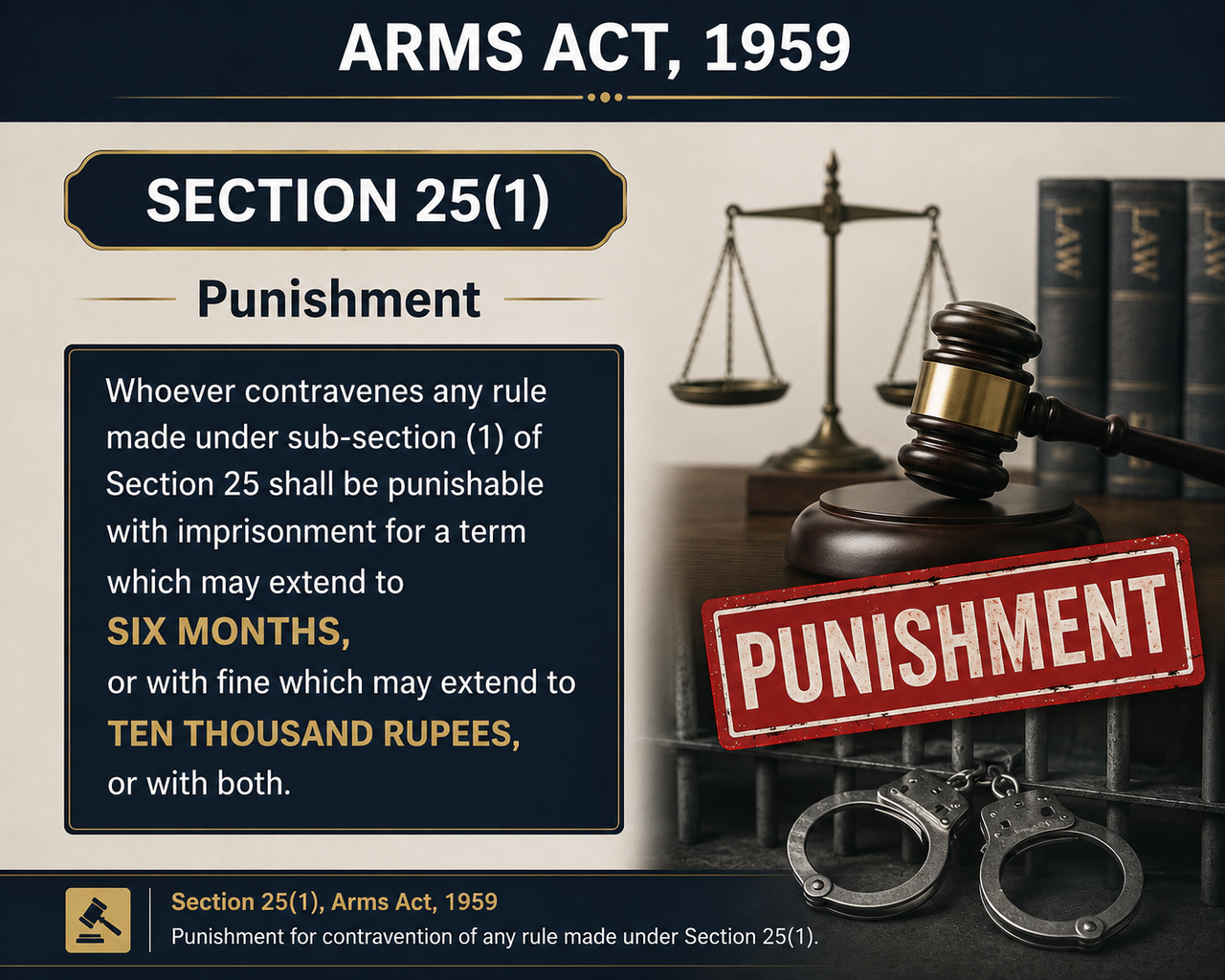
Arms Act 1959: Section 25(1): Punishment, Bail and Procedure
Introduction Arms Act, 1959 sections punishes different offences for illegal possession, acquisition, manufacture, sale, transfer, repair testing & transportation of Fire arms and ammo within the context of Arms act violtion under section 25(1) It Is One Of The Most Commonly Provisions Used In Arms Act Cases Throughout The India Any person that contravenes any provisions relating to licensing or regulation in the Arms Act as contemplated in section 25(1) shall be liable on conviction to a fine or to imprisonment for a period not exceeding five years, or to both such fine and punishment. SECTION — 25(1)- In case of dealers being incorporated or registered in any manner, without obtaining a licence. Among the offences in section 25(1) include: Unauthorized possess of a firearm Possession of ammunition without authorization. Illegal acquisition of firearms. Unauthorized manufacture of weapons. Firearms trafficking Unauthorised repair, testing or conversion of firearms Conducting business as an arm dealer without a valid license. It is meant to enforce regulation on weapons and curb weapon-related activities. Punishment Under Section 25(1) of The Arms Act However, depending on the specific clause and type of crime punishments differ. For some section 25(1) offences, the penalty can be: Your sentence (not less than 1 year but up to, 3 years and, Fine, or Both imprisonment and fine. However, however severe the violation is, this punishment would be harsher under any other section of the Arms Act. Various Scenarios Where Section 25(1) Comes Into Play Unlicensed Firearm Possession Someone is found offering to sell or unlawfully carrying arms without a valid licence. Illegal Ammunition Possession Someone has cartridges or ammunition without authorization. Unauthorized Arms Business An individual who sells or trades firearms without a license Illegal Weapon Manufacturing Workshop churns out firearms without government approval. FIR and Investigation Process When an offence is suspected: Police register an FIR. Weapons or ammunition are seized. Witness statements are recorded. Arms licenses are verified. Forensic examination may be conducted. Charge sheet is filed in front of court. Bailability of the Section: (Come prepared to answer so that there is no confusion) — section 25(1) Bailable or non-bailable? The types of bail are not based on the kind of case, but different categorizations depending on: The specific offence alleged. The type of weapon involved. Criminal history of the accused. Evidence collected by the police. The court determines bail according to the particulars of each case. Legal Defenses Valid License Lawful possession can be established by the accused with a valid arms license. False Recovery The claim that the gun was recovered is bit suspect. Lack of Conscious Possession Defense attorneys could claim the accused did not know the gun was there. Procedural Irregularities Court may dispute the search, seizure or investigation was done improperly Role of a Criminal Lawyer A lawyer can assist with: Bail applications. FIR defense. Trial representation. Examination of prosecution evidence. Protection of legal rights. Legal advice at the right time in Arms Act matter can make big difference. Conclusion The key penal provision dealing with illegal possession, acquisition, manufacture, sale, transfer and handling of firearms and ammunition is Section 25 (1) of the Arms Act, 1959. If found guilty, a person may face incarceration, fines or both. Those to whom proceedings under this section are initiated, must consult an Advocate and also know about their rights available under Indian Laws.

Cyber Crime & Cyber Offences in India: Legal Rights and Remedies
The advent of internet, online banking, digital payments, social media and e-commerce in daily life has taken the pace by truckloads. But it has also caused a huge increase in cyber crimes all around India. Cyber criminals play with technology creating fraud incidents, stealing information, harassing people and causing serious damage to the economy. There has been a huge rise in cyber crime cases happening in India over the past few years and where people are need to be more aware about cyber laws as well as legal remedies. Come out as a victim of online fraud, hacking, identity theft, cyber bullying or financial scams? Knowing your legal rights are paramount in taking action and getting justice. What are Cyber Offences? Cyberimenzione refers to violoable general stabbing through the addiction of computers, mobile devices, electronic systems or networks and Katzewerken. Such offences may involve attacks on individual citizens, corporations, banking/commercial systems or government systems. Cyber crimes could include unauthorized access to computer systems, the theft of identities or personal identifying information, the use of internet fraud. Different nature of Cyber Crimes in India Identity Theft Identity theft is the act of a cyber criminal stealing another person's information such as Aadhaar details, PAN card, passwords, bank credentials or social media accounts as identity. Common examples include: Using stolen banking information Creating fake social media profiles Fraudulent online transactions Misuse of personal documents Online Banking and Financial Fraud Cyber frauds: These tricks deceived through fake websites, links of phishing, fraudulent calls, OTP scams and through UPI Frauds. Examples include: Credit card fraud Internet banking fraud UPI payment scams Fake investment schemes Loan application fraud Online banking fraud continues to be one of the highest reported Cyber Crime in India. Hacking Hacking means to gain unauthorized access to a computer system, network, email account, website or database. Hackers may: Steal confidential information Delete important data Spread malware Demand ransom payments Cyber Stalking Cyber stalking means harassment, monitoring, threatening or intimidation of a person through the digital platform over and over again. Common methods include: Social media harassment Threatening messages Email harassment Tracking online activities Cyber Bullying Cyber bullying is even something that aligns strictyly with being online wherein one person will be using an online platform (text messaging, FB, Instagram, etc.) to instill humiliation or threats of physical or emotional harm in another person. It commonly affects: Students Teenagers Social media users Professionals Phishing Attacks Legitimate organisations, such as banks and government departments or other high-profile business use phishing attacks to dupe users into disclosing sensitive data. Victims often lose: Passwords Banking credentials Personal information OTP details Social Media Crimes Common Use Cases for social media include: Defamation Fake profiles Character assassination Image morphing Online harassment Impersonation Malware and Virus Attacks Alternatively, a malicious software may take over any device and: Steal sensitive information Corrupt files Lock systems through ransomware Monitor user activities Cyber security experts recommend keeping antivirus software up to date and steering clear of dubious downloads. Cyber Laws governing Cyber Offence in India Information Technology Act, 2000 In India, the principal legislation relating to cyber offenses is still the Information Technology Act, 2000 (IT Act). Important provisions include: 43 — Readings, access to confidential material and estimate of damage Section 66 – Computer-related offences Section 66C – Identity theft Sub section 66D – Cheating by the means of computer resource What is Section 66E – Breach of privacy 70,758?23 — 2063 Section 67 — Publication of obscene material in electronic form Section 67A — Publication of sexually explicit act 67B Even (g) Sexually abusive material pertaining to children There are civil and criminal remedies for cyber crime victims under the IT Act. Bharatiya Nyaya Sanhita (BNS) It is also possible that provisions under the Bharatiya Nyaya Sanhita may apply to cyber offences such as: Cheating Criminal intimidation Extortion Defamation Forgery Fraudulent activities Punishment for Cyber Offences Punishment is proportionate to the nature and gravity of the offence. Penalties may include: Monetary fines Compensation to victims Imprisonment Seizure of digital devices Criminal prosecution Such SERIOUS Cyber Crimes involving financial fraud, identity theft, data theft or cyber terrorism may carry lengthy prison sentences under the relevant laws. The below given are the various steps by which you can file a cyber crime complaint in India. Reporting cyber crime as soon as it happens is essential if you get caught. Step 1: Collect Evidence Preserve: Screenshots Emails SMS messages Transaction records URLs Call recordings Bank statements Step 2: Report the Incident You may: Visit your nearest police station Reach out to the local cyber crime department Lodge cyber crime complaint through the National Cyber Crime Reporting Portalle Step 3: Inform Your Bank For financial fraud: Block compromised accounts Freeze suspicious transactions Report unauthorized payments immediately Act fast and you say, the quicker the better to save your funds. Cyber Crime Prevention Tips To safeguard against Cyber Offences: Use strong passwords Enable two-factor authentication Avoid sharing OTPs Verify website authenticity Keep software updated Avoid suspicious links Use secure payment platforms Monitor banking activities regularly Subscribe to us, that should be an eye-opener From foundation it stays the five-most parsimonious options buy-cry. Why to Consult a Cyber Crime Lawyer Here are the benefits of hiring a cyber crime lawyer: File cyber crime complaints Draft legal notices Pursue compensation claims Assist in FIR registration You present you before authorities and the courts Handle digital evidence effectively There are 2 types of cybercrime victims and all 1 faces procedural delays and technical challenges. Having a legal representative tends to improve the possibility of prompt and effective action. Often discussed in online forums, community also suggests pursuing follow up with cyber cells, banks or legal counsel for faster resolution. Conclusion Cyber crimes are one of the fastest-growing types of crimes in India. With evolution of telecommunications technology, digital threats have been on the rise too–be it online banking fraud, identity theft, hacking or cyber stalking. Knowledge of cyber laws, immediate action after an incident and professional legal advice can support the victims in protecting their rights and recovering loss. Find My Vakeel will help you get in touch with cyber crime lawyers who are well experienced in providing legal advice, assistance and representation for all categories of cyber offense.

Watching Porn in India – Is It Legal or Illegal? Complete Legal Guide
One of the most searched legal topics on the internet is whether watching porn is legal in India or not. Others get fake warnings, scam messages or pop-up notices stating that viewing adult material is a crime and payment to avoid arrest is needed. It does not completely disallow private viewing of adult pornography by consenting adults in India. However, numerous pornography-related activities are outlawed under Indian law unless performed in private that chiefly involves minors, distribution of obscene material and public display. Is porn illegal in India? Generally watching adult porn in private is not a Crime under Indian law. Courts and legal scholars have pointed out that anything an adult does in the privacy of their own home — so long as no other law is broken — covered under a constitutional right to life, liberty, and the pursuit of happiness. But this does not make all pornographic activity legal. Indian law strictly prohibits: Child Sexual Abuse Material (CSAM) or child pornography Distribution of obscene content Uploading pornographic videos online Selling or publishing pornographic material Sharing explicit content without consent Public display of pornographic content Key Legislation Related to Pornography in India Information Technology Act, 2000 The IT Act regulates digital transmission of obscene and pornographic material. Relevant provisions include: Section 67 — Publishing or transmitting obscene material in electronic form; Section 67A – Publication of pornographic material in an electronic form Exemption for Child Pornography Material and Section 67B – Image Of A Child Or A Person Appearing To Be A Child. The violation could result in a prison sentence, heavy fines or both. Bharatiya Nyaya Sanhita (BNS) Indian criminal law prohibits: Sale of obscene materials Distribution of obscene content Public exhibition of obscene content For commercial purposes, any person will incur criminal liability for publishing (distributing) pornographic materials. POCSO Act, 2012 The Protection of Children from Sexual Offences (POCSO) Act provides for stringent punishment for child sex offences. To be in possession, viewing, download, store or distributing child sexual abuse materials – i.e. images or videos of you and others being sexually abused as a minor kid is a serious crime that can lead you to prosecution and imprisonment. NOBODY SHOULD HAVE TO EXPERIENCE THIS — A LEGAL ATOMISED CHILD ABUSE IN OUR SOCIETY IS CHILD PORNOGRAPHY ILLEGAL OR LEGAL IN INDIA? No. India is a country where child pornography is completely out of law Courts and law enforcement agencies in India view child sexual abuse material (CSAM) as a severe crime. Officials also investigate people who use, keep, download or transfer this kind of material. Penalties may include: Imprisonment Heavy fines Seizure of devices POPSO and IT Act provisions — a period of criminal investigation Some porn websites are blocked, could the reasons be different. Many porn sites are shutting down as per orders or directions from the government or courts. Blocking of websites does not automatically amount to a crime of viewing content privately. Instead, they are pretty much only connected to obscenity, public morality, trafficking and exploitation, and child sexual abuse material. Are Porn Warning Pop-Ups Real? In many cases, no. The most common encounter with a fake warning is as follows: Their device has been blocked Police action has been initiated You bailed out immediately by having to pay a fine Arrest warrants have been issued They are using automated phone calls which is usually online scam to fool the user for making payment or providing banking details. Do not make payments, and report any suspicious cybercrime activity. Is it legal to share pornographic content on WhatsApp or Social media? Not always. For example, any person based on the use of obscene or sexually explicit content will be liable under Information Technology Act and other laws. The egregiousness of the offence increases if the content is published without consent, which may incur criminal prosecution as well. The Legal Implications of Pornography Activities Some of the legal actions a person can be taken for are : Uploading pornographic videos Running adult content websites Sharing explicit content without consent Circulating obscene material Possessing child sexual abuse material Commercial distribution of pornography Imprisonment, monetary fines and cybercrime tracking are few to name. Conclusion In India, it is not appropriate to charge adult pornography viewing with criminal blame. The law, however, makes a clear distinction between private viewing and the illegal acts of distributing obscene material, publishing sexually explicit content on the internet or accessing child sexual abuse material. Severe statutes with penalties apply for anyone involved in the sharing, creation, storage or distribution of illegal content. Knowing the laws that apply can prevent people from getting in trouble with Indian cyber and criminal law.
.png)
Linking Aadhaar with PAN Card Online – Complete Guide for PAN-Aadhaar Linking in India
To enhance transparency, curb tax evasion and weed out duplicate PAN cards, the government has made linking of PAN with Aadhaar mandatory for most taxpayers. The Income Tax Department is using Aadhaar Linking with Permanent Account Number (PAN) to ensure that there are no tax evaders in the system and this makes all transaction financial transactions simple as it will be possible to identify every taxpayer. If you do not link PAN to Aadhaar, PAN may become inoperative meaning you cannot file income tax returns, banking services will NOT work, investments and also many other things that depend on financial se…. What is PAN-Aadhaar Linking? Linking PAN-Aadhaar entails linking an individual's Aadhaar number to the PAN card through the system of Income Tax Department. This linkage helps: Avoid duplicate PAN cards Improve tax compliance Track financial transactions accurately Simplify taxpayer verification Combined and together they roll back tax fraud and identity theft The linking requirement was introduced in Section 139AA of the Income Tax Act. Why is Aadhaar-PAN Linking Important? Benefits of linking Aadhaar with PAN: Valid PAN Status A PAN linked with Aadhaar is functional for: Income tax return filing Banking transactions Investment activities Property transactions Financial compliance Better Identity Verification Government uses Aadhaar-PAN linkage for taxpayer identity verification and the elimination of potential fraudulent taxpayers. Faster Tax Processing Linked records help simplify: Tax return processing Refund verification Financial documentation Digital authentication Linking Aadhaar with PAN for whom? Aadhaar-PAN linking is compulsory for most Indian PAN holders The requirement generally applies to: Salaried individuals Business owners Professionals Investors Taxpayers filing income tax returns Under relevant government laws, non-compliant PAN may be rendered inoperative. Whose PAN-Aadhaar Linking is not Mandatory? Mandatory linkage and certain categories are not subject to it: Non-Resident Indians (NRIs) Non-Indian citizens Residents of specific exempt regions that the government may identify Older adults aged 80 years and older under the applicable conditions The exemption categories which can be modified from time to time by government notifications. Method of Linking Aadhaar to PAN Online Through the Income Tax e-Filing portal, you can complete the PAN-Aadhaar linking process. Step 1: Go to Income Tax Portal Third Step: Visit the official Income Tax e-Filing website Step 2: Select “Link Aadhaar” Select the option to link PAN with Aadhaar in the portal. Step 3: Enter Required Details Provide: PAN number Aadhaar number Name as per Aadhaar Mobile number Step 4: Verify Information Ensure the details on both your PAN and Aadhaar match perfectly. Step 5: OTP Verification Fill the OTP, you have received on your registered mobile number. Step 6: Submit Request Once verified proceed to submit your link request. Next, the system will receive your request and change your state. PAN-Aadhaar Linking Fee and Penalty After the stipulated deadlines, individuals completing PAN-Aadhaar linking could have to pay a penalty fee. As per applicable provisions of the government, for possibly delaying the linking now would cost ₹1000. Rules are subject to change in upcoming notifications. Method to Check PAN-Aadhaar Link Status You may check the status online by: Visiting the Income Tax portal Checking the PAN-Aadhaar status Entering PAN and Aadhaar details Viewing the current linkage status You use check_status to verfy if linking was successful. Common PAN-Aadhaar Linking Problems It is common to have these type of issues with users: Name Mismatch If there are any discrepancies between PAN and Aadhaar records, it may lead to rejection. Date of Birth Mismatch Notice that the successful links are with date of birth instead, incorrect dates may cause a failure in linking. Mobile Number Issues The OTP verification process is burdensome and leads to delays. Processing Delays In some case linking is done but will take time to appear on the portal. Mismatches in detail and delays in the updated status are among some of the common reasons stated by all taxpayers for failure to link. Aadhaar-PAN Not Linking Effects Not linking of Aadhaar-PAN would lead to: PAN becoming inoperative Difficulty filing income tax returns Delays in tax refunds Higher TDS deductions are made in some issuers Restrictions on financial transactions Bank and financial institution compliance issues These implications can have significant effects on daily financial tasks. Q: Can NRIs link aadhaar with PAN Non-resident Indians also belong to exempt categories if they don't fall under the purview of getting Aadhaar. Nevertheless, some NRIs might need to link if they have Aadhaar and are subject to the provisions of law. Individuals should confirm their residency and relevant regulations. In a community, it is also very commonly talked about that how effectively the NRI status updates his tax records. Benefits of Seeking Professional Assistance Professional legal and tax advisers can assist: Resolve linking errors Correct PAN-Aadhaar mismatches Handle compliance issues Assist with tax documentation Legal advice on PAN status Technical issues that result in incorrect personal information being included in records make professional support particularly useful. Conclusion The linking of Aadhaar with PAN is an compliance requirement for assesses in India. Finalising the process keeps the PAN active, tax filing moves forward and hinders any financial transaction. They need to ensure that they verify their details properly, adhere to the deadline of linking and use the PAN-Aadhaar status check facility on a regular basis in order to avoid penalties and comply with the law. Get in touch with PAN-Aadhaar linking expert who can help you connect with some experienced legal and tax professionals that will help you understand about any complications related to your issues.Find My Vakeel — Most trusted legal path for Compliance, Documentation Corrections & Legal Matters
.webp)
BNS Section 69 Explained:
Section 69 of the Bharatiya Nyaya Sanhita (BNS) is about having sexual intercourse with someone through dishonesty, but it's not the same as rape.This law applies when someone agrees to have sex because they were lied to, like being promised a marriage, job, promotion, or something else that isn't true.This is a serious crime that the police can take action on, and you can't get bail.If someone is found guilty, they might get up to 10 years in jail and also have to pay a fine.
Car Accident Laws in the United States (2026): Complete Legal Guide
Car accidents happen every day in the United States, and they can vary from small fender benders to big crashes that lead to serious injuries or even deaths.It's important to understand car accident laws because they help protect your legal rights, help you get fair compensation, and prevent you from making big mistakes after an accident. Whether you're driving, riding in a car, walking, or biking, knowing what to do right after a crash can affect your insurance claim and any legal action that comes later. This guide explains the basics of U.S.car accident laws, including who is at fault, how insurance works, how to file a personal injury claim, and what kind of compensation you might be able to get. What Are Car Accident Laws? Car accident laws include rules set by the federal government, individual states, and local areas. These laws help determine: - Who is responsible for causing the accident - How insurance claims are processed - When someone can file a lawsuit - What kind of damages can be claimed - How long someone has to file a legal claim Unlike some other countries, the United States doesn't have a single set of car accident laws. Each state has its own traffic laws, insurance rules, liability standards, and time limits for legal claims.This means the outcome of a similar accident can be very different depending on where it happens. What Should You Do Immediately After a Car Accident? The actions you take after a crash can affect your health and your legal rights. Here are the important steps: 1. Check for Injuries Your first priority should be safety. If anyone is hurt, call emergency services right away. 2. Contact Law Enforcement Many states require drivers to report accidents that involve injuries, deaths, or major damage. A police report is often one of the most important pieces of evidence in your case. 3. Exchange Information Get the following details from the other driver: - Names - Phone numbers - Addresses - Insurance information - Vehicle registration numbers - License information 4. Gather Evidence Take pictures of: - Vehicle damage - Road conditions - Traffic signs - Weather - Tire marks - Any injuries - The location of the accident If there are witnesses, get their contact information too. 5. Get Medical Attention Even if you feel okay, some injuries like whiplash or internal damage may not show up right away. Getting medical help quickly also helps create a record that can support your claim. Understanding Fault in U.S. Car Accidents In car accident cases, one of the most important things is figuring out who is at fault. Fault means the person whose actions caused the accident. Examples of behaviors that can lead to fault include: - Distracted driving - Speeding - Driving under the influence of alcohol or drugs - Running a stop sign or light - Reckless driving - Making unsafe lane changes - Failing to yield Insurance companies look into police reports, witness statements, photos, videos, vehicle damage, and expert opinions to decide who is at fault. Fault States vs. No-Fault States The U.S. uses two main types of insurance systems. Fault States In these states, the person who caused the accident is usually responsible for paying for damages. The injured person can: - File a claim with the at-fault driver’s insurance - Use their own insurance if available - File a personal injury lawsuit if necessary Most states follow this system. No-Fault States In these states, drivers typically get compensation from their own insurance company, regardless of who caused the accident. Lawsuits are usually limited unless the injuries meet certain criteria.This system is meant to reduce lawsuits and make it faster to get medical help. Types of Compensation Available Victims may get different types of compensation based on state laws and the accident's circumstances. Medical Expenses Compensation may cover: - Emergency care - Hospital bills - Surgery - Physical therapy - Medications - Future medical treatments If someone can't work because of their injuries, they might also get: - Lost wages - Reduced earning potential - Loss of future income Property Damage Victims may be compensated for: - Car repairs - Replacement of a totaled vehicle - Rental car costs - Damage to personal belongings Pain and Suffering In serious injury cases, victims may receive compensation for: - Physical pain - Emotional distress - Mental anguish - Lower quality of life - Permanent disabilities The amount of compensation depends on state laws, the severity of injuries, and the evidence available. Common Causes of Car Accidents Many accidents happen due to careless or negligent driving. Common causes include: - Distracted driving (like using a phone) - Drinking and driving - Speeding - Driving while tired - Aggressive driving - Not following traffic signals - Unsafe lane changes - Tailgating - Bad weather - Vehicle problems Knowing the cause of an accident is important because it often determines who is at fault and how strong your claim might be.

Case Status Online Check
# Case Status Check Online It is possible to monitor your court proceedings with ease with the aid of online case status check facilities. No matter whether your case is pending before the District Court, High Court, or Supreme Court of India, you will be able to monitor all the latest developments from the comfort of wherever you are. At **Find My Vakeel**, we aim at ensuring that individuals have an insight into the legal process and how they should go about checking the status of their case. With an online case status check, you will have an idea about the hearing date, current stage of your case, orders issued by the courts, and many more updates. Not only do you save time and avoid needless trips to the courts, but also prepare yourself for all stages of your legal matter. The information you require when checking the status of your case online includes case number, party name, advocate name, filing number, FIR number, CNR number, and other details depending upon the online portal of the respective court. Should you encounter difficulties in locating information regarding your case or in comprehending the details furnished by the portals, **Find My Vakeel**

Mediation vs Arbitration: Key Differences, Process, Benefits & Legal Comparison in India
Difference Between Mediation and Arbitration: Finding out How to Solve Your Legal Problems Not all legal disputes require going to court. There are other, faster and cheaper ways to solve your problems that are available in India via Alternative Dispute Resolution (ADR). The two most popular methods of ADR include mediation and arbitration. Though mediation and arbitration can be used to solve disputes, they differ greatly in terms of procedure, role of neutral third party, enforceability, costs, etc. This article gives an overview of the two procedures, describes the pros and cons of each method, the legislation regulating it and situations when you should choose one or another. What Is Mediation? Mediation is a form of dispute resolution, when a neutral third party, a mediator, helps disputing parties reach agreement through discussion. While judge and arbitrators make decisions for disputing sides, mediator only facilitates discussion and encourages parties to cooperate. Mediation can be used to solve: family disputes divorce and child custody cases property disputes disputes among businesses employment disputes consumer disputes neighborhood disputes
Find My Vakeel® | Verified Lawyers & Free Legal Consultation in India
**Find My Vakeel®** is the most trusted legal website that brings together individuals, families, and corporates who require legal representation by verifying advocates all over India. If you require any kind of legal representation in connection with divorce, criminal, property, family, civil, consumer complaint, corporate, cheque bouncing, taxation or documentation cases, then this platform will provide you with the best solution to find a lawyer. This platform is associated with lawyers who are active in more than 100 cities in India. All the advocates registered in the Find My Vakeel platform have been properly verified by us to assist our users in locating the right lawyer. It is very easy to use this platform and all you need to do is post your query, look for experienced advocates, review their profiles and get a free initial consultation from the respective lawyer. We aim to provide legal services in an affordable, transparent and efficient manner.
.webp)
National Lok Adalat Benefits
Introduction National Lok Adalat is a countrywide way to settle disputes without going through long court battles. It is organised by the National Legal Services Authority (NALSA) and happens at the same time across India.This initiative helps people solve their issues through friendly agreement instead of fighting in court. National Lok Adalat provides a fast, affordable, and legally recognized way to resolve cases that are already in court or before they get there. The decision made by the Lok Adalat has the same legal power as a court order and is final and must be followed by both sides involved. What is National Lok Adalat? National Lok Adalat is a special session of Lok Adalat that takes place on one day in many places across the country, including courts at the Supreme Court, High Courts, District Courts, and Taluk Courts. It helps people resolve their disagreements in a friendly and helpful way, with the help of judges, lawyers, and mediators. The main goal of National Lok Adalat is to reduce the number of cases in court, cut down on the cost of legal battles, and encourage people to reach a settlement on their own. Benefits of National Lok Adalat It helps settle disputes quickly. No court fees are charged. If a case is settled, court fees can be returned. The agreement made is legally binding. It avoids long and complicated court procedures. It is a simple and informal process. It promotes friendly and peaceful resolutions. It saves time and money. It eases the burden on courts. It preserves relationships between people involved. No appeal can be made against the decision. Matters Commonly Settled in National Lok Adalat Disputes over bank loans. Cases where a cheque is not honored. Claims for compensation after a road accident. Consumer complaints. Disputes over electricity and water bills. Workplace disputes. Settlements in family and marriage matters. Disputes over property. Cases where someone is not paying money. Disputes over insurance claims. Penalties for traffic violations. Disputes that are not yet in court. How National Lok Adalat Works Cases that are eligible are identified by the courts or legal services authorities. Notices are sent to both parties involved. The parties willingly appear before the Lok Adalat panel. Judges and mediators help both sides talk and come to an agreement they both agree on. This agreement is recorded as a Lok Adalat Award. The award becomes final and can be enforced immediately. Illustrative Example A small business owner sues a customer for not paying ₹5 lakh for goods. Instead of going through a long court process, both sides agree to resolve the matter through National Lok Adalat. During the session, the customer agrees to pay the money in installments, and the business owner agrees to give up any interest or legal costs. Both accept the settlement, and the Lok Adalat makes its ruling.The dispute is completely ended, and the court fees the business owner paid can be returned according to the law. Advantages Over Regular Court Proceedings It leads to quicker resolution. It lowers the cost of legal battles. It avoids complicated rules and procedures. It allows for private and confidential discussions. It is a voluntary settlement process. The decision is legally enforceable. There is no uncertainty from long appeals. Cases That Cannot Be Settled Serious criminal offenses that cannot be settled. Crimes like murder and terrorism. Sexual offenses. Cases related to human trafficking. Cases that are in the public interest. Divorce cases where there is no mutual agreement. Who Can Approach National Lok Adalat? Everyone can take part, including individuals, businesses, banks, insurance companies, consumers, employers, employees, government offices, and anyone wishing to settle a fair dispute through friendly agreement. Legal Framework National Lok Adalats are set up under the Legal Services Authorities Act, 1987. They are organized by NALSA along with the State Legal Services Authorities, District Legal Services Authorities, and Taluk Legal Services Committees across India. Frequently Asked Questions Is the decision from National Lok Adalat legally binding? Yes, it has the same legal standing as a court order and must be followed by both parties. Can I challenge the decision from National Lok Adalat? No, since the agreement is made willingly, the decision is final and generally cannot be appealed. Do I need a lawyer? No, a lawyer is not required, but they can be used if needed. Are court fees returned? Yes, if a pending case is settled through Lok Adalat, the court fees can be refunded as per the law. Can criminal cases be settled in Lok Adalat? Only certain criminal cases that can be settled can be resolved, and serious criminal cases that cannot be settled cannot be handled in Lok Adalat. Conclusion National Lok Adalat is one of the most effective ways to resolve disputes in India without going to court. It offers people a fast, easy, and affordable way to settle eligible disputes through agreement.By encouraging voluntary settlements and reducing long legal battles, National Lok Adalat benefits individuals, businesses, and the justice system, ensuring fair and lasting solutions.
.webp)
Lok Adalat Explained
Introduction Lok Adalat, which means "People's Court," is a way to resolve disputes without going to court. It's part of the Legal Services Authorities Act, 1987.It offers a simple, fast, and inexpensive way to settle disagreements through talking and coming to an agreement, without long legal processes. The decision made by a Lok Adalat has the same legal power as a court decision. It is usually not possible to challenge it later. What is Lok Adalat? Lok Adalat is a place where people can settle their problems by talking and making a deal. Judges, lawyers, and mediators help in this process.The goal is to make it easier for courts to handle their work and to provide justice in a way that's affordable and easy to access. Lok Adalats are run by the National Legal Services Authority (NALSA), State Legal Services Authorities, District Legal Services Authorities, and Taluk Legal Services Committees. Features of Lok Adalat - Set up under the Legal Services Authorities Act, 1987. - Resolves disputes quickly and cheaply. - No court fees are needed. - If the matter is settled, any court fees already paid can be returned. - The settlement must be agreed upon by both parties. - The process is simple and not too formal. - The final decision is legally binding. - You cannot appeal against the decision of the Lok Adalat. Cases That Can Be Settled in Lok Adalat - Money owed disputes. - Bank loan recovery. - Claims after road accidents. - Family problems. - Marriage-related issues where a settlement is possible. - Work-related disputes. - Disputes about electricity and water bills. - Consumer complaints. - Cases where a cheque was not honoured. - Cases that are not yet in court. - Disputes that are not yet decided in court. Difference Between Lok Adalat and Regular Court - Procedure: Lok Adalat uses friendly negotiation, while the regular court follows strict legal steps. - Court Fees: There are no fees for Lok Adalat, but regular courts usually require fees. - Time: Lok Adalat often settles disputes quickly in one or two meetings. Regular courts can take many months or even years. - Decision: Lok Adalat's decision is based on both parties agreeing, while the court makes a decision after a trial. - Appeal: You can't appeal a Lok Adalat decision, but you can appeal a court decision if you want. Illustrative Example Imagine a person who didn't pay back a business loan, and the bank started chasing them for payment. Before going through a long legal battle, both parties chose to go to a Lok Adalat. At the meeting, the borrower offers to pay the full amount in one go. The bank agrees not to ask for interest. Once both parties agree, the Lok Adalat makes a final decision. The problem is fixed quickly, and the decision is legally binding. Benefits of Lok Adalat - Resolves issues quickly. - Low cost of going to court. - Straightforward process. - Less work for the courts. - The settlement is kept private. - The decision is legally enforceable. - It helps keep relationships between the people involved. - Court fees can be returned if the case is settled. Cases That Cannot Be Settled in Lok Adalat - Severe criminal crimes that can't be settled. - Matters related to serious crimes against the public. - Cases that need a detailed criminal trial. - Disputes where the people aren’t willing to agree. - Certain marriage-related cases where no agreement is possible. Who Can Approach Lok Adalat? - Individuals. - Business owners. - Banks. - Insurance companies. - Government offices. - Consumers. - Workers. - Employers. - Anyone who wants to settle the matter in a friendly way. Latest Developments Now, Lok Adalats are held both in person and online in many states. Across India, National Lok Adalats are held regularly to handle a large number of pending and pre-litigation cases quickly. Important Supreme Court Judgments The Supreme Court has said that Lok Adalat decisions under the Legal Services Authorities Act, 1987, are final, binding, and just like a civil court decision. It has also been said that a Lok Adalat can’t decide a case on its own without both sides agreeing. Frequently Asked Questions - Is the decision of a Lok Adalat legally valid? - Yes. It has the same effect as a court decision. - Can I challenge the decision of a Lok Adalat? - Usually, no. Since it's based on both parties agreeing, it's final and binding. - Do I need a lawyer for Lok Adalat? - A lawyer isn't required, but either party can bring one. - Are there any court fees for Lok Adalat? - No. Lok Adalat proceedings are free. If the case has already been started and the matter is settled, court fees can be returned. - Can criminal cases be settled in Lok Adalat? - Only those criminal cases where a settlement is allowed can be handled. Serious crimes that can’t be settled aren’t allowed in Lok Adalat. Conclusion Lok Adalat offers an effective way to settle legal disagreements quickly, inexpensively, and amicably. It encourages people to find a solution together instead of going through lengthy court processes. This helps reduce the overload on courts and ensures justice is available for individuals, businesses, and organisations. For suitable civil, family, consumer, banking, and compoundable criminal matters, Lok Adalat is one of the most efficient legal options available in India.

Online Court Hearings in India: Process, Benefits, Rules & Complete Guide
Online Court Hearings in India: Process, Benefits, Rules & Complete Guide Introduction The Indian judiciary has rapidly embraced digital technology, making online court hearings an integral part of the legal system. What began as a necessity during the COVID-19 pandemic has evolved into a reliable and efficient method for conducting court proceedings through secure video conferencing. Today, the Supreme Court, High Courts, and many District Courts across India regularly conduct virtual hearings for various types of cases. Online hearings save time, reduce travel expenses, improve accessibility, and help ensure the timely delivery of justice. In this guide, you'll learn how online court hearings work in India, their legal framework, benefits, challenges, eligibility, and what to expect during a virtual court appearance.
.webp)
Quashing of FIR Before High Court
Introduction Quashing an FIR is a special legal tool used by a High Court to stop the misuse of the legal system or to ensure justice is done. If a criminal case is not based on real facts, is done on purpose to harm someone, or doesn't show any criminal behavior, the High Court can stop the FIR and the related criminal action according to the law. Under the Bharatiya Nagarik Suraksha Sanhita (BNSS), the High Court has the power to act in special cases where continuing the criminal action is unfair. What is Quashing of an FIR? Quashing of an FIR means the High Court cancels the First Information Report and the criminal action that follows from it. It is a rare and special remedy that is only used in certain situations after looking at the facts, the law, and what is fair. The High Court does not usually act like a trial court or decide on factual arguments when considering a request to quash. Grounds for Quashing an FIR A High Court may decide to quash an FIR if: - The claims do not show any actual crime. - The issue is purely a legal or business matter. - The FIR was filed with bad intentions. - The claims are not possible or unlikely. - The criminal action is being used to misuse the legal system. - There is a rule that stops the prosecution. - The parties have legally settled the dispute and it is allowed to quash the FIR. Difference Between FIR and Quashing of FIR Purpose - FIR records a report about a possible serious crime. - Quashing of FIR ends the legal action before the High Court. Filed Before - FIR is filed at a police station. - A quashing petition is filed before the High Court. Initiated By - FIR is usually filed by someone who has been affected. - A quashing petition is usually filed by the accused or someone with a legal right to do so. Objective - FIR starts the investigation into a crime. - A quashing petition stops the legal process from being misused and protects justice. Result - When an FIR is registered, the police start the investigation. - If the High Court agrees to quash, the FIR and the related criminal action may be stopped. Illustrative Example 1 Two companies make a business agreement. One company fails to deliver goods on time due to financial problems.Instead of filing a civil case, the other company files an FIR for cheating. If the High Court finds that the dispute is about a contract and not about any criminal act, it may cancel the FIR after looking at the law and past court decisions. Illustrative Example 2 Two business partners have a disagreement that leads to registration of an FIR. Later, both sides agree to settle the matter through a written agreement. If the law allows settlement and the High Court feels that continuing the case would not help, it may cancel the FIR. Can Every FIR Be Quashed? No. Quashing an FIR is a rare option. The High Court carefully considers the facts of each case, the law, past court decisions, and what is fair before deciding to cancel the FIR. Can Heinous Offences Be Quashed? Serious crimes that affect the public, such as terrorism, murder, rape, human trafficking, corruption, or other serious crimes, are not usually canceled just because the parties have made a settlement. Each case is considered on its own facts and the law. Punishment Quashing an FIR does not punish anyone. It stops the legal process when the High Court believes that continuing the action would mislead the legal system. FIR Procedure A criminal case usually starts when the police register an FIR. The police collect evidence and may file a charge sheet with the court.Before or during these steps, someone affected may go to the High Court to ask for the FIR to be canceled on legal grounds. Arrest Procedure Registering an FIR does not automatically mean that someone will be arrested. While looking at the quashing petition, the High Court may provide temporary protection or give specific instructions. Bail Process Filing a quashing petition does not automatically result in bail. Based on the facts, the accused may apply for bail or other protections available under the BNSS. Important Supreme Court Judgments The Supreme Court has given key guidelines on when the High Court can use its special power to stop the legal process. Important cases include State of Haryana v.Bhajan Lal.Courts also look at later decisions when deciding whether the legal action should be canceled. Latest Amendments The Bharatiya Nagarik Suraksha Sanhita (BNSS), 2023 continues the High Court's power to stop legal misuse and ensure justice, while making changes to criminal law procedures. Legal Consequences If the High Court approves the quashing petition, the FIR and related criminal actions may be canceled. If the petition is rejected, the investigation or trial continues normally. How to Defend a Case - Get a copy of the FIR. - Gather all relevant documents and evidence. - Find the legal reasons to quash the FIR. - Prepare a detailed petition. - File the petition in the correct High Court. - Seek temporary protection or other relief if necessary. - Consult an experienced criminal lawyer. Documents Required - Copy of the FIR - Identity proof - Any relevant contracts or agreements - Compromise deed, if applicable - Supporting documents - Emails or written communications - Court orders - Affidavit - Authorization documents Frequently Asked Questions - Can the High Court quash an FIR before the charge sheet is filed? Yes, in the right cases, the High Court may use its special power even before the charge sheet is submitted. - Can an FIR be quashed after a compromise? Yes, in cases where the law allows a settlement, the High Court may decide to quash the FIR based on the facts and past court decisions. - Can every civil dispute become a criminal case? No, a simple breach of contract or a civil issue does not mean a criminal case is automatically started. - Does filing a quashing petition stop the police investigation? Not automatically. The High Court may issue temporary orders depending on the situation. - Should I hire a criminal lawyer? Yes. Quashing an FIR involves complex legal steps and decisions.A good lawyer can help you prepare a strong case and represent you in court. Conclusion Quashing an FIR is a rare legal option that helps individuals avoid unnecessary or wrong legal action. Since the High Court uses this power very carefully, every quashing petition must have strong legal reasons and proper evidence.Getting help from a lawyer quickly and preparing well-organized documents can greatly improve your chances of getting the right relief.
.webp)
Summons vs Warrant: Key Differences
A chargesheet is the last report made by the police after they finish looking into a case reported under an FIR. This report is given to a Magistrate's court and marks the end of the police's part in the case. Under Section 193 of the Bharatiya Nagarik Suraksha Sanhita (BNSS), this document moves the case from being investigated by the police to being tried by a court.It includes all the evidence against the person accused. A chargesheet includes several important parts: - The Accused Details: This lists the people who were arrested, those who were released on bail, and those who are still missing or wanted. - The Criminal Sections: This shows the exact legal charges that are being filed under the Bharatiya Nyaya Sanhita (BNS) or any special local laws. - The Column of Witnesses: This lists the people, like eyewitnesses, doctors, or experts, who will be called to court to prove what happened. - The Evidence Inventory: This includes all the physical and digital evidence, such as stolen weapons, banking records, forensic reports, and CCTV footage. - The Brief Facts: This is a story written by the Investigating Officer (IO) that explains what happened step by step. Let's look at a real case involving fake documents and immigration fraud. This case is about an illegal visa business near Nangloi Metro Station. The Background: The police raid an illegal consultancy office in Nangloi after someone reports they were cheated of 6 lakh rupees for a fake Canadian work permit. The police arrest the agent, take his computer equipment, and find many fake passports and fake embassy seals. What the Chargesheet Includes: When the Investigating Officer (IO) gives the final chargesheet to the Tis Hazari Court, it is divided into different parts: - The Charge Form: The IO names the agent as the main accused and charges him under Section 318 BNS (Cheating) and Section 336 BNS (Forging important documents). - The Witness List: The police list the victim to talk about the money paid, a bank manager to confirm the money transfer, and a document expert to show that the Canadian visa stamps were printed on a regular printer. - The Evidence Folder: This has copies of the fake visas, the seized computer parts, a bank statement showing the money flow, and a note (Fard) that was signed by neighbors when the police raided the place. - The IO's Conclusion: The report says that the accused made up a fake company to trick job seekers. The fake stamps show they were trying to deceive people. The police ask the court to take the case forward for trial. Important Time Limits and Legal Protections: - The Statutory Deadline: To stop the police from holding someone in jail without proof, the law sets a strict time frame. The chargesheet must be filed within 60 days for common crimes, and within 90 days for serious crimes that can lead to 10 years or more in prison. - Default Bail Route: If the chargesheet is not filed within the time limit, the person in jail automatically gets Default Bail, regardless of the seriousness of the crime. - Supplementary Chargesheet: Filing a chargesheet does not mean the investigation is over. If new information is found later, like new bank accounts, extra digital data, or if someone else involved in the case is found, the police can file a Supplementary Chargesheet under Section 193(9) of the BNSS. This adds new evidence to the ongoing trial. Are you trying to get a certified copy of a chargesheet from a local court, or do you need help understanding a specific part of a witness list in a pending case?
.webp)
How Criminal Trial Works in India
To understand how a criminal trial actually works in real life, imagine a case involving industrial safety negligence. A factory owner in Nangloi is charged after a boiler explosion in his factory kills a worker. Let’s walk through the stages of this trial. Stage 1: Reporting the Crime and Investigation The police file a report called an FIR under Section 106 of the BNS (causing death by negligence) right after the accident. The police officer investigating the case goes to the factory, looks at the damaged boiler parts, gets reports from experts, and talks to other workers who saw what happened.All this information is collected over 90 days.Then, the officer writes a formal report called a Chargesheet and sends it to a Metropolitan Magistrate. Stage 2: Accepting the Case and Giving the Evidence The judge looks at the Chargesheet to decide if there’s a real case. The court gives a complete copy of the report, witness statements, and photos to the accused factory owner. This allows his lawyer to plan his defence. Stage 3: Arguing about the Charges The judge listens to both the prosecutor and the defence lawyer. The defence might ask the judge to drop the case, saying there's not enough proof to try the owner. If the judge thinks there's enough evidence, he will formally charge the owner, like saying, “You are being tried for criminal negligence under Section 106 of BNS.” The accused then says he is “not guilty” and asks for a trial. Stage 4: The Prosecution Presents Evidence The state has to prove the case. The prosecutor calls people like the expert who checked the boiler and other workers who were there. These witnesses tell their story in court. The defense lawyer then asks these witnesses questions to find any mistakes, lies or missing information. For example, the lawyer might show that the boiler was checked recently or that the worker didn’t follow safety rules. Stage 5: The Accused Speaks After the prosecution finishes, the judge asks the accused directly, without making him swear an oath. This gives the accused a chance to explain the evidence against him in his own words. Stage 6: The Defence Presents Evidence The defence lawyer can call their own witnesses or show documents to prove the owner is not guilty. For example, they might bring in a mechanic who says the explosion was from an electrical issue, not poor maintenance. Stage 7: Final Talks and the Judge’s Decision Both sides give their final arguments, using the evidence and past court decisions to support their case. The judge then decides if the owner is guilty or not. If the state proves the owner was negligent, the judge will convict and decide on a punishment. If the state doesn’t prove it clearly, the owner is found innocent and released. Important Realities to Know During the trial, the accused does not have to stay in jail. Most people get bail and go home while the case is going on.In some cases, a criminal charge can be settled with the victim’s agreement—called compounding.But serious cases like workplace deaths or big fraud can’t be settled and must be tried fully in court. Are you looking for help understanding a specific court file or need help preparing documents for an upcoming hearing?
.webp)
Charge Sheet Explained in India
A chargesheet is the last report made by the police after they finish looking into a case reported under an FIR.This report is given to a Magistrate court and marks the end of the police's part in the case.Under Section 193 of the Bharatiya Nagarik Suraksha Sanhita (BNSS), this document moves the case from being investigated by the police to being tried by a court.It includes all the evidence against the person accused. A chargesheet includes several important parts: - The Accused Details: This lists the people who were arrested, those who were released on bail, and those who are still missing or wanted. - The Criminal Sections: This shows the exact legal charges that are being filed under the Bharatiya Nyaya Sanhita (BNS) or any special local laws. - The Column of Witnesses: This lists the people like eyewitnesses, doctors, or experts who will be called to court to prove what happened. - The Evidence Inventory: This includes all the physical and digital evidence like stolen weapons, banking records, forensic reports, and CCTV footage. - The Brief Facts: This is a story written by the Investigating Officer (IO) that explains what happened step by step. Let's look at a real case involving fake documents and immigration fraud. This case is about an illegal visa business near Nangloi Metro Station. The Background: The police raid an illegal consultancy office in Nangloi after someone reports they were cheated of 6 lakh rupees for a fake Canadian work permit. The police arrest the agent, take his computer equipment, and find many fake passports and fake embassy seals. What the Chargesheet Includes: When the Investigating Officer (IO) gives the final chargesheet to the Tis Hazari Court, it is divided into different parts: - The Charge Form: The IO names the agent as the main accused and charges him under Section 318 BNS (Cheating) and Section 336 BNS (Forging important documents). - The Witness List: The police list the victim to talk about the money paid, a bank manager to confirm the money transfer, and a document expert to show that the Canadian visa stamps were printed on a regular printer. - The Evidence Folder: This has copies of the fake visas, the seized computer parts, a bank statement showing the money flow, and a note (Fard) that was signed by neighbors when the police raided the place. - The IO's Conclusion: The report says that the accused made up a fake company to trick job seekers. The fake stamps show they were trying to deceive people.The police ask the court to take the case forward for trial. Important Time Limits and Legal Protections: - The Statutory Deadline: To stop the police from holding someone in jail without proof, the law sets a strict time frame. The chargesheet must be filed within 60 days for common crimes, and within 90 days for serious crimes that can lead to 10 years or more in prison. - Default Bail Route: If the chargesheet is not filed within the time limit, the person in jail automatically gets Default Bail, regardless of the seriousness of the crime. - Supplementary Chargesheet: Filing a chargesheet does not mean the investigation is over. If new information is found later, like new bank accounts, extra digital data, or if someone else involved in the case is found, the police can file a Supplementary Chargesheet under Section 193(9) of the BNSS.This adds new evidence to the ongoing trial. Are you trying to get a certified copy of a chargesheet from a local court or do you need help understanding a specific part of a witness list in a pending case?
.png)
Proclamation & Attachment of Property Law
Introduction When someone accused of a crime runs away or avoids being arrested, criminal courts have strong legal tools to handle the situation. These tools ensure that a person cannot avoid the justice system by simply hiding or leaving their home. Under the Bharatiya Nagarik Suraksha Sanhita (BNSS), if the court is certain that someone who has a warrant against them is hiding or avoiding arrest, it can issue a proclamation. This is a public notice that tells the person to appear before the court within a specific time. If they don’t show up, the court may take control of their property, either movable or immovable, as allowed by law. It's important for the accused, their family, property owners, and legal professionals to understand the difference between a proclamation and the attachment of property. What is a Proclamation? A proclamation is a formal notice from a criminal court telling a person who has run away to appear before the court within a certain time. Before issuing this notice, the court must believe that the person is avoiding the warrant. The proclamation is usually published in the way the law says, including public announcements and posting in specific places. What is Attachment of Property? Attachment of property is when the court takes temporary control of a person's movable or immovable property. This is not meant as punishment, but to make sure the person comes to court and prevents them from selling their assets during the legal process. Difference Between Proclamation and Attachment of Property | Basis | Proclamation | Attachment of Property | | Purpose | Telling the accused to come to court | Keeping them from hiding by taking their property | | Issued By | Criminal Court | Criminal Court | | Trigger | Not appearing after a warrant is issued | Not obeying the proclamation or when allowed by law | | Legal Effect | Making the person a proclaimed person | Taking control of their property | | Objective | Making the accused appear | Preventing them from evading justice and protecting the legal process | When Can a Court Issue a Proclamation? A court can issue a proclamation if: - There is a valid warrant. - The accused has run away. - The accused is hiding. - The court is sure the warrant can't be executed. When Can Property Be Attached? The court can order property to be attached if: - There is a valid proclamation. - The accused does not appear by the deadline. - The court thinks it's necessary under the BNSS. - There's a risk the accused might sell the property. Types of Property That May Be Attached - House - Office - Farm land - Cars - Business items - Bank accounts (if allowed) - Investments - Other movable or immovable property Illustrative Example Imagine a businessman who is accused of a major financial crime. After a Non-Bailable Warrant is issued, he leaves his home.The police are unable to find him.The court may declare a proclamation telling him to appear within a certain time.If he still doesn't appear, the court can attach his property as per the BNSS. Is Attachment of Property Bailable or Non-Bailable? Attachment itself isn’t bailable or non-bailable. Whether bail is allowed depends on the crime the accused is accused of. Punishment Attachment of property isn’t a punishment. It's a step to make sure the accused comes before the court. FIR Procedure The criminal process usually starts with registering an FIR. The investigating agency gathers evidence and may ask a court to issue a warrant.If the accused tries to avoid arrest, the court may issue a proclamation and, if needed, go on to attach property. Arrest Procedure If the person who was proclaimed is found, law enforcement can arrest them as per the BNSS. The attachment order doesn’t change the standard rights regarding arrest. Bail Process The accused can ask for bail based on the nature of the crime. The presence of an attachment order doesn't automatically determine if bail is given. Rights of Family Members Family members don't automatically lose ownership rights just because an attachment order is passed. If someone else claims a legal interest in the attached property, they can go to the court to establish their claim. Latest Amendments The Bharatiya Nagarik Suraksha Sanhita, 2023 changes criminal law with new rules about warrants, proclamations, attachment, digital records, and case management. Important Supreme Court Judgments The Supreme Court has said that proclamation and attachment are special court powers. Courts must strictly follow the law before taking action that affects property rights. Legal Consequences Not following the proclamation may lead to property being attached, legal action continuing, and other consequences as allowed by law. How to Protect Your Rights - Go to the court as soon as you get legal information. - Get copies of all court orders. - Keep records of property ownership. - Challenge any unlawful attachment order in court. - Get help from a criminal lawyer right away. Documents Required - Copy of FIR - Court Warrant - Proclamation Order - Attachment Order - Identity Proof - Property Documents - Sale Deeds - Revenue Records - Bank Statements (if applicable) - Court Notices - Supporting Evidence Frequently Asked Questions - Can property be attached without a proclamation? It depends on the law and the case. The court must follow the BNSS process. - Does attachment transfer ownership to the Government? No. It puts restrictions on the property.Ownership is decided by law. - Can family members object to attachment? Yes. Anyone with a legal claim on the property can go to the court for help. - Can attached property be released? Yes. The court can change or remove the attachment if allowed by law. - Should I hire a criminal lawyer? Yes. Since property rights are involved, getting legal help as soon as possible is advised. Conclusion Proclamation and attachment of property are special tools used to stop accused people from escaping justice. These should be used carefully under the BNSS, taking into account both the accused's rights and those of others.Anyone affected should act quickly, keep important documents, and get professional legal help to protect their rights.
.webp)
Non-Bailable Offence Explained
A non-bailable offense is a serious crime where the arrested person cannot automatically get released from jail as a legal right.The judge has the final say on whether to release the person.Section 2(1) of the Bharatiya Nagarik Suraksha Sanhita (BNSS) defines these kinds of serious crimes to protect people and keep evidence safe.It doesn’t mean the accused can’t ever get bail, but they must go through a formal process to convince a court to release them. Core Structural Differences: Bailable vs. Non-Bailable Feature | Bailable Offence | Non-Bailable Offence Right to Bail | Absolute legal right. | No automatic right; decided by a judge. Who Grants It? | The Station House Officer (SHO) at the police station.| Only a jurisdictional Magistrate or Sessions Judge. Gravity | Minor, less serious crimes. | Grave, violent, or high-value economic crimes. Police Power | Police must release the accused upon a valid bond. | Police cannot release the accused; they must send them to court. Real-Life Incident Scenarios Scenario 1: Workplace Negligence or Forced Labor (Non-Bailable) The Incident: A factory owner runs an illegal industrial unit in an unauthorized area of Outer Delhi. He ignores safety warnings, and a toxic gas leak or machinery malfunction causes a worker's death.The police arrest him under Section 106 of the Bharatiya Nyaya Sanhita (BNS) for causing death by negligence. The Bail Process: Since these crimes are non-bailable, the police cannot release the owner on a bond. He is placed in a cell and must appear before a Magistrate within 24 hours. The Outcome: The owner is sent to central prison (Judicial Custody). His lawyer must submit a formal application under the BNSS.The judge looks at safety records, checks if the accused is a flight risk, and whether he might harm witnesses before deciding if he can be released. Scenario 2: Identity Theft and Immigration Fraud (Non-Bailable) The Incident: An illegal agent runs a fake visa consultancy, alters official documents like passports and Aadhaar cards, and scams people out of ₹15 lakh before trying to run away. The police find him and register an FIR for forgery and cheating under the BNS. The Bail Process: Financial and identity fraud cases are non-bailable to stop the destruction of evidence. The Outcome: The agent is immediately arrested. The court holds a special hearing where the state prosecutor shows that the agent still has hidden devices and secret bank accounts.The judge denies bail to allow the police to recover the stolen money. Key Factors a Judge Weighs to Grant Bail When someone is locked up for a non-bailable offense, the court carefully balances personal freedom with public safety by looking at these factors: - The Punishment Scope: If the crime can lead to life imprisonment or the death penalty, bail is rarely given unless the accused is a minor, sick, or a pregnant woman. - Tampering Capability: Does the suspect have enough local connections or money to threaten witnesses or destroy digital or paper records? - Flight Risk Status: Has the person fled before, or do they have multiple fake passports that suggest they might try to run away? Are you trying to check if a specific criminal section under the BNS is bailable, or do you need help writing a formal bail application for a court hearing?
.webp)
Bailable Offence Explained
Introduction A bailable offence is a type of crime where a person who has been arrested has a legal right to be released on bail. Under the Bharatiya Nagarik Suraksha Sanhita (BNSS), bail is a right for such offences, but it has to be done properly according to the law.In non-bailable offences, the police or court can refuse bail, but not in bailable ones if the accused meets the required conditions. Bailable offences usually involve less serious crimes. They help make sure that someone’s freedom isn’t unnecessarily taken away while the case is being discussed in court. What is a Bailable Offence? A bailable offence is a crime where the accused has the right to get bail after being arrested. Once the accused provides the required bail bond or someone agrees to be a surety, the Station House Officer (SHO) or the court usually has to release the accused, as per the BNSS. Difference Between Bailable and Non-Bailable Offences | Feature | Bailable Offence | Non-Bailable Offence | |---------|------------------|----------------------| | Legal Entitlement | Bail is a legal right as per the law. | Bail is not a right and depends on the court’s decision.| | Who Grants Bail? | The police officer at the station or the court.| A competent Magistrate or Sessions Court.| | Police Authority | Police can give bail after the necessary bond is given. | Police can’t release someone on bail without a court order.| | Nature of Offence | Less serious crimes. | More serious or serious crimes.| | Bail Availability | Available as a right. | Based on the facts and laws.| Examples of Bailable Offences Simple hurt. Minor assault. Public nuisance. Rash or careless driving in proper cases. Minor damage to property. Certain crimes that are classified as bailable under the law. Real-Life Example 1 Two shopkeepers get into a minor argument over a parking issue. During the argument, one hurts the other slightly.The police file a case for a bailable offence. After completing all the necessary steps and giving the proper bail bond, the accused is released by the police station according to the BNSS without waiting for a detailed court hearing. Real-Life Example 2 A commercial vehicle driver causes minor damage to another parked vehicle due to careless driving. No serious injuries happen, and the crime is considered bailable by law. The driver gives the requested bond and agrees to appear in court as needed. The police release the driver after following the proper legal steps. Is a Bailable Offence Really Bailable? Yes, in a bailable offence, the accused usually has a legal right to bail. But they must follow all the legal requirements, like providing the required bond or surety if needed. Punishment The punishment depends on what crime was committed. Just because it is a bailable offence doesn’t mean there’s no punishment if the person is found guilty. FIR Procedure A criminal case usually starts with the registration of an FIR for cognizable crimes or a complaint for other cases. The police gather evidence, take statements, and prepare the case to be presented to the court. Arrest Procedure If an arrest is justified, the police can arrest the accused as per the BNSS. If the offence is bailable, the accused can ask for bail after following the required steps. Bail Process The accused requests bail. The police check the accused’s identity. The required bail bond or surety is provided. All necessary documents are completed. The accused is released with the conditions of bail. Rights of an Accused Right to ask for bail. Right to know the reason for arrest. Right to consult a lawyer. Right to get copies of legal documents. Right to be treated fairly during the investigation. Important Citizen Protections A person arrested for a bailable offence can’t be denied bail just because the police choose to, as long as the legal conditions are met. People who can’t give a financial bond or surety may be entitled to legal help under the BNSS, depending on the case. Latest Amendments The Bharatiya Nagarik Suraksha Sanhita (BNSS), 2023 updates criminal procedure and keeps the right to bail for bailable offences, while also adding more protections for those accused. Important Supreme Court Judgments The Supreme Court has always said that personal freedom is very important. The courts have said that if the law gives a right to bail, the authorities must follow those rules and can’t just deny it. Legal Consequences Even if the accused is released on bail, the criminal case continues in court. The accused must appear whenever asked and follow all the bail conditions. How to Defend a Bailable Offence Work with the investigation. Appear in court when required. Keep all important evidence. Save copies of the FIR and bail documents. Talk to an experienced criminal lawyer as soon as possible. Documents Required Copy of the FIR. Proof of identity. Bail bond. Surety documents (if needed). Proof of address. Court notice. Personal bond. Supporting documents. Frequently Asked Questions Can the police refuse bail in a bailable offence? Usually, if all the legal steps are followed, bail is a right under the BNSS. Do I need to go to court after getting bail? Yes. Getting bail doesn’t end the case.The accused has to go to court as required. Can bail be canceled? Yes. The court can cancel bail if the accused breaks any conditions or misuses their freedom. Can I get bail without hiring a lawyer? Though a lawyer is not always necessary, it's better to talk to an experienced criminal lawyer to protect your rights and follow the correct steps. Conclusion A bailable offence allows the accused to get bail as a legal right while the case moves forward in court. Knowing about the bail process, following legal steps, and getting proper legal help can help protect your rights and make sure the case is fair.
.webp)
Criminal Appeal Process in India
Your draft has a clear structure and good intent, but there are some legal points that need to be adjusted before it's ready to use on FindMyVakeel: * Do not use fixed time limits like 30, 60, or 90 days as if they apply to all cases. The time to appeal depends on the type of case and the law that applies. * Avoid saying that the High Court will "declare the agent guilty and sentence him directly." The powers of an appellate court depend on the case and the law it follows. * Don't present made-up events as real events in areas like Nangloi or Tis Hazari. * Replace strong statements such as "No new witnesses" with something like, "Appellate courts usually decide based on the trial records, although the law allows for new evidence in some situations." Here is a safer and more search-friendly version of the content you requested. What is a Criminal Appeal? A criminal appeal is a legal process where a higher court reviews the decision of a lower court in a criminal case. The main goal is to check if the lower court correctly applied the law, properly understood the evidence, and followed the right legal steps. Under the Bharatiya Nagarik Suraksha Sanhita (BNSS), a criminal appeal is not like a new trial. Instead, the appellate court looks at the records, evidence, and findings from the trial court to decide whether the judgment should be confirmed, changed, or overturned. Who Can File a Criminal Appeal? A person who has been convicted. The State Government. The Central Government in certain cases. A complainant, if allowed by law. A victim, according to the law. Difference Between Trial and Criminal Appeal | Feature | Criminal Trial | Criminal Appeal | Purpose | Determines if someone is guilty or not. | Checks if the trial court made legal errors.| | Evidence | Witnesses and proof are examined. | Based on existing trial records.| | Court | Trial Court | Appellate Court | | Outcome | Conviction, acquittal, or discharge. | The decision may be kept, changed, or sent back for more review.| Grounds for Filing a Criminal Appeal Incorrect understanding of evidence. Wrong use of the law. Procedural mistakes. Violation of natural justice. Wrong conviction. Too heavy or too light a sentence. Misunderstanding of laws. Illustrative Example 1 Imagine a factory owner is convicted for causing death due to negligence. The defense believes the trial court didn't consider important expert evidence that could change the result. The convicted person can appeal to an appropriate appellate court to review the conviction and sentence. The appellate court reviews the trial record and hears legal arguments before making a decision. Illustrative Example 2 Suppose a Sessions Court finds a person not guilty of financial fraud. If the prosecution thinks there was a major error in the law or in the understanding of the evidence, they may file an appeal to the correct appellate court, following the BNSS and other applicable laws. Is a Criminal Appeal Bailable or Non-Bailable? A criminal appeal is neither bailable nor non-bailable. Bail depends on the type of crime, the sentence given, and the laws that apply. Punishment Filing an appeal does not lead to punishment. The appellate court reviews the trial court's decision and may support, change, or cancel it as per law. FIR Procedure A criminal case usually starts with an FIR or a criminal complaint. After the investigation and trial, the person affected may use the right to appeal if it's available. Arrest Procedure When someone is convicted, the sentence may be carried out unless the appellate court gives relief according to the law. Bail During Appeal A person who files an appeal may also ask for a stay of the sentence and release on bail, where allowed by law. The appellate court looks at the type of crime, the sentence, and the facts of the case before giving any orders. Stages of a Criminal Appeal 1. Get a certified copy of the judgment. 2. Prepare the memorandum of appeal. 3. File the appeal with the correct appellate court. 4. The court checks the appeal. 5. Notice is given to the other side if needed. 6. Both sides present their arguments. 7. The appellate court gives its final decision. Limitation Period Criminal appeals must be filed within the time allowed by the law. If the appeal is filed after the time limit, the appellant may ask for an extension by explaining why the delay happened. Latest Amendments The Bharatiya Nagarik Suraksha Sanhita (BNSS), 2023 brings changes to improve criminal proceedings while keeping the right to appeal. Important Supreme Court Judgments The Supreme Court has often said that an appeal is a key tool to ensure that court decisions are correct both legally and factually. Appellate courts must look at the records independently before accepting or overturning a judgment. Legal Consequences The appellate court may throw out the appeal, allow it, change the sentence, order a new trial if allowed by law, or offer any other relief the law allows. How to Strengthen Your Appeal 1. Get certified copies of the judgment. 2. Find legal and factual errors. 3. Keep the trial records. 4. Prepare detailed reasons for the appeal. 5. File the appeal in time. 6. Get advice from a skilled criminal lawyer. Documents Required - Certified Copy of Judgment. - Memorandum of Appeal. - Trial Court Order. - FIR. - Charge Sheet. - Evidence Records. - Identity Proof. - Bail Order (if applicable). - Court Fee Documents. - Supporting Documents. Frequently Asked Questions Can a convicted person challenge the judgment? Yes. A convicted person can file a criminal appeal with the appropriate court. Can the prosecution file an appeal? Yes. The prosecution can file an appeal when allowed by law. Does filing an appeal stop the sentence automatically? No. A separate request for a stay or other relief is needed. Can new evidence be presented during an appeal? Appellate courts generally look at the trial records. However, new evidence may be allowed in some cases if the law allows it. Should I hire a criminal lawyer? Yes. A qualified criminal lawyer can find legal issues, prepare the appeal, and represent you in court. Conclusion A criminal appeal is an important legal tool that lets higher courts check the decisions of lower courts. By filing an appeal on time, clearly explaining the legal issues, and working with an experienced lawyer, an affected person can effectively challenge an incorrect conviction, acquittal, sentence, or court order.
.webp)
Criminal Revision Petition Explained
Introduction A Criminal Revision Petition is a legal tool that allows a higher court to check if a decision made by a lower criminal court was legal, correct, and properly done. It lets the High Court or Sessions Court watch over criminal cases and fix big legal or procedural mistakes when an appeal isn’t available or right. Unlike a criminal appeal, a revision petition is not meant to look at the whole case or re-review all the evidence. Instead, the higher court checks if the lower court stayed within its legal power, followed the right steps, and made a fair decision. What is a Criminal Revision Petition? A Criminal Revision Petition is a request made to a higher court asking it to look at an order from a lower court because there might have been a legal mistake, a mistake in who has the power to make the decision, or a flaw in the way things were done. The higher court ensures that criminal cases are fair and follow the rules set by the BNSS and other laws. Difference Between Criminal Appeal and Criminal Revision | Basis | Criminal Appeal | Criminal Revision Petition | | Purpose | Challenges a conviction, acquittal, sentence, or appealable order. | Challenges the legality, correctness, or propriety of certain criminal court orders.| | Scope | Wider review of facts and law. | Limited supervisory review.| | Evidence | Appellate court may examine the entire record. | Revisional court primarily examines the legality and procedural correctness of the order.| | Right | Statutory right where provided by law. | Discretionary supervisory jurisdiction of the revisional court.| | Objective | Correct an erroneous judgment. | Correct jurisdictional or legal errors.| When Can a Criminal Revision Petition Be Filed? If there was a mistake in who had the right to make a decision, if the process wasn’t followed correctly, if the order was not legal, if the judge used discretion in the wrong way, if legal rules were not followed, or if the order harmed a party seriously. Illustrative Example 1 Suppose a Magistrate dismisses a criminal complaint without looking closely at the evidence presented. The affected party can go to the higher court to check if the decision was legal and correct. Illustrative Example 2 If a trial court rejects important documents without giving good legal reasons, the affected party can file a revision petition to ask the higher court to check the legality of that decision. Is a Criminal Revision Petition Bailable or Non-Bailable? A Criminal Revision Petition is not bailable or non-bailable. Whether someone can be released on bail depends on the nature of the crime and the law that applies. Punishment Filing a revision petition is not a punishment. The higher court only checks whether the order made by the lower court was legal. FIR Procedure A criminal case usually starts with an FIR or a complaint. Then there is an investigation, and then the trial.During this time, if there were legal or procedural mistakes, and there's no other way to challenge the decision, the affected person can request a revision from the right court. Arrest Procedure If there was an arrest in the case, the higher court doesn’t automatically make the arrest illegal unless it decides to do so. Bail Process A Criminal Revision Petition doesn’t automatically stop the criminal process or give someone bail. If bail is needed, a separate application might be required. Court Procedure To start the process, get a certified copy of the order that is being challenged. Write the petition, explaining the legal reasons for the revision. Submit the petition to the right higher court. The court will check if the petition is valid. The other party might be asked to respond if needed. The court will listen to both sides. The higher court will make a decision. Orders That May Be Challenged Poorly handled complaints, illegal orders, orders that were not made within legal power, mistakes in the process, or orders that affected major legal rights. Certain other orders can be challenged as allowed by the law. Latest Amendments The Bharatiya Nagarik Suraksha Sanhita (BNSS), 2023 continues the power of higher courts to oversee criminal courts while making the process more modern and efficient. Important Supreme Court Judgments The Supreme Court has said that the power of the higher court to review is limited. They will only get involved when there is a clear mistake in power, an illegal order, a big procedural mistake, or unfair treatment. Legal Consequences The higher court may keep, change, cancel, or send the order back to the lower court, depending on the law. They usually don't do a full new trial when reviewing. How to Strengthen a Criminal Revision Petition Get a certified copy of the order being challenged. Find the legal and procedural mistakes. Get supporting court records. Write clear reasons based on the law. File the petition as soon as possible. Talk to an experienced criminal lawyer. Documents Required Certified copy of the challenged order. FIR. Charge sheet (if needed). Court records. Identity proof. Supporting documents. Legal references. Relevant evidence. Frequently Asked Questions Can every criminal court order be challenged through revision? No. Some orders can't be challenged.Whether you can file a revision depends on the law and the order. Is a Criminal Revision Petition the same as an appeal? No. An appeal usually looks at more facts and law, whereas a revision is a limited way to check for errors. Can the High Court and Sessions Court both hear revision petitions? Yes. The right court depends on the case and the laws that apply. Can new evidence be used in a revision? Usually, the higher court uses what is already in the record from the lower court. Should I hire a criminal lawyer? Yes. These cases involve legal issues about power, mistakes, and errors.A lawyer can help strengthen your case. Conclusion A Criminal Revision Petition is an important way for higher courts to fix serious legal or procedural mistakes made by lower courts. Although its scope is narrower than an appeal, it plays a key role in making sure criminal justice is fair, legal, and done properly.If you are thinking about filing a revision, it's important to get legal advice and check if your petition is valid before going to the right court.
.webp)
Compounding of Criminal Offences
Introduction Compounding a criminal offence is when the victim and the accused agree to settle their dispute together, which ends the criminal case if the law allows it. This process is only available for certain offences that are considered compoundable under the Bharatiya Nagarik Suraksha Sanhita (BNSS). When an offence is properly compounded, the accused is treated as if they were not guilty, and the criminal case is ended according to the law. What is Compounding of Criminal Offences? Compounding an offence means resolving a criminal issue through an agreement between the victim and the accused. Depending on the type of offence, the agreement can be done directly or needs approval from the right court. Compounding is meant to help settle private disagreements but makes sure serious crimes that affect the public are still handled by the State. Types of Compoundable Offences Compounding Without Court Permission Some small offences can be settled directly by the right person without needing the court's permission. Compounding With Court Permission Some offences can only be settled after the court checks that the agreement is fair, honest, and not forced or tricked. Difference Between Compoundable and Non-Compoundable Offences Basis Compoundable Offence Can be settled through a legal agreement if allowed by law. Non-Compoundable Offence Cannot usually be settled by private agreement. Court's Role Compoundable Offence The court might or might not need to be involved, depending on the offence. Non-Compoundable Offence The trial usually continues no matter what the private agreement is. Result Compoundable Offence The accused is treated as not guilty after a proper agreement. Non-Compoundable Offence The trial continues until it finishes normally. Illustrative Example Imagine a retailer and a supplier have a disagreement about payment for goods. During a criminal case, they agree to settle and the retailer pays all the money they owe. If the crime is legally compoundable, both parties can apply to the right court. After confirming that the agreement was made freely and honestly, the court may allow the case to end. Can Every Criminal Case Be Compounded? No. Only certain crimes that are listed in the BNSS can be settled through compounding. Very serious crimes that affect the public are not allowed to be privately settled. Which Offences Cannot Usually Be Compounded? Murder. Rape. Terrorism. Human trafficking. Kidnapping for ransom. Corruption cases. Major economic crimes. Crimes that have a big impact on the public. Punishment Compounding itself does not result in punishment. It just ends the criminal case if the law allows it. FIR Procedure A criminal case starts with a FIR or a complaint. Even after the case begins, certain eligible crimes can be settled through compounding if the law allows, and court approval is needed when required. Arrest Procedure If someone is arrested, compounding the crime does not automatically free them. The court will decide based on the stage of the case and the law. Bail Process Getting bail and settling a case are separate. An accused can get bail on their own if the law allows. Court Procedure First, check if the crime is compoundable. Prepare the agreement or settlement. File the correct application with the right court if needed. The court checks if the agreement is free and genuine. The court decides whether to allow compounding or not. If allowed, the case ends. Latest Amendments The Bharatiya Nagarik Suraksha Sanhita (BNSS), 2023 keeps the rules on compounding certain crimes while improving how criminal cases are handled. Important Supreme Court Judgments The Supreme Court says only crimes that are officially compoundable can be settled privately. Courts must also ensure that every agreement is voluntary, honest, and not forced or tricked. Legal Consequences If a crime is properly compounded, the accused is treated as innocent for that crime, and the case ends. However, crimes that cannot be compounded continue, even if there is a private settlement. How to Compound a Criminal Case Make sure the crime is legally compoundable. Write down the agreement. Gather all supporting documents. File the application with the right court if court approval is needed. Appear before the court for verification. Get the final compounding order. Documents Required Copy of the FIR. Compromise Deed or agreement. Proof of identity for both parties. Details of the court case. Affidavits, if needed. Supporting documents. Authorization documents. Proof of the settlement, if needed. Frequently Asked Questions Can every criminal case be settled through a compromise? No. Only crimes listed in the BNSS can be settled this way. Is court permission always needed? No. Some crimes can be settled without court permission, but others need a court's approval first. Does compounding mean the accused is free? Yes. If the crime is properly compounded, the accused is generally treated as not guilty. Can serious crimes be compounded? Normally, no. Crimes that affect society or the public can't be privately settled. Should I get a criminal lawyer? Yes. A lawyer can help determine if the crime is compoundable, prepare the documents, and represent you in court. Conclusion Compounding criminal offences is a legal way to resolve eligible private disputes through mutual agreement. However, this option is only available for specific crimes as allowed by law.Before making any agreement, it is important to check the legal status of the crime and consult a legal expert to ensure the settlement fits the law.
.webp)
How to File a Civil Suit in India
Introduction A civil suit is a legal process that takes place in a civil court to settle disagreements about things like property, contracts, money, family issues, injunctions, consumer rights, and other civil rights. The way a civil suit is handled is mainly based on the Code of Civil Procedure, 1908 (CPC). A civil suit helps individuals or businesses get legal help like getting money back, knowing their rights, making someone do what they promised, taking possession of property, getting a court order to stop something, or getting compensation from a court. What is a Civil Suit? A civil suit is a legal action taken by a person or company to protect or get someone to follow a civil right. Unlike criminal cases, civil suits are about personal problems between people, companies, or groups. Before making a final decision, the court looks at the documents, the evidence, and the law to decide what is right. Common Issues in Civil Suits Disputes over property. Claims to get money back. Broken contracts. Getting back possession of something. Making someone perform an agreement. Getting a permanent or temporary court order. Dividing property. Deciding legal rights. Making a claim for compensation. Difference Between a Civil Suit and a Criminal Case Purpose Civil Suit - To protect or enforce private legal rights. Criminal Case - To punish wrongs against society. Who Starts It Civil Suit - The person who brings the case (plaintiff). Criminal Case - The state through police or prosecutors, or someone else if allowed by law. Result Civil Suit - A court decision that gives some kind of help. Criminal Case - A guilty verdict, not guilty verdict, or being let go. Proof Needed Civil Suit - Evidence that is more likely than not true. Criminal Case - Evidence that is beyond a reasonable doubt. Step-by-Step Process for Filing a Civil Suit Step 1 Legal Notice In many cases, a legal notice is sent before going to court. It's not always needed but can give a chance to settle the issue without going to trial. Step 2 Prepares the Complaint The person who brings the case writes a complaint with the facts, the reason for the case, what they want, which court has authority, the value of the case, and any supporting papers. Step 3 File the Complaint in the Right Court The complaint is filed in the correct civil court that has the power over the area, the amount of money involved, and the subject, along with the court fee. Step 4 Court Check The court checks if the complaint meets the legal requirements. If there are problems, the person bringing the case may need to fix them. Step 5 Issue of Summons Once the case is accepted, the court sends a summons telling the other person to appear and write their response within the given time. Step 6 Written Response The other person writes a response to the complaint and can also raise any legal issues or claims they have. Step 7 Setting Up the Issues The court identifies the questions of fact and law that need to be decided. Step 8 Presenting Evidence Each side provides documents and gets witnesses to support their case. They also question each other's witnesses in front of the court. Step 9 Final Arguments After all evidence is in, both sides present their legal points based on rules and past court decisions. Step 10 Court's Decision The court announces the decision and gives a final court order that decides what each side is owed. Step 11 Follow Through on the Court Order If the winning side doesn't get what they asked for, they can file a request to enforce the court order as the law says. Example Imagine a shop owner pays a deposit for a commercial lease. After leaving the place, the landlord says no to returning the deposit even after being asked several times. The tenant can send a legal notice, and if they don't get a response, they can file a civil suit to get the deposit back, along with interest and other forms of help, in the right court. Court Fees The cost of court depends on the type of case, the amount claimed, and the state's rules about court costs. It's important to correctly value the case before filing. Time Limits Most civil suits must be filed within a certain time, as set by the Limitation Act, 1963. The time depends on the nature of the case and the facts. Temporary Help If there is a need for immediate help, the person bringing the case can ask for a temporary court order, a stay, a receiver, or other temporary help as allowed by law. Latest Changes The Code of Civil Procedure has had changes to improve the management of cases, encourage mediation, support digital filing, and reduce delays in civil cases. Important Supreme Court Rulings The Supreme Court has consistently said that civil cases should be fair, all important facts must be shared, and courts should encourage settlements when possible, while making sure cases are settled quickly. Legal Results A court order from a proper civil court is legally binding. Not following the order can lead to legal actions to get money back, property taken, or other court actions. How to Make Your Civil Suit Stronger Collect all needed documents. Keep written messages. Keep track of your money and receipts. Send a proper legal notice where needed. File the case before the time limit. Find the right court that has the authority. Talk to a qualified civil lawyer. Documents You Need Proof of identity. Proof of address. Legal notice, if any. Contracts or agreements. Property documents. Bank statements. Invoices. Receipts. Photos, if needed. Correspondence. Power of Attorney, if required. Supporting evidence. Frequently Asked Questions Is a legal notice always needed before filing a civil suit? No, it's not always required, but it's often helpful. Some types of cases may need it by law. Which court should I use for my civil case? You should file the case with the civil court that has the right to hear the case based on the place, money involved, and subject. How long does a civil case take? The length depends on how complicated the issue is, the availability of evidence, court workload, and the steps needed. Can I settle the case after it's started? Yes, the parties can settle the case at any point using mediation, compromise, or other accepted methods. Should I get a civil lawyer? Yes, civil cases involve rules and steps, correct court choice, writing the case, gathering evidence, and making legal arguments. A lawyer makes a big difference. Conclusion Filing a civil suit is the main way to protect civil rights and settle issues about property, contracts, money, and other personal legal matters. A well-written complaint, good documents, following time limits, and a good lawyer are key to getting a good result in court.
.webp)
How to File a Criminal Complaint in India
Introduction A criminal complaint is a formal statement made to the police or a court saying that someone has committed a crime. It is the first step in starting legal action against the person who is accused under the Bharatiya Nagarik Suraksha Sanhita (BNSS). Depending on the type of crime and the situation, a criminal complaint can be filed at a police station to start an FIR or directly with a court. What is a Criminal Complaint? A criminal complaint is a written or spoken statement that tells about a crime that is believed to have happened. It allows the legal system to look into the matter and take action against the accused as per the law. A good complaint should explain what happened, tell who is accused if known, mention the date, time, and place where it happened, and include any proof that is available. Ways to File a Criminal Complaint Police Complaint If the crime is a serious one, the complaint can be given to the local police station to start an FIR. Complaint Before the Magistrate If the police don’t register an FIR or the law allows, the complainant can file a complaint directly with the court under the BNSS. Difference Between FIR and Criminal Complaint Purpose FIR It is used to record details of a serious crime and starts the police investigation. Criminal Complaint It is used to ask the police or the court to take legal action after a crime is reported. Where Filed FIR At a police station. Criminal Complaint At a police station or with the court. Investigation FIR The police start an investigation after the FIR is made. Criminal Complaint The court may review the complaint, order an investigation, or ask the police to investigate if it is allowed. Outcome FIR The investigation may lead to charges or the case being closed. Criminal Complaint The court may reject the complaint, ask for more information, or take legal steps based on the BNSS. How to File a Criminal Complaint Step 1 Write a detailed complaint that explains what happened, including the time, place, names of people involved, and all the important facts. Step 2 Gather all the proof you have, like photos, videos, emails, texts, bank records, call logs, medical reports, or witness information. Step 3 Give your complaint to the right police station or the court that has the power to handle the case. Step 4 Get a copy or a receipt of your complaint when possible. Step 5 Work with the police or appear in court when needed. What if the Police Refuse to Register the Complaint? If the police don’t register an FIR when it should be done, the complainant can go to a higher police officer or take legal action with the court according to the BNSS. Online Criminal Complaints Some crimes, like cyber crimes, financial frauds, identity theft, and online scams, can be reported through online government complaint portals. Who Can File a Criminal Complaint? The person who was harmed. A family member. A lawyer representing someone. A witness, if the law allows it. Any person who knows about the crime, in certain cases. Documents Required Proof of identity. Proof of address. A written complaint. Photos. Videos. Audio recordings. Bank statements. Medical reports. Bills or invoices. Electronic messages. Witness details. Supporting documents. Latest Amendments The Bharatiya Nagarik Suraksha Sanhita (BNSS), 2023 makes criminal procedures better by protecting victims' rights, using more digital tools, and making the process of filing complaints and investigating crimes more efficient. Important Supreme Court Judgments The Supreme Court has said that police must follow the law when handling complaints about crimes. Courts also support the right of victims to get legal help if the police don't act. Legal Consequences Once a complaint is accepted, the police or a court take action according to the law. Making up a complaint or making false accusations can also lead to legal problems. How to Strengthen Your Criminal Complaint Tell the story in the order it happened. Attach all the evidence you have. Give full details about any witnesses. Keep electronic records safe. Don't exaggerate or lie. File your complaint as soon as possible. Consult a lawyer who specializes in criminal law. Frequently Asked Questions Can I file a criminal complaint without a lawyer? Yes, you can do it yourself. But a lawyer can help if the case is complicated. Can I file a complaint against someone I don’t know? Yes, you can still file the complaint with what you know and the evidence you have. Can I submit a complaint online? Yes, some crimes like cyber crimes can be reported through government online portals. What should I do if the police refuse to register my complaint? You can go to a higher police authority or take legal action against the police in court. Should I hire a criminal lawyer? Yes, a lawyer can help you write a strong complaint, keep evidence safe, advise you on the best way to proceed, and help you in court. Conclusion Filing a criminal complaint is the first step to get justice after a crime is done. A well-made complaint with real evidence helps the police or court act properly as per the law.Knowing the correct steps and getting legal help on time can make the process more effective and protect the rights of the person who filed the complaint.
.webp)
Court Fee Explained in India
Introduction Court fees are charges that people pay to the government when they start a legal case, appeal, or request something from a court. These fees are set by the Court Fees Act, 1870 and the laws of each state.Usually, you need to pay these fees before a case can begin. Court fees help manage the legal system, discourage unnecessary lawsuits, and support the court's operations. What are Court Fees? Court fees are money that people pay to the government for starting or continuing a legal matter in court. The amount depends on what kind of case it is, what you're asking for, and the court fee laws in your state. In most civil cases, you are asked to pay court fees when you first start the case, unlike in criminal cases. Types of Court Fees Fixed Court Fee A fixed court fee is a set amount that you pay no matter how much money you're asking for. These are often used for certain kinds of cases like petitions, court orders, family law matters, and other cases specified by law. Ad Valorem Court Fee An ad valorem court fee depends on the value of what you're asking for or the value of the property in the case. If the value of the claim is higher, the fee is generally higher too, based on the state's fee schedule. Difference Between Fixed Court Fee and Ad Valorem Court Fee Basis Fixed Court Fee A fixed amount set by law. Ad Valorem Court Fee Calculated based on the value of the claim or property. Amount Fixed Court Fee The fee stays the same regardless of the claim's value. Ad Valorem Court Fee The fee changes with the claim's value. Common Cases Fixed Court Fee Injunctions, order applications, family law petitions, and specific other cases. Ad Valorem Court Fee Money recovery cases, property disputes, land division cases, and compensation claims. Purpose Fixed Court Fee Used when the value of money isn't the main focus. Ad Valorem Court Fee Used when the case has a measurable financial value. Illustrative Example Imagine a supplier asks a court for ₹500,000 to recover unpaid bills. Since this is a money claim, the court fee is calculated based on the amount claimed, as per the state's schedule. The exact fee can vary from state to state and depends on local laws. Who Pays Court Fees? Usually, the person who starts the case (the plaintiff or petitioner) pays the court fee at the beginning. In some situations, the winning party may get back the court fees if the court allows it. Court Fee Exemptions Some people can get a break or delay in paying court fees if the law allows it. These include people who qualify as poor under the Code of Civil Procedure. Some cases are exempt based on state laws. Statutory Exemptions Special laws can provide exemptions for certain groups or situations. Refund of Court Fees In some cases, court fees may be refunded if allowed by law, especially in cases settled through mediation, Lok Adalat, or other recognized methods of resolving disputes. Court Fee Procedure First, figure out the type of case you're filing. Next, calculate the court fee according to the law. Then, prepare the payment and keep the receipt. Attach the receipt with your legal document (like the plaint or petition). File your case in the correct court. The court will check your case before it can be registered. Latest Amendments Many states have updated their court fee laws by changing fee schedules, enabling online payments, and allowing online filing through e-courts. Important Supreme Court Judgments The Supreme Court says that paying court fees is a necessary part of starting a case, and that it must be done according to the law. They may let you correct certain issues if it’s appropriate. Legal Consequences of Non-Payment If you do not pay the court fee, the court may ask you to fix the problem within a given time. If you don't, your case might be rejected or face other consequences set by the law. How to Calculate Court Fees Know what kind of case you are dealing with. Determine the value of the claim or suit. Look up the court fee schedule from your state's laws. Calculate the required fee. Double-check your calculation before you file. Get help from a lawyer if you need to. Documents Required Your legal document like a petition or suit. Proof of your identity. Any supporting documents you have. Property valuation documents, if required. Details of the money claim you are making. Receipt for the court fee. Authorization documents, if needed. Frequently Asked Questions Are court fees the same everywhere in India? No. While the Court Fees Act, 1870 sets the general rules, each state may have different fee schedules. Can court fees be paid online? Yes. Many courts allow online or electronic payment of court fees. Can a poor person file a case without paying court fees? Yes. If someone is considered poor under the Code of Civil Procedure, they can start a case without paying court fees at the start. Are court fees refundable? In some cases, yes. Refunds may be given if allowed by law, especially if the case is settled through approved methods. Should I consult a lawyer before calculating court fees? Yes. Correct calculation depends on the case type, the claim value, and the law of your state.A lawyer can help avoid mistakes and delays. Conclusion Court fees are an important part of the legal process and are usually required before a case can be accepted by the court. As the fee varies based on the type of case and state laws, it’s important to calculate and pay the correct amount before filing.Following these rules helps avoid problems and ensures your case moves smoothly through the courts.
.webp)
Court Hierarchy in India
Introduction Court fees are charges that people pay to the government when they start a legal case, appeal, or request something from a court. These fees are set by the Court Fees Act, 1870 and the laws of each state.Usually, you need to pay these fees before a case can begin. Court fees help manage the legal system, discourage unnecessary lawsuits, and support the court's operations. What are Court Fees? Court fees are money that people pay to the government for starting or continuing a legal matter in court. The amount depends on what kind of case it is, what you're asking for, and the court fee laws in your state. In most civil cases, you are asked to pay court fees when you first start the case, unlike in criminal cases. Types of Court Fees Fixed Court Fee A fixed court fee is a set amount that you pay no matter how much money you're asking for. These are often used for certain kinds of cases like petitions, court orders, family law matters, and other cases specified by law. Ad Valorem Court Fee An ad valorem court fee depends on the value of what you're asking for or the value of the property in the case. If the value of the claim is higher, the fee is generally higher too, based on the state's fee schedule. Difference Between Fixed Court Fee and Ad Valorem Court Fee Basis Fixed Court Fee A fixed amount set by law. Ad Valorem Court Fee Calculated based on the value of the claim or property. Amount Fixed Court Fee The fee stays the same regardless of the claim's value. Ad Valorem Court Fee The fee changes with the claim's value. Common Cases Fixed Court Fee Injunctions, order applications, family law petitions, and specific other cases. Ad Valorem Court Fee Money recovery cases, property disputes, land division cases, and compensation claims. Purpose Fixed Court Fee Used when the value of money isn't the main focus. Ad Valorem Court Fee Used when the case has a measurable financial value. Illustrative Example Imagine a supplier asks a court for ₹500,000 to recover unpaid bills. Since this is a money claim, the court fee is calculated based on the amount claimed, as per the state's schedule. The exact fee can vary from state to state and depends on local laws. Who Pays Court Fees? Usually, the person who starts the case (the plaintiff or petitioner) pays the court fee at the beginning. In some situations, the winning party may get back the court fees if the court allows it. Court Fee Exemptions Some people can get a break or delay in paying court fees if the law allows it. These include people who qualify as poor under the Code of Civil Procedure. Some cases are exempt based on state laws. Statutory Exemptions Special laws can provide exemptions for certain groups or situations. Refund of Court Fees In some cases, court fees may be refunded if allowed by law, especially in cases settled through mediation, Lok Adalat, or other recognized methods of resolving disputes. Court Fee Procedure First, figure out the type of case you're filing. Next, calculate the court fee according to the law. Then, prepare the payment and keep the receipt. Attach the receipt with your legal document (like the plaint or petition). File your case in the correct court. The court will check your case before it can be registered. Latest Amendments Many states have updated their court fee laws by changing fee schedules, enabling online payments, and allowing online filing through e-courts. Important Supreme Court Judgments The Supreme Court says that paying court fees is a necessary part of starting a case, and that it must be done according to the law. They may let you correct certain issues if it’s appropriate. Legal Consequences of Non-Payment If you do not pay the court fee, the court may ask you to fix the problem within a given time. If you don't, your case might be rejected or face other consequences set by the law. How to Calculate Court Fees Know what kind of case you are dealing with. Determine the value of the claim or suit. Look up the court fee schedule from your state's laws. Calculate the required fee. Double-check your calculation before you file. Get help from a lawyer if you need to. Documents Required Your legal document like a petition or suit. Proof of your identity. Any supporting documents you have. Property valuation documents, if required. Details of the money claim you are making. Receipt for the court fee. Authorization documents, if needed. Frequently Asked Questions Are court fees the same everywhere in India? No. While the Court Fees Act, 1870 sets the general rules, each state may have different fee schedules. Can court fees be paid online? Yes. Many courts allow online or electronic payment of court fees. Can a poor person file a case without paying court fees? Yes. If someone is considered poor under the Code of Civil Procedure, they can start a case without paying court fees at the start. Are court fees refundable? In some cases, yes. Refunds may be given if allowed by law, especially if the case is settled through approved methods. Should I consult a lawyer before calculating court fees? Yes. Correct calculation depends on the case type, the claim value, and the law of your state.A lawyer can help avoid mistakes and delays. Conclusion Court fees are an important part of the legal process and are usually required before a case can be accepted by the court. As the fee varies based on the type of case and state laws, it’s important to calculate and pay the correct amount before filing.Following these rules helps avoid problems and ensures your case moves smoothly through the courts.
.webp)
District Court vs High Court
Introduction District Courts and High Courts are the two main levels in the Indian judicial system. District Courts act as the main trial courts in each district, while High Courts are the top judicial authorities in a State or Union Territory. High Courts hear appeals from lower courts, manage subordinate courts, and have power based on the Indian Constitution. Knowing the difference between these courts helps people know where to file a case or appeal. What is a District Court? A District Court is the main court in every judicial district that listens to civil and criminal cases during the first trial. It takes evidence, checks witnesses, listens to arguments, and decides cases based on the facts and the law. District Courts also take appeals from lower courts in the district, if allowed by law. What is a High Court? A High Court is the top court in a State or Union Territory. It has the power to start cases, hear appeals, oversee lower courts, and use constitutional rights under the Indian Constitution.High Courts take appeals from District Courts, explain laws, issue orders under Article 226 of the Constitution, and manage subordinate courts. Difference Between District Court and High Court Hierarchy District Court It is the main trial court at the district level. High Court It is the top judicial court in a State or Union Territory. Jurisdiction District Court It has authority within a certain judicial district. High Court It has authority across the entire State or Union Territory. Primary Function District Court It holds trials, records evidence, and decides civil and criminal cases. High Court It takes appeals, explains laws, oversees lower courts, and has constitutional authority. Evidence District Court Witnesses and evidence are presented before the court during trial. High Court It usually looks at the records from the lower court and listens to legal arguments. Constitutional Powers District Court It cannot issue writs under Article 226. High Court It can issue constitutional writs to protect legal and basic rights. Illustrative Example Imagine a District Court finds someone guilty after a criminal trial. If the convicted person thinks the trial court made a mistake in applying the law, they can appeal to the High Court. The High Court looks at the trial records, listens to legal arguments from both sides, and may keep, change, or cancel the decision according to the law. Powers of the District Court Hold civil and criminal trials. Take witness statements. Check written and physical evidence. Give judgments and orders. Take certain appeals from lower courts. Powers of the High Court Take civil and criminal appeals. Oversee lower courts. Issue writs under Article 226 of the Constitution. Interpret the Constitution and laws. Move cases when allowed by law. Review and change decisions from lower courts where proper. When Should You Approach a District Court? For most civil lawsuits. For criminal trials. For cases where you need to get money back. For property disputes. For family issues. For stopping certain actions. When Should You Approach a High Court? To challenge a decision from a District Court. For writ petitions. For legal remedies based on the Constitution. For some initial cases where the High Court can start. For review and change processes allowed by law. Latest Developments Indian High Courts are using e-filing, virtual meetings, digital records, and online case lists to make the courts more efficient. District Courts are also using digital tools as part of the e-Courts Project. Important Supreme Court Judgments The Supreme Court has always said that High Courts have the main responsibility to oversee lower courts and that it's important to ensure fair trials, freedom for judges, and protection of people's rights. Frequently Asked Questions Can I file a case directly in the High Court? Yes, in some cases like writ petitions, public interest litigation, or when the High Court has the power to start a case. Most civil and criminal cases start in the correct trial court. Can the High Court change a District Court decision? Yes. The High Court can agree with, change, reverse, or send back the decision after looking at the appeal or review based on the law. Does the High Court record witness evidence? Usually not. Witnesses and evidence are recorded by the trial court, while the High Court mostly looks at existing documents and legal issues. Which court has more power? The High Court is higher than the District Court and can oversee lower courts in its area through appeals and supervision. Should I hire a lawyer for High Court proceedings? Yes. High Court cases often involve complex legal issues, appeals, constitutional matters, and procedures.It's better to have a lawyer. Conclusion District Courts and High Courts have different but important roles in India’s court system. District Courts act as trial courts that examine evidence and settle disputes first, while High Courts manage lower courts, hear appeals, explain laws, and protect constitutional rights. Understanding their powers and roles helps people choose the right legal court and get the best help under Indian law.
.webp)
How to File an Online FIR in India: Step-by-Step Process, Eligibility & Legal Guide
1.Introduction 2. Quick Highlights Can you file an FIR online? Which crimes are eligible? When must you visit a police station? Documents required Legal validity of an e-FIR 3. What is an Online FIR? Definition Purpose Difference from a physical FIR 4. Is Online FIR Available Across India? State Police portals Availability differs by State/UT National Cyber Crime Portal e-FIR facilities 5. Which Cases Can Usually Be Reported Online? Table: Offence Online Available? Remarks Vehicle Theft ✔ State dependent Mobile Theft ✔ State dependent Lost Documents ✔ Usually Lost Report Cyber Fraud ✔ National Portal Murder ✘ Visit Police Station Kidnapping ✘ Immediate FIR Rape ✘ Immediate Police Action 6. Step-by-Step Online FIR Process Visit official police portal Register mobile number Verify OTP Select complaint category Fill incident details Upload supporting documents Submit application Receive acknowledgement/FIR reference Follow investigation updates 7. Documents Required 8. What Happens After Submission? Complaint verification Registration Assignment to Investigating Officer Investigation (where applicable) 9. Real-Life Incident Analysis ⭐⭐⭐⭐⭐ This section is not just a story. Incident House theft in Delhi. Legal Analysis Why e-FIR was available. Why the accused being unknown mattered. How the investigation started. What legal powers the police had. What rights the complainant had. Insurance implications. What would change if the accused was known. 10. Online FIR vs Physical FIR Proper comparison table. 11. Common Mistakes While Filing Online FIR 12. What If Online FIR Is Rejected? 13. Can Police Convert an Online Complaint into an FIR? 14. Rights of the Complainant 15. Rights of the Accused 16. Common Myths vs Facts ⭐⭐⭐⭐⭐ Myth Fact Online FIR is available for every crime No. Availability depends on the State/UT and the nature of the offence. e-FIR has no legal value e-FIR registered by the competent authority is legally valid. Police must arrest immediately after an e-FIR No. Arrest depends on the facts of the case and applicable law. 17. Practical Tips Keep screenshots. Save acknowledgement number. Upload clear documents. Avoid false information. 18. Frequently Asked Questions (15–20) 19. Conclusion ⭐ I will make one more improvement. Each article will have three exclusive sections that are rarely used by most legal websites: ✅ Practical Lawyer's Advice Example: If the online portal does not support your complaint category or the matter involves an immediate threat to life or safety, visit the nearest police station without delay instead of waiting for an online response. ✅ Common Mistakes Real mistakes that people make. ✅ Expert Legal Insight Example: An online complaint and an FIR are not always the same. Depending on the State Police portal and the nature of the offence, an online submission may first be treated as a complaint and later converted into an FIR after verification.
.webp)
What to Do If Police Refuse to Register an FIR: Legal Rights, Remedies & Step-by-Step Guide
Step-by-Step Legal Steps If Police Won’t Register an FIR Step 1: Talk to the Superintendent of Police or Deputy Commissioner of Police If the officer at the police station won’t register an FIR even though there’s information about a serious crime, you can write a complaint and send it to the Superintendent of Police (SP) or Deputy Commissioner of Police (DCP) in your area. Your complaint should include: - A clear description of what happened - The exact date, time, and place of the incident - Names of all people involved (if you know them) - Any documents or evidence you have - Information about any witnesses - A copy of the complaint you already sent to the police station After looking at your complaint, the senior officer may tell the police to register an FIR or take other actions allowed by the Bharatiya Nagarik Suraksha Sanhita (BNSS). Tip for You: Always keep copies of: - The postal receipt - The confirmation for speed post - An email copy if you sent it electronically - Photocopies of all your documents These records can be very helpful if the case goes to court. Step 2: Go to the Jurisdictional Magistrate If the police still don’t act, you can go to the Jurisdictional Magistrate and file an application under the BNSS. If the Magistrate thinks the complaint shows a serious crime, they can tell the police what to do next according to the law. What the Court Looks At - What the complaint says - The evidence you have - Whether a serious crime is likely to have happened - What you have already told the police The Magistrate looks at all the facts on their own before making any decision. Real-Life Situations Scenario 1: Workers Are Being Harmed A worker says he is being kept in a factory without pay and is being physically harmed. He goes to the police to get an FIR registered. The Police’s First Reaction The police see it as a labor issue and don’t register an FIR. Legal Breakdown If the complaint says someone is being held illegally, beaten, or forced to work, you can take legal steps against the police or go to court. What Might Happen Next After looking at the evidence, the right person in authority might tell the police to register an FIR and start an investigation. Whether they can take actions like searching or arresting people depends on the case and the law. Scenario 2: Scam with Immigration Documents A person pays a lot of money to an immigration consultant to get a job abroad. Later, he finds out the documents he was given are fake and reports it to the police. The Police’s First Reaction The police treat it as a money dispute and don’t register an FIR. Legal Breakdown If the complaint shows people are cheating, making fake documents, or using them, you can file a detailed report with the police and include copies of the payments, messages, and documents. What Might Happen Next After reviewing the report, the proper authority might tell the police to register an FIR if it looks like a serious crime. The police may then gather evidence, talk to witnesses, and take actions allowed by the law. Important Legal Protections Every Citizen Should Know Zero FIR If a serious crime happens in a place that isn’t the police station’s area, the police can still register a Zero FIR and then send it to the right station later. This way, the police can act quickly even if the crime isn’t in their area. Police Officer Responsibility Indian law says that if a police officer doesn’t register an FIR when they should, they might face consequences, especially if the law requires it. The outcome depends on the facts and the law. Advice from a Lawyer If the police won’t register your FIR: - Stay calm and ask for a written reason if possible - Keep copies of all your complaints and supporting documents - Don’t change or make up any evidence - Use the legal steps allowed under the BNSS to move forward - Get help from a qualified criminal lawyer before going to court.
.webp)
How to Get Bail in India: Complete Bail Procedure, Eligibility & Legal Guide
Step-by-Step Bail Procedure in India Getting bail in India depends on the type of crime, where the case is in, and the rules from the Bharatiya Nagarik Suraksha Sanhita (BNSS). In some cases, bail is a right, but in others, it's up to the judge to decide based on the facts. Route 1: Bail in Bailable Offences When a crime is bailable, the accused generally has the right to be released on bail, but they must follow legal rules. How It Works The accused is arrested or comes before the police. They sign a bail bond. They provide a surety or personal bond if needed. The police finish the required paperwork. The accused is then released according to the law. Note Even in bailable cases, the accused must follow the conditions set by the law. Route 2: Bail in Non-Bailable Offences In non-bailable cases, bail is not automatic. The accused must go to court and the judge considers many factors before deciding on bail. What the Court Looks At How serious the crime is What kind of proof exists The accused's past criminal record Whether the accused might try to influence witnesses The risk of the accused fleeing Whether the investigation needs to be done while the person is in custody What is best for justice overall The court listens to both sides before making a decision. Real-Life Example 1: Industrial Safety Negligence The Situation A factory owner is arrested after a fire caused by faulty wiring injures many workers. The police file a case and the accused is taken to court. Legal Details Because this is a serious crime, the accused can't automatically get bail. They must file a bail request in court. During the hearing, the defense argues that: the accused has worked with the police, all documents are available, the evidence is collected, and there's no chance the accused will run away. Possible Court Decision After both sides present their case, the court might grant bail with conditions like signing a bond, providing guarantors, giving up travel documents, or appearing when needed. Real-Life Example 2: Anticipatory Bail Before Arrest The Situation An immigration consultant finds out a complaint about visa fraud is filed against him. Thinking he might be arrested, he talks to a lawyer. Legal Details The lawyer files an application for anticipatory bail, explaining the person is ready to help with the investigation and has records showing his work. Possible Court Decision If the court thinks anticipatory bail is right, they might protect the person from arrest with conditions like helping with the investigation, not meddling with witnesses, and following any instructions from the police. Things That Can Affect a Bail Application Each case is different, but courts often look at: Possibility of Tearing Up Evidence If there's a sign the accused might tamper with evidence or influence someone, the court may put strict rules or refuse bail. Risk of Fleeing The court checks if the accused is likely to escape based on their behavior and situation. How Serious the Crime Is More serious charges usually need more careful review before bail is given. Past Criminal Record Previous convictions or repeated offenses might be considered if relevant. Helping with the Investigation Someone who helps the police and follows the law might be treated better than someone who avoids it. Practical Tips from a Lawyer If you or a relative needs bail: Talk to a criminal lawyer right away after being arrested. Prepare documents like ID and address proof for the accused and any guarantors. Gather records showing a stable home and job if relevant. Work with the investigation as much as possible. Follow all the court's bail rules to avoid losing the bail.
.webp)
Anticipatory Bail vs Regular Bail: Key Differences, Eligibility & Complete Legal Guide
Step-by-Step Bail Procedure in India Getting bail in India depends on the type of crime, where the case is in, and the rules from the Bharatiya Nagarik Suraksha Sanhita (BNSS). In some cases, bail is a right, but in others, it's up to the judge to decide based on the facts. Route 1: Bail in Bailable Offences When a crime is bailable, the accused generally has the right to be released on bail, but they must follow legal rules. How It Works The accused is arrested or comes before the police. They sign a bail bond. They provide a surety or personal bond if needed. The police finish the required paperwork. The accused is then released according to the law. Note Even in bailable cases, the accused must follow the conditions set by the law. Route 2: Bail in Non-Bailable Offences In non-bailable cases, bail is not automatic. The accused must go to court and the judge considers many factors before deciding on bail. What the Court Looks At How serious the crime is What kind of proof exists The accused's past criminal record Whether the accused might try to influence witnesses The risk of the accused fleeing Whether the investigation needs to be done while the person is in custody What is best for justice overall The court listens to both sides before making a decision. Real-Life Example 1: Industrial Safety Negligence The Situation A factory owner is arrested after a fire caused by faulty wiring injures many workers. The police file a case and the accused is taken to court. Legal Details Because this is a serious crime, the accused can't automatically get bail. They must file a bail request in court. During the hearing, the defense argues that: the accused has worked with the police, all documents are available, the evidence is collected, and there's no chance the accused will run away. Possible Court Decision After both sides present their case, the court might grant bail with conditions like signing a bond, providing guarantors, giving up travel documents, or appearing when needed. Real-Life Example 2: Anticipatory Bail Before Arrest The Situation An immigration consultant finds out a complaint about visa fraud is filed against him. Thinking he might be arrested, he talks to a lawyer. Legal Details The lawyer files an application for anticipatory bail, explaining the person is ready to help with the investigation and has records showing his work. Possible Court Decision If the court thinks anticipatory bail is right, they might protect the person from arrest with conditions like helping with the investigation, not meddling with witnesses, and following any instructions from the police. Things That Can Affect a Bail Application Each case is different, but courts often look at: Possibility of Tearing Up Evidence If there's a sign the accused might tamper with evidence or influence someone, the court may put strict rules or refuse bail. Risk of Fleeing The court checks if the accused is likely to escape based on their behavior and situation. How Serious the Crime Is More serious charges usually need more careful review before bail is given. Past Criminal Record Previous convictions or repeated offenses might be considered if relevant. Helping with the Investigation Someone who helps the police and follows the law might be treated better than someone who avoids it. Practical Tips from a Lawyer If you or a relative needs bail: Talk to a criminal lawyer right away after being arrested. Prepare documents like ID and address proof for the accused and any guarantors. Gather records showing a stable home and job if relevant. Work with the investigation as much as possible. Follow all the court's bail rules to avoid losing the bail.
.webp)
Property Transfer: Legal Process Explained
Property Transfer: Legal Process Explained Introduction Buying, selling, gifting, leasing, or mortgaging a property involves big financial and legal responsibilities. Understanding the Transfer of Property Act, 1882 is important if you are involved in any of these activities.This law sets the rules for transferring immovable property in India and helps protect the rights of buyers, sellers, and other parties involved. A well-documented property transfer helps establish clear ownership, lowers the risk of future arguments, and gives legal protection to everyone involved. This guide explains how the property transfer process works, the different ways to transfer property, the documents you need to register, legal papers involved, and some important court decisions. What is the Transfer of Property Act, 1882? The Transfer of Property Act, 1882 sets the rules for transferring immovable property between living people. It tells us how ownership or other rights in a property can legally pass from one person to another. The Act includes rules about: - Selling property - Giving property as a gift - Taking a mortgage - Renting property - Exchanging property - Actionable claims What is Property Transfer? Property transfer means moving ownership or a share in a property from one person to another in a legal way. The transfer must follow rules about registration, stamp duty, documentation, and who is allowed to transfer the property. Different Ways to Transfer Property 1. Sale Ownership is transferred in exchange for money through a registered Sale Deed. 2. Gift Ownership is transferred without money through a registered Gift Deed. 3. Mortgage A property is offered as security to get a loan. 4. Lease The owner allows someone else to use the property for a certain time. 5. Exchange Two people swap ownership of their properties. Who Can Transfer Property? A person can transfer property if they: - Are legally able to make decisions. - Own the property. - Have the right to transfer it. - Follow the legal steps. Is the Transfer of Property Act Bailable or Non-Bailable? This law is not bailable or non-bailable. It is a civil law about property rights.It doesn’t create criminal offenses, so the bailable/non-bailable rules don’t apply here. Punishment Under the Transfer of Property Act The Act doesn’t have criminal punishments. But if someone does something illegal like fraud, forgery, or lying during a property deal, they might face legal action under other laws. FIR Procedure Usually, an FIR (First Information Report) is not filed just because there is a problem with a property transfer under this law. An FIR may be filed if there are accusations of criminal actions like fraud, cheating, forgery, or trust violation. In those cases, the facts must show that a serious crime has happened. Arrest Procedure You can’t be arrested just because of a civil property dispute. An arrest may happen only if there is a criminal charge under other laws. Bail Process Since this law doesn’t create criminal actions, bail isn’t usually given. If someone is charged under another law, bail rules will follow that law. Property Registration Process The steps for registration are: - Writing the transfer deed. - Checking the title documents. - Paying the stamp duty. - Paying the registration fee. - Signing the document. - Registering it with the Sub-Registrar. - Updating the property records, if needed. Latest Changes Even though the Transfer of Property Act is the main law for transfers, it is supported by changing court rulings and state laws on registration and stamp duty. You should also follow the local rules for property registration. Important Supreme Court Decisions - *Suraj Lamp & Industries Pvt. Ltd.v.State of Haryana (2011)* The Supreme Court said that immovable property usually cannot be transferred through a GPA, Agreement to Sell, or Will alone. A properly signed and registered conveyance deed is usually needed for a legal transfer. - *Narandas Karsondas v. S.A.Kamtam* The Court explained the law about ownership and property transfer. - *State of Rajasthan v. Basant Nahata* The Supreme Court looked at the limits of transferring property and the power of the Transfer of Property Act. Consequences of Improper Property Transfer If the transfer is not done correctly, you might face: - Disputes over who owns the property. - Documents being canceled. - Legal fights. - Money loss. - Problems with registration. - Difficulty in selling the property later. - Legal issues about the title. How to Protect Your Property Rights - Check the title documents. - Do proper legal checks. - Get an Encumbrance Certificate. - Review government records. - Register all documents properly. - Pay the required stamp duty. - Consult a lawyer before signing any documents. Documents Needed - Sale or Gift Deed - Previous Title Documents - Identity Proof - Address Proof - PAN Card - Property Tax Receipts - Encumbrance Certificate - Approved Building Plan (if needed) - Mutation Records - Stamp Duty Receipt Frequently Asked Questions - Can property be transferred without registration? Some transfers need to be registered by law. It depends on the type of deal and the rules in the state. - What’s the difference between a Sale Deed and a Gift Deed? A Sale Deed gives ownership in exchange for money, while a Gift Deed gives ownership without payment. - Is stamp duty mandatory? Yes, it is usually required based on the state’s laws. - Can agricultural land be transferred? Rules vary by state and local land laws. - Why check the property title before buying? Checking the title helps find any ownership problems, debts, or ongoing disputes before finalizing the deal. Conclusion The Transfer of Property Act, 1882 is the main law governing property transfers in India. Whether you buy, sell, gift, lease, or mortgage property, following the legal requirements is important to protect your ownership rights and avoid future problems.Doing everything properly, like registering documents and checking legal details, can make the transaction safe and fair.
.webp)
Anticipatory Bail vs Regular Bail: Complete Difference, Eligibility & Court Procedure in India
Anticipatory Bail vs Regular Bail: Full Difference, Eligibility, and Court Process In India Getting arrested or even thinking about being arrested can be really stressful. Indian criminal law offers different types of bail depending on the situation. Two of the most talked about options are Anticipatory Bail and Regular Bail. Both are meant to protect a person's freedom, but they are used at different times in a legal case and have different rules. Knowing these differences can help someone who is accused choose the right option without wasting time. Quick Comparison: Anticipatory Bail vs Regular Bail Basis Anticipatory Bail Regular Bail Purpose Protects someone before they are arrested. Helps someone who is already arrested get released When Applied Before arrest After arrest Who Can Apply? Someone who expects to be arrested, someone who has already been arrested? Court Used in Sessions Court or High Court, Used in Magistrate, Sessions Court or High Court Arrest Required Not needed Yes, the person must have been arrested Goal: Stop unnecessary arrests. Help someone who is in custody get out What Is Anticipatory Bail? Anticipatory Bail is a legal option for someone who thinks they might be arrested for a non-bailable crime. Instead of waiting for the police to take them, the person can go to a court and ask for protection against arrest. If the court says yes, the person is safe from being taken into custody, but they have to follow the court's rules. What Is Regular Bail? Regular Bail is asked for when someone has already been arrested and is in police or court custody. The accused goes to court and asks to be released so they can stay while the case is going on. Unlike anticipatory bail, regular bail is only used after the arrest happens. Main Differences Between Anticipatory Bail And Regular Bail Timing The most important difference is when each is used. Anticipatory Bail is applied before arrest. Regular Bail is applied after arrest. Purpose Anticipatory Bail helps stop an arrest that might happen if there's a real reason to worry about it. Regular Bail helps someone who's already in custody get out. Court Process To get Anticipatory Bail, the person applies to a Sessions Court or High Court before they are arrested. For Regular Bail, the person applies to the right court after they are arrested, depending on the crime. Police Custody If Anticipatory Bail is granted, the person usually doesn’t get arrested, as long as they follow the court’s rules. In Regular Bail cases, the person has already been arrested and wants to be released from custody. When To Apply For Anticipatory Bail? You should think about applying for Anticipatory Bail if: You think you might be arrested. A criminal case has been filed against you. You get a tip that the police are about to act. You believe the charges are false. The crime is non-bailable. The court checks if giving protection makes sense based on the facts. When To Apply For Regular Bail? Regular Bail comes into play if: The person has already been arrested. They are in police or court custody. They want to be released while the case goes on. The court looks at different factors before making a decision on bail. Real Life Examples Case 1: False Business Fraud Charge (Anticipatory Bail) The Situation A businessman running an import-export business is told that a former partner has filed a criminal case saying he cheated and broke trust after a business disagreement. Legal Position Even though no arrest has happened yet, the businessman believes he might be arrested during an investigation. Legal Action His lawyer quickly applies for Anticipatory Bail before the court, explaining: the nature of the business disagreement, He has all the documents, He's willing to help with the investigation, and he has no previous criminal history. Possible Outcome If the court is sure that jail is not necessary right now, it may give Anticipatory Bail with conditions like: helping with the investigation, showing up when needed, not trying to influence witnesses, and not leaving the country without permission if told to. Case 2: Arrest In A Criminal Case (Regular Bail) The Situation A factory supervisor is arrested after an accident at work injures several workers. Legal Position Since he is already arrested, Anticipatory Bail is not an option. Legal Action His lawyer files a Regular Bail request to the court, saying: he has been helpful during the investigation, important evidence is already taken, there's no chance he'll run away, and more jail time isn't needed. Possible Outcome After hearing both sides, the court might allow Regular Bail with certain conditions, based on the case details. Can Anticipatory Bail Be Changed Into Regular Bail? No. Anticipatory Bail and Regular Bail are separate. Once someone is arrested, Anticipatory Bail is no longer valid, and they need to apply for Regular Bail. Can Anticipatory Bail Be Rejected? Yes. The court can deny Anticipatory Bail after looking at things like: the seriousness of the case, whether the person needs to be questioned in jail, if they might try to influence witnesses, if they might run away, their past criminal record, and what's best for justice in the case. Each case is decided based on its own facts. Common Mistakes People Make Many people hurt their bail chances by: waiting till the last minute to talk to a lawyer, not telling the court important facts, ignoring police notices, trying to contact witnesses, breaking court rules, thinking bail is automatic. Advice From A Lawyer If you think a criminal case could lead to your arrest, find a lawyer right away, not after the arrest happens. Also, if you have been arrested, make sure your bail application has all the right documents and truthful information. Courts prefer people who help with the investigation and follow all the rules given when bail is approved. Frequently Asked Questions Is Anticipatory Bail available after arrest? No. Once a person is arrested, they should apply for Regular Bail. Which court gives Anticipatory Bail? Regularly, it's filed with the Sessions Court or High Court, depending on the situation. Is Regular Bail available in every criminal case? Not always. In non-bailable cases, the court decides if bail should be given after considering the case details. Which is better—Anticipatory Bail or Regular Bail? Neither is better. The right choice depends on whether the person is trying to avoid an arrest or get out of jail. Conclusion Both Anticipatory Bail and Regular Bail protect a person's freedom, but they are used at different stages of a legal case. Anticipatory Bail helps someone who fears an arrest, while Regular Bail helps someone who has already been arrested to get out of jail.Knowing these differences and getting legal help quickly can help people protect their rights and follow the law. SEO Note: This article naturally targets the following keywords: Anticipatory bail vs regular bail Difference between anticipatory bail and regular bail Anticipatory bail in India Regular bail procedure Types of bail in India Bail under BNSS Pre-arrest bail Post-arrest bail
.webp)
पेमेंट ऑफ ग्रेच्युटी एक्ट: ग्रेच्युटी नियम
परिचय पेमेंट ऑफ ग्रेच्युटी एक्ट, 1972 भारत के कर्मचारियों को वित्तीय सुरक्षा प्रदान करने वाला एक महत्वपूर्ण श्रम कानून है। यह अधिनियम उन कर्मचारियों को ग्रेच्युटी (Gratuity) का अधिकार देता है जिन्होंने किसी संस्थान, कंपनी, फैक्ट्री, दुकान या अन्य पात्र प्रतिष्ठान में निर्धारित अवधि तक निरंतर सेवा की हो। ग्रेच्युटी कर्मचारी की वर्षों की सेवाओं के सम्मान और आर्थिक सुरक्षा का एक महत्वपूर्ण लाभ है। यदि कोई कर्मचारी सेवानिवृत्त होता है, इस्तीफा देता है, स्थायी रूप से विकलांग हो जाता है या उसकी मृत्यु हो जाती है, तो निर्धारित परिस्थितियों में ग्रेच्युटी का भुगतान किया जाता है। प्रत्येक कर्मचारी और नियोक्ता को इस अधिनियम के नियमों की जानकारी होना आवश्यक है। पेमेंट ऑफ ग्रेच्युटी एक्ट, 1972 क्या है? पेमेंट ऑफ ग्रेच्युटी एक्ट, 1972 ऐसा कानून है जो पात्र कर्मचारियों को उनकी सेवा अवधि पूरी होने पर ग्रेच्युटी भुगतान सुनिश्चित करता है। यह अधिनियम उन संस्थानों पर लागू होता है जहाँ सामान्यतः 10 या उससे अधिक कर्मचारी कार्यरत होते हैं। इसका उद्देश्य कर्मचारियों को उनकी लंबी और निरंतर सेवाओं के बदले आर्थिक लाभ प्रदान करना है। ग्रेच्युटी क्या है? ग्रेच्युटी एक वैधानिक वित्तीय लाभ है जो कर्मचारी को उसकी सेवा समाप्त होने पर दिया जाता है। यह कर्मचारी की सेवा अवधि और अंतिम वेतन के आधार पर निर्धारित की जाती है। ग्रेच्युटी पाने की पात्रता कम से कम 5 वर्ष की निरंतर सेवा। सेवानिवृत्ति। स्वैच्छिक इस्तीफा। सुपरएन्युएशन। स्थायी विकलांगता। कर्मचारी की मृत्यु (इस स्थिति में 5 वर्ष की सेवा की शर्त लागू नहीं होती और राशि नामांकित व्यक्ति या कानूनी उत्तराधिकारी को मिलती है।) ग्रेच्युटी की गणना कैसे होती है? ग्रेच्युटी की गणना सामान्यतः अंतिम प्राप्त मूल वेतन तथा महंगाई भत्ते और कुल सेवा अवधि के आधार पर अधिनियम में निर्धारित सूत्र के अनुसार की जाती है। क्या यह मामला जमानती या गैर-जमानती है? ग्रेच्युटी से जुड़े विवाद मुख्यतः श्रम एवं दीवानी प्रकृति के होते हैं। इसलिए जमानती या गैर-जमानती अपराध की अवधारणा सामान्यतः लागू नहीं होती। दंड का प्रावधान यदि नियोक्ता बिना उचित कारण के ग्रेच्युटी का भुगतान नहीं करता या अधिनियम के प्रावधानों का उल्लंघन करता है, तो उसके विरुद्ध जुर्माना, ब्याज तथा अन्य कानूनी कार्रवाई की जा सकती है। एफआईआर प्रक्रिया सिर्फ ग्रेच्युटी का भुगतान न होने पर सामान्यतः एफआईआर दर्ज नहीं होती। कर्मचारी संबंधित नियंत्रक प्राधिकारी (Controlling Authority) या सक्षम श्रम प्राधिकरण के समक्ष शिकायत दर्ज करा सकता है। यदि धोखाधड़ी या अन्य आपराधिक अपराध हो, तो अलग से आपराधिक कार्रवाई की जा सकती है। गिरफ्तारी प्रक्रिया ग्रेच्युटी विवादों में सामान्यतः गिरफ्तारी नहीं होती। गिरफ्तारी केवल तभी संभव है जब किसी अन्य आपराधिक अपराध के पर्याप्त आधार हों। जमानत प्रक्रिया चूँकि यह मुख्य रूप से श्रम कानून से संबंधित मामला है, इसलिए सामान्य परिस्थितियों में जमानत का प्रश्न नहीं उठता। ग्रेच्युटी दावा करने की प्रक्रिया कर्मचारी या उसका नामांकित व्यक्ति निर्धारित आवेदन प्रस्तुत करता है। नियोक्ता दावे की जांच करता है और पात्रता होने पर निर्धारित समय के भीतर ग्रेच्युटी का भुगतान करता है। यदि भुगतान से इंकार किया जाता है या विवाद उत्पन्न होता है, तो कर्मचारी संबंधित नियंत्रक प्राधिकारी के समक्ष दावा प्रस्तुत कर सकता है। नवीनतम संशोधन समय-समय पर सरकार ने ग्रेच्युटी की अधिकतम सीमा तथा अन्य प्रावधानों में संशोधन किए हैं ताकि कर्मचारियों को बेहतर आर्थिक सुरक्षा मिल सके। कर्मचारियों और नियोक्ताओं को नवीनतम नियमों की जानकारी रखना आवश्यक है। महत्वपूर्ण सर्वोच्च न्यायालय के निर्णय सर्वोच्च न्यायालय ने अनेक मामलों में स्पष्ट किया है कि ग्रेच्युटी कर्मचारी का वैधानिक अधिकार है और पात्र होने पर इसका भुगतान बिना अनावश्यक विलंब के किया जाना चाहिए। कानूनी परिणाम ग्रेच्युटी का भुगतान न करने पर नियोक्ता को ब्याज, जुर्माना, कानूनी कार्यवाही तथा न्यायिक आदेशों का सामना करना पड़ सकता है। मामले का बचाव कैसे करें? यदि नियोक्ता और कर्मचारी के बीच विवाद हो, तो दोनों पक्षों को सेवा रिकॉर्ड, वेतन विवरण, नियुक्ति पत्र, त्यागपत्र, सेवानिवृत्ति आदेश, बैंक रिकॉर्ड तथा अन्य आवश्यक दस्तावेज सुरक्षित रखने चाहिए। समय पर कानूनी सलाह लेना विवाद के समाधान में सहायक होता है। आवश्यक दस्तावेज नियुक्ति पत्र सेवा प्रमाण पत्र वेतन पर्ची आधार कार्ड पैन कार्ड बैंक खाता विवरण त्यागपत्र या सेवानिवृत्ति आदेश नामांकन फॉर्म सेवा रिकॉर्ड ग्रेच्युटी आवेदन अन्य सहायक दस्तावेज अक्सर पूछे जाने वाले प्रश्न क्या 5 वर्ष की सेवा पूरी करना आवश्यक है? सामान्यतः हाँ। लेकिन कर्मचारी की मृत्यु या स्थायी विकलांगता की स्थिति में यह शर्त लागू नहीं होती। क्या इस्तीफा देने पर ग्रेच्युटी मिलती है? यदि कर्मचारी ने आवश्यक सेवा अवधि पूरी कर ली है, तो वह ग्रेच्युटी पाने का पात्र हो सकता है। क्या नियोक्ता ग्रेच्युटी रोक सकता है? केवल कानून में निर्धारित सीमित परिस्थितियों में ही ग्रेच्युटी रोकी जा सकती है। ग्रेच्युटी का दावा कहाँ किया जा सकता है? संबंधित नियंत्रक प्राधिकारी या श्रम विभाग के समक्ष दावा किया जा सकता है। क्या वकील की सहायता लेनी चाहिए? हाँ। यदि ग्रेच्युटी भुगतान को लेकर विवाद हो, तो अनुभवी श्रम कानून विशेषज्ञ की सहायता लेने से आपके अधिकारों की बेहतर सुरक्षा हो सकती है। निष्कर्ष पेमेंट ऑफ ग्रेच्युटी एक्ट, 1972 कर्मचारियों को उनकी वर्षों की सेवा के बदले आर्थिक सुरक्षा प्रदान करता है। प्रत्येक कर्मचारी को अपने ग्रेच्युटी अधिकारों की जानकारी होनी चाहिए, जबकि नियोक्ताओं को समय पर और कानून के अनुसार ग्रेच्युटी का भुगतान करना चाहिए। उचित दस्तावेज, समय पर दावा और कानूनी सलाह विवादों के समाधान में महत्वपूर्ण भूमिका निभाते हैं।
.webp)
What Happens After an FIR is Filed? Complete Investigation Process Explained
What Happens After an FIR is Filed? Complete Investigation Process Explained Many people believe that once an FIR is registered, the accused is immediately arrested and the case reaches court. In reality, **an FIR is only the starting point of a criminal investigation.** After registration, the police begin collecting evidence, recording witness statements, examining documents, and deciding the next legal course of action based on the facts of the case. The investigation process is governed by the **Bharatiya Nagarik Suraksha Sanhita (BNSS)**, which lays down the procedure that investigating agencies must generally follow while handling criminal cases. --- Step 1: FIR is Registered The investigation officially begins after the police register the FIR for a cognizable offence. The complainant is entitled to receive a copy of the FIR free of cost, and the matter is assigned to the police station having jurisdiction or transferred through a Zero FIR mechanism where applicable. --- Step 2: Investigating Officer (IO) is Assigned After registration, the Station House Officer assigns the case to an **Investigating Officer (IO).** The IO becomes responsible for: * Visiting the place of occurrence * Collecting evidence * Recording witness statements * Examining documents * Coordinating forensic examination where necessary * Preparing the investigation report The Investigating Officer plays a central role throughout the investigation. --- Step 3: Inspection of the Crime Scene Depending on the nature of the offence, the police may immediately visit the location where the incident occurred. During inspection, the investigating team may: * Photograph or videograph the scene * Prepare a site plan * Identify witnesses * Search for physical evidence * Secure important documents * Preserve material relevant to the investigation The objective is to prevent loss or destruction of evidence. --- Step 4: Collection of Evidence Evidence collection is one of the most important stages of every criminal investigation. Depending upon the case, investigators may collect: * CCTV footage * Mobile phone records * Digital communications * Bank transactions * Medical records * Identity documents * Forensic samples * Weapons or other physical objects connected with the offence Every piece of evidence is examined together before conclusions are drawn. --- Step 5: Recording Statements The police may record statements of: * The complainant * Witnesses * Victims * Persons having knowledge of the incident These statements help investigators understand how the alleged incident occurred and whether additional evidence is required. --- Step 6: Medical and Forensic Examination Certain offences require scientific examination. Examples include: * Medical examination of injured persons * DNA profiling * Fingerprint analysis * Cyber forensic examination * Handwriting comparison * Digital device analysis Forensic evidence often strengthens or disproves allegations made during the investigation. --- Step 7: Is an Arrest Automatic After an FIR? **No.** One of the biggest misconceptions is that registration of an FIR automatically results in arrest. In reality, the investigating agency evaluates: * Nature of the offence * Available evidence * Requirement of custodial interrogation * Risk of absconding * Possibility of influencing witnesses * Legal requirements under the applicable law In many investigations, the police may first issue notices, record statements, or collect documents before deciding whether an arrest is necessary. --- # Step 8: Questioning of the Accused If required, the investigating officer may question the accused regarding the allegations. During this stage, investigators may: * Verify documents * Examine financial records * Cross-check statements * Recover relevant articles * Clarify inconsistencies The accused also has legal rights during the investigation, including the right to legal representation in accordance with law. --- # Step 9: Real-Life Incident Analysis ## Scenario: Warehouse Fire Caused by Alleged Negligence ### The Incident A fire breaks out inside a privately operated warehouse storing electrical equipment. Several workers suffer injuries, and valuable goods are destroyed. The warehouse owner alleges that the fire resulted from defective electrical installations maintained by an outside contractor. The police register an FIR after receiving information regarding the incident. ### Investigation Begins The Investigating Officer immediately visits the warehouse and secures the premises. The investigation team: * Photographs the damaged building. * Collects burnt electrical components. * Records statements of workers, security guards, and nearby shopkeepers. * Obtains CCTV footage from surrounding establishments. * Seizes maintenance records and inspection reports. * Requests an electrical and forensic expert to determine the probable cause of the fire. ### Legal Analysis Although the FIR has been registered, the police do **not** immediately arrest every person named in the complaint. Instead, investigators first examine whether the available material supports allegations of criminal negligence or whether the incident resulted from an accidental electrical fault. The contractor, warehouse owner, employees, and other witnesses may all be questioned before any further legal action is taken. ### Possible Outcome After analysing the forensic reports, witness statements, and documentary evidence, the investigating agency decides whether sufficient material exists to proceed against any individual. If adequate evidence is found, the investigation may culminate in filing a **charge sheet** before the competent court. If the evidence is insufficient, the investigating agency may submit an appropriate report in accordance with the law. --- Step 10: Filing of Charge Sheet If the investigating agency concludes that sufficient evidence exists against the accused, it prepares and files a **charge sheet** before the competent criminal court. The charge sheet generally contains: * Details of the accused * Nature of allegations * Witness list * Documentary evidence * Expert reports * Material objects recovered * Opinion of the investigating officer The court then considers the report and proceeds according to the applicable criminal procedure. --- Step 11: Can a Case Be Closed? Yes. If the investigation does not reveal sufficient evidence, the investigating agency may submit a closure report or other report permitted under law before the competent court. The Magistrate examines the report independently and may accept it or pass any other order permissible under law. --- Rights of the Complainant The complainant generally has the right to: * Receive a copy of the FIR. * Provide evidence to the investigating officer. * Be informed about important developments where required by law. * Approach higher authorities if dissatisfied with the investigation. * Seek appropriate legal remedies before the competent court. --- # Rights of the Accused An accused person also enjoys legal protections during the investigation. These include: * Fair investigation. * Legal representation. * Protection against unlawful procedures. * Opportunity to seek bail where permissible. * Right to defend themselves during subsequent court proceedings. --- Common Myths About FIR Myth 1: FIR Means Immediate Arrest **Reality:** Registration of an FIR does not automatically result in arrest. --- Myth 2: Police Cannot Investigate Without Arrest **Reality:** Investigation can continue even if no arrest is made immediately. --- ### Myth 3: FIR Means the Accused is Guilty **Reality:** An FIR only records information about an alleged offence. Guilt is determined by the court after evaluating the evidence. --- Practical Lawyer's Advice After an FIR is registered, both the complainant and the accused should preserve all relevant documents, cooperate with the investigation, and avoid making misleading statements or destroying evidence. If you receive a notice from the investigating agency or believe your legal rights are affected, consult an experienced criminal lawyer at the earliest opportunity. Timely legal guidance can help you understand the investigation process, comply with legal requirements, and protect your interests throughout the proceedings. --- # Frequently Asked Questions ### Does an FIR always lead to arrest? No. Arrest depends on the facts of the case, the investigation, and the applicable legal provisions. --- ### How long does a police investigation take? The duration varies depending on the complexity of the case, the evidence involved, and statutory requirements. --- ### What happens if no evidence is found? If sufficient evidence is not available, the investigating agency may submit an appropriate report before the court in accordance with law. --- ### Can the complainant track the investigation? In many cases, the complainant can obtain information regarding the progress of the investigation through lawful procedures or by approaching the investigating officer, subject to applicable legal restrictions. --- # Conclusion Registering an FIR is only the first step in India's criminal justice system. The investigation that follows involves evidence collection, witness examination, forensic analysis, legal scrutiny, and judicial oversight before any person can be held criminally liable. Understanding this process helps both complainants and accused persons appreciate that an FIR is the beginning of an investigation—not the conclusion of a case.
.webp)
Police Notice Under BNSS Explained: Meaning, Legal Rights & What to Do
Police Notice Under BNSS Explained: Meaning, Legal Rights & What to Do Getting a police notice can be really stressful, especially if you aren't familiar with how the legal system works. A lot of people think that just getting a notice means they will be arrested.But that's not always true.A police notice is often part of an investigation and doesn't automatically mean someone is guilty or that they will be arrested. Under the Bharatiya Nagarik Suraksha Sanhita (BNSS), police officers can ask people to come in for questioning or to help with an investigation. It's important to understand your rights and what you should do when you get such a notice. What is a Police Notice Under BNSS? A police notice is an official message sent out during a criminal case. It tells a person to appear before the investigating officer at a specific time and place. This notice can be sent to: - A person suspected of a crime - A witness - A person who reported a crime - Someone who has useful information - Someone who might have documents linked to the case Getting a notice doesn’t mean you will be arrested automatically. Why Do Police Send These Notices? Police might send a notice for various reasons, such as: - To take a statement - To get more information - To check documents - To collect evidence - To find out who the suspects are - To recover property - To continue an ongoing investigation Often, sending a notice allows the investigation to move forward without immediately arresting someone. What Should You Do Once You Get a Police Notice? After you get the notice, you should: - Read it thoroughly - Check the police station and the officer in charge - Note the date and time - Bring your ID and any documents asked for - Keep a copy of the notice - Talk to a criminal lawyer if needed - Be honest and helpful during the investigation If you don't follow the notice without a good reason, it could cause more legal issues. Real-Life Example A businessman gets a police notice asking him to go to the Cyber Crime Cell to talk about an online investment fraud case. He gets worried, thinking that the police have decided to arrest him. During the investigation, the officer explains that some bank accounts received money related to the fraud. The businessman's account appears because his company had done legitimate business with one of the companies under investigation. The officer asks for: - Bank statements - GST invoices - Business agreements - Identity documents - Details of financial transactions Legal Analysis The businessman isn't accused just because he got a notice. The notice is meant to check his financial records and see if his transactions were legal or linked to the alleged crime. After reviewing the documents, the investigator finds that the payments are for normal business and no further action is taken. This shows that getting a police notice is often just part of the regular investigation and not a sign that someone is guilty. Can the Police Arrest You After Sending a Notice? It depends on what happens during the investigation. Receiving a notice doesn’t automatically mean you will be arrested. However, if the investigation finds enough evidence that someone is guilty, the police may arrest them according to the law. Each case is handled separately based on the facts and the legal rules in place. What Documents Should You Bring? Depending on the investigation, you may need to show: - Aadhaar Card - PAN Card - Passport - Driving Licence - Bank records - Mobile phone records - Property documents - Business records - Employment documents - Electronic devices (if required by law) Only bring the documents that the officer asks for or those that are relevant. Can You Have a Lawyer? Yes. If you get a police notice, you can get legal help before you go to meet the officer. A lawyer can: - Explain your rights - Review the notice - Tell you what documents you need to bring - Help you during the investigation - Protect your legal interests What Happens If You Ignore the Notice? If you don’t follow the notice without a good reason, the police might take further action depending on the situation. If you can’t attend on the given date, like if you are sick or traveling, it's better to tell the officer right away and ask for another date if possible. Common Myths Myth: A Police Notice Means You’ll Be Arrested Immediately Reality: A notice is often sent to help with the investigation and doesn’t mean you will be arrested. Myth: Only People Who Did Something Wrong Get a Notice Reality: Witnesses, people who reported a crime, and others with useful information can also get a notice. Myth: Not Showing Up Will Make the Case Go Away Reality: Failing to respond without a good reason can make the investigation harder and could lead to more legal problems. Advice from a Lawyer Don’t panic when you get a police notice. Carefully read the notice, save all necessary documents, and be truthful and professional during the investigation.Avoid destroying evidence, making false claims, or pressuring witnesses.If the case involves a serious crime or there is a chance you might be arrested, talk to a criminal lawyer before you meet the officer to ensure your rights are protected. Frequently Asked Questions Does getting a police notice mean I am accused? No. It could also be sent to witnesses, complainants, or people with relevant information. Can I ignore a police notice? It’s better to follow the notice or tell the officer if you can't attend on the given date. Can the police ask for documents? Yes. During a legal investigation, the officer might need to see documents that are connected to the case. Should I get a lawyer after getting a notice? If the case involves serious accusations or you're unsure about your rights, it's a good idea to consult a lawyer early on. Conclusion A police notice under the BNSS is mainly used in the investigation process to help the police get information and evidence. It does not automatically mean that someone is guilty or that they will be arrested.Understanding why the notice is given, responding properly, and getting legal advice when needed can help you protect your rights while ensuring the investigation is done correctly by the law.
.webp)
Police Custody vs Judicial Custody: Complete Difference Explained
Police Custody vs Judicial Custody: Complete Difference Explained When someone is arrested in India, the court may decide to keep them in either police custody or judicial custody, depending on where the investigation is and what is needed. Although both involve holding someone legally, they are different in terms of who is in charge, where the person is kept, the reason for being held, and the legal protections given under the Bharatiya Nagarik Suraksha Sanhita (BNSS). Knowing the difference between these two types of custody helps the person who is arrested, their family, and the public understand how criminal investigations work. What is Police Custody? Police custody means the person is under the direct control of the police officers who are doing the investigation. The main reason for this type of custody is to help with the investigation through: - Talking to the person (interrogation) - Recovering stolen items - Getting weapons back - Getting digital devices - Finding other people involved in the case - Confirming evidence - Reconstructing the crime scene The person is usually kept in a lock-up room at the police station while the investigation continues. What is Judicial Custody? Judicial custody begins when a Magistrate orders that the person be sent to jail instead of staying with the police. The person is then moved to a jail or correctional facility, and the custody is managed by the jail staff, not the investigating police. In judicial custody: - The person is in jail. - The police can't talk to the person freely. - Lawyers and family can meet the person based on jail rules. - A bail application can be filed with the court. - The investigation continues without interruption. Police Custody vs Judicial Custody | Feature | Police Custody | Judicial Custody | |--------|----------------|------------------| | Place of detention | Police station lock-up | District or Central Jail | | Control | Investigating Police Officer | Jail Authorities under Court supervision | | Main purpose | Investigation and interrogation | Safe detention during investigation or trial | | Interrogation | Police may question the accused | Police need court permission for further questioning | | Authority | Ordered by the Magistrate | Ordered by the Magistrate | | Bail | Bail application may be filed | Bail application may also be filed | When Does Police Custody Become Necessary? Police may request police custody when they need to: - Find stolen items - Locate hidden evidence - Get weapons back - Track digital devices - Find co-conspirators - Check financial records - Conduct interviews with the accused The Magistrate decides if this custody is really needed before allowing it. When is Judicial Custody Ordered? Judicial custody is typically ordered when: - The initial questioning is finished - The police don't need to question the person often - The investigation is ongoing - The person may try to influence witnesses, destroy evidence, or run away if released The person stays in judicial custody until the court gives new orders, grants bail, or the legal process is complete. Real-Life Incident Analysis Scenario 1: Police Custody – Investigation Phase The Incident A special team finds a group making fake passports in a warehouse. During a raid, the main person is caught and taken before the court on time. Why Police Seek Custody The officer tells the court that the investigation isn't finished yet, including: - Getting the computers used to make the fake passports - Finding other members of the group - Getting the printing equipment - Collecting digital evidence - Checking financial records Court's Decision After looking at what is needed, the court allows police custody for the time allowed by law. During this time, investigators find: - Many fake passports - High-quality printers - Fake immigration stamps - Digital storage devices - Financial records pointing to other people The person stays in the police lock-up while these steps are done. Scenario 2: Judicial Custody – Court Supervision Phase The Investigation Progresses After most of the work is done and questioning is complete, the police don't need to keep questioning the person. The person is again brought before the Magistrate. Court's Decision The investigating team tells the court: - Evidence has been collected - Statements from witnesses are being made - Forensic tests are still ongoing - The person might try to influence witnesses or avoid the investigation if released The Magistrate orders judicial custody. The person is moved from the police station to the district jail where they stay as someone not yet convicted. If the police need to talk to the person later, they usually need permission from the court first. Important Legal Safeguards Judicial Supervision Neither police nor judicial custody can continue without the court's approval. The court makes the final decision based on the law. Medical Examination In some cases, the person in police custody may need a medical check-up to note their health and protect their rights. Right to Meet a Lawyer The person has the right to speak to a lawyer during the whole process as per the law. Right to Apply for Bail Whether in police or judicial custody, the person can ask for bail if it is allowed. The court looks at things like the nature of the crime, the evidence, the chance of the person running away, and if they might try to influence someone. Common Misconceptions Myth: Police Custody Means the Person is Guilty Reality: Police custody is only for investigation. Guilt is decided by a court after a trial. Myth: Judicial Custody Means the Investigation Has Ended Reality: The investigation may still be going on even if the person is in judicial custody. Myth: Police Can Enter Jail Anytime to Question an Accused Reality: Once a person is in judicial custody, further questioning often needs court permission. Practical Lawyer's Advice If a family member is in police custody, it’s important to know that this is usually to help with investigation. Once the investigation doesn’t need more questioning, the court might order judicial custody.Keep copies of all court orders, know hearing dates, and get help from a qualified criminal lawyer as soon as possible.Early help can protect the person's rights, help with bail, and make sure legal steps are followed. Frequently Asked Questions Which custody is more serious? Neither is worse. Police custody is for investigation, while judicial custody is for being held by the court. Can police interrogate someone in judicial custody? Usually, the police have to get court permission before questioning someone in judicial custody. Can an accused get bail while in judicial custody? Yes. If the law allows it, the person can apply for bail with the appropriate court. Does judicial custody mean conviction? No. Judicial custody does not mean the person is guilty.They are considered innocent until proven guilty by a court. Conclusion Police custody and judicial custody have different roles in India's legal system. Police custody helps with investigations like questioning and finding evidence, while judicial custody keeps the person under court and jail supervision.Understanding these differences helps people know the legal protections under the BNSS and how the court oversees the criminal process.
.webp)
Arrest Procedure Under BNSS: Step-by-Step Process, Rights of the Accused & Police Powers
Arrest Procedure Under BNSS: Step-by-Step Process, Rights of the Accused & Police Powers An arrest is a legal action where a person is taken into custody because they are suspected of committing a crime. However, being arrested does not mean they are guilty.Everyone is considered innocent until proven guilty by a court. The Bharatiya Nagarik Suraksha Sanhita (BNSS) sets the rules that the police must follow when making an arrest. These rules help ensure that investigations are effective while also protecting the rights of the person being arrested. Step 1: Police Get Information About a Cognizable Offence The process usually starts when: - A complaint is filed (FIR) - There is reliable information - Evidence is found during an investigation - A victim reports the crime - Intelligence from law enforcement The officer in charge checks if there is a legal reason to take further action. Step 2: Checking Before Making an Arrest Before deciding to arrest, the officer thinks about several things: - The type of crime - The evidence available - Whether the person might try to escape - The risk of witnesses being influenced - If they need to be questioned while in custody - Public safety concerns In some cases, the investigation can go on without making an arrest right away. Step 3: Telling the Person They Are Being Arrested When someone is being arrested, the police must tell them why they are being taken into custody. The person should understand: - Why they are being arrested - What they are accused of - What crime they are being charged with Step 4: Writing the Arrest Memo The police create a document called an arrest memo. It includes: - The date and time of arrest - Where the arrest took place - The name of the officer who made the arrest - Details about any witnesses - The person's signature if they agree This memo is an important part of the investigation record. Step 5: Searching the Person’s Belongings If it is allowed by law, the police may search the person and list all the items found. Common items that may be found include: - Mobile phone - Wallet - Money - Identity documents - Jewelry - Papers - Electronic devices All items taken are recorded according to the legal process. Step 6: Notifying a Family Member or Friend The arrested person has the right to have a family member, friend, or someone they choose informed about the arrest, as long as it is permitted by law. This helps keep the process open and transparent. Step 7: Medical Checkup If required by law or due to the situation, the arrested person may be needed to have a medical checkup. A medical check helps: - Record any injuries - Protect the rights of the accused - Keep evidence safe if needed - Ensure the person's health is monitored while in custody Step 8: Showing the Person to a Magistrate The arrested person should be taken to a Magistrate in the area within the time set by law unless they are released earlier according to the law. The Magistrate will check: - If the arrest was proper - Where the investigation is - If the person needs to stay in custody - If they are applying for bail Real-Life Incident Analysis Scenario: Burglary at a Jewellery Shop The Incident A jewellery store reports a large burglary where expensive items and money are stolen. CCTV shows a former employee entering the shop shortly before the theft. The police register a FIR and start the investigation. Investigation The officer collects: - CCTV footage - Fingerprints - Phone location data - Work records - Statements from people who saw something - Communication details After looking at all the information, they question the employee and get more evidence. Legal Analysis The police look at whether an arrest is needed. They consider things like whether the person is helping, the amount of evidence, and if they need to be questioned while in custody. The arrest is made based on facts and legal requirements, not just an assumption or the presence of an FIR. Possible Outcome If the arrest happens, the person is told why they are being arrested, a memo is created, family members may be informed according to the law, and the person is taken to the Magistrate within the required time. Rights of an Arrested Person Everyone who is arrested has important legal rights, including: - Knowing the reason for their arrest - Talking to a lawyer - Being shown to a Magistrate within the legally set time - Applying for bail if it is allowed - Getting a medical checkup if needed - Being treated with respect and according to the law What Happens After an Arrest? Depending on the case, the next steps can include: - Being questioned by the police - Getting evidence back - Applying for bail - Staying in police or court custody - Filing a formal charge - Going to court for trial Each case moves forward based on its own facts. Common Misconceptions Myth: Filing an FIR Means Immediate Arrest Reality: Just because a FIR is filed doesn't mean the police must arrest the person right away. Myth: Arrest Means You Are Guilty Reality: An arrest is only part of the investigation. The court decides guilt after a trial. Myth: Police Can Arrest Anyone Without Following the Rules Reality: The police must follow legal procedures when making an arrest. Practical Advice from a Lawyer If you or someone in your family is arrested, stay calm and follow the instructions given by the police. Don't resist or lie.Ask for the reason for the arrest, save all relevant documents, and contact a qualified criminal lawyer as soon as possible.Getting legal help early can help protect your rights throughout the case. Frequently Asked Questions Can the police arrest someone without an FIR? In some cases, the police may arrest someone without an FIR, as allowed by law. Whether it is legal depends on the situation and the law. Can family members meet the arrested person? Depending on where the investigation is and the rules, family members may be allowed to see the person, but they need to follow legal procedures. Is an arrest necessary in every criminal case? No. Whether an arrest is needed depends on the case, evidence, the crime, and the law. Can an arrested person apply for bail? Yes. The person can ask for bail before the court or authority if it is allowed. Conclusion The BNSS sets the rules for how the police make arrests to make sure that criminal investigations are done fairly and that people's rights are protected. Understanding the arrest process, from why someone is arrested to showing them to a Magistrate, helps people know how the police use their powers and what rights are available under Indian law.
.webp)
Rights of an Arrested Person in India: Complete Legal Rights Under BNSS Explained
Rights of an Arrested Person in India: Complete Legal Rights Under BNSS Explained Being arrested can be a stressful and confusing situation, but being arrested doesn't take away a person's legal or constitutional rights. Every person who is arrested in India is protected by Article 22 of the Indian Constitution and the Bharatiya Nagarik Suraksha Sanhita (BNSS).These rules ensure that the police follow a fair and transparent process during arrest and investigation. These protections are meant to stop unfair treatment, prevent abuse while holding someone in custody, and ensure that the police don’t misuse their authority, while also allowing them to do their job properly. What Are the Rights of an Arrested Person? An arrested person has several legal rights given by law and the Constitution. These rights help ensure that the criminal justice system is fair, no matter if the crime is bailable or not bailable. 1. Right to Know the Grounds of Arrest The police must tell the arrested person right away why they were arrested, what charges they face, and which law they are accused of breaking. Without knowing why they are arrested, a person can't understand their rights or build a good defense. 2. Right to Consult a Lawyer Every arrested person has the right to get help from a lawyer of their choice. A criminal defense lawyer can: - Explain what the charges are - Help protect the accused while the police are investigating - Assist in applying for bail - Make sure that the police follow the right procedures Getting a lawyer early can help avoid problems during the investigation. 3. Right to Inform a Family Member or Friend After an arrest, the police are usually required to let a family member, friend, or someone else know: - That the person has been arrested - The police station where the person is being held - The current custody status This makes sure that there isn't any secret or illegal detention and helps keep things open. 4. Right to a Medical Examination The arrested person may be asked to undergo a medical check-up as required by law. A medical exam is important because: - It records the person's physical condition - It documents any injuries - It helps stop any abuse while in custody - It protects both the person and the police The medical report becomes part of the official case records. 5. Right to be Taken Before a Magistrate Within a Certain Time The police can't keep someone in custody forever. The arrested person needs to be taken before the Magistrate in charge within the time allowed by law. The Magistrate checks: - Whether the arrest was legal - Whether more custody is needed - Whether bail should be considered - Whether the investigation is fair This judicial check helps stop wrong detention. 6. Right to Apply for Bail When allowed by law, the arrested person has the right to apply for bail. Depending on the type of crime: - In some cases, the police can grant bail - In more serious cases, the Magistrate or the Sessions Court considers the bail application Whether bail is granted depends on the case and the law that applies. 7. Right to Free Legal Aid If someone can't afford a lawyer, they can get free legal help from the legal services authorities. This makes sure that people who can’t pay don’t miss out on justice. Real-Life Incident Analysis Scenario: Business Fraud Complaint Against a Workshop Owner The Incident A small footwear manufacturer, operating in an industrial area, is visited by the local police after a business rival files a complaint accusing them of forging documents and cheating during a trade deal. After some early investigation, the police arrest the workshop owner for more questioning. How the Law Protects the Arrested Person Step 1: Reasons for Arrest Before taking the owner into custody, the police clearly tell them about the allegations, the laws being looked into, and why they were arrested. The owner now knows the legal basis for the action. Step 2: Arrest Memo The police make an official record of the arrest, including: - Date - Time - Place - Name of the police officer - Details of anyone present during the arrest This becomes part of the official case. Step 3: Informing Family The arrested owner asks that his elder brother be informed. The police contact the family member and inform them: - The police station where he is being held - The time of arrest - The custody status This makes sure the family knows where the person is. Step 4: Medical Exam Before being taken into custody, the accused is taken to a government hospital for a medical check. The doctor writes down any injuries, blood pressure, and general health, and any medical problems. This medical record helps protect the person and the investigating agency. Step 5: Taken Before a Magistrate The arrest happens around 7:30 PM on a Tuesday. Within the legal time limit, the police show the accused before the local Magistrate. The Magistrate checks: - If the arrest was done properly - If more custody is needed - If judicial custody should be granted - If the person wants to ask for bail Only after the Magistrate checks everything can the investigation continue. Special Protection for Women The law gives extra help to women during arrest. Generally: - Women shouldn’t be arrested after sunset or before sunrise unless the law says otherwise -Female officers are usually involved in arresting women - Their dignity and privacy must be respected throughout the process These protections are meant to ensure women are treated properly during legal procedures. Common Myths Myth 1: Arrest Means You're Guilty Reality: An arrest is the start of the legal process. It doesn’t prove guilt.A court decides guilt after a trial. Myth 2: Police Can Keep Someone in Custody Any Length of Time Reality: The police have to follow the law. The person must be shown to a magistrate within a legal time frame. Myth 3: Poor People Can't Get Legal Help Reality: Poor people who can’t afford a lawyer can get free legal help from the legal services authorities. Practical Lawyer’s Advice If you or someone in your family is arrested, stay calm and follow the law. Ask for the reasons for the arrest, keep copies of all documents, and ask that a family member is informed.Don’t sign anything without understanding it, and get help from an experienced crime lawyer as soon as possible.Getting legal help early can protect your rights during questioning, bail processes, and other stages of the case. Frequently Asked Questions Does an arrested person have the right to a lawyer? Yes. Every person arrested has the right to talk to and be represented by a lawyer. Can the police arrest someone without telling their family? No. The law requires that a family member, friend, or someone else is informed about the arrest, subject to the law's rules. Is a medical exam compulsory after arrest? Yes, if required by law or the situation. The medical exam is done to protect the rights of the arrested person and to keep evidence safe. Can an arrested person get free legal aid? Yes. Those who can't afford a private lawyer can get free legal help from the appropriate legal services authorities. Conclusion The rights of an arrested person are crucial protections under India's legal system. The Constitution of India and the BNSS ensure that arrests are done according to the law with judicial supervision, transparency, and fairness.Understanding these rights helps people protect themselves from wrong treatment while making sure the criminal justice system remains fair, responsible, and follows the law.
.webp)
Sale Deed Registration: Complete Legal Guide
Sale Deed Registration: Full Legal Guide Introduction Buying a home or any property is one of the biggest financial choices someone can make. But legally, you don’t own the property until you officially register the Sale Deed under the Registration Act, 1908.A registered sale deed proves you own the property and helps protect both the buyer and seller from future problems. Whether you're buying a house, apartment, land, or commercial space, knowing how sale deed registration works is important. This guide covers the legal steps, stamp duty, registration fees, required documents, key Supreme Court rulings, and common legal issues. What is the Registration Act, 1908? The Registration Act, 1908 is a law that governs the registration of documents related to immovable property in India. It makes property transactions transparent, protects ownership rights, and keeps an official public record of all property deals. This law applies to various types of documents, including: - Sale Deeds - Gift Deeds - Lease Deeds - Mortgage Deeds - Exchange Deeds - Partition Deeds What is a Sale Deed? A Sale Deed is a legal document that transfers ownership of immovable property from the seller to the buyer in exchange for money or some other valuable thing. A registered sale deed usually includes: - Names and details of the buyer and seller - Description of the property - Amount paid for the property - Information about how and when the money is paid - Rights and responsibilities of both parties - Date when the buyer takes possession of the property - Signatures of the buyer, seller, and witnesses Why is Sale Deed Registration Important? Registration offers several benefits, like: - Proof that you are the legal owner of the property - A public record of the sale - Protection from fake claims about the property - Easier to sell or take a loan against the property later - More legal certainty and security Is the Registration Act Bailable or Non-Bailable? The Registration Act is not about criminal offenses. It is a civil law.This means the idea of bailable or non-bailable offenses doesn’t apply here. Punishment Under the Registration Act The Registration Act mainly sets rules for registering documents. It usually doesn’t include criminal punishments for just registering property.However, if someone uses fake documents, impersonates someone else, or does something fraudulent during registration, they might face legal consequences under other criminal laws. FIR Procedure An FIR (First Information Report) is not filed just because someone is registering a sale deed or there is a disagreement over a registration. But if there is fraud, forgery, cheating, or impersonation, then police may take action as per the criminal laws. Arrest Procedure In normal sale deed registration cases, there is no arrest. Arrest may happen only if there is a separate criminal charge, like forgery or cheating. Bail Process Since the Registration Act doesn’t create any criminal charges related to regular registration, bail isn’t usually a concern. If criminal charges are filed, then bail will depend on those charges. Sale Deed Registration Process The general steps for registration are: - Check the seller’s ownership documents - Prepare the Sale Deed document - Pay the stamp duty - Pay the registration fees - Book an appointment with the Sub-Registrar - Both buyer and seller sign the Sale Deed - Confirm the identities and collect biometric data - Register the document with the Sub-Registrar - Collect the registered document - Update the property records, if needed Stamp Duty and Registration Fees The cost for stamp duty and registration can vary between states and is based on factors such as: - The market value of the property - The circle rate (fixed government rate) - Where the property is located - Rules set by the state government - Whether the buyer is eligible for special benefits Latest Amendments Many states now offer online appointment booking, digital document verification, e-registration, biometric confirmation, and links to electronic land records. Buyers should check the local rules for the latest changes. Important Supreme Court Judgments - Suraj Lamp & Industries Pvt. Ltd.v.State of Haryana (2011): The Supreme Court stated that ownership of a property cannot be transferred through a GPA, Agreement to Sell, or a Will without a properly registered sale deed. - State of Rajasthan v. Basant Nahata: The court discussed the importance of legal compliance in property transfers and registered documents. - Narandas Karsondas v. S.A.Kamtam: This case explained key rules about ownership rights from officially registered property deals. Legal Consequences If a sale deed is not properly registered, it may lead to problems like: - Disputes over ownership - Hard time proving your claim to the property - Trouble getting a loan or mortgage - Issues when trying to sell the property later - Legal action - Financial loss How to Ensure a Safe Property Purchase To make sure you are buying a property in a legal and safe way: - Check all the title documents - Get an Encumbrance Certificate to see if there are any debts or claims - Make sure the seller is the actual owner - Check for all necessary approvals and land records - Pay the correct stamp duty - Register the sale deed as soon as possible - Consult a lawyer who specializes in property law before signing the document Documents Required These are the documents you need to complete the sale deed registration: - Draft of the Sale Deed - Previous Title Deeds - Identity Proof - Address Proof - PAN Card - Passport-size Photographs - Property Tax Receipts - Encumbrance Certificate - No Objection Certificate (NOC), if needed - Proof of Stamp Duty Payment Frequently Asked Questions - Is sale deed registration compulsory? Yes, registration is generally required by law for transferring ownership of immovable property. - Can a property be sold without registration? An unregistered sale deed may not legally transfer ownership in places where registration is required. - Who pays the registration charges? This depends on the agreement between the buyer and seller and state laws. Usually, the buyer covers these costs. - Can registration be done online? Many states provide online booking and partial e-registration services, though some steps may still need to be done in person. - How long does registration take? It depends on the state, how quickly the documents are verified, and how well the local registration office works. Conclusion The Registration Act, 1908 plays a key role in making sure that all property transactions are properly recorded and verified. If you complete the sale deed registration correctly, with all required documents and stamp duty, you protect your ownership rights and help avoid future problems. It is a good idea to seek help from a qualified property lawyer before making any purchases.
.webp)
Stamp Duty: Rules, Charges & Legal Guide
Stamp Duty: Rules, Charges & Legal Guide Introduction Stamp duty is a tax that the government charges on certain legal papers, especially those connected to buying or selling property. In India, the Stamp Act of 1899 and state laws set the rules for how much stamp duty should be paid.It’s important to pay the right amount of stamp duty so that your documents are legal and can be used as proof in court. Whether you are buying a house, a commercial building, agricultural land, or signing a gift or lease agreement, knowing about stamp duty helps you avoid fines, delays, and legal problems. This guide will explain how stamp duty is calculated, how to pay it, the legal requirements, and important court rulings related to stamp duty. What is the Indian Stamp Act, 1899? The Indian Stamp Act, 1899, is a law that sets the rules for collecting stamp duty on certain legal documents. Since stamp duty is mainly a state responsibility, each state may have its own rates and procedures. The main goals of the Act are: - To make legal documents valid. - To help the government earn money. - To stop fake property deals. - To keep proper records of legal papers. What is Stamp Duty? Stamp duty is a tax that you pay on certain legal papers, like: - Sale Deed - Gift Deed - Lease Deed - Mortgage Deed - Exchange Deed - Partition Deed - Power of Attorney (in some cases) Most of these documents are not legal unless the correct stamp duty is paid and the paper is registered properly. How is Stamp Duty Calculated? Stamp duty is based on several things, such as: - The market value of the property. - The circle rate or the value set by the government. - Where the property is located. - The type of deal being made. - Whether it’s residential, commercial, or agricultural land. - State laws that may affect the rate. - Whether you are a buyer who qualifies for any discounts. How to Pay Stamp Duty To pay stamp duty, you need to: 1. Find out how much stamp duty applies to your document. 2. Calculate the amount you need to pay. 3. Pay it through the proper method, like physical stamps, e-stamp, or online payment, depending on your state. 4. Get proof of payment. 5. Submit your document for registration at the Sub-Registrar’s office. Is the Indian Stamp Act Bailable or Non-Bailable? This is not a criminal law, so the terms of bailable or non-bailable do not apply. Penalties Under the Indian Stamp Act If someone doesn’t pay the correct stamp duty, they can face consequences like: - Paying a fine for not paying enough. - Using a document that isn’t properly stamped. - Not registering the document as required. The exact punishment depends on the situation and the state’s laws. FIR Procedure Normally, just because stamp duty is not paid properly does not mean that a police report (FIR) will be filed. However, if someone doesn’t pay stamp duty and also involves fraud, forgery, or other crimes, the police may start an investigation under criminal laws. Arrest Procedure You won’t be arrested for a regular stamp duty issue. Arrest may happen only if there is a separate crime involved. Bail Process Since the Indian Stamp Act deals mostly with money and procedures, bail is not usually available for standard stamp duty matters. Legal Consequences Not paying stamp duty can lead to: - Fines for not paying enough. - Delay in registering your property. - Your paper not being accepted as proof in court. - More money owed. - Legal problems about the validity of your documents. Latest Amendments Many states now use e-stamping systems, online payment, and digital verification to make the process clearer and reduce fraud. The rules can be different depending on the state where the property is located. Important Supreme Court Judgments SMS Tea Estates Pvt. Ltd.v.Chandmari Tea Co.Pvt.Ltd. The Supreme Court talked about how insufficiently stamped agreements affect their legal standing and admissibility in court. N.N. Global Mercantile Pvt.Ltd.v.Indo Unique Flame Ltd. The Court looked at how stamp duty compliance affects the enforceability of arbitration agreements and clarified the legal treatment of documents that have not been stamped properly. Avinash Kumar Chauhan v. Vijay Krishna Mishra The Supreme Court stressed the importance of proper stamping for a document to be considered valid evidence. How to Avoid Stamp Duty Disputes - Check the correct rate of stamp duty. - Look at any new notices from the state government. - Use official e-stamp facilities. - Keep a copy of your payment receipt. - Register your document as soon as possible. - Get professional help before signing a big property deal. Documents Required - Sale Deed or other legal paper. - Identity proof. - Address proof. - PAN card. - Documents that value the property. - Stamp duty receipt. - Registration documents. - Records showing who owns the property. Frequently Asked Questions Is stamp duty compulsory? Yes, in most cases you have to pay stamp duty if you are using a document that is covered by the law. Can stamp duty be paid online? Many states allow online payment through e-stamping systems. Is stamp duty the same in every State? No, each state has its own rates and rules. What happens if stamp duty is underpaid? Your document might get fined and may not be used as evidence until the correct amount is paid. Can you register without paying stamp duty? Generally, you can’t complete the registration process without paying the required stamp duty. Conclusion The Indian Stamp Act, 1899, is important for making property transactions and other legal deals legal. Paying the correct stamp duty helps you follow the law and also avoids problems like fines, delays, and legal fights in the future.Before signing or registering any important document, make sure to check the correct stamp duty rate and, if needed, seek advice from a legal professional.
.webp)
Injunction Suit: Protect Your Legal Rights
Injunction Suit: Safeguard Your Legal Rights Introduction The Specific Relief Act, 1963 helps people and businesses protect their legal rights. One of the key ways it does this is by allowing an injunction.An injunction is a court order that tells someone to stop doing something or to do something they are legally required to do.Injunctions are often used in cases involving property, contracts, intellectual property, partnerships, and situations where someone's legal rights are being interfered with. The purpose of an injunction is to stop harm before it happens. If someone waits until everything is settled, the damage might already be done.So, courts can give temporary protection while the case is being decided and, if everything is clear, give lasting protection.Understanding how injunction suits work can help property owners, businesses, and individuals protect their rights well. What is the Specific Relief Act, 1963? The Specific Relief Act, 1963 is a law that helps enforce legal and contract rights. It allows courts to make orders that fix the problem instead of just giving money.This includes making people follow contracts or stop them from doing something wrong.The goal is to ensure fairness and protect rights when money alone isn't enough. What is an Injunction Suit? An injunction suit is a case where someone goes to court asking for an order to stop another person from doing something against the law or to make them do what they should. Courts only grant injunctions if the person has a real legal right and needs protection right away. For example, you might get an injunction to stop illegal building, prevent someone from taking over land, stop the use of trademarks or copyrights, prevent breaking a contract, or stop someone from taking possession of your property. Types of Injunction Temporary Injunction A temporary injunction is granted while a case is ongoing to keep things as they are until the court makes a final decision. It's usually given when there is a strong case, it's better for the person asking for protection, and if there's a risk of serious loss without it. Permanent Injunction A permanent injunction is given after the court finishes the case and decides the rights of the parties. It stops someone from doing something that violates another person's legal rights. Mandatory Injunction A mandatory injunction tells someone to do something specific. For example, the court may order the removal of an illegally built wall or the restoration of a property to its original state. Who Can File an Injunction Suit? Anyone whose legal or property rights are at risk can file an injunction suit. This includes property owners, tenants, business owners, companies, housing societies, partners, intellectual property owners, and people seeking protection against unlawful interference. Is an Injunction Suit Bailable or Non-Bailable? Injunction suits are civil and do not involve criminal offenses. So, the issue of bail or non-bail does not come up. Punishment Under the Specific Relief Act The Specific Relief Act doesn't include criminal penalties. However, if someone intentionally ignores a court order, the court may use other legal steps like contempt proceedings, taking property, or other actions allowed by the law. FIR Procedure FIR is usually not needed when filing an injunction suit since it's a civil matter. However, if there are criminal issues like trespass, cheating, or vandalism, a person can report to the police and take action under criminal law. Arrest Procedure Arrest is not common in injunction suits. It might happen if a criminal case is filed or if the court uses its powers for non-compliance with a court order. Bail Process Since an injunction suit is not a criminal case, bail rules don't usually apply. Bail comes into play if criminal charges are filed under another law. Court Procedure The process usually starts by filing a document with the right civil court and asking for temporary injunction. The court looks at the documents and may ask the other party to respond.In urgent cases, the court might give temporary protection before asking for responses. Both sides get a chance to present their case, documents, and evidence. After considering all the information and listening to both sides, the court decides if the temporary injunction should continue.After the trial, the court delivers a final decision and decides whether to give a permanent injunction or not. Important Supreme Court Judgments In Dalpat Kumar v. Prahlad Singh, the Supreme Court said a temporary injunction can be given if there is a case, the balance of convenience is in favor of the person asking, and without the order, the person could suffer serious harm. In Wander Ltd. v.Antox India Pvt.Ltd., the Supreme Court pointed out that appellate courts shouldn't usually interfere with the decision to grant or refuse a temporary injunction unless there is a clear mistake. In Best Sellers Retail (India) Pvt. Ltd.v.Aditya Birla Nuvo Ltd., the court reminded that an injunction is an equitable remedy and should be given only after considering all facts and legal rules. Latest Amendments The Specific Relief (Amendment) Act, 2018 changed things by making it easier to enforce contracts and limiting how much judges can decide in certain cases about specific performance. Although the way injunctions work hasn't changed, courts now focus more on making sure things are fair for business while considering fairness. Legal Consequences Ignoring an injunction order can lead to serious consequences. A person who doesn't follow a court order may face charges of contempt, lose property, face fines, or other legal actions.This can also make it harder to win in the final decision. How to Make Your Injunction Case Stronger A strong case for an injunction needs good documents and quick legal action. Property owners should keep all important papers like title deeds, sale deeds, photos, maps, surveys, legal notices, letters, and witness statements.Delaying can make it harder to get quick protection.Getting help from a good civil lawyer early can greatly improve your chances of success. Documents Required Common documents needed include ID proof, address proof, title deeds, sale deeds, property tax bills, mutation records, encumbrance certificates if needed, site plans, photos of the disputed area, legal notices, letters, contracts, and other evidence supporting your claim. Frequently Asked Questions Can I get an injunction without starting a civil case? Usually, an injunction is part of a civil case, but temporary applications can come with the case based on the situation and law. How long does an injunction case take? The time depends on the complexity of the case, the court's schedule, and if they give temporary protection. Can an injunction stop illegal construction? Yes. If the court finds that the unauthorized construction affects your rights and meets legal requirements, it can stop it through an injunction. Can an injunction order be challenged? Yes. You can challenge an order granting or refusing an injunction in an appropriate higher court as per the law. Is a lawyer necessary for an injunction suit? Although someone can represent themselves, getting a lawyer is highly recommended. Injunctions often require quick action, proper documents, and detailed arguments. Conclusion An injunction suit is a strong legal option under the Specific Relief Act, 1963 to protect legal and property rights. Whether the issue is land, contracts, business issues, intellectual property, or property possession, getting timely court protection can stop serious harm and keep things the same until the case is resolved.Filing the case quickly, keeping good documents, and working with an experienced civil lawyer can greatly increase your chance of getting the right legal help.
.webp)
Right of Way: Complete Legal Guide Under the Easements Act
Introduction The Indian Easements Act, 1882 is a key law that helps one property owner use another person's land for a particular purpose. One of the most common and important rights under this law is the Right of Way.This lets someone legally go through another person's land to reach their own property when that access is allowed by law, an agreement, the need for it, or by long-time use. Disputes about the Right of Way often happen between neighbors, property owners, housing societies, farmers, and commercial property owners. These conflicts can be about blocked paths, illegal buildings, border issues, or refusing access to public roads.Understanding the laws of the Easements Act can help property owners protect their rights and keep good relations with their neighbors. What is the Indian Easements Act, 1882? The Indian Easements Act, 1882 is a law that takes care of rights to use immovable property. An easement is a right that a person who owns or lives in one property has to use another person's land for a specific and legal purpose.The Act tries to balance the needs of neighboring property owners by acknowledging certain rights that help people enjoy their land properly. Other rights covered by the Act include those relating to light, air, water, drainage, support, and other benefits for properties near each other. What is Right of Way? The Right of Way is a type of easement that allows a person to walk through another's land to reach their own. This right may come from an agreement, from continuous use over time, from necessity, or from long-established local customs. For example, if a house or piece of land doesn’t have a direct path to a public road, the owner may have a legal Right of Way across the neighboring land. However, this depends on the specific case and the laws at play. Types of Right of Way Right of Way by Necessity This type of right happens when a property can't be accessed properly without going through another's land. The right lasts only as long as the need continues. Right of Way by Grant This is created through an agreement, sale, gift, lease, or any other legal document between the involved parties. Right of Way by Prescription A person may gain a Right of Way by using a path continuously, openly, peacefully, and without interruption for a certain time as defined by law. Customary Right of Way Some paths that have been used by villagers or the public for a long time might be recognized as a legal Right of Way based on local customs and traditions. Who Can Claim a Right of Way? A person can claim a Right of Way if they have a legitimate interest in the land and meet the conditions set out by the Easements Act. This may include owners, people who live in the property, agricultural landowners, housing societies, commercial owners, and other institutions, depending on the situation. Is Right of Way Bailable or Non-Bailable? The terms bailable or non-bailable don't apply to Right of Way issues because these are usually civil matters. Criminal actions only come into play if separate offenses, like trespassing, assault, or forgery, are involved. Punishment Under the Easements Act The Indian Easements Act does not set criminal penalties for Right of Way disputes. Instead, it provides legal remedies through civil courts.If someone blocks a valid path, the court may order a declaration, stop the blockage, direct removal of the obstruction, or provide compensation if needed. If the dispute also includes criminal actions like damaging property, threats, or violence, separate criminal charges may be taken under relevant criminal laws. FIR Procedure A simple Right of Way dispute usually does not require an FIR because it's a civil land issue. However, if there's a criminal act involved, like trespassing, assault, or mischief, the affected person can report it to the police for possible action. Arrest Procedure In general, no arrest is made in civil Right of Way disputes. Arrest may happen only if a separate criminal offense is involved and the police follow the criminal law process. Bail Process Since Right of Way disputes are civil in nature, bail rules are usually not used. Bail applies only if criminal cases are started for offenses that come from the dispute. Court Procedure A person who wants to enforce a Right of Way can file a civil case in the appropriate court asking for a declaration of their rights, an injunction to stop the blockage, or other legal help. They may also ask for an interim injunction to prevent the blockage before the court makes a final ruling. The court looks at various documents and evidence, including ownership papers, land records, survey maps, historical use, witness testimony, photos, and other proof, to determine if the Right of Way is valid. If they believe it is, the court may declare the easement and order that any illegal blockage be removed. Latest Amendments Although the Indian Easements Act hasn't had major changes recently, Indian courts continue to interpret the law considering modern developments like urban growth, infrastructure projects, gated communities, and changes in land use. Court decisions help shape how the law is applied in practice. Important Supreme Court Judgments In the case of Hero Vinoth v. Seshammal, the Supreme Court discussed important legal points about easement rights and how evidence is considered in property disputes. In Sree Swayam Prakash Ashramam v. G.Anandavally Amma, the Court looked into how easement rights can be gained through long-term continuous use. In Bachhaj Nahar v. Nilima Mandal, the Supreme Court clarified how to handle legal claims and relief in property cases, including those involving easements. Legal Consequences Blocking a legal Right of Way without permission can lead to civil court cases, orders to remove the block, payments of compensation, paying court costs, and lengthy legal fights. If someone ignores court orders, enforcement actions and more penalties may follow. How to Defend a Right of Way Case A strong defense needs good records and legal help. Property owners should keep documents like ownership papers, sale agreements, land records, survey maps, photographs of the path, historical evidence of use, letters, legal notices, and witness accounts.Getting help from an experienced lawyer early on can greatly improve the chance of defending their rights. Documents Required Sale Deed Title Documents Revenue Records Mutation Certificate Survey Maps Site Plan Property Tax Receipts Encumbrance Certificate Identity Proof Address Proof Photographs of the Pathway Legal Notices Witness Statements Government Survey Reports Frequently Asked Questions Can my neighbor legally block my access road? No, someone cannot block a recognized Right of Way illegally. The owner of the affected property can go to a civil court for help. Can I file a civil suit for Right of Way? Yes, you can file a civil case asking for a declaration of your right, an injunction, or other legal help from the proper court. How can I prove my Right of Way? Proof can be through documents like ownership papers, land records, historical evidence, survey reports, official maps, photos, and witness statements. Can the court order removal of illegal obstructions? Yes, if the court finds that your Right of Way is legal, they may direct the removal of walls, gates, fences, or other unauthorized obstructions. Is hiring a lawyer necessary? Although not required by law, it's highly suggested to get legal help from a specialist in property law, as these cases often require expert evidence and understanding of complex property rules. Conclusion The Right of Way is one of the most important easement rights under the Indian Easements Act, 1882. It protects legal access to homes, farms, and business properties, while also keeping the rights of neighboring landowners balanced.Taking timely legal action, keeping proper records, collecting reliable evidence, and getting professional legal help can help resolve access issues efficiently and protect property rights for the future.
.webp)
Real Estate RERA Complaint: Complete Legal Guide
Introduction The Real Estate (Regulation and Development) Act, 2016, also known as RERA, was introduced to make the real estate industry more transparent, fair, and accountable. Before RERA, many homebuyers faced problems like delayed project completion, misleading ads, hidden fees, poor construction, and a lack of responsibility from developers.This law helps protect homebuyers and makes sure real estate developers follow rules and regulations. One of the most important things about RERA is the right to file a complaint against a builder, developer, or real estate agent if they break the law. Whether it's about delayed possession, getting a refund, construction issues, or not following agreements, homebuyers can use RERA to get help. What is the Real Estate (Regulation and Development) Act, 2016? The Real Estate (Regulation and Development) Act, 2016, is a law in India that controls the real estate industry. It requires developers to register their projects with the State Real Estate Regulatory Authority.This law helps ensure that property transactions are clear, projects finish on time, and buyers are protected. Every registered project must provide details like approval status, construction progress, layout plans, finish dates, and financial information through the State RERA website. What is a RERA Complaint? A RERA Complaint is a legal document that can be filed with the Real Estate Regulatory Authority or the Real Estate Appellate Tribunal. It is used to report a builder, developer, promoter, or real estate agent for not following the rules of the RERA Act. Homebuyers can file complaints for issues like delayed possession, refusal to return money, misleading ads, poor construction, changes to the original design, not providing promised facilities, and breaking contractual terms. Who Can File a RERA Complaint? The following people can usually file a RERA Complaint: Homebuyers Allottees Apartment Owners Property Investors Housing Societies Resident Welfare Associations Legal Heirs of Buyers Anyone affected by a violation of the RERA Act Common Reasons to File a RERA Complaint - Delayed delivery of the property. - Builder not refunding the money. - Construction problems or poor work. - Project not finishing on time. - False claims in advertisements. - Changes made to the approved plans without permission. - Hidden charges or unfair demands. - Not signing the sale agreement. - Not providing promised amenities. - Not following RERA rules. Is a RERA Complaint Bailable or Non-Bailable? A RERA Complaint is a civil matter, so the terms bailable or non-bailable do not apply. However, if someone breaks the law in a way that is criminal (like fraud or forgery), criminal proceedings may start. Punishment Under the RERA Act If a builder, promoter, or real estate agent breaks the RERA rules, they can be fined, given a refund, told to pay compensation, have their project registration canceled, or other orders given by the Authority. Severe violations can lead to more serious consequences. FIR Procedure An FIR (First Information Report) is not usually filed just because a builder breaks the RERA Act. However, if there are criminal charges like fraud or forgery, the affected person can report it to the police or a criminal court. Arrest Procedure Generally, there is no arrest in a RERA complaint. Arrest may happen only if someone is being investigated for a separate criminal case. Bail Process Since RERA complaints are usually civil, bail is not typically involved unless criminal charges are also introduced. Procedure for Filing a RERA Complaint The person filing the complaint should first understand what the issue is and collect all necessary documents. Then, the complaint can be submitted to the appropriate State RERA Authority in the right format and with the required fee.Once the complaint is received, the Authority will send a notice to the other party, hear both sides, review the evidence, and issue an order.If either party is unhappy with the decision, they can appeal to the Real Estate Appellate Tribunal within the time limit. Latest Amendments Many State RERA Authorities have introduced online filing, virtual hearings, and digital document submission to make the process faster and more transparent. Buyers should check the latest rules for their state. Important Supreme Court Judgments In the case of M/s Newtech Promoters and Developers Pvt. Ltd.v.State of Uttar Pradesh, the Supreme Court supported the powers of RERA authorities and clarified homebuyers' rights. In Imperia Structures Ltd. v.Anil Patni, the Supreme Court said that both the Consumer Protection Act and RERA offer similar remedies, so homebuyers can choose between them. In Pioneer Urban Land and Infrastructure Ltd. v.Govindan Raghavan, the Supreme Court said that builder-buyer agreements should be fair and protect buyers from unfair terms. Legal Consequences Breaking the RERA Act can lead to financial penalties, refunds with interest, compensation, cancellation of project approval, restrictions on the developer, legal orders, and extended legal battles. Not following the Authority’s orders can result in more legal action. How to Strengthen Your RERA Complaint Keep all records of transactions like the Builder-Buyer Agreement, payment receipts, allotment letters, brochures, ads, emails, WhatsApp messages, photos of construction, bank statements, letters of possession, legal notices, and any communication with the developer. Filing the complaint quickly and providing clear proof can increase the chances of getting a good outcome. Documents Required - Builder-Buyer Agreement - Allotment Letter - Payment Receipts - Bank Statements - Identity Proof - Address Proof - Project Brochure - Advertisement Copies - Construction Progress Photographs - Legal Notices - Email Correspondence - Possession Letter (if applicable) - Builder Communications - Any Other Supporting Evidence Frequently Asked Questions Can I file a RERA complaint online? Yes. Most State RERA Authorities have online complaint filing options on their websites. Can I get a refund under RERA? Yes. Depending on the situation, buyers can claim a refund, interest, compensation, or possession. Can I go to a Consumer Court instead of RERA? Yes. The Supreme Court has said that remedies under both the Consumer Protection Act and RERA are available, so buyers can choose the one that fits best. How long does a RERA complaint take? It depends on how complicated the case is, the evidence provided, and the workload of the relevant authority. Is it necessary to hire a lawyer? While it’s possible to represent yourself, it’s highly recommended to get help from an experienced RERA lawyer, especially in high-value property cases. Conclusion The Real Estate (Regulation and Development) Act, 2016, has greatly improved protection for homebuyers in India by making the real estate industry more transparent, accountable, and efficient. Filing a RERA complaint is a powerful way for homebuyers to deal with delays, construction issues, false promises, or other problems caused by builders and developers.Keeping good records, acting quickly, and getting professional legal advice can help buyers protect their rights and get the relief they deserve under the law.
.webp)
Corporate Insolvency Process: Complete IBC Legal Guide
Introduction The Insolvency and Bankruptcy Code, 2016 (IBC) is a major economic reform in India. It creates a clear and time-bound system to handle cases where companies, partnership firms, or individuals are facing financial trouble.Before the IBC was introduced, there were many different laws dealing with insolvency.This often made the process slow, delayed debt recovery, and created uncertainty for businesses and their lenders. The Corporate Insolvency Resolution Process (CIRP) under the IBC aims to help financially struggling companies stay in business while protecting the rights of creditors, employees, investors, and others. If the company can't be saved, the IBC provides a way to slowly sell its assets in an orderly fashion.It’s important for businesses, financial institutions, and others to understand this process. What is the Insolvency and Bankruptcy Code, 2016? The Insolvency and Bankruptcy Code, 2016 is a single law that brings all the rules related to dealing with financial distress in India together. It sets up a structured way to handle financial problems using the National Company Law Tribunal (NCLT).This helps speed up the process and makes sure that assets are used as effectively as possible. The Code is managed by the Insolvency and Bankruptcy Board of India (IBBI). It involves several roles, such as Insolvency Professionals, Resolution Professionals, Financial Creditors, Operational Creditors, and Adjudicating Authorities. What is the Corporate Insolvency Resolution Process (CIRP)? The Corporate Insolvency Resolution Process (CIRP) is a legal method used to resolve a company’s debts before it has to close down. It begins when a financial creditor, an operational creditor, or the company itself applies to the National Company Law Tribunal (NCLT). Once the application is accepted, the company's management stops, and a Resolution Professional takes control. During this time, creditors look at plans that could save the business. Who Can Initiate CIRP? Several people can start the Corporate Insolvency Resolution Process, including: - Financial Creditors - Operational Creditors - Corporate Debtors - Authorized Representatives of Creditors - Eligible Applicants under the Insolvency and Bankruptcy Code Key Stages of the Insolvency Process The process starts with filing an application with the NCLT. The Tribunal then decides whether to accept or reject it.An Interim Resolution Professional is appointed, and a moratorium is declared.This stops any legal actions against the company. Credits are invited to submit their claims, which are then verified. A Committee of Creditors (CoC) is formed, and a Resolution Professional is appointed.Resolution plans are prepared and submitted.These plans must be approved by the Committee of Creditors and then confirmed by the NCLT. If the plan is approved, it's implemented. If not, the company may be liquidated. Is the Insolvency Process Bailable or Non-Bailable? The Corporate Insolvency Resolution Process is a civil and commercial process. So, the terms bailable or non-bailable, which are used in criminal law, do not apply.However, if there are criminal actions like fraud or financial misconduct, criminal procedures can be started separately. Punishment Under the Insolvency and Bankruptcy Code The IBC has penalties for actions such as fraud, hiding assets, falsifying accounts, and misconduct during the insolvency process. The severity of the punishment can include fines, imprisonment, or both, depending on the situation. FIR Procedure Starting the CIRP does not require an FIR. However, if there are suspicions of fraud, forgery, or misusing company assets, the right authorities can start a criminal investigation under the law. Arrest Procedure In the normal course of the CIRP, there is no arrest. Arrest may happen only if there is a separate criminal case related to fraud or illegal financial actions. Bail Process Since the CIRP is a civil process, bail is not usually applied for. It only applies if there are criminal charges based on the IBC or other laws. Procedure Before the NCLT An eligible person files an application with the National Company Law Tribunal. After looking at the documents, the Tribunal can accept the case if the requirements are met.Once accepted, a moratorium is enforced, stopping any legal actions against the debtor. An Interim Resolution Professional takes over management, collects creditor claims, and forms the Committee of Creditors. Resolution applicants then submit plans to keep the company running.If the Committee of Creditors votes to approve a plan and the NCLT confirms it, the company continues under the approved plan.If no plan is accepted in time, the company may be liquidated. Latest Amendments The Insolvency and Bankruptcy Code has seen several updates to make it more efficient, protect creditor rights more, introduce pre-packaged solutions for small businesses, and simplify the resolution timelines. The Supreme Court and NCLAT have also given important interpretations that have clarified how the Code works. Important Supreme Court Judgments In the case of Swiss Ribbons Pvt. Ltd.v.Union of India, the Supreme Court confirmed the validity of the IBC and stressed its goal of helping companies recover. In Committee of Creditors of Essar Steel India Ltd. v.Satish Kumar Gupta, the Court explained the role and decision-making process of the Committee of Creditors when approving plans. In Innoventive Industries Ltd. v.ICICI Bank, the Court provided guidance on how the admission process works and the powers of the National Company Law Tribunal. Legal Consequences If insolvency isn't resolved properly, the company may be liquidated, assets may be sold, the company’s management may lose control, stakeholders may suffer losses, contracts may be canceled, the company may suffer reputational damage, and there may be legal problems. Directors might also face consequences like disqualification under the law. How to Handle an Insolvency Case Businesses should keep good financial records, statutory documents, audited financial statements, agreements with creditors, loan documents, board resolutions, tax records, and maintain proper corporate governance. Getting early help from an experienced insolvency lawyer or an Insolvency Professional can greatly improve the chances of a positive outcome. Documents Required - Certificate of Incorporation - Financial Statements - Loan Agreements - Default Records - Bank Statements - Board Resolutions - Books of Accounts - Creditor List - Operational Debt Documents - Demand Notices - Identity Proof - Company PAN - GST Registration - Auditor Reports - Supporting Financial Records Frequently Asked Questions Who can file an insolvency application under the IBC? Financial creditors, operational creditors, and the corporate debtor can file an application according to the IBC’s rules. What is a moratorium under the IBC? A moratorium is a temporary protection given once the insolvency application is accepted. It stops all recovery actions against the company during the resolution process. Can the company continue operations during CIRP? Yes. The company can keep running under the supervision of the Resolution Professional while efforts are made to save it. What happens if no resolution plan is approved? If no viable plan is approved in time, the company may be put into liquidation. Is professional legal assistance necessary? Yes. Insolvency cases involve complex legal, financial, and procedural steps.It’s important to have an experienced insolvency lawyer and a Resolution Professional involved. Conclusion The Insolvency and Bankruptcy Code, 2016 has changed how insolvency is handled in India. It provides a clear, time-based, and creditor-friendly way to deal with financial distress.The Corporate Insolvency Resolution Process helps protect creditors and gives struggling companies a chance to recover and continue operating.Taking timely legal steps, preparing accurate financial records, and getting professional help are essential for a successful resolution under the IBC.
.webp)
Bank Recovery: SARFAESI Guide
Introduction The Securitisation and Reconstruction of Financial Assets and Enforcement of Security Interest Act, 2002, or the SARFAESI Act, was created to help banks and financial institutions quickly recover loans that are not being repaid. Before this law was passed, it often took a long time to get back money from borrowers who didn't pay, which caused financial loss and delayed the handling of unpaid loans. The SARFAESI Act allows banks and certain financial institutions to take control of assets that are used as security for loans, sell these assets, and collect the money owed without going through court for every case. Borrowers also have the right to contest any unfair actions taken by the lender in the Debt Recovery Tribunal (DRT).It’s important for borrowers, guarantors, financial institutions, and businesses facing loan recovery cases to understand this law. What is the SARFAESI Act, 2002? The SARFAESI Act, 2002 provides a legal way for banks and financial companies to collect money from loans that have security, without first getting a court order. This law applies to loans where the bank has a valid claim over property, either movable or immovable. The main goal of this law is to help banks recover unpaid loans, reduce the amount of money that is not being repaid (NPAs), strengthen the banking system, and encourage borrowers to be responsible with their loans. What is Bank Recovery Under the SARFAESI Act? Bank recovery under the SARFAESI Act refers to the legal process by which banks or approved financial institutions recover money owed by borrowers who have defaulted. When a borrower stops repaying their loan and it becomes an NPA, the bank can start the recovery process after sending a notice as required by the law. If the borrower doesn’t pay the money owed within the time given, the bank can take control of the secured asset, hire an officer to manage it, or sell it through a public auction to recover the money. Who Can Initiate Recovery Proceedings? Recovery actions under the SARFAESI Act can be started by: - Scheduled Banks - Public Sector Banks - Private Sector Banks - Financial Institutions - Asset Reconstruction Companies (ARCs) - Secured Creditors approved by the Act Types of Recovery Actions - Issuing a demand notice - Taking possession of secured property - Symbolic possession - Physical possession - Auctioning secured assets - Appointing an asset manager - Assigning financial assets - Selling movable or immovable property - Recovering the unpaid loan amount Is a SARFAESI Proceeding Bailable or Non-Bailable? Recovery processes under the SARFAESI Act are considered civil matters. So, the terms bailable or non-bailable do not apply.However, if there is fraud, forgery, or other criminal acts, criminal charges may be brought. Punishment Under the SARFAESI Act The SARFAESI Act mainly provides remedies for collecting debts, not criminal punishment. But if there is fraudulent behavior or other legal violations, the law allows for legal action. FIR Procedure An FIR is not usually filed just because SARFAESI recovery proceedings have started. However, if there is fraud, forgery, or other criminal acts, the police may open a criminal case based on the applicable laws. Arrest Procedure A borrower is not arrested just because they failed to repay a loan. Arrest can happen only if there are separate criminal charges and an investigation is done. Bail Process Since the SARFAESI Act deals with collecting debts, bail is not usually involved. However, if there are criminal charges, bail may be considered. Bank Recovery Procedure The recovery process starts when a loan is classified as a Non-Performing Asset (NPA). The bank then sends a notice requiring repayment within 60 days.If the borrower doesn't pay, the bank can take control of the secured assets, get an appraisal, publish auction details, and conduct a public sale. If a borrower feels the bank is acting improperly, they can go to the Debt Recovery Tribunal (DRT) to challenge the actions. Latest Amendments The SARFAESI Act has been updated multiple times to strengthen the rights of lenders, make the recovery process more transparent, allow electronic auctions, and improve the handling of unpaid loans. The Reserve Bank of India’s guidelines and court decisions continue to influence how this law is applied. Important Supreme Court Judgments In Mardia Chemicals Ltd. v.Union of India, the Supreme Court confirmed that the SARFAESI Act is constitutional and protected borrowers from unjust actions. In Authorized Officer, Indian Overseas Bank v. Ashok Saw Mill, the court explained the powers of the Debt Recovery Tribunal to check if recovery actions are legal. In Transcore v. Union of India, the court clarified how SARFAESI processes work with the Recovery of Debts and Bankruptcy Act. Legal Consequences Not repaying a secured loan can lead to loss of secured property, public auction, collection of the unpaid amount, bad credit history, extra costs, legal action before the DRT, and other consequences as allowed by law. How to Defend a SARFAESI Case Borrowers should check the demand notice, confirm the amount owed, keep all documents related to the loan, repayment, and the property. If the court process seems wrong or not followed, they should get legal help and approach the DRT within the required time. Documents Required - Loan Agreement - Mortgage Deed - Demand Notice - Bank Statements - Repayment Records - Property Documents - Identity Proof - Address Proof - Valuation Report - Possession Notice - Auction Notice - Correspondence with the Bank - Security Documents - Any Other Supporting Evidence Frequently Asked Questions Can a bank take my property without going to court? Yes. With the SARFAESI Act, secured lenders can take control of assets without a court order. Can I challenge a possession notice? Yes. Borrowers can challenge the action taken by the lender in the Debt Recovery Tribunal. What is a Non-Performing Asset (NPA)? An NPA is a loan that is not being repaid as agreed, according to RBI rules. Can the bank auction my property? Yes. If a borrower doesn’t repay after following the required steps, the secured asset can be sold through a public auction. Should I hire a lawyer? Yes. SARFAESI cases involve complex laws and strict time limits.A lawyer can help you protect your rights and challenge any unfair actions. Conclusion The SARFAESI Act, 2002 helps banks and financial institutions quickly recover debt and maintains stability in the Indian banking system. At the same time, borrowers are protected by legal processes and rights against unfair recovery actions.Getting legal help early, keeping proper documents, and acting quickly can help protect your rights and financial situation during a SARFAESI case.
.webp)
Tenant Rights: Rent Control Guide
Introduction The Rent Control Act was introduced to help manage the relationship between landlords and tenants by making sure rent is fair, stopping unfair evictions, and protecting the rights of both sides. Even though different states in India have their own Rent Control laws, the main goal is the same—to stop unfair rental practices and keep a fair balance between property owners and people who rent. Tenant rights have become more important because there's a bigger need for residential and commercial rental properties. Conflicts often happen over eviction, rent changes, security deposits, maintenance, lease agreements, and control of rented spaces.Knowing your rights under the Rent Control Act can help you protect your interests and settle disagreements by following the right legal steps. What is the Rent Control Act? The Rent Control Act refers to laws made by individual states to help regulate rental properties and stop landlords from doing unfair things like evicting tenants without reason or asking for too much rent. These laws set out what landlords and tenants can and cannot do, how eviction works, how to set a fair rent, and what to do if there's a problem. Many states have made newer tenancy laws, but some older rental agreements still follow the traditional Rent Control Acts based on the state's laws. What are Tenant Rights? Tenant rights are the legal protections given to people or businesses that are renting a place under a valid lease. These rights help tenants stay in their homes or businesses without being unfairly treated by the landlord. A tenant usually has the right to live in the space as agreed, get proper notice before being asked to leave if required by law, fight back against wrong evictions, and take legal steps to solve problems with the right authority or court. Rights Available to Tenants Right to peaceful control of the rented space. Protection from being thrown out without a good reason. Right to be given proper notice before being asked to leave when needed. Right to challenge unfair rent increases. Right to get basic amenities and services. Right to get the security deposit back as agreed and according to the law. Right to go to the Rent Controller or court for legal help. Right to make sure the lease agreement is followed. Common Tenant-Landlord Disputes Unfair eviction. Not getting the security deposit back. Too high rent asking. Denying basic facilities. Landlord entering the place without permission. Disputes over maintenance and repairs. Breaking the lease agreement. Cutting off electricity or water supply. Disputes in business rental situations. Disagreements about who owns the property. Is a Tenant Rights Case Bailable or Non-Bailable? Tenant rights cases are usually civil, so the ideas of bailable and non-bailable offenses do not apply. However, if there are criminal acts like trespassing, intimidation, assault, or damaging property, separate criminal cases may be started under the relevant criminal laws. Punishment Under the Rent Control Act The Rent Control Act mostly provides civil solutions. Depending on the state's law, breaking the rules may lead to fines, being asked to leave, getting money back, compensation, or other legal actions by the right authority. FIR Procedure An FIR is not usually filed just because there's a rental dispute. However, if crimes like assault, intimidation, trespassing, cheating, or causing damage happen during the dispute, the affected person can go to the police for action. Arrest Procedure Arrests are not common in rental disputes. Arrest can happen only if a separate criminal case is opened and investigated under the criminal law. Bail Process Most tenant disputes are civil, so bail rules don't usually apply unless a separate criminal case is started. Court Procedure A tenant or landlord can go to the Rent Controller, Rent Tribunal, Civil Court, or another authority based on the state's law. The person files a petition along with documents like the rental agreement, rent receipts, legal notices, and other proof.The authority will inform the other party, listen to both sides, look at evidence, and make a decision based on the law. Latest Amendments Many states have made changes to rental laws, using the Model Tenancy Act to make things clearer, encourage signed agreements, solve problems faster, and balance the rights of both landlords and tenants. The law that applies depends on which state the property is in. Important Supreme Court Judgments In Nopany Investments (P) Ltd. v.Santokh Singh (HUF), the Supreme Court outlined key points about landlord-tenant relations and ending a lease. In Shyamcharan Sharma v. Dharamdas, the Court discussed the goals of Rent Control laws and how tenants are protected. In Prabhakaran Nair v. State of Tamil Nadu, the Court looked at protections under rent control and stressed the need to follow the right procedures. Legal Consequences Not following rental laws or court orders can result in being asked to leave, paying unpaid rent, losing possession, getting compensation, facing legal actions, or other penalties based on the state's laws. How to Defend a Tenant Rights Case Keep copies of the rental agreement, rent receipts, security deposit records, utility bills, ID proof, letters to the landlord, maintenance records, photos of the property, legal notices, and payment logs. Never leave the property or stop paying rent without getting legal advice.Getting help from a property lawyer early on can greatly help your case. Documents Required Rental Agreement Rent Receipts Security Deposit Receipt Identity Proof Address Proof Electricity Bills Water Bills Maintenance Receipts Property Correspondence Legal Notices Photographs of the Property Bank Payment Records Any Other Supporting Documents Frequently Asked Questions Can a landlord evict a tenant without notice? Usually, no. Eviction has to follow the rules set by the rental law and the agreement. Can a tenant refuse to leave the property? A tenant can’t stay illegally after a valid order to leave. They can, however, challenge the eviction before the right authority. Can the landlord cut off electricity or water? Essential services can't be cut off unfairly to force a tenant out. This may lead to legal options based on the law. Can I get my security deposit back? Yes. A tenant can request a refund of the security deposit as outlined in the agreement and the law. Should I hire a lawyer? Yes. Rental disputes are often complex, involve legal rules, and need following proper steps.A property lawyer can help protect your rights and get a fair result. Conclusion The Rent Control Act helps protect tenants while making sure landlords are treated fairly. It stops unfair evictions, unreasonable rent asks, and other unfair actions.Whether you're a tenant facing eviction or a landlord looking to get your property back, knowing the right laws, keeping good records, and getting legal help early can help resolve issues properly and legally.
.webp)
Labour Rights: Factories Act Guide
Introduction The Factories Act, 1948 was made to look after the health, safety, well-being, and working conditions of people who work in factories across India. It sets rules that employers must follow regarding how long people work, how safe the workplace is, how clean it is, the facilities provided for workers, and how to keep workers safe from dangerous situations. Labour rights are important for making sure work is safe and productive. Factory workers have the right to be treated fairly, work reasonable hours, get enough pay, stay safe at work, and use welfare facilities.Knowing these rights helps workers protect themselves from unfair treatment and helps employers follow the law. What is the Factories Act, 1948? The Factories Act, 1948 is a law that applies to factories where people do manufacturing work. It sets standards for workplace safety, cleanliness, air movement, safe machinery, good lighting, clean drinking water, first aid, welfare measures, and working conditions. Its main goal is to keep factory workers healthy and respected, while also helping industries grow safely. What are Labour Rights? Labour rights are the legal protections given to people who work in factories and industrial places. These rights make sure that workers have safe workplaces, controlled working hours, days off each week, good welfare facilities, and protection from unsafe work practices. Employers are required by law to follow these labour laws and provide a workplace that meets safety and welfare standards. Key Labour Rights Under the Factories Act Safe working environment. Reasonable working hours. Weekly days off. Overtime pay according to the law. Clean drinking water. Good sanitation facilities. First aid facilities available. Good lighting and air circulation. Protection from dangerous machines. Welfare facilities like restrooms and lunch areas where needed. Health and safety rules. Special protection for women and young workers as required by law. Who is Protected Under the Factories Act? The Act applies to workers in factories that carry out manufacturing work and meet the legal requirements related to the number of workers and use of electricity. Is Violation of Labour Rights Bailable or Non-Bailable? Most problems under the Factories Act are dealt with through legal procedures related to regulations and labour laws, not criminal cases. Whether an offence is bailable or not depends on the specific violation and the law it breaks. Punishment Under the Factories Act If employers break the rules of the Factories Act, they may face penalties, fines, legal action, or other legal consequences based on how serious the violation is. Repeated or very serious violations may have more severe punishment under the law. FIR Procedure Usually, complaints about labour rights are reported to Factory Inspectors or the appropriate Labour Department. A First Information Report (FIR) may be filed if the situation meets the criteria for a crime under other criminal laws. Arrest Procedure Arrest is not typical in usual labour law matters. It may happen only when there is a criminal violation under certain laws. Bail Process Bail comes into play only if there are criminal charges for violations of labour laws. Complaint Procedure A worker can report problems to the Factory Inspector, Labour Commissioner, Labour Department, or other relevant authority, depending on the issue. This can include unsafe conditions, refusal to provide benefits, long hours, or not following safety rules. Latest Amendments Labour reforms in India have brought together several employment laws into Labour Codes. Employers and workers should also look at the Occupational Safety, Health and Working Conditions Code, 2020, if it applies, along with rules set by the state. Important Supreme Court Judgments The Supreme Court has often said that employers have a duty to provide safe conditions and protect the health, dignity, and well-being of workers in industrial settings. Legal Consequences Not following the law can lead to inspections, fines, legal charges, compensation claims, orders to stop operations, and actions by government officials. How to Protect Your Labour Rights Keep documents like appointment letters, salary slips, attendance records, overtime logs, ID cards, safety training records, medical reports, accident reports, photos, and communications with the employer. Report unsafe situations to the right authority as soon as possible. Documents Required Appointment Letter Identity Card Salary Slips Attendance Records Bank Statements Medical Records Accident Reports Photographs Employment Contract Complaint Copies Legal Notices Supporting Documents Frequently Asked Questions Can factory workers report unsafe working conditions? Yes. Workers can report unsafe conditions to the relevant labour authorities. Can an employer make workers work too many hours? Working hours and overtime must follow the rules of labour laws. Who checks factory safety? Factory Inspectors and other official bodies check if factories follow safety rules. Can workers get compensation after a work accident? Workers may be entitled to compensation and other legal options based on the situation and the laws that apply. Should I talk to a labour lawyer? Yes. A professional lawyer can help protect your legal rights and find the right legal solutions. Conclusion The Factories Act is important for protecting workers by making sure workplaces are safe, conditions are fair, and workers are treated well. Employees should know their legal rights, while employers must follow labour laws carefully to build a safe, lawful, and efficient workplace.
.webp)
Wrongful Termination: Employee Rights Guide
Introduction The Industrial Disputes Act, 1947 was made to protect employees and keep workplaces peaceful by providing a way to resolve conflicts between workers and their employers. One of the most common issues under this law is wrongful termination, which happens when an employee is fired in a way that breaks the law, is unfair, or doesn’t follow proper procedures. Wrongful termination can have big effects on an employee’s money and emotions. Indian labour laws offer ways to fix this, such as getting the job back, getting paid for missed time, receiving compensation, and being protected from being fired without reason.If you think your job was taken away unfairly, it’s important to understand your rights. What is the Industrial Disputes Act, 1947? This law deals with problems that come up between workers and their employers, like getting fired, being laid off, changes in pay, and work conditions. The Act sets up special courts and tribunals to handle these disputes fairly and quickly. What is Wrongful Termination? Wrongful termination is when an employer fires an employee without following the law, their employment contract, company rules, or the idea of fair treatment. You can’t be fired just because someone wants to, especially when there are laws to protect you. Common Examples of Wrongful Termination - Getting fired without following the right steps. - Being dismissed without a proper investigation when it’s needed. - Being let go without getting the required pay as per the law. - Being fired because of discrimination. - Getting fired after complaining about unfair practices. - Being let go because of a violation of the job contract. - Being fired without giving the proper notice. - Being targeted or treated unfairly because of your job. Who Can Challenge Wrongful Termination? - Workers who are protected by labour laws. - Full-time employees. - Contract workers in certain situations. - Industrial workers. - Employees with special protections under the law. Is Wrongful Termination Bailable or Non-Bailable? Wrongful termination is mostly a legal issue related to employment and work, so the ideas of bailable and non-bailable offences usually don’t apply unless there are other criminal charges involved. Punishment Under the Industrial Disputes Act The law offers solutions like getting your job back, continuing your service, getting your pay for the time you were fired, getting compensation, and punishing employers who break the rules, depending on the situation. FIR Procedure An FIR is not usually filed just because of wrongful termination. Criminal cases only happen if other offences are involved, like threats, assault, or making false documents. Arrest Procedure Generally, there isn’t an arrest in cases of wrongful termination unless there are separate criminal charges. Bail Process Since wrongful termination is a legal matter and not a criminal one, the rules about bail usually don’t apply. Labour Court Procedure If you feel your job was taken away unfairly, you can first try to reach an agreement with your employer through the Labour Department. If that doesn’t work, the case can be taken to a Labour Court or an Industrial Tribunal.The court looks at all the records, letters, rules, and other evidence to decide if the firing was legal or not. Latest Amendments New laws like the Industrial Relations Code, 2020, have been introduced to make rules about work disputes clearer. Employees should also check the new rules from the central and state governments that affect their job. Important Supreme Court Judgments The Supreme Court has said that if an employer fires someone, they must follow the law and treat the employee fairly. Courts have given back jobs, paid compensation, and other help when a firing was found to be wrong. Legal Consequences If you’re fired illegally, you can get your job back, your pay for the time you were unemployed, compensation, continued service, and the employer might be fined. It can also lead to a long legal battle. How to Challenge Wrongful Termination You should keep all your job-related documents safe, like your appointment letter, contract, salary slips, and any emails or messages from your employer. Getting help from a lawyer right after you’re fired can give you a better chance to get the help you need. Documents Required - Appointment Letter - Employment Contract - Termination Letter - Salary Slips - Attendance Records - Identity Proof - Company ID Card - Performance Records - Email Correspondence - HR Communications - Bank Statements - Legal Notice - Supporting Documents Frequently Asked Questions - Can my employer fire me without notice? It depends on your contract, the laws that apply, and the reason for your termination. - Can I get money for wrongful termination? Yes. Courts may order your job back, pay for missing time, compensation, or other help based on the facts. - Where do I file a case for wrongful termination? Most cases are filed with the Labour Department, Labour Court, or Industrial Tribunal, depending on local laws. - Can contract workers challenge illegal termination? In some situations, contract workers can take legal action depending on their contract and the laws. - Should I hire a labour lawyer? Yes. These cases are complex and need quick action.A lawyer can help protect your rights and get the right help. Conclusion Being fired unfairly can change your life and career. The Industrial Disputes Act and other laws protect you from being fired without reason and give you ways to get justice.Taking action quickly, keeping good records, and getting help from a lawyer can greatly increase your chances of getting your job back, getting paid, or getting other help.
.webp)
Employee Compensation: Legal Guide
Introduction The Employees' Compensation Act, 1923 is a law that helps workers who get hurt, become disabled, suffer from work-related illnesses, or die because of their job. It gives them money to help with their expenses without them having to go through long court battles.This law also makes sure that employers are responsible for paying compensation to workers who are eligible. Workplace accidents, injuries on construction sites, problems with machines, electrical issues, sickness from work, and deaths at work can cause a lot of money problems for workers and their families. It's important for both employers and workers to know about their rights under this law. What is the Employees' Compensation Act, 1923? The Employees' Compensation Act, 1923 is a law that makes employers responsible for paying money to workers who get hurt or get sick from their job. It covers certain types of workers and gives compensation depending on their wages, age, the type of injury, and how severe the disability is. What is Employee Compensation? Employee compensation is the money an employer has to pay to a worker or their legal family members when they get hurt, become disabled, get an illness from work, or die because of their job. The amount is determined by the rules in the Act and the rules in the schedules that go with it. Who Can Claim Compensation? Those who are covered by the Act. Workers who get hurt while working. Workers who get sick from their job. Family members of workers who die because of work. People who depend on workers who are killed in work-related accidents. Types of Compensation Money for death. Compensation for permanent total disability. Compensation for permanent partial disability. Compensation for temporary disability. Compensation for work-related illnesses. Money for medical treatment if needed. Interest and fines if required. Is an Employee Compensation Case Bailable or Non-Bailable? Claims under the Employees' Compensation Act are not criminal cases, so the rules about bailable and non-bailable offences do not apply here. Punishment Under the Employees' Compensation Act If an employer does not follow the rules of the Act or delays payment without a good reason, they may face fines, interest, other legal actions, and penalties under the Act. FIR Procedure Usually, you don't need to file an FIR for an employee compensation claim. But if the accident involves criminal behavior, safety issues, or other crimes, the police may take action under the law. Arrest Procedure Arrests are not common in compensation cases. If a person is arrested, it's because there is a separate criminal case. Bail Process Since these are not criminal cases, the rules about bail do not apply. Compensation Claim Procedure If an employee is hurt or an employee dies, they or their family should tell the employer right away. They should also get medical help and keep all the important documents.If the employer refuses or says no, the claim can be made to the Commissioner for Employees' Compensation.The Commissioner looks at the documents and decides how much money should be given. Latest Amendments The Employees' Compensation Act has been updated several times to change the amount of money given, protect workers better, and make sure employers are held responsible. Employers also need to follow the labor rules and workplace safety laws. Important Supreme Court Judgments The Supreme Court has said that laws like the Employees' Compensation Act should be interpreted in a way that helps workers and their families get fair compensation. Legal Consequences If an employer doesn't pay the required compensation, they may be taken to court, have to pay interest, face fines, and go through legal fights. They might also face another type of legal case if they break safety rules. How to Strengthen Your Compensation Claim Report the accident and get medical help right away. Keep all the documents such as medical records, accident reports, photos, witness statements, pay slips, appointment letters, insurance papers, and any messages with the employer.Getting legal help early on can help you get the right amount of money. Documents Required Appointment Letter Identity Documents Pay Slips Medical Reports Hospital Records Accident Report Employer's Incident Report Witness Statements Bank Statements Insurance Papers Disability Certificate Death Certificate (if needed) Legal Heir Certificate (if needed) Photographs Supporting Evidence Frequently Asked Questions Can I claim compensation for a workplace injury? Yes. Workers who are hurt on the job can claim compensation under the Act. Who pays the compensation? The employer is legally required to pay the compensation as per the Act. Can my family claim compensation if a worker dies? Yes. Family members of a worker who dies because of work can claim compensation. How is compensation calculated? The amount depends on rules in the Act, wages, age, and the type and severity of the injury or death. Should I hire a labor lawyer? Yes. Claims often involve legal and medical proof.A lawyer can help you get the right amount of money quickly. Conclusion The Employees' Compensation Act, 1923 helps employees and their families when accidents at work, illness from work, or deaths happen because of the job. By knowing their rights, keeping good records, and getting legal help, workers can get the compensation they are due.Employers must follow their legal duties and protect their workers.
.png)
ईपीएफ एक्ट | पीएफ निकासी नियम
परिचय कर्मचारी भविष्य निधि एवं विविध उपबंध अधिनियम, 1952 (ईपीएफ एक्ट) भारत के संगठित क्षेत्र के कर्मचारियों को सामाजिक सुरक्षा प्रदान करने वाला एक महत्वपूर्ण कानून है। इस अधिनियम के तहत कर्मचारियों और नियोक्ताओं द्वारा भविष्य निधि (Provident Fund) में नियमित अंशदान किया जाता है, जिससे कर्मचारी को नौकरी छोड़ने, सेवानिवृत्ति, बेरोजगारी, गंभीर बीमारी, घर खरीदने, शिक्षा, विवाह या अन्य निर्धारित परिस्थितियों में आर्थिक सहायता मिल सके। पीएफ निकासी के नियमों की सही जानकारी होने से कर्मचारी बिना किसी परेशानी के अपना दावा प्रस्तुत कर सकते हैं और समय पर अपनी राशि प्राप्त कर सकते हैं। ईपीएफ एक्ट क्या है? ईपीएफ एक्ट, 1952 कर्मचारियों के लिए भविष्य निधि, पेंशन और बीमा जैसी सामाजिक सुरक्षा योजनाओं का प्रावधान करता है। इसका संचालन कर्मचारी भविष्य निधि संगठन (EPFO) द्वारा किया जाता है। पीएफ निकासी क्या है? पीएफ निकासी का अर्थ है कर्मचारी द्वारा अपने भविष्य निधि खाते में जमा राशि को कानून में निर्धारित परिस्थितियों के अनुसार आंशिक या पूर्ण रूप से निकालना। पीएफ निकासी कब की जा सकती है? सेवानिवृत्ति के बाद। नौकरी छोड़ने के बाद। दो माह से अधिक बेरोजगार रहने पर। गंभीर बीमारी के उपचार हेतु। घर खरीदने या निर्माण के लिए। बच्चों की उच्च शिक्षा के लिए। बच्चों या स्वयं के विवाह हेतु। गृह ऋण के भुगतान के लिए। दिव्यांगता की स्थिति में। क्या यह मामला जमानती या गैर-जमानती है? पीएफ निकासी से संबंधित विवाद प्रशासनिक एवं श्रम कानून के अंतर्गत आते हैं। इसलिए जमानती या गैर-जमानती अपराध की अवधारणा सामान्यतः लागू नहीं होती। दंड का प्रावधान यदि नियोक्ता पीएफ जमा नहीं करता, गलत जानकारी देता है या ईपीएफ कानून का उल्लंघन करता है, तो उसके विरुद्ध जुर्माना, ब्याज तथा अन्य कानूनी कार्रवाई की जा सकती है। एफआईआर प्रक्रिया सामान्य पीएफ विवाद में एफआईआर दर्ज नहीं होती। कर्मचारी EPFO या संबंधित प्राधिकरण के समक्ष शिकायत दर्ज कर सकता है। धोखाधड़ी या जालसाजी होने पर अलग से आपराधिक कार्रवाई हो सकती है। गिरफ्तारी प्रक्रिया सामान्य पीएफ निकासी मामलों में गिरफ्तारी नहीं होती। केवल गंभीर आपराधिक मामलों में ही गिरफ्तारी की जा सकती है। जमानत प्रक्रिया चूँकि यह मुख्य रूप से श्रम एवं प्रशासनिक कानून का विषय है, इसलिए सामान्य परिस्थितियों में जमानत का प्रश्न नहीं उठता। पीएफ निकासी की प्रक्रिया कर्मचारी अपना UAN सक्रिय करे, KYC पूर्ण करे, बैंक विवरण सत्यापित करे और EPFO पोर्टल के माध्यम से ऑनलाइन दावा प्रस्तुत करे। आवश्यक सत्यापन के बाद EPFO पात्रता की जांच करता है और स्वीकृति मिलने पर राशि सीधे कर्मचारी के बैंक खाते में स्थानांतरित कर दी जाती है। नवीनतम संशोधन समय-समय पर EPFO द्वारा ऑनलाइन क्लेम प्रक्रिया, KYC सत्यापन, ऑटो-सेटलमेंट, डिजिटल सेवाओं तथा निकासी नियमों में संशोधन किए जाते हैं। कर्मचारियों को नवीनतम दिशा-निर्देशों की जानकारी रखना आवश्यक है। महत्वपूर्ण सर्वोच्च न्यायालय के निर्णय सर्वोच्च न्यायालय ने अनेक मामलों में कर्मचारियों के सामाजिक सुरक्षा अधिकारों को महत्वपूर्ण माना है तथा ईपीएफ से संबंधित प्रावधानों का कर्मचारियों के हित में व्यापक रूप से व्याख्या की है। कानूनी परिणाम यदि नियोक्ता समय पर पीएफ जमा नहीं करता या कर्मचारी के अधिकारों का उल्लंघन करता है, तो उसके विरुद्ध ब्याज, जुर्माना, वसूली की कार्रवाई तथा अन्य कानूनी दंड लगाए जा सकते हैं। मामले का बचाव कैसे करें? कर्मचारी को अपना UAN, आधार, पैन, बैंक खाता, वेतन पर्ची, नियुक्ति पत्र, सेवा रिकॉर्ड और KYC विवरण सुरक्षित रखना चाहिए। किसी विवाद की स्थिति में तुरंत EPFO या श्रम कानून विशेषज्ञ से संपर्क करना उचित रहता है। आवश्यक दस्तावेज आधार कार्ड पैन कार्ड UAN नंबर बैंक पासबुक रद्द चेक मोबाइल नंबर नियुक्ति पत्र सेवा प्रमाण पत्र वेतन पर्ची KYC दस्तावेज अन्य सहायक दस्तावेज अक्सर पूछे जाने वाले प्रश्न क्या नौकरी छोड़ने के तुरंत बाद पीएफ निकाला जा सकता है? यह EPFO के लागू नियमों और पात्रता शर्तों पर निर्भर करता है। क्या ऑनलाइन पीएफ क्लेम किया जा सकता है? हाँ, EPFO पोर्टल के माध्यम से ऑनलाइन दावा किया जा सकता है। क्या आंशिक पीएफ निकासी संभव है? हाँ, कानून में निर्धारित विशेष परिस्थितियों में आंशिक निकासी की अनुमति है। क्या KYC अनिवार्य है? हाँ, अधिकांश ऑनलाइन पीएफ दावों के लिए KYC पूर्ण होना आवश्यक है। क्या वकील की सहायता लेनी चाहिए? यदि पीएफ भुगतान, क्लेम अस्वीकृति या नियोक्ता द्वारा अंशदान जमा न करने से संबंधित विवाद हो, तो श्रम कानून विशेषज्ञ से सलाह लेना लाभदायक होता है। निष्कर्ष ईपीएफ एक्ट कर्मचारियों की आर्थिक सुरक्षा सुनिश्चित करने वाला एक महत्वपूर्ण सामाजिक सुरक्षा कानून है। पीएफ निकासी के नियमों, पात्रता, आवश्यक दस्तावेजों और ऑनलाइन प्रक्रिया की सही जानकारी होने से कर्मचारी आसानी से अपने अधिकारों का लाभ उठा सकते हैं। किसी भी विवाद की स्थिति में समय पर कानूनी सलाह लेना आपके हितों की रक्षा करने में सहायक हो सकता है।
.webp)
ESI Act: Employee Benefits Guide
Introduction The Employees' State Insurance Act, 1948 (ESI Act) is a key law in India that offers financial help and medical care to workers and their families. This law creates the Employees' State Insurance Corporation (ESIC), which provides healthcare and cash support to workers when they are sick, pregnant, injured at work, disabled, or facing other approved situations. The ESI Act helps workers in certain types of workplaces get good healthcare and support whenever they are unable to work because of illness or workplace issues. Knowing about the benefits available under the ESI Act helps both workers and their employers follow the law and protect their rights. What is the ESI Act? The Employees' State Insurance Act, 1948 is a law that offers medical care and financial help to workers in factories, businesses, and other covered organizations. Both workers and their employers pay into the ESI scheme so that workers can get different types of legal benefits. What are the benefits under the ESI Act? Benefits under the ESI Act include medical treatment, money during sickness, maternity support, disability assistance, help for dependents, funeral costs, vocational training, and other support provided by the ESIC. Types of Benefits Available Medical Benefit Sickness Benefit Extended Sickness Benefit Enhanced Sickness Benefit Maternity Benefit Temporary Disablement Benefit Permanent Disablement Benefit Dependants' Benefit Funeral Expenses Vocational Rehabilitation Physical Rehabilitation Unemployment Allowance under other schemes Who is Eligible? Workers who are employed in places covered by the ESI Act Workers earning wages within the set limits Workers for whom ESI contributions are made regularly Family members who are covered under the scheme Is an ESI Claim Bailable or Non-Bailable? ESI benefit claims are not legal criminal cases, so the ideas of bailable and non-bailable do not usually apply. Punishment Under the ESI Act If employers fail to register workers, pay ESI contributions, keep proper records, or act according to the law, they may face penalties, legal action, fines, and other consequences. FIR Procedure An FIR is not needed to claim ESI benefits. However, if there's fraud or another criminal act, separate legal action may take place. Arrest Procedure Normally, there is no arrest involved in ESI benefit matters. Arrest may happen only if there is a separate criminal issue. Bail Process Since ESI claims are administrative, bail rules usually don’t apply unless someone is charged with a crime. How to Claim ESI Benefits Employees should make sure their ESI details, Aadhaar number, bank account, and employer information are up to date. Based on the benefit type, they might need to fill a form along with medical documents through the ESIC system.After checking, the ESIC processes the claim and gives the right benefits. Latest Amendments The ESI scheme is updated from time to time to improve medical care, increase coverage, simplify online services, adjust wage limits, and enhance worker support. Employers need to follow the latest ESIC notices and contribution rules. Important Supreme Court Judgments The Supreme Court has treated the ESI Act as a important welfare law and has interpreted it in a way that helps workers get timely benefits. Legal Consequences If an employer does not follow the ESI Act, they might have to pay back unpaid contributions, pay interest, face legal action, and suffer other penalties. How to Protect Your Rights Employees should save documents like appointment letters, salary slips, ESI details, insurance cards, contribution records, medical reports, treatment records, bank statements, and employer emails. If their benefits are denied, they should quickly challenge the decision with the right ESIC authority. Documents Required ESI Card Insurance Number Aadhaar Card PAN Card Bank Details Medical Certificate Hospital Records Salary Slips Appointment Letter Identity Proof Employer Certificate Supporting Medical Documents Frequently Asked Questions Who can claim ESI benefits? Workers in places covered by the ESI Act and who meet the conditions can claim benefits. Can family members get medical care? Yes, approved dependents can get medical care as part of the scheme. Can an employee get money for being sick? Yes, eligible workers can get sickness benefits as per the rules. What happens if the employer doesn’t deposit ESI contributions? The employer may face legal actions, penalties, and other consequences. Should I talk to a lawyer? Yes, if your claim is denied or delayed, a labor law expert can help protect your rights. Conclusion The Employees' State Insurance Act, 1948 is important for protecting workers through medical care and financial support. By understanding the benefits, keeping proper records, and getting legal help when needed, workers can make the most of their social security rights under the ESI Act.
.webp)
Maternity Benefit Act: Maternity Leave Guide
Introduction The Maternity Benefit Act, 1961 is a key law aimed at helping women employees during pregnancy and after giving birth. It ensures that women get paid time off, medical care, breaks to feed their babies, and protection from being fired while they are on leave. Maternity leave is not just a perk, it is a legal right that every woman employee is entitled to. The law requires employers to follow the rules, so that women can take care of their babies and keep their jobs without fear of losing them. What is the Maternity Benefit Act? The Maternity Benefit Act, 1961 covers women who work in factories, shops, mines, plantations, or other workplaces that are included in the law. It ensures that women get paid leave and are not treated unfairly because of their pregnancy. What is Maternity Leave? Maternity leave is the time off given to women before and after giving birth. It allows women to recover from childbirth and take care of their newborn while still keeping their job and salary. Who is Eligible? Women who work in places covered by the Maternity Benefit Act. Women who meet the legal requirements set out in the law. Women who are employed in eligible workplaces. Adoptive and commissioning mothers, if they meet the specific conditions of the law. Benefits Available Under the Act Paid maternity leave. Medical bonus, if applicable. Protection from being fired during maternity leave. Breaks to nurse the baby after returning to work. Work from home options, if allowed by the employer. Leave for miscarriage or medical termination of pregnancy, under legal conditions. Leave for a tubectomy operation. Protection from discrimination because of pregnancy. Employer Responsibilities Provide maternity leave as required by law. Pay maternity benefits on time. Keep proper records as required. Do not discriminate against pregnant employees. Follow all the rules under the Maternity Benefit Act. Is a Maternity Leave Dispute Bailable or Non-Bailable? Disputes about maternity leave are usually about employment and labor laws, so the idea of bailable or non-bailable offenses does not apply. Punishment Under the Maternity Benefit Act If an employer breaks the law, they may face legal action, including fines, penalties, and even imprisonment, depending on the situation. FIR Procedure An FIR (First Information Report) is not usually needed for maternity benefit issues. Employees can approach the Labour Department or a relevant authority.Criminal charges may come up only if there is a separate crime involved. Arrest Procedure Arrests are not common in normal maternity benefit cases unless there is a separate criminal offense. Bail Process Since these cases usually fall under labor law, bail provisions are not typically used. Complaint Procedure If a woman is not given maternity benefits, she can file a complaint with the Labour Authority or the proper government body. The authority will review the documents like employment records, salary slips, medical reports, and other proof before taking action. Latest Amendments The Maternity Benefit (Amendment) Act, 2017 made many changes, like increasing maternity leave, adding work from home options, and requiring child care facilities in some workplaces. Important Supreme Court Judgments The Supreme Court has said that maternity benefits are part of a woman’s rights under the Constitution and laws. It has also said that pregnancy should not be a reason for unfair treatment at work. Legal Consequences If an employer denies maternity benefits or fires a woman because of pregnancy, they may face legal action, penalties, compensation, and other consequences from the authorities. How to Protect Your Rights Keep copies of your appointment letter, salary slips, maternity leave request, medical documents, pregnancy records, employer communications, attendance records, and other important papers. If your maternity benefits are denied or delayed, get in touch with a legal expert immediately. Documents Required Appointment Letter Employment Contract Salary Slips Identity Proof Medical Certificate Pregnancy Reports Hospital Records Maternity Leave Application Employer Communication Bank Account Details Supporting Documents Frequently Asked Questions Who is eligible for maternity leave? Women who meet the conditions of the Maternity Benefit Act can claim maternity benefits. Can an employer fire a pregnant employee? No, an employer cannot fire or treat a pregnant woman unfairly if the law protects her. Is maternity leave paid? Yes, eligible women are entitled to paid maternity leave under the law. Can I work from home after childbirth? If the work allows it and the employer agrees, you may be allowed to work from home. Should I consult a lawyer? Yes, if you are denied maternity benefits or face unfair treatment, you should talk to a labor law lawyer. Conclusion The Maternity Benefit Act, 1961 helps protect the health, dignity, and job security of women employees. By knowing their rights, keeping proper records, and taking legal steps when needed, women can ensure they receive the maternity benefits they are entitled to under Indian law.
.webp)
POSH Act: Sexual Harassment Complaint Guide
Introduction The Sexual Harassment of Women at Workplace (Prevention, Prohibition and Redressal) Act, 2013, is commonly called the POSH Act. It was created to help women have a safe, respectful, and dignified workplace.The law makes it clear that employers must stop sexual harassment, set up a good way to report issues, and act quickly when someone does something wrong. A POSH complaint is when a woman who has been harassed at work reports what happened. Every company that is covered by the law must have an Internal Complaints Committee (ICC) to check complaints fairly and keep things private. What is the POSH Act? The POSH Act, 2013 is a special law that helps protect women from sexual harassment in both public and private jobs. It covers places like offices, schools, hospitals, factories, and other workplaces. The law helps create a fair and equal workplace and ensures that people who report harassment are treated with fairness and care. What is a POSH Complaint? A POSH complaint is a formal written report by a woman who says she was sexually harassed at work. It is looked into by the Internal Complaints Committee or a Local Committee, if that applies. What Counts as Sexual Harassment? Unwanted physical contact. Sexual comments or jokes. Requests for sexual favors. Showing inappropriate or explicit material. Unwanted words or actions of a sexual nature. Creating a scary or uncomfortable work environment. Repeated messages or communications that are not appropriate. Using power in a sexual way. Who Can File a POSH Complaint? Women who work, including interns, trainees, contract workers, consultants, temporary staff, and visitors in certain cases. Any woman who faces harassment at work can report it. Is a POSH Case Bailable or Non-Bailable? The POSH Act mainly deals with internal investigations. But if the behavior breaks other criminal laws, like the Bharatiya Nyaya Sanhita, then separate criminal actions may be taken. Punishment Under the POSH Act The Internal Complaints Committee can suggest things like warnings, salary cuts, counseling, or even ending the job. If someone breaks the law, they may also face criminal punishment. Complaint Procedure A complaint should be written and handed to the Internal Complaints Committee within a set time. The committee checks the complaint, listens to everyone involved, looks at evidence, and brings its findings to the employer. Employer Responsibilities Employers must: - Set up an Internal Complaints Committee. - Put up notices about the law. - Offer training on sexual harassment. - Keep everything confidential. - Help with the investigation. - Follow the committee's recommendations. - Make sure no one retaliates against the person who reported the harassment. Latest Amendments Employers need to keep improving their POSH policies through regular awareness events, updated rules, digital tools for complaints, and proper follow-up on the law. Important Supreme Court Judgments A Supreme Court case called Vishaka v. State of Rajasthan helped create the POSH Act.The court keeps stressing the need for safe and fair workplaces. Legal Consequences Not following the POSH Act can lead to fines, loss of business licenses, damage to reputation, and legal actions against the responsible people. How to Strengthen Your Complaint Save emails, text messages, screenshots, CCTV footage, witness details, meeting notes, call records, medical records if needed, and any other documents related to the incident. Report the issue as soon as possible and help with the investigation. Documents Required - A written complaint. - Proof of identity. - Employment ID. - Information about witnesses. - Emails. - Chat messages. - Screenshots. - Medical records (if applicable). - CCTV footage (if available). - Communications from the company. - Supporting documents. Frequently Asked Questions Can a complaint be filed against a senior manager? Yes. The POSH Act applies no matter who is involved. Is confidentiality maintained? Yes. The law says that the whole process must be kept private. Can an employer fire someone after an ICC inquiry? Yes, but only if the Internal Complaints Committee recommends it and the employer follows the rules. Can criminal proceedings also be started? Yes. If the behavior breaks criminal laws, then the police can take action. Should I consult a lawyer? Yes. A lawyer can help understand your rights, prepare the complaint, and protect your interests. Conclusion The POSH Act is important for making sure women have a safe and respectful workplace. Reporting the issue quickly, keeping good records, and following the proper process helps get a fair outcome and strong legal protection.Employers and employees both have a role to play in making sure the workplace is fair, equal, and respectful.
.webp)
FIR vs NCR: Know the Complete Difference Before Filing a Police Complaint
Real-Life Incident Analysis: Why FIR and NCR Make a Huge Difference The Situation Let’s imagine a patient goes to a medical practitioner who is not officially licensed and runs a clinic without proper permission. During a small surgery, the practitioner is accused of using unclean tools and poor medical equipment.As a result, the patient gets a serious infection inside their body and needs to go to the hospital urgently. The patient’s family goes to the nearest police station to start legal action right away. At this point, an important legal question comes up: Should the police register an FIR or just an NCR? The answer depends on the kind of crime and the information provided in the complaint, not just how serious the complainant thinks it is. Scenario 1 – If the Complaint Is Recorded as an NCR If the police decide that the information shows only a non-cognizable offence, then: The complaint is noted in the police records as a Non-Cognizable Report (NCR). The complainant gets a copy of the NCR. The police usually can’t start a full investigation without permission from a Magistrate, unless the law says otherwise. The complainant might have to ask the local Magistrate for more steps. Practical Impact Since the police can’t investigate quickly: Gathering evidence might take longer. Searches or seizures generally need proper legal permission. The case might take a long time before a full criminal investigation starts. This shows why classifying the offence is important legally. Scenario 2 – If the Complaint Is Registered as an FIR Now, imagine the complaint shows facts that point to a cognizable offence, like serious harm or even death due to carelessness, along with other possible crimes depending on the proof. In that case: The police register a First Information Report (FIR). A criminal investigation starts right away. The investigator can visit the clinic, get medical records, talk to witnesses, collect evidence, and take other legal steps. Any arrest, search, or seizure still needs to follow the rules in the Bharatiya Nagarik Suraksha Sanhita (BNSS) and respect constitutional protections. Registering an FIR does not mean an arrest will happen automatically. Practical Impact An FIR allows the police to act quickly to keep evidence safe and start the investigation without waiting for the Magistrate’s permission to begin. Legal Difference Explained Through This Incident Situation | NCR | FIR --- | --- | --- Complaint Recorded | ✅ | ✅ Police Investigation Begins Immediately | ❌ (Needs Magistrate’s permission usually) | ✅ Evidence Collection | Limited until permission is obtained | Can start immediately depending on the law Search & Seizure | Needs legal permission | Can be done through legal investigation under BNSS Arrest | Not just because of an NCR | Only if legally justified—not automatic Criminal Investigation | Delayed | Starts quickly after FIR is filed What Citizens Should Learn from This Incident This example shows that the difference between an FIR and an NCR isn’t just about forms. It directly affects: - How fast the police can investigate, - How evidence is saved, - How witnesses are questioned, - Whether urgent actions can be taken, and - How quickly the criminal justice process moves. For people who have been victims of serious crimes, filing the right report early can make a big difference in how the investigation goes. Important Legal Rights If a complaint shows a cognizable offence has been committed, the complainant has the right to demand that the police file an FIR according to the law. If the police refuse to file an FIR when a cognizable offence is clear, the complainant can take action under the BNSS. This includes reaching out to higher-ranking police officials or the local Magistrate, following the proper legal steps.
.webp)
धन शोधन निवारण अधिनियम (PMLA): PMLA जमानत, जांच प्रक्रिया और कानूनी प्रावधान
**धन शोधन निवारण अधिनियम (PMLA): PMLA जमानत, जांच प्रक्रिया और कानूनी प्रावधान** **परिचय** आर्थिक अपराधों और अवैध रूप से अर्जित धन को वैध दिखाने की गतिविधियों पर रोक लगाने के लिए भारत में **धन शोधन निवारण अधिनियम, 2002 (Prevention of Money Laundering Act – PMLA)** लागू किया गया। इस कानून का उद्देश्य अवैध स्रोतों से प्राप्त धन की पहचान करना, उसे जब्त करना तथा ऐसे अपराधों में शामिल व्यक्तियों के विरुद्ध कानूनी कार्रवाई सुनिश्चित करना है। PMLA के मामलों की जांच मुख्य रूप से **प्रवर्तन निदेशालय (Enforcement Directorate – ED)** द्वारा की जाती है। इस कानून के तहत जांच, संपत्ति की कुर्की, गिरफ्तारी और जमानत से संबंधित विशेष प्रावधान लागू होते हैं। यदि किसी व्यक्ति के विरुद्ध PMLA के तहत कार्रवाई होती है, तो उसके लिए कानून में निर्धारित प्रक्रिया और अधिकारों को समझना अत्यंत आवश्यक है। इस लेख में हम **PMLA जमानत**, जांच प्रक्रिया, प्रवर्तन निदेशालय की भूमिका, आरोपी के अधिकार और उपलब्ध कानूनी उपायों को विस्तार से समझेंगे। --- # **धन शोधन निवारण अधिनियम (PMLA) क्या है?** **धन शोधन निवारण अधिनियम, 2002** भारत का प्रमुख कानून है, जिसका उद्देश्य धन शोधन (Money Laundering) को रोकना तथा अपराध से अर्जित संपत्ति की पहचान, कुर्की और जब्ती सुनिश्चित करना है। यह अधिनियम निम्न विषयों को नियंत्रित करता है— * धन शोधन अपराध * अपराध से अर्जित संपत्ति * प्रवर्तन निदेशालय (ED) की जांच * संपत्ति की कुर्की एवं जब्ती * गिरफ्तारी की प्रक्रिया * अभियोजन * विशेष न्यायालय में सुनवाई * जमानत संबंधी प्रावधान --- # **धन शोधन (Money Laundering) क्या है?** जब किसी अपराध से प्राप्त धन या संपत्ति को वैध (Legal) दिखाने का प्रयास किया जाता है, तो उसे **धन शोधन (Money Laundering)** कहा जाता है। ऐसे मामलों में धन विभिन्न बैंक खातों, कंपनियों, निवेशों या अन्य वित्तीय माध्यमों से स्थानांतरित किया जा सकता है ताकि उसके वास्तविक स्रोत को छिपाया जा सके। --- # **PMLA मामलों की जांच कौन करता है?** PMLA के तहत मामलों की जांच मुख्य रूप से **प्रवर्तन निदेशालय (ED)** करता है। जांच के दौरान ED निम्न कार्य कर सकता है— * वित्तीय दस्तावेजों की जांच * बैंक खातों का विश्लेषण * डिजिटल रिकॉर्ड का परीक्षण * संपत्ति की पहचान * आवश्यक होने पर पूछताछ * कानून के अनुसार संपत्ति की कुर्की की कार्यवाही सभी कार्यवाही संबंधित कानूनी प्रावधानों के अनुसार की जाती है। --- # **PMLA जमानत क्या है?** यदि किसी व्यक्ति को PMLA के तहत गिरफ्तार किया जाता है, तो वह कानून के अनुसार **जमानत (Bail)** के लिए आवेदन कर सकता है। PMLA के अंतर्गत जमानत के मामलों में न्यायालय उपलब्ध साक्ष्यों, आरोपों की प्रकृति तथा कानून में निर्धारित शर्तों को ध्यान में रखकर निर्णय लेता है। प्रत्येक मामले का निर्णय उसके तथ्यों और परिस्थितियों के आधार पर किया जाता है। --- # **PMLA मामलों में आरोपी के अधिकार** PMLA के तहत कार्रवाई होने पर भी प्रत्येक व्यक्ति को कानून द्वारा कुछ महत्वपूर्ण अधिकार प्राप्त होते हैं, जैसे— * निष्पक्ष जांच का अधिकार * कानूनी सहायता प्राप्त करने का अधिकार * अधिवक्ता से परामर्श का अधिकार * न्यायालय के समक्ष अपना पक्ष रखने का अधिकार * कानून के अनुसार जमानत के लिए आवेदन करने का अधिकार * न्यायिक प्रक्रिया का पालन सुनिश्चित करने का अधिकार --- # **PMLA मामलों में आवश्यक दस्तावेज** मामले की प्रकृति के अनुसार निम्न दस्तावेज उपयोगी हो सकते हैं— * बैंक स्टेटमेंट * आयकर रिटर्न * कंपनी के वित्तीय रिकॉर्ड * संपत्ति संबंधी दस्तावेज * निवेश संबंधी रिकॉर्ड * अनुबंध (Contracts) * लेखा दस्तावेज * अन्य वित्तीय साक्ष्य --- # **PMLA के तहत संभावित कानूनी परिणाम** यदि जांच के दौरान पर्याप्त साक्ष्य प्राप्त होते हैं, तो कानून के अनुसार निम्न कार्यवाही हो सकती है— * संपत्ति की कुर्की * संपत्ति की जब्ती * अभियोजन * आर्थिक दंड * कारावास (जहाँ कानून में प्रावधान हो) * विशेष न्यायालय में मुकदमे की सुनवाई अंतिम निर्णय संबंधित न्यायालय उपलब्ध साक्ष्यों और कानून के आधार पर करता है। --- # **कानूनी सहायता क्यों आवश्यक है?** PMLA से जुड़े मामले वित्तीय लेन-देन, दस्तावेजी साक्ष्य और जटिल कानूनी प्रावधानों से संबंधित होते हैं। ऐसे मामलों में अनुभवी अधिवक्ता की सहायता लेने से जांच प्रक्रिया को समझने, आवश्यक दस्तावेज तैयार करने, जमानत आवेदन प्रस्तुत करने और न्यायालय में प्रभावी प्रतिनिधित्व प्राप्त करने में सहायता मिल सकती है। --- **निष्कर्ष** **धन शोधन निवारण अधिनियम (PMLA)** भारत में आर्थिक अपराधों और धन शोधन पर नियंत्रण के लिए बनाया गया एक महत्वपूर्ण कानून है। यदि किसी व्यक्ति को PMLA के तहत जांच, नोटिस या गिरफ्तारी का सामना करना पड़ता है, तो उसे अपने कानूनी अधिकारों की जानकारी होना और निर्धारित प्रक्रिया का पालन करना अत्यंत आवश्यक है। यदि आप **PMLA जमानत**, **ED जांच**, संपत्ति की कुर्की या धन शोधन से संबंधित किसी कानूनी विवाद का सामना कर रहे हैं, तो अनुभवी अधिवक्ता से परामर्श लेकर अपने अधिकारों और उपलब्ध कानूनी विकल्पों को बेहतर ढंग से समझ सकते हैं।
.webp)
Passport Act: Passport Impound, Legal Grounds & Rights Explained
Passport Act: Passport Impound, Legal Grounds & Rights Explained Introduction A passport is a vital document that allows Indian citizens to travel abroad. However, under certain legal conditions, the relevant authority may take possession of or restrict a passport according to the Passport Act, 1967.This can impact someone's ability to travel and may occur due to ongoing legal cases, criminal investigations, national security issues, or other reasons allowed by law. Receiving a notice about passport impound can be worrying, but it doesn't always mean someone has done something wrong. The Passport Act sets out the rules for issuing, renewing, suspending, impounding, and revoking passports, along with protections and legal options available to individuals. This guide explains the Passport Act, the process of passport impound, the legal reasons for it, the powers of passport authorities, the rights of passport holders, and the legal remedies available under Indian law. What is the Passport Act, 1967? The Passport Act, 1967 governs the process for issuing, renewing, suspending, impounding, and revoking passports and other travel documents in India. The Act includes provisions for: - Issuing a passport - Renewing a passport - Impounding a passport - Revoking a passport - Travel document regulations - Appeals and penalties - Legal compliance What Does Passport Impound Mean? Passport impound refers to the legal action where the competent authority takes control of or limits the use of a passport, as per the Passport Act. Impounding a passport is not the same as cancelling or revoking it. The legal implications depend on the specific order given by the authority. Common Grounds for Passport Impound A passport can be impounded under certain legal grounds, such as: - Ongoing criminal cases - National security issues - Breach of passport regulations - Court orders - Providing false information when applying for a passport - Other reasons stated in the Passport Act Whether a passport can be impounded depends on the facts of the case and the relevant law. Authority Empowered to Impound a Passport The competent Passport Authority has the power to impound or revoke a passport when allowed by the Passport Act. In some situations, this action can also be based on court orders or other legally authorized actions. Rights of the Passport Holder When a passport is impounded, the holder has certain legal rights, including: - The right to know the reasons for the action, if required by law - The right to get legal advice - The right to challenge the order through legal means - The right to a fair legal process as per the law These rights depend on the specific facts and the relevant legal provisions. Legal Remedies Depending on the situation, an affected person may be able to: - Submit a representation to the competent authority - Challenge the order in court if allowed by law - Request the restoration or release of the passport under legal provisions The correct legal remedy varies with each case. Documents Commonly Required The following documents may be needed: - A copy of the passport - The impound order or notice - Proof of identity - Court orders, if any - Supporting legal documents - Travel-related documents Why Legal Advice is Important Cases related to passport impound often involve criminal law, immigration law, and constitutional rights. Getting advice from a lawyer who specializes in these areas can help you understand the laws that apply, the available options, and the best steps to take based on your specific situation. Conclusion The Passport Act, 1967 gives the legal framework for handling passports in India, including passport impound. Understanding your rights, why such action might be taken, and the remedies available can help you deal with the situation and protect your legal interests. If your passport has been impounded or you’ve received a notice from the Passport Authority, it’s important to get legal help quickly to understand the process and your options.
.webp)
Foreigners Act: Visa Issues, Legal Rights & Immigration Rules Explained
Foreigners Act: Visa Problems, Legal Rights & Immigration Rules Explained Introduction People from other countries who come to India for reasons like travel, work, study, business, medical care, or other legal reasons must follow India's immigration laws. The Foreigners Act, 1946 is the law that sets the rules for how people from other countries can come to India, stay there, move around, and leave. Problems like staying past the visa end date, losing a visa, having trouble extending a visa, making mistakes in documents, or not following immigration rules can lead to legal trouble if not handled properly. It's important to know your legal duties and the options you have to avoid problems. This guide explains the Foreigners Act, typical visa issues, immigration rules, the rights and responsibilities of foreign nationals, and the legal actions available in India. What is the Foreigners Act, 1946? The Foreigners Act, 1946 sets the rules for how foreign nationals can enter, stay, move, and leave India. This law covers: - Entering India - Following visa rules - Immigration regulations - Registration requirements - Limits on where you can go - Deportation processes - Legal duties of foreign visitors - Government powers over foreigners Common Visa Issues Foreigners may face several visa-related problems, such as: - Visa Overstay: Staying in India after your visa has ended without getting an extension. - Visa Cancellation: Your visa being canceled because of legal, administrative, or security reasons. - Visa Extension Problems: Delays or refusal when trying to extend an existing visa. - Document Errors: Submitting incomplete or incorrect information when applying for a visa or during immigration processes. - Breaking Visa Conditions: Doing things that aren't allowed under your visa type, like working without permission. Rights and Responsibilities of Foreign Nationals Foreigners are usually required to: - Have a valid passport and visa. - Follow the rules on their visa. - Obey immigration regulations. - Complete any required registrations. - Help lawful authorities when needed. They also have legal protections and the right to fair treatment as outlined in Indian laws. Possible Legal Consequences Depending on the situation and the laws that apply, authorities can take actions like: - Cancelling the visa. - Imposing legal penalties. - Ordering them to leave the country. - Starting deportation processes. - Taking other legal steps as allowed by law. Each case is looked at separately based on the facts and the relevant laws. Legal Remedies Depending on the situation, people affected may: - Apply for a visa extension if it's allowed. - Submit a request to the proper authority. - Challenge an administrative decision through legal channels. - Get legal help related to immigration rules. The right remedy depends on the nature of the issue and the applicable laws. Documents Commonly Required The following documents could be needed: - Passport - Valid visa - Immigration records - Registration documents (if applicable) - Travel plans - Identity documents - Official notices or messages Why Legal Advice Matters Immigration laws are complicated and require strict compliance. Getting help from an experienced immigration lawyer can help you understand your position, respond to notices, and take the right legal steps. Conclusion The Foreigners Act, 1946 is the main law that deals with how foreign nationals are treated in India. Knowing about visa problems, immigration rules, and available legal solutions can help people stay in line with Indian laws and handle immigration issues properly. If you are dealing with visa issues or immigration matters in India, getting professional legal advice can help you understand your rights and the options you have.
.webp)
Citizenship Act: Citizenship Rules, Eligibility & Legal Process Explained
Citizenship Act: Citizenship Rules, Eligibility & Legal Process Explained Introduction Citizenship is the legal status that connects a person to a country and gives them certain rights under the law. In India, citizenship is regulated by the Citizenship Act, 1955, along with the rules made under this law. People who are not Indian citizens, such as foreign nationals, Persons of Indian Origin (PIOs), Non-Resident Indians (NRIs), and those moving to India, often have questions about citizenship, like how to get it, who is eligible, and what the process involves. This guide explains the Citizenship Act, the rules related to citizenship, ways to become an Indian citizen, the legal steps involved, the requirements for eligibility, and the rights and responsibilities that come with being an Indian citizen. What is the Citizenship Act, 1955? The Citizenship Act, 1955 is the main law that rules how Indian citizenship is gained, confirmed, registered, given up, or ended. The Act includes the following: - Citizenship by birth - Citizenship by descent - Citizenship by registration - Citizenship by naturalization - Citizenship by incorporation of territory - Overseas Citizen of India (OCI) status - Renouncing or losing citizenship Ways to Acquire Indian Citizenship You can become an Indian citizen through several legal ways: - Citizenship by Birth: This is when you are born in India, or in certain cases, even if you are born outside India but your parents are Indian citizens. - Citizenship by Descent: If your parents are Indian citizens and you were born outside India, you may be eligible for citizenship. - Citizenship by Registration: Some people can apply for citizenship through a registration process if they meet the legal requirements. - Citizenship by Naturalization: Foreigners who meet certain conditions can apply to become Indian citizens. - Citizenship by Incorporation of Territory: When a new area is added to India, people who lived there may automatically become Indian citizens. Citizenship Rules The Citizenship Rules explain the steps and procedures for: - Submitting a citizenship application - The process for registration - How naturalization works - Checking documents - Registering as an OCI - How to apply for citizenship renunciation - Getting a citizenship certificate Depending on your situation, you may need to provide: - A valid passport - Birth certificate - Identity proof - Address proof - Documents proving your parents’ citizenship - Marriage certificate, if applicable - Residential records - Additional declarations The exact documents required may vary depending on the law that applies. Rights of Indian Citizens Indian citizens have various rights according to the Constitution and laws, including: - Fundamental rights - The right to vote, if you are eligible - Access to an Indian passport - Access to public services as per the law - Other legal rights under Indian law Common Citizenship Issues Some common issues people face include: - Delays in processing applications - Disputes over document verification - Matters related to OCI status - Questions about citizenship eligibility - Procedures for renouncing citizenship - Verifying citizenship status Each case is evaluated based on the relevant laws and supporting documents. Legal Remedies Depending on the situation, you may: - Submit more documents - Apply under the correct legal category - Request a review by an authority - Challenge a decision through legal means - Get advice from a qualified lawyer about citizenship Why Legal Advice is Important Citizenship matters can be complicated because they require careful documentation, meeting specific conditions, and understanding the legal process. Getting help from an experienced immigration lawyer can make it easier to understand the law, prepare your documents, and complete the process smoothly. Conclusion The Citizenship Act, 1955 sets the rules for Indian citizenship. Knowing the rules, eligibility, required documents, and legal procedures can help you go through the process with more confidence and in compliance with the law. If you need help with Indian citizenship, OCI registration, or any other citizenship issue, consulting an experienced immigration lawyer can help you find the best legal options available.

UAPA: UAPA Bail, Investigation & Legal Rights Explained
UAPA: Understanding Bail, Investigation, and Legal Rights Introduction The Unlawful Activities (Prevention) Act, 1967, or UAPA, is India's main law against terrorism and other unlawful activities. It covers actions that threaten the country's security, like terrorism, illegal organizations, and financial support for such groups. When a case is filed under UAPA, it is usually handled by specialized agencies such as the National Investigation Agency (NIA) or other law enforcement bodies, depending on what the case involves. One of the most common legal questions about UAPA is about bail. The Act has rules about how bail is granted.Each case is looked at separately, based on the facts, evidence, and laws that apply. This guide covers what UAPA is, how bail works, the investigation process, the rights of the accused, and how the courts handle UAPA cases. What is UAPA? The Unlawful Activities (Prevention) Act, 1967 is a law created to stop unlawful activities and fight terrorism in India. It includes rules about: - Unlawful activities - Terrorist actions - Terrorist groups - Funding for terrorism - Investigating and trying cases - Taking control of property, when allowed by law - Rules for getting bail - Trials in special courts What is UAPA Bail? If someone is arrested under UAPA, they can apply for bail before the right court. The court decides on bail applications based on the law as interpreted by the courts. They look at the charges, the evidence, the requirements in the law, and other legal factors before giving a decision. Each case is treated individually, and the result depends on the facts and the law that applies. Who Investigates UAPA Cases? Depending on the type of crime, investigations might be done by: - National Investigation Agency (NIA) - State police - Special units set up for investigations - Other authorities allowed by law These agencies often look into things like: - Digital data - Money transfers - Electronic devices - Phone records - Statements from people who saw something - Forensic reports - Other legal proof Legal Rights of the Accused Everyone accused of a crime has certain legal rights under Indian law, including: - Right to have a lawyer - Right to a fair trial - Right to be taken to court as required - Right to apply for bail if it is allowed by law - Right to challenge court orders through proper legal steps These rights are based on laws that apply to each case. Documents Usually Needed Depending on the case, these documents may be required: - Copy of the FIR (if available) - Arrest record - Court orders - Charge sheet (if filed) - Bail application - Identity documents - Other legal papers relevant to the case Possible Legal Outcomes If enough evidence is found and the law supports it, cases under UAPA can go through: - Criminal investigation - Arrest - Court prosecution - Trial in a special court - Property being taken if allowed by law - Punishments if found guilty, as per the Act The final decision is made by the court after looking at the evidence and what the law says. Why Legal Help is Important UAPA cases involve complicated laws, protections from the Constitution, legal procedures, and special security agencies. Getting help from a lawyer who knows criminal law can help you understand the process, protect your rights, and prepare a good defense. Conclusion The Unlawful Activities (Prevention) Act, 1967 is one of India's major laws dealing with unlawful activities and terrorism. Understanding how bail works, the investigation process, your legal rights, and how courts handle these cases can help you deal with such matters in a lawful way. If you are involved in a UAPA investigation or need help with a UAPA case, talking to a lawyer who specializes in criminal law can help you learn about your rights and the options available under Indian law.
.webp)
National Security Act (NSA): NSA Detention, Powers & Legal Safeguards Explained
National Security Act (NSA): NSA Detention, Powers & Legal Safeguards Explained Introduction The National Security Act, 1980 (NSA) is a law in India that allows the government to detain people if it is needed to keep public order, protect national security, or ensure essential services are running smoothly. Unlike regular criminal laws, where someone is arrested after they commit a crime, NSA detention is different. It is a preventive measure.This means a person can be held without being convicted of a crime if there is a suspicion that their actions could harm national security or public order. Because of its strong nature, NSA is a powerful law and is only used in special situations. But it also has some rules and protections to make sure it is used properly. What is NSA Detention? NSA detention is when someone is held under the National Security Act, 1980 without going to trial for a limited time. This happens if their actions are thought to be harmful to: - National security - Public order - The functioning of essential services This type of detention is meant to stop a threat before it happens, not to punish someone after they’ve done something wrong. Grounds for NSA Detention A person can be detained under the NSA if there is a belief that: - They are involved in activities that threaten national security - They are doing things that disturb public order - They are preventing essential services from working - They have been linked to activities that could harm the state - Preventive action is needed to stop a potential threat Each case is decided based on specific facts and the authorities’ judgment. Who Can Order NSA Detention? NSA detention can be ordered by: - A District Magistrate - The State Government - The Central Government in certain situations The order must then be reviewed and approved by higher authorities as required by law. Duration of NSA Detention Under the NSA: - The first period of detention can last up to 3 months - It can be extended to 12 months in some cases - The detention must be reviewed by an Advisory Board before it can continue Rights of a Detained Person Even though NSA detentions are preventive, the person being held still has certain rights under the law and the constitution: - They have the right to know why they are being held (in some cases, with certain limits) - They can make a case against their detention - They can get legal help from courts - They can get a review from an Advisory Board - They are protected from unfair or arbitrary detention Legal Safeguards under NSA The NSA has several rules to protect people who are detained: - Detention must be reviewed by an Advisory Board - There must be proof that detention is needed - There are time limits on how long someone can be held - The courts can check the legality of detention through writ petitions - The government must approve the detention - Legal action can be taken if someone feels their rights have been violated How to Challenge NSA Detention A person or their family can fight an NSA detention by: - Filing a Habeas Corpus petition in a High Court or Supreme Court - Submitting a representation to the government - Going through an Advisory Board process - Having the detention order reviewed by the courts The courts check if the detention was done correctly and if all the legal and constitutional rules were followed. Documents Required in NSA Cases To deal with an NSA case, you may need: - The detention order - The reasons for detention - Supporting documents (if provided) - Identity proof - Legal documents if someone is representing the detained person - Court filings if the detention is being challenged Why Legal Help is Important NSA cases are complex and involve constitutional law, preventive detention rules, and fast-moving court procedures. Having a lawyer quickly is important to challenge detention orders, file legal petitions, and protect basic rights. Conclusion The National Security Act (NSA), 1980 is a strict law that lets the government detain people to protect national security and public order. While it gives authority to the government, it also includes protections and ways for people to challenge their detention through the courts. If someone is held under the NSA, it is important to take legal steps quickly to protect their rights and ask if the detention was done correctly.
.webp)
Juvenile Justice Act: Child Protection, Juvenile Crime & Legal Process Explained
Juvenile Justice Act: Child Law, Juvenile Crime & Legal Protection Explained Introduction The Juvenile Justice (Care and Protection of Children) Act, 2015 is the main law in India that deals with children who have committed crimes and children who need care and protection. This law focuses not only on punishing the child but also on helping them change, grow and get back into society. In India, a "child" is a person who is under 18 years old. When a child does something wrong, the case is handled differently than adult cases.This is done because children are still developing mentally and the law tries to help them change for the better. This article explains the Juvenile Justice Act, the child law system, how juvenile crime cases are handled, the rights of children, and the steps taken in such legal cases. What is the Juvenile Justice Act? The Juvenile Justice Act, 2015 is a special law that: - Protects children who need care and protection - Handles cases where a child has done something wrong - Helps children get better and rejoin society - Sets up Juvenile Justice Boards (JJB) - Makes sure the legal process is kind to children The law is focused on helping children change, not on punishing them. Who is a Juvenile or Child? In Indian law, a child is anyone under 18 years old. Children are divided into two groups: - Child in conflict with law (a child who has done something wrong) - Child in need of care and protection (a child who is abused, left alone, trafficked, etc.) Juvenile Crime Process If a child is accused of doing something wrong: 1. Police Action The police cannot treat the child like an adult. The child must be shown to the Juvenile Justice Board (JJB) 2. Preliminary Assessment In serious cases (for children aged 16–18), the JJB may check the child’s mental and physical ability 3. Hearing Before JJB The hearing is done in a way that is kind to the child The child is not questioned harshly Legal help is offered 4. Final Order The child is helped to change Counseling is provided A probation period is set The child may be placed in an observation home if needed In some serious crimes, children aged 16–18 could be handled in a more structured way depending on the crime. However, the main focus is still on helping the child change. Rehabilitation System The Juvenile Justice Act strongly focuses on: - Giving counseling - Providing education - Teaching new skills - Helping the child fit back into society - Offering adoption or foster care to children in need The goal is to make sure the child can be a responsible part of society. Rights of Children Under Law Children have special legal rights, including: - The right to be treated with respect and be protected - The right to get legal help - The right to keep their privacy - Protection from being abused or exploited - A legal process that is child-friendly - The right to be helped to change - The Juvenile Justice Board (JJB) The JJB is the body that deals with juvenile cases. It includes: - A Judicial Magistrate - Social workers or experts in child welfare Its main role is to make sure the case is handled fairly and kindly. Documents Required The following documents may be needed: - A copy of the FIR (if any) - Proof of age like a birth certificate - School records - Identity documents - Medical or psychological reports (if needed) - Documents related to legal representation Legal Remedies Depending on the case, the following may be available: - Appeal against decisions made by the JJB - Representation in higher courts - Applications for bail or release - Review of rehabilitation orders Why Legal Help is Important Handling juvenile cases requires a special and careful approach. A lawyer who understands child protection laws can make sure the child's rights are protected and that the right steps are taken for their change and growth. Conclusion The Juvenile Justice Act, 2015 is a forward-thinking law that looks after children and focuses on helping them change and grow instead of punishing them. It recognizes that children can be helped and deserve a new start. Understanding child law is important for parents, guardians and legal professionals to ensure that a child's rights are fully protected under Indian law.

Family Courts Act: Family Court Procedure, Jurisdiction & Legal Process Explained
Family Courts Act: Family Court Procedure, Jurisdiction & Legal Process Explained Introduction Family issues like divorce, child custody, financial support, relationships, and marriage rights often need a legal process that is both efficient and caring. To help resolve these matters quickly, the Family Courts Act, 1984 was created in India.It set up special Family Courts to handle these cases. Unlike regular civil courts, Family Courts try to solve family problems through talks, mediation, and settlements. If that doesn't work, the court follows normal legal steps. This guide explains the Family Courts Act, how family courts work, what they can handle, the mediation process, what documents are needed, and the rights of people involved in family legal matters. What is the Family Courts Act, 1984? The Family Courts Act, 1984 helps set up Family Courts that are only for marriage and family-related issues. The main goals of this law are: - To help people reach a peaceful agreement. - To settle family matters quickly. - To offer a less strict court setting. - To protect the interests of both spouses and children. - To support mediation and trying to fix problems through understanding. What Cases Are Heard by Family Courts? Family Courts handle many types of family-related issues, including: - Requests for divorce - Divorce through mutual agreement - Custody of children - Rights of parents to see their children - Financial support and alimony - Reuniting couples after separation - Legal separation - Matters regarding guardianship - Property issues related to marriage - Other family matters that the law allows Family Court Procedure The steps in the legal process usually include: 1. Filing a Petition The person who is affected by the issue files the appropriate request with the right Family Court. 2. Notice to the Other Party The court sends a notice to the person involved and sets a date for the hearing. 3. Mediation and Conciliation The court might first try to settle the matter through talks or send the parties to a mediator if that's suitable. 4. Evidence Presentation If agreement is not reached, both sides provide documents, witnesses, and other legal evidence. 5. Final Arguments Each side gives their final arguments and legal points to the court. 6. Judgment The Family Court makes its final decision based on the facts, evidence, and the law. Documents Commonly Required Depending on the case, the following documents may be needed: - Marriage certificate - Proof of identity - Proof of address - Photos of the marriage - Income details - Bank account statements - Documents related to children - Property records (if relevant) - Previous court orders (if any) Jurisdiction of Family Courts Family Courts have authority over: - Marriage-related disputes - Requests for financial support - Issues about child custody - Requests for guardianship - Property matters related to marriage - Other matters specifically assigned by law The court's authority is based on the facts and the legal rules that apply. Rights of the Parties Each person appearing in a Family Court has the following rights: - To get a fair hearing - To have a lawyer - To provide evidence - To ask questions of witnesses - To seek mediation - To appeal if allowed by law Why Legal Help is Important Even though Family Courts try to settle matters out of court, family issues often involve difficult legal and emotional challenges. A skilled family lawyer can help you prepare your case, speak for you in court, negotiate for a better settlement, and make sure your legal rights are protected throughout the process. Conclusion The Family Courts Act, 1984 offers a special legal system for dealing with family issues quickly and encouraging understanding and resolution. Knowing how family courts work, their area of control, and your rights can make it easier for you to deal with family law problems with more confidence. If you're going through a family law matter, talking with an experienced family lawyer can help you understand the process and protect your rights all the way through.
.webp)
Section 125 CrPC: Maintenance Rights Explained
Introduction What is Section 125 CrPC? Section 125 of the Code of Criminal Procedure is a law that helps people who need financial support. It allows a person to get maintenance from their spouse, children, or parents. BNSS Equivalent of Section 125 CrPC This law is now replaced by the Bharatiya Nagarik Suraksha Sanhita (BNSS), and the similar rules are covered in the BNSS. Who Can Claim Maintenance? A wife, child, or parent can ask for maintenance under this law. Eligibility for Maintenance Anyone who needs support can claim it, depending on the situation. This includes wives, children, and parents. Is Section 125 CrPC Bailable or Non-Bailable? Not Applicable. Section 125 CrPC is not a criminal offense.It is about providing support, so bailable or non-bailable status does not apply. Punishment under Section 125 CrPC Section 125 is not a penal law. However, if someone doesn’t follow a court order for maintenance, they may face legal problems.This can include court actions and, in some cases, jail time for breaking the court’s order. FIR Procedure No FIR is filed under Section 125 CrPC because it is not a criminal case. The process starts with filing a maintenance petition in the right court, like a Family Court or Judicial Magistrate. Arrest Procedure Typically, no one is arrested just because a maintenance case is started. But if someone refuses to follow a court order, the court can take steps to make them comply with the law. Bail Process Bail is not usually granted since this is not a criminal case. It is about support, not punishment. Court Procedure Filing Petition Court Notice Reply Evidence Arguments Final Maintenance Order Latest Amendments The Code of Criminal Procedure, 1973 has been replaced by the Bharatiya Nagarik Suraksha Sanhita (BNSS), 2023. But the rules about getting maintenance are still in place under the new law. Important Supreme Court Judgments Important cases include: - Rajnesh v. Neha (2020): This case explained the rules about how much maintenance is needed and how it should be paid. - Bhuwan Mohan Singh v. Meena (2015): This case discussed how the court decides on maintenance based on each person’s situation. - Shamima Farooqui v. Shahid Khan (2015): In this case, the court emphasized the need for support for children and how the law works in different situations. Legal Consequences The court can order monthly maintenance payments. If someone doesn’t pay, the court can take action to recover the money.Also, failing to follow the order can lead to legal penalties.If someone doesn't pay, they may face legal problems.To fight a maintenance case, someone can show proof of income, challenge false claims, and prove they can’t afford the amount asked for.It is also helpful to follow the court’s directions and get help from a lawyer. Documents Required You will need: - Marriage Certificate - Identity Proof - Address Proof - Income Proof - Bank Statements - Salary Slips - Child Birth Certificate (if applicable) - Medical Expenses - Previous Court Orders Frequently Asked Questions (FAQ) Here are some common questions about Section 125 CrPC: 1. Who can claim maintenance under Section 125 CrPC? 2. Can a working wife claim maintenance? 3. Can parents claim maintenance? 4. Is maintenance taxable? 5. Can the maintenance amount be modified? 6. Can maintenance be claimed after divorce? 7. What is the BNSS equivalent of Section 125? 8. Which court has jurisdiction?
.webp)
Arbitration Process: A Complete Legal Guide
Introduction What is the Arbitration and Conciliation Act, 1996? What is Arbitration? Types of Arbitration Domestic Arbitration International Commercial Arbitration Institutional Arbitration Ad Hoc Arbitration Arbitration Agreement Step-by-Step Arbitration Process 1. Arbitration Agreement 2. Notice Invoking Arbitration 3. Appointment of Arbitrator 4. Preliminary Hearing 5. Submission of Claims & Defence 6. Evidence & Hearings 7. Final Arguments 8. Arbitral Award 9. Enforcement of Award Is Arbitration a Criminal or Civil Process? Arbitration is a method to resolve disputes without going to court. It is a form of alternative dispute resolution (ADR) used mainly for civil and commercial issues.Criminal cases are not usually settled through arbitration. Punishment Under the Arbitration Act The Arbitration and Conciliation Act, 1996 is not a law that punishes people. It focuses on helping parties settle their disputes and make sure the decision from the arbitration is carried out. FIR Procedure An FIR (First Information Report) is not needed for starting arbitration because it is a way to resolve civil disputes. Arrest Procedure Arrests are not usually part of arbitration. It is not a criminal process. Bail Process Bail rules do not apply in arbitration because it is not a criminal matter. Time Limit for Arbitration There is no specific time limit for arbitration. However, the process should be completed in a reasonable time. Grounds for Challenging an Arbitral Award There are certain reasons why an arbitration decision can be questioned. These include issues like lack of proper agreement, bias, or procedural mistakes. Enforcement of Arbitration Award Once an award is made, it can be enforced through the courts. Latest Amendments The Arbitration and Conciliation Act, 1996 has been updated several times. Major changes were made in 2015, 2019, and 2021 to make the process more efficient and help with enforcement. Important Supreme Court Judgments Some important court decisions include: - *Bharat Aluminium Co. v.Kaiser Aluminium Technical Services Inc.(BALCO)*: This case clarified that parties can choose arbitration even if they are in different countries. - *Ssangyong Engineering & Construction Co. Ltd.v.NHAI*: This case focused on the importance of the arbitration agreement. - *Perkins Eastman Architects DPC v. HSCC (India) Ltd.*: This case highlighted the need for proper procedures in setting up arbitration. - *Vidya Drolia v. Durga Trading Corporation*: This case discussed the enforceability of arbitration awards in certain situations. Legal Consequences An arbitral award is a formal decision that must be followed. It can be enforced in courts, challenged under the law, and the amount awarded can be collected.There may also be costs and interest involved. How to Strengthen Your Arbitration Case To make your arbitration case strong, keep all your contracts and agreements. Keep records of all communications, invoices, and payments.Collect any written proof.It is also a good idea to hire a lawyer who specializes in arbitration.Make sure you follow the steps and deadlines properly. Documents Required To start an arbitration, you need to have: - An arbitration agreement - The original contract - A legal notice - Invoices and purchase orders - Emails and other communications - Payment records - Identity proof - Company documents (if applicable) Frequently Asked Questions (FAQs) Some common questions are: - What is arbitration? - Is arbitration legally binding? - How long does arbitration take? - Can an arbitral award be challenged? - Is arbitration cheaper than court litigation? - Who appoints the arbitrator? - Can foreign companies use arbitration in India? - Is an arbitration award enforceable?
.webp)
Limitation Period: Know Your Legal Time Limits
Limitation Period: Know Your Legal Time Limits Introduction The Limitation Act, 1963 is an important law in the Indian legal system that sets the maximum time a person has to start legal action in court. This time is called the limitation period.If someone files a case after this time has passed, the court might not accept it, unless the law allows for some exception. It's important for people, businesses, and legal experts to understand these time limits. If you miss the deadline set by law, you might lose your right to take legal action.Whether it's a disagreement between people, a money claim, a property issue, a broken contract, or a business problem, each type of legal matter usually has its own time limit. This guide provides an overview of the Limitation Act, the time limits for various legal issues, how court procedures work, key Supreme Court decisions, the consequences of missing deadlines, and tips to protect your legal rights. What is the Limitation Act, 1963? The Limitation Act, 1963 sets the time limits for starting legal actions in courts or other tribunals. The purpose of the Act is to: - Help settle disputes quickly. - Prevent claims that are too late to be valid. - Make the law more predictable. - Help courts work efficiently. - Encourage people to act quickly on their legal rights. What is a Limitation Period? A limitation period is the time set by law for someone to file a lawsuit, appeal, or other legal request in the correct court or authority. Different legal matters have different time limits depending on the law and the nature of the issue. Common Limitation Periods Some examples include: - Recovering money. - Breach of a contract. - Disputes over property. - Complaints about consumer rights. - Appeals. - Execution of court orders. - Business-related disputes. The specific time limit depends on the facts of the case and the relevant laws, like the Limitation Act or other special laws. Is the Limitation Act Bailable or Non-Bailable? This is not applicable. The Limitation Act is not a criminal law and does not define any criminal offenses. So the terms bailable or non-bailable do not apply to it. Punishment Under the Limitation Act The Limitation Act does not set out any criminal punishments. However, if a case is filed after the time limit has passed, the court may throw it out if it's too late to be considered, unless there is a legal reason to forgive the delay. FIR Procedure No FIR (First Information Report) is filed under the Limitation Act. The Act controls time limits for civil and procedural matters and does not create any criminal offenses that require police action. Arrest Procedure There is no arrest process under the Limitation Act because it is a procedural law that sets time limits, not a law about criminal responsibility. Bail Process Bail is not a part of the Limitation Act because it is not a criminal law. Court Procedure The process usually involves: - Filing the suit, appeal, or application. - The court checks if it is within the time limit. - If there was a delay, the applicant may ask the court for forgiveness if it's allowed by law. - The court listens to both sides. - The court decides if the case can go forward. - If it is within the time limit or the delay is forgiven, the court proceeds with the main issue. Condonation of Delay In some cases, the court may accept a delayed case if the person can show a valid reason for not filing the case on time. Whether the delay is accepted depends on the specific case and the laws that apply. Latest Amendments While the Limitation Act hasn't had major changes recently, court rulings continue to shape how it is applied. Courts often explain the rules about time limits in different areas like civil, commercial, insolvency, arbitration, and consumer matters. Important Supreme Court Judgments Collector, Land Acquisition v. Mst.Katiji (1987) The Supreme Court said that when someone asks for forgiveness for a late filing, the court should be lenient if there's a good reason. Bharat Barrel & Drum Manufacturing Co. v.ESI Corporation The Court stressed the importance of time limits in keeping legal procedures clear and certain. Sesh Nath Singh v. Baidyabati Sheoraphuli Cooperative Bank Ltd.(2021) The Supreme Court explained the rules about time limits and how certain periods can be excluded from the calculation. Legal Consequences If you miss the time limit, you might face: - The court rejecting your case. - Appeals being turned down. - Loss of the right to take legal action. - Delays in resolving disputes. - Higher costs for legal action. How to Protect Your Legal Rights - Get legal help early. - Keep legal documents safe. - Store contracts and letters. - Keep records of payments. - Respond to legal notices quickly. - File your case before the time limit ends. Documents Required - Proof of identity - Relevant contracts - Legal notices - Agreements - Payment records - Court documents - Property records (if needed) - Supporting evidence Frequently Asked Questions What is the limitation period? It is the time limit within which a case can be filed. Can a delayed case still be accepted? Yes, in some cases, if there is a good reason for the delay. Does every legal case have the same time limit? No, different legal cases can have different time limits. Does the Limitation Act apply to criminal cases? It mainly applies to civil matters. Some criminal laws have their own time limits. Can the time limit be changed by agreement? Usually not, unless the law allows it. Conclusion The Limitation Act, 1963 is one of the most important laws in India because it determines how long you have to take legal action. Missing the time limit can change the outcome of your case.It's important to know the time limits for your case, get help from a lawyer quickly, and file your case before the deadline to protect your rights and get justice.
.webp)
Dowry Prohibition Act: Dowry Case & Legal Provisions Explained
Dowry Prohibition Act: Dowry Case & Legal Provisions Explained Introduction The Dowry Prohibition Act, 1961 is an important law that stops people from giving, taking, or asking for dowry when someone gets married. The law helps protect people, especially women, from being harassed, abused, or taken advantage of because of unfair dowry demands. Even though there is more awareness now, there are still many cases related to dowry in India. People who are affected by these issues often go to court to get help for harassment, unfair demands, and other related problems.Knowing about the Dowry Prohibition Act can help people understand their legal rights and the help they can get through the law. This article explains the Dowry Prohibition Act, what makes up a dowry case, the punishments involved, how the legal process works, and what rights people have in simple language. What is the Dowry Prohibition Act? The Dowry Prohibition Act, 1961 stops the following actions: - Giving dowry - Taking dowry - Demanding dowry - Advertising things related to dowry The main goal is to stop the practice of dowry and promote equal treatment and respect in marriages. What is Considered Dowry? Under the law, dowry usually means any property, money, valuable security, or other assets that are given or agreed to be given when a marriage takes place. Whether something is considered dowry depends on the specific situation and the rules in the law. What is a Dowry Case? A dowry case happens when someone accuses another person of: - Asking for dowry before the marriage - Asking for dowry after the marriage - Harassing someone for dowry - Being physically or mentally cruel because of dowry demands - Accepting or paying dowry that is not allowed by law Each case is looked into based on the evidence and the law that applies. Punishment Under the Dowry Prohibition Act The law sets punishments for people who give, take, or ask for dowry. Depending on what the court finds, the punishment may include: - Being in jail - Paying a fine - Or both The exact punishment depends on the law and the facts of the case. How to File a Dowry Complaint If someone wants to take legal action, they can: - Report the issue to the local police - Go to the appropriate women's protection office - Talk to a family or criminal lawyer - Provide evidence that supports their claims - Be part of the legal process in the right court The steps can vary depending on the case. Rights of Victims A person who has been harassed for dowry may have the following legal rights: - Protection by the law - Ability to ask for help from the right court - Right to have legal help - Right to get help from family and criminal laws The type of help they get depends on the facts and the law. Difference Between Dowry and Voluntary Gifts The law clearly separates unfair dowry from gifts that are given willingly. Whether a gift is allowed depends on factors like: - Whether it was given on its own - Whether there was any demand for it - The situation around the gift - Whether it follows the law Why Legal Advice is Important Dowry matters often involve both family and criminal laws. Getting help from a lawyer early can help people understand their rights, how the legal process works, and what help they can get. Conclusion The Dowry Prohibition Act, 1961 is very important because it stops the dowry practice and helps protect people from unfair demands and harassment. Understanding the law, the process for filing a case, and the help that is available can help people make better decisions and protect their rights. If you are dealing with a dowry problem or need legal help, talking to an experienced lawyer can help you understand your options based on your situation.
.webp)
Domestic Violence Act: Rights, Maintenance & Legal Remedies Explained
Domestic Violence Act: Rights, Maintenance & Legal Remedies Explained Introduction The Protection of Women from Domestic Violence Act, 2005 (also known as the Domestic Violence Act or DV Act) is a law that helps women who are facing abuse in their homes. Domestic violence is not just about hitting someone—it can include things like hurtful words, emotional harm, unwanted sexual acts, and controlling someone’s money or resources. This law helps women get protection and support without needing to end their marriage. It gives options like protection orders, the right to live in the home, financial support, and compensation. This article explains the Domestic Violence Act, women’s rights, financial support, protection orders, living arrangements, and other legal options in an easy way to understand. What is the Domestic Violence Act? The Protection of Women from Domestic Violence Act, 2005 is a law that helps protect women from abuse that happens in a family or living situation. The Act covers abuse from people like: - A husband - A former husband - A live-in partner (in certain legal situations) - In-laws - Other family members who live together What is Domestic Violence? The Act includes different types of abuse like: - Physical abuse such as hitting or causing injury - Emotional or verbal harm like threatening, insulting, or humiliating someone - Economic abuse, such as cutting off support or taking away money or property - Sexual abuse, such as unwanted sexual acts Rights Under the Domestic Violence Act A woman can get several protections under this law, including: - The right to be safe from abuse - The right to stay in the shared home if possible - The right to get financial help if needed - The right to ask for money to cover losses or injuries - The right to ask for help from officials like Protection Officers The kind of help a woman gets depends on her situation and what the court decides. Maintenance Under the DV Act A woman can ask for financial support to cover daily costs if the law allows it. When deciding if she gets support, the court considers things like: - The woman’s financial needs - The other person’s income and ability to pay - The lifestyle they had together - Other relevant facts This financial support can go along with other legal help available through other laws. Protection Orders The court can give protection orders to stop further abuse. These orders can tell the abuser to: - Stop doing harmful things - Not contact or threaten the woman - Not go to certain places - Not interfere with her rights Residence Rights The law allows a woman to ask for help with where she can live. After looking at the case and the law, the court can decide where she should live. Compensation and Other Reliefs The court may give help in certain cases like: - Money to cover losses or injuries - Help with child custody if allowed by law - Other types of help as allowed by the law The kind of help a person gets depends on the story and evidence the court hears. How to Get Help Under the DV Act If someone needs help, they can: - Talk to the local police - Contact a Protection Officer - Get help from a lawyer - Apply before a court with the right authority - Bring evidence to support their claim The process can vary depending on the situation. Conclusion The Protection of Women from Domestic Violence Act, 2005 is an important law that helps women who are being abused in their homes. It recognizes many types of abuse and provides help like protection orders, financial support, living arrangements, and compensation. If you or someone you know is experiencing domestic violence, speaking to a lawyer early can help you understand the available options and steps to protect your rights.
.webp)
Divorce Laws: Mutual Divorce Process, Eligibility & Legal Rights Explained
Divorce Laws: Mutual Divorce Process, Eligibility & Legal Rights Explained Introduction Marriage is a legal relationship, but when a couple can't live together even after making real efforts, the law gives a way to end the marriage. One of the simplest and least argument-filled ways is Mutual Divorce, where both partners agree to end the marriage together. In India, divorce laws allow Mutual Consent Divorce under different personal laws. Since both people agree on matters like alimony, child custody, maintenance, and how to split property, the process is usually easier than a fight over divorce. This article explains what Mutual Divorce is, who is eligible, the steps involved, the documents needed, the rights of each spouse, and the support available under Indian law. What is Mutual Divorce? Mutual Divorce, also called Mutual Consent Divorce, is when both a husband and wife ask a Family Court to end their marriage after they agree on all important matters. Typically, both agree on: - Ending the marriage - Child custody (if there are children) - Permanent alimony or maintenance - Splitting of property - Settling financial matters Who Can Apply? A couple can apply for Mutual Divorce if they meet the legal conditions under the law that applies to their marriage. Generally, they must: - Be legally married - Be living apart as required by their law - Agree that their marriage can't continue - Both want to end the marriage The exact requirements may change depending on which law governs their marriage. Mutual Divorce Procedure The process usually follows these steps: 1. Joint Petition Both partners file a divorce petition together with the Family Court. 2. First Motion The court listens to both sides and checks if they are giving their consent on their own. 3. Cooling-Off Period Depending on the situation and the court's view, there might be a wait period, or the court might skip it. 4. Second Motion Both return to the court to confirm their decision. 5. Divorce Decree If the court is satisfied that all the rules are met, they can approve the divorce. Documents Commonly Required - Marriage certificate - Marriage photos - Proof of identity - Proof of address - Passport-sized photos - Agreement on how they will split things - Income documents (if needed) - Child-related documents (if there are children) Maintenance and Alimony The couple can choose to agree on: - Permanent alimony - Monthly maintenance - One-time money settlement - Education costs for children - Medical costs The court may look at the agreement before approving the divorce. Child Custody If there are children, the parents can agree on: - Physical custody - Joint custody - Visitation rights - Education expenses - Medical care The court looks after the child's best interests first. Legal Rights of Both Spouses Both partners have the right to: - Get a fair legal process - Give their own consent - Have a lawyer help them - Stay away from any forced decisions - Make sure the agreement is followed - Ask the court to check the agreement again if needed Why Legal Help is Important Although Mutual Divorce is usually easier than fighting over divorce, having a lawyer makes sure the settlement is legal, complete, and can be followed. A good family lawyer can help write the agreement, file the papers, and get things done properly in court. Conclusion Mutual Divorce is a respectful and legal way for couples to end a marriage when they can't go back together. By agreeing on important matters together, the process can be smoother and protect both people's rights. If you're thinking about Mutual Divorce, talking to a family lawyer can help you understand the legal steps, what you need to prepare, and the options allowed under Indian law.
.webp)
Section 138 Cheque Bounce: Negotiable Instruments Act Explained
Section 138 Cheque Bounce: Negotiable Instruments Act Explained Introduction A cheque is a common way to pay money in India, used for personal and business purposes. But if a cheque is returned by the bank as unpaid, it can lead to big problems.To protect the person who receives the money and keep banking trustworthy, Section 138 of the Negotiable Instruments Act, 1881 gives legal help in cases where a cheque is not honoured. A bounced cheque doesn’t always mean someone is guilty of a crime. There are certain rules that need to be followed before any legal action is taken under Section 138.Both the person who writes the cheque and the person who receives it should know about these rules. This guide explains what Section 138 cheque bounce is, the steps involved in legal action, the notice requirements, the punishment, bail options, and the rights of both sides, all in simple language. What is Section 138 of the Negotiable Instruments Act? Section 138 handles situations where a cheque is not honoured and was issued to settle a legal debt or obligation. If a cheque is returned for reasons covered by the law and all the required steps are followed, the person who received the cheque can start legal action in court. The goal of this section is to make people more responsible when writing cheques and to prevent them from issuing cheques without enough money to pay. When Does Section 138 Apply? Section 138 may apply in the following situations: - The cheque was issued to settle a legal debt or obligation. - The cheque was presented within its valid period. - The bank returned the cheque unpaid for a reason allowed by the law. - A legal notice was sent to the drawer within the allowed time. - The drawer didn’t pay the money within the required period after receiving the notice. Whether Section 138 applies depends on the specific situation and if all the legal conditions are met. Common Reasons for Cheque Bounce Cheques can be returned unpaid for several reasons, such as: - There wasn’t enough money in the account. - The account was closed. - The person who wrote the cheque stopped payment. - The signature didn’t match. - The cheque was altered. - The cheque was issued beyond the agreed bank limit. The legal outcome depends on the reason for the bounce and the overall situation. Legal Procedure in a Cheque Bounce Case The process usually goes like this: 1. Cheque is Presented – The cheque must be given to the bank within its valid time. 2. Cheque is Dishonoured – If the bank returns it unpaid, they’ll give a reason for the return. 3. Legal Notice is Sent – The person who received the cheque sends a notice to the person who wrote it, asking for payment within a specific time. 4. Complaint is Filed – If the payment isn’t made on time, the person who received the cheque can take the case to court. Punishment Under Section 138 If someone is found guilty, the court may give: - Time in jail. - A fine. - Both, depending on the facts of the case and the law. Is Section 138 Bailable? Cases under Section 138 are treated differently from serious crimes. Whether someone can get bail and how the process works depends on the law and where the case is in its stages.The court decides based on the facts of each case. Can a Cheque Bounce Case Be Settled? Yes. Many cases are resolved through: - The drawer paying the amount owed. - A mutual agreement between the parties. - Mediation if that’s appropriate. - A court-approved agreement. Settling a case can help avoid long and costly court battles. Rights of the Payee If a cheque is returned unpaid, the person who received it has the right to: - Send a legal notice. - Take legal steps to collect the money. - Use the remedies provided by the Negotiable Instruments Act. The right course of action depends on the situation. How to Avoid Cheque Bounce Cases To help prevent such issues: - Make sure there’s enough money in the account before issuing a cheque. - Check all details on the cheque carefully. - Don’t write blank or signed cheques. - Keep good financial records. - Talk quickly if you run into payment problems. Conclusion Section 138 of the Negotiable Instruments Act helps protect people from unfair treatment in cheque transactions and builds trust in the banking system. Knowing the right steps, notice requirements, and available options can help businesses and individuals protect their rights and follow the law. If you are dealing with a cheque bounce situation, getting help from a lawyer early can help you understand the process and choose the best solution for your case.
.webp)
Motor Vehicles Act: Traffic Rules, Penalties & Legal Provisions
Motor Vehicles Act: Traffic Rules, Penalties & Legal Provisions Explained Introduction The Motor Vehicles Act, 1988 is one of the most important laws in India that controls how vehicles are used on the roads. It covers things like driving licences, vehicle registration, insurance, road safety, and rules for traffic.The law helps make roads safer by setting rules for using vehicles and punishing people who break those rules. If you own a car, drive for business, or just travel every day, it's important to understand this law. Breaking traffic rules can lead to big fines, losing your driving licence, having your vehicle taken away, or even going to jail in serious cases. This guide explains the Motor Vehicles Act, important traffic rules, what happens if you break the rules, how driving licences work, insurance requirements, and your rights under the law, all in simple language. What is the Motor Vehicles Act? The Motor Vehicles Act, 1988 is the main law that covers: - Driving licences - Vehicle registration - Road safety - Traffic offences - Insurance requirements - Compensation for road accidents - Transport permits - Responsibilities of drivers and vehicle owners This law is managed by State Transport Departments and enforced by Traffic Police throughout India. Objectives of the Motor Vehicles Act The main goals of the law include: - Making roads safer. - Reducing road accidents. - Controlling the use of motor vehicles. - Protecting people who are hurt in accidents. - Making sure vehicles are safe and properly insured. - Encouraging better traffic discipline. Important Provisions Under the Motor Vehicles Act 1. Driving Licence You can't legally drive a vehicle on public roads without a valid driving licence from the correct authority. Driving without a licence can lead to legal trouble. 2. Vehicle Registration Every vehicle must be registered with the Regional Transport Office (RTO). You can't drive an unregistered vehicle on public roads unless there's a special reason allowed by law. 3. Mandatory Motor Insurance All vehicles must have third-party insurance. This is required for operating on public roads. Driving without this insurance can result in penalties and legal consequences. 4. Road Safety Rules Drivers must follow rules like: - Wearing seat belts. - Wearing helmets when needed. - Keeping to speed limits. - Following traffic signals. - Not driving in a dangerous way. - Carrying all the necessary documents for the vehicle. If you break these rules, you might get fined or face legal action. Common Traffic Offences The Motor Vehicles Act deals with violations like: - Speeding: Going over the speed limit usually means fines and possible legal action. - Drinking and driving: Driving under the influence of alcohol or drugs is a major crime. It can result in legal charges, licence suspension, fines, or even jail. - Dangerous driving: Driving in a reckless or careless way that puts others in danger can lead to legal consequences. - Driving without insurance: This is illegal and can lead to penalties. - Driving without a licence: You must have a valid licence. Driving without one can lead to fines and other penalties. Traffic Challans Traffic police can issue fines (challans) for things like: - Parking in the wrong place - Running a red light - Using a phone while driving - Not wearing a helmet - Not wearing a seat belt - Overloading a vehicle - Not having the right documents Many states now use electronic fines, which you can pay online. Road Accident Compensation The Motor Vehicles Act allows people to get compensation in certain accident situations. You might be able to claim compensation if: - Someone dies in a road accident. - A person is permanently disabled. - Someone gets serious injuries. - Property is damaged. The amount of compensation and who is eligible depends on the situation and the law. Rights of Accident Victims If you're involved in an accident, you have the right to: - Get emergency medical care. - File a police report (FIR) if necessary. - Seek compensation through the proper legal channels. - Have legal help during the process. Getting legal advice quickly can help protect your rights. Responsibilities of Drivers Every driver should: - Carry a valid driving licence. - Keep registration documents with the vehicle. - Have proper insurance. - Follow all traffic signals and signs. - Avoid distractions or driving while tired. - Make sure the vehicle is in good condition. Driving safely helps protect everyone and reduces the risk of accidents. Motor Vehicles Act and Road Safety Road safety depends on everyone following the law—drivers, passengers, pedestrians, and officials. By following the Motor Vehicles Act, we can reduce accidents and keep people safe. Conclusion The Motor Vehicles Act, 1988 is a key law that helps control road transport and keeps public safety in India. It covers everything from getting a licence and registering a vehicle to knowing traffic rules, getting insurance, and handling road accidents. If you've received a fine, been in an accident, or need help with vehicle laws, it's important to understand your rights and duties under this Act. If you need legal help, talking to an experienced lawyer can guide you through the process.
-(1).webp)
Arms Act: Sections 3/25, 25(1)(A), 25(1)(B) & 27 Explained
Arms Act: Sections 3/25, 25(1)(A), 25(1)(B) & 27 Explained Introduction The Arms Act, 1959 is one of the main laws in India that controls how people can own, make, sell, move, and use guns and bullets. The main goal of the Act is to keep people safe by making sure that people only use guns and bullets in ways that are allowed by law. Among the rules in the Act, Sections 3, 25, and 27 are often used in court cases where someone is caught with a gun, moving it illegally, making it without permission, selling it, or using it in a wrong way. It is important to understand these laws so that people know what they can and cannot do. This article explains Sections 3, 25, 25(1)(A), 25(1)(B), and 27 of the Arms Act in simple language. It also covers what these sections mean, what crimes they deal with, the punishments, and how bail works in these cases. What is the Arms Act, 1959? The Arms Act is a law that controls: - Getting a license for guns. - Possessing weapons. - Making and selling guns. - Importing and exporting weapons. - Moving guns from one place to another. - Punishing people for having or using guns without permission. This law is made to stop people from getting guns without proper permission and to keep the public safe. Section 3 – Licence for Acquisition and Possession of Firearms Section 3 says that a person must have the right license before they can get or keep certain types of guns and bullets. If someone has a gun without the correct license, they may be taken to court and face legal trouble. Section 25 – Punishment for Certain Offences Section 25 sets out the punishments for different crimes under the Arms Act, such as illegally having, making, selling, moving, or using guns or bullets, depending on the facts of the case. Section 25(1)(A) This part of the law covers specific crimes related to guns and bullets that are against the Arms Act and the rules for getting licenses. Section 25(1)(B) This part deals with other crimes that involve not having the correct permission to have, get, carry, move, or do other things with guns and bullets as defined by the law. Which part of the law applies depends on what the person is accused of and what evidence is presented in court. Section 27 – Punishment for Using Arms Section 27 covers the use of guns or bullets in situations that are not allowed by law. If a gun is used during the commission of a crime or in a way that is not permitted, the punishment may be more severe depending on what happened and how bad the consequences were. When deciding guilt and punishment, courts look at how the gun was used, the damage it caused, and the circumstances of the case. Punishment Under the Arms Act The punishment for crimes under the Arms Act depends on: - The type of crime committed. - The kind of weapon involved. - Whether a valid license was held. - Whether the weapon was used in another crime. - The specific law that applies. The penalties may include time in jail, fines, or both, depending on the crime. Are Arms Act Offences Bailable? Whether someone can get bail depends on: - Which part of the law is being used. - How serious the crime is. - The facts of the case. - The legal rules that apply. Some crimes allow bail, while others do not. The court decides whether to grant bail after looking at the situation and the law. Common Situations Where the Arms Act Applies Law enforcement may look into situations like: - Having a gun without a license. - Moving guns without permission. - Selling guns without approval. - Making weapons that are not allowed. - Using guns during another crime. Each case is looked at based on the facts and the evidence. Rights of an Accused Person When someone is accused of breaking the Arms Act, they have certain rights, including: - The right to have a lawyer help them. - The right to apply for bail whenever it is allowed by law. - The right to have a fair investigation and trial. - The right to question the evidence the prosecution presents before the court. Conclusion The Arms Act, 1959 is an important law that helps control guns and keeps people safe. Sections 3, 25(1)(A), 25(1)(B), and 27 deal with requirements for getting a license, illegal possession of weapons, and the use of guns in certain situations. If you are accused of breaking the Arms Act or need help with getting a license or any other legal issue related to guns, it's a good idea to talk to a lawyer who specializes in criminal law. This can help you understand your rights and how the legal process works for your case.
.webp)
Evidence Act: Section 65B Explained for Electronic Evidence
Evidence Act: Section 65B Explained for Electronic Evidence Introduction In today's world, where we use emails, WhatsApp messages, CCTV videos, mobile phone recordings, and computer files, these are often used in court cases as proof. But not all electronic records are accepted by courts automatically.In India, the Evidence Act, 1872, has a section called Section 65B that sets the rules for using electronic evidence in court. Even though the Bharatiya Sakshya Adhiniyam (BSA), 2023 has taken over for new cases, Section 65B of the Evidence Act is still important because many old cases and court decisions still depend on it. This article explains Section 65B, what electronic evidence is, the role of the 65B certificate, and why following the right procedures is key in court cases. What is Section 65B of the Evidence Act? Section 65B of the Evidence Act talks about when electronic records can be used as proof in court. It outlines the conditions that must be met for digital information to be considered reliable and accepted during legal proceedings. The main goal of Section 65B is to make sure that the electronic evidence shown in court is real, accurate, and hasn't been changed or made up. What is Electronic Evidence? Electronic evidence refers to any information that is stored or shared through electronic means. Examples of electronic evidence include: - WhatsApp chats - Emails - SMS messages - CCTV footage - Mobile call recordings - Audio and video recordings - Computer files - Hard drives and USB drives - Social media posts - Bank transaction records - Digital photos This type of evidence is now used in many different kinds of court cases, like criminal, civil, family, and business disputes. What is a Section 65B Certificate? A Section 65B certificate is a document that confirms the electronic record is genuine. It shows that the information was created or stored by a computer or electronic device in the normal way, and meets the legal standards for being used in court. The certificate usually includes things like: - The electronic record being presented - The computer or device used to create it - How the record was made - A check that the device was working properly during the time the record was created Whether a 65B certificate is needed depends on the law and court decisions that apply to the case. Why is Section 65B Important? Section 65B is important because it helps courts: - Check if the digital evidence is real - Lower the chance of fake or altered records - Make sure court cases are fair and reliable - Build trust in digital documents and online communication Common Cases Where Section 65B Applies Electronic evidence is often used in cases like: - Cybercrime - Online fraud - Property disputes - Business lawsuits - Banking fraud - Family law issues - Defamation - Criminal investigations Electronic Evidence Under Bharatiya Sakshya Adhiniyam (BSA) The Bharatiya Sakshya Adhiniyam, 2023 has updated India’s laws regarding evidence. It continues to recognize the importance of electronic records in investigations and court proceedings.Digital evidence remains a key part of the new legal system. Conclusion Section 65B of the Evidence Act changed how Indian courts look at digital evidence. As technology is part of our everyday life, things like emails, CCTV videos, mobile data, and online messages keep playing an important role in court cases. Even though the Bharatiya Sakshya Adhiniyam (BSA) has replaced the old Evidence Act for new cases, it’s still important to understand Section 65B for legal awareness and for cases that follow the old law. If your case involves electronic evidence, getting legal advice early can help ensure the evidence is collected and presented properly according to the rules.
.webp)
Criminal Procedure Code (CrPC): Section 41A & Anticipatory Bail Explained
Criminal Procedure Code (CrPC): Section 41A & Anticipatory Bail Explained Introduction The Criminal Procedure Code (CrPC) has been the main law that controls how criminal cases are handled in India. Even though the Bharatiya Nagarik Suraksha Sanhita (BNSS) has been introduced to take over the new criminal cases, many people still look for sections like Section 41A of the CrPC and anticipatory bail because they are still applicable for older cases and help in understanding legal rights. One of the important parts of the CrPC was Section 41A, which made the police give someone a notice before arresting them in certain situations, instead of taking them in custody immediately. Anticipatory bail is another legal tool that allows a person who is worried about being arrested to get protection from the court before the arrest happens. This article explains Section 41A of the CrPC, anticipatory bail, who is eligible, the legal process involved, and the rights of someone accused in simple words. What is the Criminal Procedure Code (CrPC)? The Code of Criminal Procedure, 1973 (CrPC) sets out the rules for: - Filing a First Information Report (FIR) - Police investigations - Arrest procedures - Applying for bail - Conducting criminal trials - Filing appeals and revisions Its goal is to make sure criminal cases are handled fairly and in a consistent way according to the law. What is Section 41A of the CrPC? Section 41A of the CrPC requires the police to give someone a notice to appear before them if there is no need to arrest them immediately. Instead of arresting the person right away, the officer in charge can tell them to come to the police station and help with the investigation. Why Was Section 41A Introduced? Section 41A was introduced to: - Stop unnecessary arrests - Protect people's freedom - Prevent misuse of arrest powers - Make sure investigations are fair - Reduce prison overcrowding When Can Police Issue a Section 41A Notice? A Section 41A notice can be given if: - The crime doesn’t require a person to be arrested right away - The accused is helping with the investigation - There is no risk of the accused running away - There is no chance that evidence might be destroyed or witnesses might be influenced The officer in charge has to look at the case details before deciding if a notice is needed. What Happens After Receiving a Section 41A Notice? If someone gets a Section 41A notice, they should: - Go to the police station on the given date and time - Help with the investigation - Bring any papers the police ask for - Think about talking to a lawyer for help If they don’t follow the notice without a good reason, they may face more legal action, including being arrested if that’s allowed by law. What is Anticipatory Bail? Anticipatory bail is a way for a person who thinks they might be arrested for a non-bailable offence to get court permission to avoid arrest. If the court gives it, the person can be released on bail if they are arrested, but they must follow certain conditions. Who Can Apply for Anticipatory Bail? A person can apply for anticipatory bail if they have real reasons to believe they may be arrested for a non-bailable offence. The application is usually made to the correct court, which looks at the facts and the law. Factors Considered by the Court When deciding on an anticipatory bail application, the court may look at: - The type and seriousness of the accusations - The person’s role in the alleged crime - Whether the person might run away from justice - If the person could destroy evidence or influence witnesses - The need for questioning the person while they are in custody Every case is judged based on its own unique facts. Conditions That May Be Imposed If anticipatory bail is given, the court may ask the person to: - Help with the investigation - Go to the police station when asked - Not threaten or try to influence witnesses - Not leave the country without the court’s permission (if needed) If someone breaks these rules, their bail can be taken away. Difference Between Section 41A Notice and Anticipatory Bail | Section 41A CrPC | Anticipatory Bail | |------------------|-------------------| | Notice to appear before police | Court-ordered protection from arrest | | Issued by the investigating officer | Granted by a competent court | | Used when arrest is not necessary right away | Sought when a person fears arrest | | Helps with investigation without custody | Protects personal freedom while ensuring cooperation | CrPC and BNSS The Bharatiya Nagarik Suraksha Sanhita (BNSS) is now used for new criminal cases. However, the CrPC is still relevant for understanding older cases, legal ideas, and how courts have ruled in the past. Conclusion Section 41A of the CrPC and anticipatory bail have both helped to protect people’s freedom while keeping the police and courts able to do their job. A Section 41A notice helps avoid unnecessary arrests in the right cases, and anticipatory bail gives justice to people who are worried about being arrested. If you get a notice from the police or think you need anticipatory bail, it’s best to get legal help early to know your rights and what you should do under the law.
.webp)
Indian Penal Code (IPC): IPC 420, 406, 323, 307 & 302 Explained
IPC Section 406 – Criminal Breach of Trust IPC Section 406 is about when someone is given property to take care of, but they use it dishonestly for their own benefit. Examples of this include: - An employee taking company money for personal use - A business partner using partnership funds for their own needs - Using entrusted jewelry for personal gain - Not returning property that was given to them Punishment for this can be: - Up to 3 years in prison - A fine - Or both This section is often used in legal cases related to money and business dealings. IPC Section 323 – Voluntarily Causing Hurt IPC Section 323 applies when someone causes someone else physical harm on purpose, without a serious reason. Common situations where this may happen include: - Small fights between people - Disputes between neighbors - Arguments at home - Road rage incidents - Conflicts at work A person convicted of this may get: - Up to 1 year in prison - A fine - Or both Doctors’ reports and what others say are often important in proving such cases. IPC Section 307 – Attempt to Murder IPC Section 307 is one of the most serious legal sections in the IPC. What is an attempt to murder? It happens when a person tries to kill someone, and even though the victim survives, they had the intention or knew their actions might result in death. The case needs to show the person had the intention to kill, not just that someone got hurt. Examples include: - Stabbing someone with the aim to kill - Shooting at someone - Using dangerous weapons in a serious attack - Trying to poison someone Punishment can be: - Up to 10 years in prison - A fine - In some cases, life imprisonment Courts look at medical evidence, witness accounts, and other factors carefully when deciding these cases. IPC Section 302 – Punishment for Murder IPC Section 302 is about the most serious crime – murder. Murder is when someone causes the death of another person on purpose, under certain conditions. Examples are: - Intentionally killing someone - Planning to kill someone - Using weapons that can cause death Punishment under IPC Section 302 may be: - Death penalty (only in very rare cases) - Life imprisonment - A fine When deciding the punishment, courts look at the nature of the crime, the motive, the evidence, and other factors. Are These IPC Offences Bailable? | IPC Section | Offence | Bail Status | |-------------|---------|-------------| | IPC 420 | Cheating | Generally Non-Bailable | | IPC 406 | Criminal Breach of Trust | Generally Bailable | | IPC 323 | Voluntarily Causing Hurt | Bailable | | IPC 307 | Attempt to Murder | Non-Bailable | | IPC 302 | Murder | Non-Bailable | Whether someone gets bail depends on the facts of the case, how serious the accusations are, and what the court decides. Difference Between IPC and BNS India has introduced the Bharatiya Nyaya Sanhita (BNS) as a replacement for the IPC. Many types of crimes are similar, but the new law has a different structure, uses updated language, and has new changes for modern justice systems. However, the IPC is still used in: - Older criminal cases - Legal education - Court decisions - Understanding how Indian criminal law has changed over time Why Understanding IPC Sections is Important Knowing about these legal sections helps people understand their legal rights and duties. These sections often come up in matters like: - Fraud involving money - Disputes about property - Cases of assault - Serious crimes - Investigations by the police - Complaints against the police Being familiar with the law can help people make better decisions and get legal help quickly. Conclusion The Indian Penal Code (IPC) has played a major role in India’s criminal courts. Sections 420, 406, 323, 307, and 302 deal with some of the most common and serious crimes, from cheating and losing trust in business to assault, attempted murder, and murder. Even though the Bharatiya Nyaya Sanhita (BNS) has replaced the IPC for new legal cases, knowing these IPC sections is still important for pending cases, understanding the law, and for learning. If you are involved in a crime or need help with any IPC or BNS section, it’s best to talk to a lawyer who can explain your rights and how the law works.
.webp)
Bharatiya Sakshya Adhiniyam (BSA): Evidence Rules
Bharatiya Sakshya Adhiniyam (BSA): Evidence Rules Explained in Simple Language Introduction Evidence is important in every legal case, whether it's criminal or civil. No matter how serious a claim is, the court can only decide the case properly if there is reliable evidence to back up the facts.To update India's legal system and keep up with new technologies, the Bharatiya Sakshya Adhiniyam (BSA), 2023 has replaced the Indian Evidence Act, 1872. This new law brings updated rules about evidence, especially for things like emails, digital files, and other modern methods used to prove facts in court. Whether you're a regular citizen, a lawyer, a business person, or a law student, it's important to understand these changes because evidence often decides the outcome of a legal case. This guide explains what the BSA is, its main goals, important rules about evidence, how evidence is accepted, and how digital evidence is treated in a simpler and clearer way. What is Bharatiya Sakshya Adhiniyam (BSA)? The Bharatiya Sakshya Adhiniyam, 2023 is a new law in India that says what kind of evidence can be used in court, whether it's relevant, and how it should be judged. It replaces the old Indian Evidence Act, 1872, but keeps many of its important principles.It also adds new rules that work better for the modern world, including the digital age. The law aims to make evidence rules easier to understand and help courts deal with new forms of evidence like emails, CCTV footage, mobile data, and other digital records. Objectives of Bharatiya Sakshya Adhiniyam The main goals of BSA are: - To make the laws on evidence more modern. - To accept electronic and digital evidence in court. - To make court cases run more efficiently. - To make court proceedings fair for everyone. - To reduce confusion in the rules about evidence. - To increase trust in the justice system. Understanding BSA Evidence Rules The BSA defines what kinds of information can be given in court and how they are judged. Important categories of evidence include: 1. Oral Evidence A person can give testimony about what they saw, heard, or experienced. The court checks if the person is truthful and if their statements are consistent. 2. Documentary Evidence Written documents are still important, such as: - Agreements - Government documents - Financial records - Medical reports - Property papers - Official certificates These documents need to be real and legally accepted. 3. Electronic Evidence One major change in BSA is that it officially accepts digital evidence. Examples include: - Mobile messages - Emails - CCTV videos - Digital photos - Audio and video recordings - GPS data - Computer files - Social media messages - Cloud-stored documents Digital evidence is important because many crimes now happen online. Admissibility of Evidence Under BSA Not all documents or statements can be used as evidence in court. Before accepting evidence, courts check: - Whether the evidence is related to the case - Whether it is real and not fake - Whether the information is reliable - Whether it was collected properly - Whether it follows the law If evidence is altered or was obtained illegally, the court may not use it. Digital Evidence Under Bharatiya Sakshya Adhiniyam Modern investigations rely heavily on technology, and BSA provides better legal support for digital evidence, such as: - Mobile phone records - Electronic transactions - Bank statements - CCTV recordings - Computer documents - Online contracts This helps investigators and courts handle cybercrime, fraud, identity theft, and other online issues more effectively. Importance of Witnesses Witness testimony is one of the strongest forms of evidence. A witness can be: - Someone who saw the event (eye witness) - A specialist (expert witness) - A doctor - A police officer - An independent person The court checks if the witness is reliable, honest, and consistent throughout the trial. Expert Evidence Some cases need special knowledge. Experts who may be called in: - Doctors - Forensic scientists - Cyber experts - Fingerprint analysts - Handwriting experts - DNA specialists Their reports help the court understand technical details that are hard for the average person to grasp. Presumption Under BSA BSA also includes certain legal assumptions in specific situations. For example: - Government records are usually considered genuine unless proven otherwise. - Some electronic records may be assumed valid if certain conditions are met. - Courts can make reasonable assumptions based on facts that are already known. These assumptions help the court process cases more quickly, but the parties can still challenge the evidence if needed. Why BSA Matters for Citizens BSA is important for almost everyone because evidence is needed in many legal matters, such as: - Criminal cases - Cybercrime complaints - Property disputes - Family issues - Contract disputes - Consumer complaints - Banking fraud - Medical negligence claims - Road accident claims Whether you're filing a complaint with the police or defending yourself in court, having proper evidence can greatly help you get justice. BSA vs Indian Evidence Act Some key differences are: | Indian Evidence Act | Bharatiya Sakshya Adhiniyam | |-------------------|-----------------------------| | An old colonial law | A modern Indian law | | Limited mention of digital records | Recognizes electronic evidence | | Uses old legal terms | Uses updated and simple language | | Less focus on technology | Better for digital investigations | Practical Examples 1. Cyber Fraud If a person loses money through online fraud, the court might look at: - Bank transaction records - Mobile OTP logs - Email messages - CCTV footage - Device data 2. Property Dispute Evidence could include: - Sale agreements - Registration documents - Government records - Witness statements 3. Business Dispute Courts may review: - Contracts - Emails - Invoices - GST records - Payment receipts Conclusion The Bharatiya Sakshya Adhiniyam (BSA), 2023 is a significant step in updating India's law about evidence. By recognizing digital records, improving evidence rules, and adjusting legal procedures for the modern digital world, the law aims to make court processes more fair, efficient, and transparent. Whether you're involved in criminal, civil, cybercrime, or commercial cases, knowing the rules about evidence is crucial. Getting proper legal advice and keeping your evidence safe can help protect your rights and help you get a fair result. If you need help with evidence, legal matters, or criminal cases, visit FindMyVakeel to get professional help from a qualified lawyer for your specific situation.
.webp)
Hindu Marriage Act: Divorce Procedure & Restitution Explained
Hindu Marriage Act: Divorce Procedure & Restitution Explained Introduction The Hindu Marriage Act, 1955 is a major law that deals with marriage, divorce, separation, and other family matters for Hindus, Buddhists, Jains, and Sikhs in India. It lays out the rules for marriage and also helps protect the rights of both partners if there are problems in the relationship. One of the most common topics people look up under this law is how to get a divorce and what is called restitution of conjugal rights. Whether a couple decides to end their marriage together or one partner wants to end it after a separation, it's important to know the legal steps involved. This guide explains the Hindu Marriage Act, the process of getting a divorce, what restitution of conjugal rights means, and other legal remedies, all in simple language. What is the Hindu Marriage Act? The Hindu Marriage Act, 1955 covers many aspects of marriage for Hindus, including: - The requirements for a valid marriage - How to get a divorce - What judicial separation means - What restitution of conjugal rights is - How to provide maintenance - How children are considered legitimate - Who gets custody of children The Act is meant to ensure that marriages are fair and that both partners have legal protection. Grounds for Divorce A spouse can ask for a divorce if certain conditions are met under the Hindu Marriage Act. These reasons may include: - Physical or mental cruelty - One partner leaving the other without a good reason - Adultery - Changing religion - Suffering from a mental illness - Having a communicable disease - One partner being presumed dead - Other reasons as stated in the law The court looks at the facts of each case and decides based on the law and the evidence presented. Mutual Consent Divorce If both spouses agree to end the marriage, they can file for divorce together, as long as the legal requirements are met. The usual steps are: - Both partners file a joint petition with the Family Court - They give statements explaining their decisions - They follow the required legal conditions - The court issues a final divorce order Contested Divorce If one spouse does not agree to the divorce, the other can file a petition with the court on legal grounds. The court will look at: - The evidence - What the witnesses say - What documents are provided - What both sides argue The court will make a final decision based on the facts and the law. What is Restitution of Conjugal Rights? Restitution of Conjugal Rights is a legal option provided under Section 9 of the Hindu Marriage Act. If one partner leaves the other without a valid reason, the injured partner can go to court and ask for restitution of conjugal rights. If the court is satisfied that the conditions are met, it may give an order for the couple to get back together. Maintenance Under the Hindu Marriage Act The Act also provides for financial support in some cases. When deciding maintenance, the court considers things like: - The income of both partners - Their financial needs - Their standard of living - Other important factors The amount and type of maintenance depends on each case. Child Custody When there are children involved, the court makes sure the child's best interests are protected when deciding who gets custody and how often the other parent can visit. Documents Usually Needed Depending on the case, some common documents may be needed, such as: - Marriage certificate - Proof of identity - Proof of address - Photos - Evidence to support the claims - Income-related documents Additional documents may be needed depending on the situation. Why Legal Advice is Important Family issues often have both legal and personal aspects. Talking to a lawyer who specializes in family matters can help people understand their rights, the court process, and the legal options under the Hindu Marriage Act. Conclusion The Hindu Marriage Act, 1955 is a complete law that handles marriage and family disputes. Whether the issue is divorce, restitution of conjugal rights, maintenance, or child custody, the law offers legal options while ensuring fairness for both partners. Understanding the law can help people make better decisions and know when to seek legal help if needed.
.webp)
Muslim Personal Law: Divorce Rights & Legal Procedure Explained
Muslim Personal Law: Divorce Rights & Legal Procedure Explained Introduction Muslim Personal Law deals with different areas of family life like marriage, divorce, support, inheritance, and family relationships for Muslims in India. Divorce in Muslim Personal Law is handled through personal law rules, legal acts, and court decisions. Many people look for information about Muslim divorce rights, like talaq, khula, support, and how the legal process works. Knowing these things helps married people protect their rights and make smart choices. This guide explains Muslim Personal Law, divorce rights, types of divorce, support, child custody, and the legal process in an easy way. What is Muslim Personal Law? Muslim Personal Law covers family-related issues like: - Marriage (Nikah) - Divorce - Support (Maintenance) - Child custody - Inheritance - Succession This law applies to Muslims in India, but it must follow the country's constitution and laws. Divorce Under Muslim Personal Law Divorce can happen in several ways depending on the situation. Common forms of divorce include: 1. Talaq Talaq is when the husband ends the marriage as per the law. Note: Instant Triple Talaq (Talaq-e-Biddat) is not allowed in India. 2. Khula Khula is when the wife asks for a divorce and the husband agrees. This usually happens when both agree on certain terms. 3. Mubarat Mubarat is a mutual divorce where both the husband and wife agree to end the marriage. 4. Divorce Through Court A Muslim woman can go to court to end her marriage if there are legal reasons. Rights of Women After Divorce Depending on the situation and the law, a divorced Muslim woman may be entitled to: - Support if needed - Return of Mehr (if relevant) - Child custody and visitation rights - Help with living arrangements based on the law - Other legal help provided by the courts The court decides these matters based on each case. Maintenance Rights Whether a Muslim woman gets support depends on the law and court decisions. When considering maintenance, courts take into account: - Both parties' incomes - How much each person needs - The standard of living they were used to - The welfare of children - Any other important factors Child Custody When there are children involved, the court puts the child's well-being first when deciding about custody and visitation rights. Documents Commonly Required Depending on the case, you may need to provide: - Marriage Certificate (Nikahnama) - ID proof - Address proof - Income documents - Evidence to support your claims - Photographs - Any other necessary documents Legal Procedure The process usually includes: - Talking to a family lawyer - Learning about the relevant laws - Trying to resolve things amicably if possible - Filing a petition or application with the proper court, if needed - Going through court proceedings and getting a final decision based on the facts and laws The exact process can change based on the type of divorce and the case details. Conclusion Muslim Personal Law offers a legal system for marriage and divorce that helps protect the rights of both partners. Understanding your rights, support, child custody, and the legal steps can help you deal with family issues more effectively. If you are going through a family problem under Muslim Personal Law, it is a good idea to speak with a family lawyer who knows the law well. They can help you understand your rights and the options available to you.
.webp)
Special Marriage Act: Court Marriage Procedure Explained
Special Marriage Act: How Court Marriage Works Introduction The Special Marriage Act of 1954 gives a legal way for couples to get married in court in India. This law lets two people get married through a civil process, no matter what religion, caste, or community they come from, as long as they meet the legal requirements. This law is often used by couples from different religions or castes, or those who want a civil ceremony instead of a religious one. It also makes sure that both partners have the same legal rights and protection when it comes to marriage registration, inheritance, divorce, and other family matters. This guide explains what the Special Marriage Act is, how court marriage works, who is eligible, what documents are needed, how to register the marriage, and the legal rights of married couples, all in simple language. What is the Special Marriage Act? The Special Marriage Act of 1954 is a national law that lets two people who meet certain conditions get married through a civil process before a Marriage Officer. This law works no matter: - What religion they follow - What caste they belong to - What community they are part of - What language they speak - Where they live (as long as there are no special rules in that area) Who Can Get Married Under the Special Marriage Act? To get married under this law, the people usually need to: - Be of legal age to get married - Be able to understand and agree to the marriage - Not be married to someone else at the time of the marriage - Not be related in a way that is not allowed unless it's permitted by law or custom Before the marriage happens, the Marriage Officer checks if all these conditions are met. How Does Court Marriage Work? The process usually follows these steps: 1. Filing the Notice of Intended Marriage The couple tells the Marriage Officer about their intention to get married. 2. Publishing the Notice The notice is made public so anyone who might have a problem with the marriage can raise an objection within a certain time. 3. Checking Eligibility The Marriage Officer looks into the couple’s details and any possible objections. 4. Holding the Marriage Ceremony If everything is okay, the marriage takes place in front of the Marriage Officer and witnesses. 5. Getting the Marriage Certificate After the ceremony, the Marriage Officer gives a certificate that proves the marriage legally. Documents Usually Needed Depending on the situation, couples may need to provide: - Proof of their identity - Proof of their address - Proof of their birth date - Passport-sized photos - Passport (if needed) - A statement about their marital status - A divorce decree or death certificate of a previous spouse (if applicable) The exact list may vary depending on where they live and their own situation. Why Choose Court Marriage? Many couples choose court marriage for these reasons: - They are from different religions - They are from different castes - They prefer a civil wedding - They want legal proof of the marriage - They want recognition without going through religious rituals Benefits of Court Marriage Some main advantages of court marriage include: - A marriage that is officially recognized by law - It doesn’t depend on religion - It’s great for people of different faiths or castes - An official marriage certificate is given - Both partners get legal protection under the law - The process is easier compared to other forms of marriage registration Legal Rights for Married Couples After getting married under the Special Marriage Act, both partners are entitled to certain legal rights, such as: - Registration of the marriage - Divorce or separation through the court - Maintenance (financial support) if needed - Inheritance rights based on the law - Custody of children and other family law matters These rights are covered by the law and court rulings. Why People Choose Court Marriage Many couples choose to get married through the court for these reasons: - They are from different religions - They are from different castes - They prefer a non-religious ceremony - They need official legal documents - They want legal recognition without religious ceremonies Conclusion The Special Marriage Act of 1954 gives a clear and legal way for people to have a court marriage in India. It allows couples of different backgrounds to marry and ensures they have important legal protections in areas like marriage, financial support, inheritance, and divorce. If you are planning to get married through the court or have questions about the Special Marriage Act, it’s a good idea to talk to a family lawyer who can guide you through the process and make sure everything is done correctly.
.webp)
POCSO Act: Bail, Offences & Legal Procedure Explained
POCSO Act: Bail, Offences & Legal Procedure Explained Introduction The Protection of Children from Sexual Offences Act, 2012 is a special law made to protect children under the age of 18 from sexual crimes. This law gives a child-friendly way to report, look into, and take action against such crimes, and makes sure the child is safe, respected, and their privacy is protected during the whole legal process. One of the most common questions about this law is about bail in POCSO cases. Since these crimes are taken very seriously, whether someone gets bail depends on many things like what happened in the case, what the accusations are, what evidence is available, and the rules of the law. This guide explains the POCSO Act, the bail rules, the different types of crimes, the punishments, the investigation process, and the rights of both the victim and the person accused. It uses simple language so it's easy to understand. What is the POCSO Act? The Protection of Children from Sexual Offences Act, 2012 was made to protect children from things like abuse, harassment, and exploitation. It applies to any child under 18 and has special ways to look into and try cases. Objectives of the POCSO Act The main goals of this law are: - To protect children from sexual crimes. - To make sure the investigation and trial are child-friendly. - To keep the child's identity and privacy safe. - To ensure quick justice through Special Courts. - To punish people who commit these crimes according to the law. Offences Covered Under the POCSO Act This law covers several types of crimes, including: - Sexual assault. - Aggravated sexual assault. - Sexual harassment of a child. - Using a child for pornographic material. - Trying or helping someone commit these crimes. Each crime is looked into and dealt with according to the rules in the Act. POCSO Bail Getting bail in POCSO cases is not automatic. A court looks at many factors before deciding if someone should get bail, including: - What the accusations are and how serious they are. - The child's age. - What evidence the police found. - Whether the person might try to influence witnesses. - Whether there's a risk of changing or destroying evidence. - Other important details. The court decides each case based on the specific facts and the law. Punishment Under the POCSO Act The POCSO Act has different punishments depending on: - What crime was committed. - How serious the accusations are. - The age of the child who was harmed. - Any making the crime worse, like hurting the child or using threats. The punishment could be jail time, fines, or both, based on what the court finds true. Investigation Process When there's a report about a POCSO crime, the authorities usually follow a process that is kind to children, which might include: - Registering the complaint. - The police investigating the case. - Taking statements in the way the law says. - Doing a medical exam if needed by law. - Sending a report to the court. - Trying the case in a Special Court. The steps can change depending on what happened in the case. Rights of the Child The POCSO Act protects children in several ways, including: - Keeping their identity private. - Making sure the investigation is kind to them. - Protecting them from being frightened or threatened. - Helping them during the legal process. - Making sure their case is tried quickly in a Special Court. Rights of the Accused Everyone accused of a crime is also given some protections, such as: - The right to have a lawyer. - The right to a fair investigation. - The right to ask for bail if allowed by the law. - The right to defend themselves in court. Importance of Legal Representation POCSO cases have serious consequences for everyone involved. It’s important to get help from a lawyer who knows criminal law well.A good lawyer can explain the legal process, your rights, and what options are available under the law. Conclusion The POCSO Act, 2012 is an important law that helps protect children from sexual offences while making sure the legal process is fair. It’s important to understand the rules about bail, the investigation, and the legal rights in these cases if you are involved. If you need help with a POCSO matter, talking to a qualified criminal lawyer can help you understand the legal steps and what choices you have, based on your situation.
.webp)
Juvenile Justice Act: Juvenile Crime & Legal Procedure Explained
Juvenile Justice Act: Understanding Juvenile Crime and Legal Process Introduction The Juvenile Justice (Care and Protection of Children) Act, 2015 is the main law in India that deals with children who either break the law or need care and protection. This Act is focused on helping children in a better way, giving them support, and making sure they can go back into society in a healthy and safe way.It also tries to make sure that justice is done fairly. When a child is said to have done something wrong, the legal steps taken are very different from those for adults. The Juvenile Justice Act does not just focus on punishing children, but also on helping them develop, get advice, and get support as needed. This guide talks about the Juvenile Justice Act, juvenile crime, the legal steps that are followed, the role of the Juvenile Justice Board, what rights children have, and how they are helped to recover and live normally. All this is explained in a way that is easy to understand. What is the Juvenile Justice Act? The Juvenile Justice (Care and Protection of Children) Act, 2015 is a legal law that covers: Children who break the law. Children who need care and protection. Steps for adopting a child. Helping a child get back into society. Systems to protect children from harm. The Act is made to make sure children's rights are protected while also making sure the law is followed correctly. Who is a Juvenile? Under the Juvenile Justice Act, a child is a person who has not yet turned 18 years old. Whether the Act applies depends on the child’s age when they are said to have done something wrong and the specific rules in the law. What is Juvenile Crime? Juvenile crime is when a child under the age set by the Juvenile Justice Act is said to have done something wrong. Such cases are dealt with using a different law and process compared to the normal system used for adults. Types of Offences Under the JJ Act The Act groups different kinds of offences into three types: Minor crimes. Serious crimes. Very serious crimes. The way the case is handled and which authority is involved can depend on the type of crime and the child’s age. Juvenile Justice Board (JJB) The Juvenile Justice Board (JJB) is the group that looks after cases where a child is said to have broken the law. The Board can: Check the situation. Look at what happened. Make decisions allowed by the Act. Plan for the child's recovery and support. Ensure the child's rights are protected. Child Welfare Committee (CWC) The Child Welfare Committee (CWC) looks after children who need help because of abuse, neglect, being left alone, or other difficult situations. Legal Process in Juvenile Cases The usual legal steps include: 1. Showing the Child Before the Juvenile Justice Board If a child is said to have broken the law, they are shown before the Juvenile Justice Board as required by the law. 2. Social Investigation Special people may prepare a report about the child’s family and their situation. 3. Inquiry by the Board The Board will look into the case after checking what is known and the rules in the law. 4. Rehabilitation Measures Depending on what is found, the Board can make decisions that help the child recover and live a better life. Rights of Children Under the JJ Act Children have several rights, including: Getting a fair chance in court. Keeping their private information private. Having a lawyer to support them. Getting help and advice if needed. Receiving education and support to live in society. These rights help protect the child's best interests. Role of Parents and Guardians Parents or guardians are important by: Working with the authorities. Helping the child get back on track. Participating in legal steps when needed. Supporting the child’s education and behavior. Importance of Legal Representation Juvenile cases have special rules. A lawyer who knows about juvenile justice can help children and families understand the legal process, the rights the child has, and the help that is available. Conclusion The Juvenile Justice (Care and Protection of Children) Act, 2015 focuses on protecting the rights of children while encouraging them to recover and become part of society again. By creating a legal system that is child-friendly, the Act tries to balance making sure the law is followed with helping children change for the better. If your child is involved in the Juvenile Justice Act or you need legal help, speaking to a lawyer who is experienced in this area can help you understand the process and the steps you can take.
.webp)
SC/ST Act: Bail, Offences & Legal Procedure Explained
SC/ST Act: Bail, Offences & Legal Procedure Explained Introduction The Scheduled Castes and Scheduled Tribes (Prevention of Atrocities) Act, 1989, is often called the SC/ST Act. It was made to stop crimes, discrimination, and mistreatment against people from Scheduled Castes (SC) and Scheduled Tribes (ST).This law gives extra legal protection, harsher punishments for certain crimes, and special steps to make sure investigations and courts work fast. One of the most popular topics people look up when it comes to this law is bail under the SC/ST Act. Because crimes under this law are taken seriously, the chance of getting bail depends on the type of crime, the proof, the legal rules that apply, and what exactly happened in the case. This guide aims to explain the SC/ST Act, the rules about bail, the types of crimes covered, the process of investigation, the penalties for offenses, and the legal rights involved, all in simple terms. What is the SC/ST Act? The Scheduled Castes and Scheduled Tribes (Prevention of Atrocities) Act, 1989 aims to: - Stop mistreatment and violence against people from Scheduled Castes and Scheduled Tribes. - Protect the dignity and rights of those who are affected. - Make sure there is a quick investigation and trial. - Ensure proper help and recovery for the victims according to the law. - Set up Special Courts for cases that are eligible. Objectives of the SC/ST Act The Act tries to: - Stop discrimination and violent acts based on caste. - Help vulnerable communities. - Make sure the investigation is fair. - Provide legal help to the victims. - Improve access to justice. Offences Covered Under the SC/ST Act Depending on what happened in the case, the crimes can include: - An intentional insult or fear based on a person's caste. - Social or economic discrimination that is not allowed by law. - Taking away property unjustly. - Physical attacks or other crimes that are covered by the Act. - Any criminal acts against someone from a Scheduled Caste or Scheduled Tribe as stated in the law. Each accusation is checked carefully based on the proper legal rules. SC/ST Act Bail Getting bail in a case that is under the SC/ST Act depends on: - The type of charge. - The legal rules that apply. - The available evidence. - How far the investigation has gone. - The specific circumstances of the case. The court that has the power to decide makes the bail decision by looking at the legal rules and the facts of the case. The availability of anticipatory bail follows the rules of the Act and the decisions made by judges. Investigation Procedure The usual legal steps are: 1. FIR Registration If a serious crime is found, the police may put in a First Information Report (FIR) as required by law. 2. Investigation The police or other investigating body gathers evidence, collects statements, and does other legal steps to find the truth. 3. Charge Sheet If enough evidence is found, a charge sheet is filed with the appropriate court. 4. Trial Before Special Court Eligible cases are taken up by Special Courts that are set up for them. Punishment Under the SC/ST Act The Act sets out penalties for the different types of crimes it covers. The punishment given by the court depends on the crime proved and can include: - Jail time. - A fine. - Both jail and a fine. The exact punishment depends on the crime and the evidence shown during the trial. Rights of Victims Victims under this law have the following legal rights: - Protection under the Act. - A fair and thorough investigation. - Legal help if needed. - Support and recovery as allowed by the law. - A trial in the Special Court set up for such cases. These rights are based on the law and any court orders. Rights of the Accused Everyone who is accused has the following rights: - A fair investigation. - An opportunity to get legal help. - A chance to defend themselves against the charges. - Bail if it is allowed by law and decided by the court. The guilt or innocence of an accused person is only decided through the legal process. Importance of Legal Advice Cases under the SC/ST Act involve unique legal steps and can have big consequences. Whether you are the one who filed the complaint or the person accused, getting legal advice quickly can help you understand your rights, duties, and how the legal process works. Conclusion The SC/ST (Prevention of Atrocities) Act, 1989 is an important law that protects members of Scheduled Castes and Scheduled Tribes from crime and discrimination. It also helps ensure they can get justice.Understanding the rules about bail, investigation, and your legal rights can help you deal with the legal process better. If you are involved in a case under the SC/ST Act, talking to a lawyer who knows criminal law can help you find the best legal solutions for your situation.
.webp)
Information Technology Act: Cyber Crime Laws Explained
Information Technology Act: Cyber Crime Laws Explained Introduction With the fast growth of digital technology, cyber crimes have become one of the most common types of crime in India. Problems like online banking fraud, identity theft, hacking, phishing scams, ransomware attacks, data breaches, and social media-related issues affect people and businesses every day. To deal with these digital crimes, India passed the Information Technology Act, 2000 (IT Act). This law gives legal recognition to electronic records and digital transactions, and it also sets rules and punishments for dealing with cyber crimes. This guide explains the Information Technology Act, common cyber crimes, how investigations work, what punishments are given, and the legal help available to victims, all in simple language. What is the Information Technology Act? The Information Technology Act, 2000 is India's main law that deals with electronic communication, digital transactions, cyber security, and cyber crimes. The Act rules on: - Electronic records - Digital signatures - Cyber security - Online fraud - Hacking - Identity theft - Data protection (as per other laws) - Electronic governance It allows law enforcement to investigate cyber crimes and take action against those who commit them. Objectives of the IT Act The main goals of the IT Act are to: - Make digital transactions safer - Stop cyber crimes - Protect digital data - Encourage online business - Recognize electronic records legally - Make cyber security stronger Common Cyber Crimes Covered The Information Technology Act covers many cyber offences, like: Online Banking Fraud Fake transactions, incorrect payments, and scams related to online banking. Identity Theft Using someone else’s identity, passwords, or login details without permission. Hacking Breaking into computer systems, networks, or accounts without authorization. Phishing Fake emails, messages, or websites that trick people into giving away sensitive info. Cyber Stalking & Online Harassment Harassing or threatening someone through digital platforms or online. Data Theft Taking, copying, or using someone else’s private digital information without permission. How to Report Cyber Crime If you are a victim of cyber crime, you can: 1. Keep Digital Evidence Save screenshots, emails, transaction details, phone numbers, messages, and payment records. 2. File a Cyber Crime Complaint You can report the crime to a Cyber Crime Police Station or use the National Cyber Crime Reporting Portal. 3. Help During the Investigation Give the required documents and digital evidence to the authorities working on the case. Investigation Process A typical cyber crime investigation might include: - Filing a complaint - Collecting electronic proof - Doing a digital forensic check - Finding the person responsible - Filing a charge sheet if needed - Going through trial in the right court The exact steps may vary depending on the situation and the legal rules that apply. Punishment Under the IT Act The Information Technology Act has different penalties based on: - The type of cyber crime - The financial loss caused - The kind of evidence available - The applicable laws Punishments can include jail time, fines, or both, depending on what the court finds. Rights of Cyber Crime Victims Victims of cyber crime have certain legal rights, such as: - Filing a cyber crime report - Getting an investigation by the right authorities - Getting legal help under the applicable laws - Protecting digital evidence during the investigation The available options depend on the specific situation of each case. How to Stay Safe Online To lower the risk of being a victim of cyber crime: - Use strong passwords - Turn on two-factor authentication - Don’t click on suspicious links - Check all online payment requests - Keep your devices updated - Never share OTPs or banking details Conclusion The Information Technology Act, 2000 plays an important role in protecting people and businesses from cyber crimes in India. Knowing the rules, how to report cyber crimes, and your legal rights can help you act quickly and effectively if you become a victim. If you have been affected by a cyber crime or need help with legal issues related to digital crimes, talking to an expert cyber law lawyer can help you understand the process and your options.
.webp)
Copyright Act: Copyright Infringement & Legal Remedies Explained
Copyright Act: Copyright Infringement & Legal Remedies Explained Introduction Creative things like books, music, movies, software, pictures, art, building designs, and digital stuff are important because they belong to the people who make them. If someone copies, shares, or uses these things without permission, it can cause big problems for the creators, both financially and in terms of their reputation. The Copyright Act of 1957 is the main law in India that protects original works like books, music, films, software, pictures, art, building designs, and digital content. It gives creators the right to control how their work is used.When someone uses a protected work without proper permission, it can be considered copyright infringement. This guide explains the Copyright Act, what copyright infringement is, the rights of a creator, the legal options available, the penalties for breaking the law, and how creators can protect their work in India. What is the Copyright Act? The Copyright Act of 1957 is the main law in India that helps protect intellectual property. It gives creators the right to control how their original work is used and provides legal options if someone uses it without permission. The Act covers many types of creative works, including: - Books and eBooks - Music and songs - Films - Photos - Paintings and art - Building designs - Sound recordings - Digital content - Computer software What is Copyright Infringement? Infringement happens when someone uses a protected work without the creator’s permission in a way that is not allowed by law. Some examples include: - Copying books without permission - Uploading movies illegally - Using photos on websites without permission - Downloading pirated software - Using music without a proper license - Publishing someone else's text as your own Whether an action is considered infringement depends on the specific situation and the laws that apply. Rights of the Copyright Owner A copyright owner usually has the right to: - Make copies of the work - Share or sell copies - Let someone else use the work through a license - Change or translate the work - Share the work with the public - Allow others to use the work These rights are protected by the Copyright Act. Legal Remedies for Copyright Infringement If someone breaks copyright laws, the owner can take legal action. Some of the possible options include: - Civil Remedies: Like getting a court order to stop the infringement, getting money for damages, or having illegal copies taken away. - Criminal Remedies: In some cases, infringement may also lead to criminal charges, depending on the situation and the law. How to Protect Your Copyright Creators can better protect their work by: - Keeping records that show they created the work - Using written agreements when others use their work - Checking for illegal use online - Registering their copyright if possible - Talking to an IP lawyer if there’s a problem Documents Commonly Required Depending on the case, these might be needed: - The original creative work - Proof that the person created it - A copyright registration certificate if available - Licensing agreements - Screenshots or copies of the illegal content - Emails or letters from the person who used the work without permission Importance of Legal Advice Copyright issues often involve complicated legal rules about ownership, licenses, fair use, and infringement. It’s a good idea to talk to an intellectual property lawyer to understand your rights and the options available. Conclusion The Copyright Act of 1957 gives strong legal protection to original creative works and helps creators keep their intellectual property safe from unauthorized use. Knowing about ownership, infringement, and legal remedies is important for artists, businesses, writers, photographers, musicians, and digital content creators. If you think your work was used without permission, it’s best to consult an experienced intellectual property lawyer to understand your options and protect your rights.
.webp)
Trade Marks Act, 1999: Trademark Registration Process & Brand Protection Explained
Trade Marks Act, 1999: Trademark Registration Process & Brand Protection Explained Introduction In today's busy business world, your brand name, logo, slogan, or product identity is one of your most important assets. A strong trademark helps people know your business and tells them your products or services are different from others.Without proper legal protection, your brand could be used without permission, copied, or imitated by others. The Trade Marks Act, 1999 gives a clear legal structure for the registration and protection of trademarks in India. This law gives trademark owners special rights and lets them take legal action against anyone using their mark without permission. Whether you are starting a new business, running a small company, or have an established brand, it's important to understand the trademark registration process. This guide explains the Trade Marks Act, how to register a trademark, what happens if someone tries to copy your brand, how to challenge a trademark, how to renew it, and the legal rights you get as a trademark owner. What is a Trademark? A trademark is a unique symbol or sign that helps identify the goods or services of one business and differentiates them from those of others. A trademark can include: - Brand name - Business name - Company logo - Slogan or tagline - Product label - Symbol - Signature - Device mark - A mix of words and images Once registered, your trademark becomes a valuable piece of intellectual property and is protected under Indian law. What is the Trade Marks Act, 1999? The Trade Marks Act, 1999 controls several things including: - How to register a trademark - Who owns a trademark - How to license or transfer a trademark - What happens if someone uses a trademark without permission - Legal actions for misleading customers - How to renew a trademark - How to oppose another person's trademark application This law is managed by the Office of the Controller General of Patents, Designs & Trade Marks. Benefits of Trademark Registration Registering your trademark offers many important advantages: - You have exclusive control over your brand. - You get strong legal protection against unauthorized use. - Your business is viewed as more trustworthy. - Customers can easily recognize your brand. - It makes it easier to license or franchise your brand. - It becomes a valuable asset in your business. - You can take legal action against anyone who infringes on your brand. Trademark Registration Process The process for registering a trademark generally includes these steps: 1. Trademark Search Before applying, check whether a similar or exactly same trademark already exists. 2. Filing the Application Submit your trademark application with the relevant Trademark Registry. 3. Examination The Trademark Office checks if your application follows the legal rules. 4. Publication If the application is approved, your trademark is published in the Trade Marks Journal for public review. 5. Opposition Period Anyone with a valid reason can object to your trademark application within the given time period. 6. Registration If there are no successful objections and everything meets the legal requirements, your trademark is registered, and you receive a registration certificate. Trademark Infringement Trademark infringement happens when someone uses a mark that is the same or very similar to a registered trademark in a way that is not allowed by law. Examples may be: - Using a registered logo without permission. - Selling fake products with your brand name. - Using a name similar to your business name. - Using another company’s brand identity without permission. - Using a registered trademark for commercial purposes without authorization. Whether infringement has occurred depends on the specific facts of the case and the law that applies. Trademark Opposition During the trademark registration process, any qualified person can oppose your trademark application if there are legal grounds for doing so. Common reasons for opposition can be: - Another existing trademark that is similar. - A risk of confusion among the public. - Another party already has rights to the trademark. - The application does not meet legal standards. The Trademark Registry reviews the evidence from both sides and makes a decision. Trademark Renewal Trademark registration does not last forever. You must renew your trademark within the time set by law to keep your legal protection. If you do not renew it on time, your trademark can be removed from the official register, depending on the rules in place. Legal Remedies Available If your trademark rights are violated, the registered owner can take legal actions such as: - Getting a court order to stop someone from using your trademark without permission. - Getting compensation if applicable. - Having infringing goods destroyed or taken away, as allowed by law. - Other legal actions allowed under the Trade Marks Act. The right legal remedy depends on the facts of the case and the applicable law. Conclusion The Trade Marks Act, 1999 plays an important role in helping businesses protect their brands and prevent unfair competition. Registering a trademark strengthens your legal rights, builds trust with customers, and supports the long-term value of your brand. Whether you're starting a new business or protecting an established brand, getting legal advice from an experienced intellectual property lawyer can help you register your trademark properly and enforce your rights effectively.
.webp)
Consumer Protection Act: Consumer Complaint Process & Legal Rights Explained
Consumer Protection Act: Consumer Complaint Process & Legal Rights Explained Introduction Every consumer has the right to get good quality goods and services without being treated unfairly or misled. However, many consumers in India face problems like faulty products, bad service, false ads, late deliveries, hidden charges, and unfair business practices. To protect consumers better, the Consumer Protection Act, 2019 was passed. This law strengthens consumer rights and provides a quicker and clearer way to settle disputes.It allows consumers to get compensation or other legal help from companies, sellers, service providers, and online platforms as allowed by law. This guide explains the Consumer Protection Act, how to file a consumer complaint, your rights as a consumer, the legal options available, and how to approach the right consumer commission. What is the Consumer Protection Act? The Consumer Protection Act, 2019 is India's main law that protects consumers from unfair trade practices and faulty goods or poor services. The Act covers: - Faulty or damaged products - Poor quality services - False or misleading advertisements - Responsibility of manufacturers or sellers - Unfair business practices - Disputes related to online shopping - Consumer rights - How to resolve consumer disputes Who Can File a Consumer Complaint? A complaint can generally be filed by: - A single consumer - A group of consumers - A registered consumer organization - A legal representative - The Central or State Government in certain cases Eligibility depends on the situation and the relevant laws. Consumer Rights Under the Act The Act gives consumers several important rights, including: - Right to safety - Right to information - Right to choose - Right to be heard - Right to get justice - Right to be educated about consumer rights These rights help consumers make better choices and seek help if needed. Common Consumer Disputes Consumers often face issues like: - Faulty products: Items that don’t work or don’t meet the promised standards. - Poor services: Unreliable services from banks, hospitals, builders, insurance firms, telecom companies, travel agencies, and other service providers. - False advertisements: Ads that give wrong or misleading information about products or services. - Unfair trade practices: Hidden charges, fake discounts, misleading offers, or deceptive business methods. - E-commerce problems: Issues like delayed delivery, damaged items, refund problems, or fake products during online shopping. Consumer Complaint Process The process usually involves the following steps: 1. Gather supporting documents like invoices, bills, warranty cards, emails, chat logs, payment receipts, screenshots, and photos. 2. Contact the seller or service provider before taking legal action.Try to resolve the issue directly. 3. File a complaint with the right Consumer Commission as governed by law. 4. The Consumer Commission will review the evidence from both sides. 5. If the complaint is accepted, the Commission may give relief under the Consumer Protection Act. Reliefs Available Depending on the case, the Consumer Commission may provide: - Replacement of faulty goods - Refund of the money paid - Compensation for any loss or injury - Fixing defects - Stopping unfair practices - Other help as allowed by the Act Documents Commonly Required You might need to prepare: - Purchase invoice - Payment receipt - Warranty details - Email or chat messages - Product pictures - Complaint letters - Delivery records - Proof of identity Importance of Legal Advice While many consumer issues are simple, some cases involving builders, insurance companies, hospitals, banks, or e-commerce platforms can be more complex. A lawyer who specializes in consumer rights can help you organize documents, present your case, and represent you before the Consumer Commission. Conclusion The Consumer Protection Act, 2019 is important for protecting consumers from faulty goods, bad services, and unfair business practices. Knowing your rights and the proper way to file a complaint can help you resolve issues and get the justice you deserve. If you are facing a consumer problem, it is helpful to consult a skilled consumer law lawyer to understand your legal options and take the right steps to resolve your case.
.webp)
Companies Act: Director Liability & Legal Responsibilities Explained
Consumer Protection Act: Consumer Complaint Process & Legal Rights Explained Introduction Every consumer has the right to get good quality goods and services without being treated unfairly or misled. However, many consumers in India face problems like faulty products, bad service, false ads, late deliveries, hidden charges, and unfair business practices. To protect consumers better, the Consumer Protection Act, 2019 was passed. This law strengthens consumer rights and provides a quicker and clearer way to settle disputes.It allows consumers to get compensation or other legal help from companies, sellers, service providers, and online platforms as allowed by law. This guide explains the Consumer Protection Act, how to file a consumer complaint, your rights as a consumer, the legal options available, and how to approach the right consumer commission. What is the Consumer Protection Act? The Consumer Protection Act, 2019 is India's main law that protects consumers from unfair trade practices and faulty goods or poor services. The Act covers: - Faulty or damaged products - Poor quality services - False or misleading advertisements - Responsibility of manufacturers or sellers - Unfair business practices - Disputes related to online shopping - Consumer rights - How to resolve consumer disputes Who Can File a Consumer Complaint? A complaint can generally be filed by: - A single consumer - A group of consumers - A registered consumer organization - A legal representative - The Central or State Government in certain cases Eligibility depends on the situation and the relevant laws. Consumer Rights Under the Act The Act gives consumers several important rights, including: - Right to safety - Right to information - Right to choose - Right to be heard - Right to get justice - Right to be educated about consumer rights These rights help consumers make better choices and seek help if needed. Common Consumer Disputes Consumers often face issues like: - Faulty products: Items that don’t work or don’t meet the promised standards. - Poor services: Unreliable services from banks, hospitals, builders, insurance firms, telecom companies, travel agencies, and other service providers. - False advertisements: Ads that give wrong or misleading information about products or services. - Unfair trade practices: Hidden charges, fake discounts, misleading offers, or deceptive business methods. - E-commerce problems: Issues like delayed delivery, damaged items, refund problems, or fake products during online shopping. Consumer Complaint Process The process usually involves the following steps: 1. Gather supporting documents like invoices, bills, warranty cards, emails, chat logs, payment receipts, screenshots, and photos. 2. Contact the seller or service provider before taking legal action.Try to resolve the issue directly. 3. File a complaint with the right Consumer Commission as governed by law. 4. The Consumer Commission will review the evidence from both sides. 5. If the complaint is accepted, the Commission may give relief under the Consumer Protection Act. Reliefs Available Depending on the case, the Consumer Commission may provide: - Replacement of faulty goods - Refund of the money paid - Compensation for any loss or injury - Fixing defects - Stopping unfair practices - Other help as allowed by the Act Documents Commonly Required You might need to prepare: - Purchase invoice - Payment receipt - Warranty details - Email or chat messages - Product pictures - Complaint letters - Delivery records - Proof of identity Importance of Legal Advice While many consumer issues are simple, some cases involving builders, insurance companies, hospitals, banks, or e-commerce platforms can be more complex. A lawyer who specializes in consumer rights can help you organize documents, present your case, and represent you before the Consumer Commission. Conclusion The Consumer Protection Act, 2019 is important for protecting consumers from faulty goods, bad services, and unfair business practices. Knowing your rights and the proper way to file a complaint can help you resolve issues and get the justice you deserve. If you are facing a consumer problem, it is helpful to consult a skilled consumer law lawyer to understand your legal options and take the right steps to resolve your case.
.webp)
GST Act: GST Penalty, Notices & Compliance Explained
GST Act: GST Penalty, Notices & Compliance Explained Introduction The Goods and Services Tax (GST) has changed how taxes are collected in India by combining several different taxes into one system. While GST has made the tax process simpler, businesses are still required to follow rules related to registration, return filing, tax payments, invoicing, and record keeping.If they do not follow these rules, they may face penalties, interest, notices, or legal issues. The Central Goods and Services Tax Act, 2017 (CGST Act), along with the Integrated GST (IGST), State GST (SGST), and Union Territory GST (UTGST) laws, manage how GST compliance works in India. This guide explains the GST Act, how penalties work, common compliance problems, types of GST notices, offences, and the rights of people who pay taxes. What is the GST Act? The GST Act is the law that governs how Goods and Services Tax is applied and collected in India. It covers a variety of things, including: - Registering for GST - Collecting taxes - Filing returns - Using Input Tax Credit (ITC) - Issuing tax invoices - E-way bills - Conducting audits - Assessment and recovery of tax - Penalties and legal issues Who Needs to Follow GST Rules? Generally, businesses that are registered under GST, such as manufacturers, service providers, traders, retailers, e-commerce operators, online sellers, importers, and exporters, must comply with these rules. The exact requirements depend on the type of business and the specific provisions in the GST laws. Common Reasons for GST Penalties Businesses may get notices or face penalties for the following reasons: - Not filing GST returns on time - Delay in paying the required GST amount - Mistakes in the GST returns, such as wrong figures for sales, purchases, or tax due - Claiming Input Tax Credit (ITC) without meeting the required conditions - Not keeping records like books of accounts or invoices - Issuing tax invoices that do not meet GST rules Types of GST Notices The tax department may send a notice for: - Not filing returns - Discrepancies in tax amounts - Issues with ITC claims - Audit processes - Assessment of tax liability - Recovery of unpaid taxes - Checking business documents Getting a notice does not automatically mean the business is guilty. They usually get a chance to respond according to the law. GST Penalties Depending on the situation, penalties may include: - Financial fines - Interest for delaying tax payments - Legal proceedings for recovering taxes - Suspension or cancellation of GST registration in certain cases - Legal action for breaking GST rules The type and amount of penalty depend on the rules and the specific case. How to Avoid GST Penalties To reduce the risk of facing penalties, businesses should: - Submit GST returns on time - Pay taxes before the due date - Keep proper invoices and records - Review ITC claims to make sure they are correct - Do regular GST reconciliations - Get help from a tax professional if needed Rights of Taxpayers Taxpayers have the right to: - Be informed before any action is taken, as required by law - Respond to notices received - Provide supporting documents - Use legal remedies available under GST laws - Appeal against decisions that are made Importance of Legal Help Dealing with GST issues can be complicated due to laws, audits, and tax calculations. A tax lawyer or GST expert can assist businesses in responding to notices, staying compliant, and representing them when needed. Conclusion The GST Act is a key part of India's tax system and requires businesses to follow strict rules. Understanding GST penalties, notices, and legal duties can help avoid disputes and keep business operations running smoothly. If your business has been served with a GST notice or is facing penalties, it is best to consult a lawyer or tax professional who specializes in GST to understand your rights and options.
.png)
इनकम टैक्स अधिनियम, 1961: इनकम टैक्स नोटिस क्या है, क्यों आता है और इसका जवाब कैसे दें?
इनकम टैक्स अधिनियम, 1961: इनकम टैक्स नोटिस क्या है, क्यों आता है और इसका जवाब कैसे दें? परिचय यदि आपको इनकम टैक्स नोटिस प्राप्त हुआ है, तो घबराने की आवश्यकता नहीं है। अधिकांश मामलों में इनकम टैक्स विभाग नोटिस इसलिए जारी करता है ताकि करदाता द्वारा दाखिल की गई जानकारी का सत्यापन किया जा सके या आवश्यक स्पष्टीकरण प्राप्त किया जा सके। हर नोटिस का अर्थ यह नहीं होता कि आपने कर चोरी की है या किसी कानून का उल्लंघन किया है। इनकम टैक्स अधिनियम, 1961 (Income Tax Act, 1961) भारत में कराधान से संबंधित प्रमुख कानून है। यह अधिनियम इनकम टैक्स रिटर्न (ITR) दाखिल करने, कर निर्धारण, कर संग्रह, जांच, अपील तथा दंड संबंधी प्रावधानों को नियंत्रित करता है। इस लेख में हम इनकम टैक्स नोटिस, इसके सामान्य कारण, जवाब देने की प्रक्रिया, करदाताओं के अधिकार तथा उपलब्ध कानूनी उपायों को सरल, सटीक और पेशेवर भाषा में समझेंगे। इनकम टैक्स अधिनियम, 1961 क्या है? इनकम टैक्स अधिनियम, 1961 भारत में आय पर कर लगाने, उसका निर्धारण करने और वसूली की प्रक्रिया को नियंत्रित करने वाला प्रमुख केंद्रीय कानून है। यह व्यक्तियों, कंपनियों, साझेदारी फर्मों, एलएलपी, ट्रस्टों तथा अन्य करदाताओं पर लागू होता है। इस अधिनियम के अंतर्गत निम्नलिखित विषय शामिल हैं— इनकम टैक्स रिटर्न (ITR) दाखिल करना कर निर्धारण (Assessment) कर संग्रह (Tax Collection) टीडीएस (TDS) इनकम टैक्स रिफंड जांच एवं सत्यापन अपील की प्रक्रिया दंड एवं अभियोजन इनकम टैक्स नोटिस क्या होता है? इनकम टैक्स विभाग द्वारा जारी किया गया आधिकारिक पत्र, जिसमें किसी करदाता से अतिरिक्त जानकारी, दस्तावेज़, स्पष्टीकरण या कर संबंधी अनुपालन की मांग की जाती है, इनकम टैक्स नोटिस कहलाता है। यह नोटिस ऑनलाइन या ऑफलाइन दोनों माध्यमों से जारी किया जा सकता है। इनकम टैक्स नोटिस आने के सामान्य कारण 1. आय में अंतर (Income Mismatch) यदि आपके द्वारा दाखिल किए गए इनकम टैक्स रिटर्न और विभाग के रिकॉर्ड में अंतर पाया जाता है। 2. ITR दाखिल न करना यदि नियमानुसार इनकम टैक्स रिटर्न (ITR) दाखिल करना आवश्यक था लेकिन समय पर दाखिल नहीं किया गया। 3. उच्च मूल्य के वित्तीय लेन-देन बैंक में बड़ी नकद जमा, संपत्ति खरीद, शेयर निवेश या अन्य उच्च मूल्य के लेन-देन विभाग के सत्यापन का कारण बन सकते हैं। 4. गलत कटौती या छूट का दावा यदि बिना पर्याप्त आधार या दस्तावेज़ के टैक्स छूट अथवा कटौती का दावा किया गया हो। 5. कर बकाया यदि कर, ब्याज या अन्य देय राशि का भुगतान शेष हो। इनकम टैक्स नोटिस मिलने पर क्या करें? 1. नोटिस को ध्यानपूर्वक पढ़ें नोटिस का प्रकार, कारण, संबंधित आकलन वर्ष तथा उत्तर देने की अंतिम तिथि अवश्य देखें। 2. जानकारी का सत्यापन करें अपने इनकम टैक्स रिटर्न, Form 26AS, AIS, बैंक स्टेटमेंट, वेतन विवरण तथा अन्य दस्तावेज़ों से जानकारी का मिलान करें। 3. आवश्यक दस्तावेज़ तैयार करें इनकम टैक्स रिटर्न Form 16 / Form 16A बैंक स्टेटमेंट निवेश संबंधी दस्तावेज़ वेतन पर्ची संपत्ति संबंधी रिकॉर्ड व्यवसायिक दस्तावेज़ (यदि लागू हो) 4. समय सीमा के भीतर उत्तर दें इनकम टैक्स विभाग द्वारा निर्धारित समय के भीतर उचित उत्तर प्रस्तुत करें। 5. विशेषज्ञ की सलाह लें यदि मामला जटिल है या कानूनी व्याख्या की आवश्यकता है, तो अनुभवी कर अधिवक्ता (Tax Lawyer) या चार्टर्ड अकाउंटेंट (CA) से सलाह लें। इनकम टैक्स नोटिस की अनदेखी करने के परिणाम यदि नोटिस का समय पर उत्तर नहीं दिया जाता, तो परिस्थितियों के अनुसार निम्न परिणाम हो सकते हैं— अतिरिक्त कर निर्धारण ब्याज की देयता आर्थिक दंड पुनर्मूल्यांकन (Reassessment) वसूली की कार्यवाही अन्य वैधानिक कार्रवाई करदाताओं के अधिकार प्रत्येक करदाता को कानून के अंतर्गत निम्न अधिकार प्राप्त हैं— निष्पक्ष सुनवाई का अधिकार दस्तावेज़ प्रस्तुत करने का अधिकार नोटिस का उत्तर देने का अवसर अपील करने का अधिकार (जहाँ लागू हो) अधिकृत अधिवक्ता या चार्टर्ड अकाउंटेंट की सहायता लेने का अधिकार इनकम टैक्स नोटिस से कैसे बचें? समय पर इनकम टैक्स रिटर्न (ITR) दाखिल करें। सही एवं पूर्ण आय घोषित करें। Form 26AS और AIS का मिलान करें। केवल वैध कर छूट का दावा करें। सभी वित्तीय रिकॉर्ड सुरक्षित रखें। विभागीय संचार का समय पर उत्तर दें। निष्कर्ष इनकम टैक्स अधिनियम, 1961 भारत की कर व्यवस्था का आधार है। यदि आपको इनकम टैक्स नोटिस प्राप्त होता है, तो घबराने के बजाय उसके कारण को समझें, आवश्यक दस्तावेज़ तैयार करें और निर्धारित समय के भीतर उचित उत्तर दें। सही जानकारी, समय पर अनुपालन और विशेषज्ञ की सलाह से अधिकांश कर संबंधी विवादों का प्रभावी समाधान किया जा सकता है। यदि आप इनकम टैक्स नोटिस, कर विवाद, पुनर्मूल्यांकन या अन्य कर संबंधी मामलों में कानूनी सहायता चाहते हैं, तो अनुभवी कर अधिवक्ता से परामर्श लेकर अपने अधिकारों और उपलब्ध कानूनी विकल्पों को बेहतर ढंग से समझ सकते हैं।

भ्रष्टाचार निवारण अधिनियम: CBI मामला, जांच प्रक्रिया और कानूनी प्रावधान
**भ्रष्टाचार निवारण अधिनियम: CBI मामला, जांच प्रक्रिया और कानूनी प्रावधान** **परिचय** भ्रष्टाचार सार्वजनिक प्रशासन, सरकारी संस्थानों और शासन व्यवस्था के लिए एक गंभीर चुनौती है। रिश्वत लेना या देना, पद का दुरुपयोग करना, अवैध लाभ प्राप्त करना तथा सार्वजनिक पद का निजी हित के लिए उपयोग करना भारतीय कानून के तहत दंडनीय अपराध हो सकता है। इन्हीं अपराधों की रोकथाम के लिए **भ्रष्टाचार निवारण अधिनियम, 1988 (Prevention of Corruption Act, 1988)** बनाया गया। इस कानून के तहत सार्वजनिक सेवकों (Public Servants) द्वारा किए गए भ्रष्टाचार संबंधी अपराधों की जांच और अभियोजन का प्रावधान है। कई मामलों में जांच **केंद्रीय अन्वेषण ब्यूरो (CBI)** या अन्य सक्षम जांच एजेंसियों द्वारा की जाती है। यदि किसी व्यक्ति या सरकारी अधिकारी के विरुद्ध **CBI मामला** दर्ज होता है, तो जांच प्रक्रिया, कानूनी अधिकारों और उपलब्ध उपायों की जानकारी होना अत्यंत महत्वपूर्ण है। इस लेख में हम **भ्रष्टाचार निवारण अधिनियम**, **CBI मामला**, जांच प्रक्रिया, आरोपी के अधिकार और कानूनी प्रावधानों को विस्तार से समझेंगे। --- **भ्रष्टाचार निवारण अधिनियम क्या है?** **भ्रष्टाचार निवारण अधिनियम, 1988** भारत का प्रमुख कानून है, जिसका उद्देश्य सार्वजनिक सेवकों द्वारा किए जाने वाले भ्रष्टाचार संबंधी अपराधों पर रोक लगाना और दोषियों के विरुद्ध कानूनी कार्रवाई सुनिश्चित करना है। यह अधिनियम निम्न विषयों को नियंत्रित करता है— * रिश्वतखोरी * पद का दुरुपयोग * अवैध आर्थिक लाभ * लोक सेवकों के विरुद्ध भ्रष्टाचार संबंधी अपराध * जांच एवं अभियोजन * विशेष न्यायालय में सुनवाई * दंड संबंधी प्रावधान --- **CBI मामला क्या होता है?** जब किसी भ्रष्टाचार, आर्थिक अपराध या अन्य विशेष अपराध की जांच **केंद्रीय अन्वेषण ब्यूरो (CBI)** को सौंपी जाती है, तो उसे सामान्य रूप से **CBI मामला** कहा जाता है। CBI मुख्य रूप से निम्न प्रकार के मामलों की जांच करती है— * सरकारी भ्रष्टाचार * रिश्वतखोरी * आर्थिक अपराध * बैंक धोखाधड़ी * बड़े वित्तीय घोटाले * न्यायालय या सरकार द्वारा सौंपे गए विशेष मामले --- **CBI जांच प्रक्रिया** मामले की प्रकृति के अनुसार CBI निम्नलिखित कार्रवाई कर सकती है— * प्रारंभिक जांच * दस्तावेज़ों का परीक्षण * गवाहों से पूछताछ * डिजिटल एवं वित्तीय साक्ष्यों का विश्लेषण * तलाशी एवं जब्ती (जहाँ कानून अनुमति देता हो) * संबंधित व्यक्तियों के बयान दर्ज करना * आवश्यक होने पर आरोप-पत्र (Charge Sheet) प्रस्तुत करना सभी कार्यवाही लागू कानून और न्यायिक प्रक्रिया के अनुसार की जाती है। --- **भ्रष्टाचार के सामान्य आरोप** भ्रष्टाचार निवारण अधिनियम के अंतर्गत सामान्यतः निम्न प्रकार के आरोप सामने आते हैं— * रिश्वत लेना या देना * सरकारी पद का दुरुपयोग * अनुचित आर्थिक लाभ प्राप्त करना * सार्वजनिक धन का दुरुपयोग * सरकारी कार्य में अनियमितता * भ्रष्टाचार से संबंधित साजिश प्रत्येक मामले का निर्णय उपलब्ध साक्ष्यों और न्यायालय के समक्ष प्रस्तुत तथ्यों के आधार पर किया जाता है। --- **CBI मामले में आरोपी के अधिकार** यदि किसी व्यक्ति के विरुद्ध CBI जांच चल रही है, तो उसे कानून के अनुसार कई अधिकार प्राप्त होते हैं— * निष्पक्ष जांच का अधिकार * अधिवक्ता से परामर्श का अधिकार * न्यायालय में अपना पक्ष रखने का अधिकार * कानून के अनुसार जमानत के लिए आवेदन करने का अधिकार (जहाँ लागू हो) * न्यायिक प्रक्रिया का पालन सुनिश्चित कराने का अधिकार --- # **CBI जांच में आवश्यक दस्तावेज़** मामले की प्रकृति के अनुसार निम्न दस्तावेज़ महत्वपूर्ण हो सकते हैं— * सरकारी रिकॉर्ड * वित्तीय दस्तावेज़ * बैंक स्टेटमेंट * अनुबंध (Contracts) * निविदा (Tender) दस्तावेज़ * ईमेल एवं डिजिटल रिकॉर्ड * लेखा अभिलेख * अन्य संबंधित साक्ष्य --- **संभावित कानूनी परिणाम** यदि जांच में पर्याप्त साक्ष्य प्राप्त होते हैं, तो कानून के अनुसार— * आरोपपत्र दाखिल किया जा सकता है। * विशेष न्यायालय में मुकदमा चल सकता है। * दोष सिद्ध होने पर दंड का प्रावधान लागू हो सकता है। * अन्य वैधानिक कार्रवाई की जा सकती है। अंतिम निर्णय संबंधित न्यायालय द्वारा उपलब्ध साक्ष्यों और लागू कानून के आधार पर दिया जाता है। --- **कानूनी सहायता क्यों आवश्यक है?** CBI और भ्रष्टाचार से जुड़े मामले जटिल कानूनी प्रक्रियाओं, विस्तृत जांच और दस्तावेज़ी साक्ष्यों पर आधारित होते हैं। ऐसे मामलों में अनुभवी अधिवक्ता की सहायता लेने से अपने अधिकारों को समझने, उचित कानूनी रणनीति तैयार करने और न्यायालय में प्रभावी प्रतिनिधित्व प्राप्त करने में सहायता मिल सकती है। --- **निष्कर्ष** **भ्रष्टाचार निवारण अधिनियम, 1988** सार्वजनिक जीवन में पारदर्शिता और जवाबदेही सुनिश्चित करने वाला महत्वपूर्ण कानून है। यदि किसी व्यक्ति को **CBI मामले** या भ्रष्टाचार संबंधी जांच का सामना करना पड़ता है, तो उसे अपने कानूनी अधिकारों की जानकारी होना और कानून के अनुसार उचित कदम उठाना आवश्यक है। यदि आप **CBI जांच**, भ्रष्टाचार संबंधी आरोप, जमानत या अन्य कानूनी विवाद का सामना कर रहे हैं, तो अनुभवी अधिवक्ता से परामर्श लेकर अपने अधिकारों और उपलब्ध कानूनी विकल्पों को बेहतर ढंग से समझ सकते हैं।
BNS Explained: Sections, Bail & Punishment
Bharatiya Nyaya Sanhita (BNS): Sections, Punishments & Bail Explained Simply Introduction India's law system has changed with the new Bharatiya Nyaya Sanhita (BNS), which replaces the old Indian Penal Code (IPC). This change is more than just a new name – it is a major change in how crimes are treated, investigated, and punished in India. For normal people, lawyers, and students, it is very important to know about BNS sections, BNS punishments, and BNS bail rules. These rules affect how criminal cases are handled in court today. This article explains the Bharatiya Nyaya Sanhita in an easy way so you can clearly understand the changes and how it affects real-life situations. What is Bharatiya Nyaya Sanhita (BNS)? The Bharatiya Nyaya Sanhita 2023 is India’s new law that replaces the old Indian Penal Code (IPC) from 1860. It started in the government's plan to modernize criminal law, make it more understandable, and help people get justice faster. Key Objectives of BNS: - Make the law easy for all people to understand - Give stricter punishments for serious crimes - Remove ancient rules from the past - Improve how police and courts work Main Features of BNS Sections The BNS has a simpler structure than the old IPC. Many old laws have been changed, combined, or removed. 1. Reorganized Structure The BNS groups crimes into four main types: - Crimes against people - Crimes against property - Crimes against the state - Sexual crimes - Economic crimes 2. Attention to Digital and Cyber Crimes BNS gives more focus to: - Cybercrime - Fraud and identity theft online - Online harassment and using digital evidence 3. Stronger Punishment Rules Serious crimes now have: - Longer minimum jail terms - Life imprisonment for more crimes - Higher fines and rules about taking away property Important BNS Punishment Rules One of the biggest changes is in how punishments are given for crimes. 1. Heinous Crimes For serious crimes like murder, rape, and terrorism: - Minimum sentences have increased - In many cases, life imprisonment or death penalty is possible - Judges have less freedom to give lighter sentences 2. Theft & Property Crimes Punishments depend on the value of stolen property: - Repeat offenders get harsher sentences - Faster trials are encouraged for property-related crimes 3. Cyber & Financial Crimes Crimes like online fraud, fake online money transfers, and identity theft now have stricter rules: - Punishments include jail time and big fines - Companies that helped in fraud can also be punished 4. Community Service as an Alternative For small crimes, BNS allows community service instead of jail in some cases. This is meant to help people change their behavior instead of just punishing them. BNS Bail Rules (Very Important) Bail under BNS works like before, but whether someone gets bail depends on the type of crime. 1. Bailable Offences In bailable cases: - Bail is a right - Police or court must give it - Examples: minor fights, small thefts 2. Non-Bailable Offences In non-bailable cases: - Bail is not automatic - Court decides whether to give it - Factors like the crime type, past record, and risk of hiding evidence are considered 3. Serious Offences For major crimes under BNS: - Getting bail is harder - Courts look more closely - In cases like murder or terrorism, bail is rarely given early 4. Anticipatory Bail If someone thinks they might be arrested, they can ask for anticipatory bail: - The court may protect them from arrest - There may be conditions like helping with the investigation What Actually Changed in BNS Compared to IPC? Understanding the difference between BNS and IPC helps you see the changes: 1. New Name and Easier Language - IPC became Bharatiya Nyaya Sanhita - The language is simpler and easier to understand 2. More Focus on Digital Crimes - IPC had few rules about cyber crime - BNS covers cyber crime more thoroughly 3. Faster Justice - BNS wants to: - Reduce delays in court cases - Improve the number of convictions - Help police investigate better 4. Modern and Simple Language - Old colonial words have been replaced with simpler, more modern terms Why BNS Matters for Normal People Many people think criminal law only affects lawyers and courts, but BNS actually affects everyday life: - Police reports and FIRs are now handled under BNS sections - Bail applications are reviewed with the new rules - Victims of online fraud are better protected - Fraud in property issues falls under new penalties Common Situations Covered Under BNS Example 1: Online Fraud Case If someone is cheated through UPI or online banking: - Stronger rules for cyber fraud apply - Investigations are expected to be quicker - Those accused face heavier punishment Example 2: Physical Assault Depending on how serious it is, the crime is categorized under BNS sections on harm: - Bail depends on the injury and the intention behind the act Example 3: Property Dispute Fraud Cheating or forgery leads to structured punishment: - Repeated fraud means harsher sentences Conclusion The Bharatiya Nyaya Sanhita (BNS) is a big step towards making India’s criminal justice system more modern. With clearer BNS sections, stricter BNS punishments, and better BNS bail rules, the law tries to balance fairness, punishment, and efficiency. For normal people, understanding these changes is important because it affects how complaints, arrests, and court cases are handled today. If you are dealing with any legal issue, it’s best to consult a lawyer who knows BNS to get good advice and protect your rights.
.webp)
How to Recover Money Lost in a UPI Fraud?
UPI fraud can happen in various ways like through fake payment requests, QR code scams, phishing links, fake customer care numbers, or tricks that use social engineering.If someone has sent money through fraud, it's very important to act quickly because reporting early can help stop or get back the money. 1. Call 1930 Right Away If you lost money through a UPI scam or other financial fraud, report it immediately using the National Cyber Crime Helpline at 1930. You can also report the incident through the National Cyber Crime Reporting Portal.The official system helps the authorities and banks take action on reported cyber fraud. 2. Contact Your Bank or UPI Provider Tell your bank right away about the fraud. Also, reach out to the UPI app or payment service provider and report the transaction. Give them the transaction ID, amount, date and time, your UPI ID, and screenshots. The Reserve Bank of India (RBI) suggests that customers should notify their bank as soon as they see an unauthorized electronic transaction because waiting too long can make losing money more likely. 3. Keep All Evidence Make sure to save all the evidence related to the fraud, including: - UPI transaction ID - Screenshots of the transaction - Fraudster's phone number or UPI ID - WhatsApp or SMS messages - Emails and any suspicious links - Bank statements - Call details and recordings, if legally allowed - Screenshots of fake websites or social media profiles The cybercrime reporting system asks victims to provide transaction details and any available screenshots or other evidence. 4. File a Cyber Crime Complaint Submit a detailed complaint using the National Cyber Crime Reporting Portal. Explain how the fraud happened, how much money you lost, and include all the evidence you have. Once you file the complaint, keep the acknowledgment or complaint number safe so you can track and follow up on the case. 5. Can the Money Be Recovered? It's not always possible to recover the money, but acting quickly can help the authorities and banks try to stop or trace the funds. The official financial fraud system notes that timely reporting can help in getting money back and finding who did it. In some cases, the RBI's customer protection rules may offer zero or limited liability, depending on the situation and how fast you report the transaction. For example, if a third party is responsible and you didn't do anything wrong, reporting within three working days can result in zero liability, according to the applicable framework. 6. Secure Your Bank and UPI Accounts Change any passwords or PINs that were used in the fraud, block cards if needed, and turn on extra security features. Never share your UPI PIN, OTP, CVV, password, or banking information with anyone. Remember that a UPI PIN is needed to make payments, not to receive money. 7. Follow Up With the Authorities Keep your complaint number, bank reference, and transaction details in a safe place. Keep checking in with your bank and the authorities, and give them any extra details they ask for. If your bank doesn't resolve an eligible complaint properly, you can also use the RBI's grievance redress mechanisms.
.png)
How to File a Cyber Crime Complaint in India
Cyber crimes like online fraud, hacking, identity theft, phishing, social media harassment, and online blackmail are becoming more frequent.If you are a victim, it's important to report the incident quickly.This helps in keeping evidence and helping with the investigation. 1. Report the Cyber Crime Online The Government of India has a National Cyber Crime Reporting Portal where you can report cybercrime complaints. This portal lets you report different kinds of cybercrimes, including financial fraud online, hacking, ransomware, crimes related to cryptocurrency, and crimes related to online or social media. 2. Visit the Cyber Crime Reporting Portal Go to the official National Cyber Crime Reporting Portal. Choose the right category for your complaint.Usually, you need to register with your mobile number and get an OTP to verify before submitting the complaint. 3. Provide Complete Details When you file the complaint, make sure you give accurate details about: - The date and time of the incident - How the cybercrime happened - Phone numbers, email addresses, or social media accounts involved - Bank or UPI transaction details, if applicable - The website or suspicious link involved - The amount of money lost, if any - Details of the person you suspect, if known 4. Upload Supporting Evidence Keep all the digital evidence related to the incident. This can include screenshots, emails, messages, transaction receipts, bank statements, call details, URLs, photographs, and other relevant information.The portal's guidelines ask complainants to provide all the incident and evidence details. Don't delete any of the original messages or other evidence related to the incident. 5. For Financial Cyber Fraud, Call 1930 If you lost money due to online financial fraud, report it right away through the 1930 Cyber Fraud Helpline. Also, submit the complaint through the cybercrime portal.The government has specifically named 1930 for reporting such fraud. You should also immediately let your bank or payment service provider know about the fraudulent transaction. 6. Can You File a Police Complaint? Yes, you can also report the incident to the police. Under Section 173 of the Bharatiya Nagarik Suraksha Sanhita (BNSS), 2023, information about a cognizable offence can be given either in writing or through electronic communication, as long as it follows the legal requirements.A copy of the recorded information must be given to the informant or victim free of cost. If the police officer refuses to record information about a cognizable offence, Section 173(4) allows you to send the information in writing to the concerned Superintendent of Police. In some cases, you can also approach the Magistrate. 7. Keep Your Complaint Number Safe After you submit your complaint, save the acknowledgment or complaint reference number. It can be very useful when you need to follow up with the authorities or provide more information. Conclusion If you're a victim of cyber crime, act quickly. Report financial fraud using 1930, file a complaint on the National Cyber Crime Reporting Portal, inform your bank if needed, keep all digital evidence, and go to the police if required.Quick and accurate reporting helps the authorities investigate the crime and take the necessary actions.
.webp)
What to Do If You Become a Victim of Online Fraud?
Online fraud can happen in many ways, such as through fake websites, UPI scams, phishing links, fraudulent calls, fake investment schemes, or social media scams.If you are a victim, acting quickly can help reduce your loss and increase the chance of getting your money back. 1. Report the Fraud Immediately If you have lost money through online financial fraud, call the 1930 Cyber Fraud Helpline right away. You can also report the incident using the National Cyber Crime Reporting Portal.The official guidance on cybercrime suggests reporting financial fraud quickly so that action can be taken promptly. 2. Contact Your Bank Immediately Tell your bank, card issuer, or payment service provider about the fraudulent transaction. Ask them to block the affected card, account, or payment method if needed, and get a complaint or acknowledgment number. The Reserve Bank of India (RBI) advises customers to inform their bank as soon as they find an unauthorized electronic transaction. The time you take to report can affect how much you are responsible for in some cases. 3. Preserve All Evidence Do not delete messages, emails, call records, screenshots, transaction details, or any suspicious links. Keep the following information: - Transaction ID or reference number - Date and time of the transaction - Bank or wallet details - UPI ID or account details involved - Phone numbers and email addresses - Screenshots of conversations - Website or social media profile details - Call recordings or other relevant evidence The National Cyber Crime Reporting Portal specifically tells victims to keep the original digital evidence. 4. File a Cyber Crime Complaint You can file your complaint through the National Cyber Crime Reporting Portal. Give accurate details about how the fraud happened and upload any available evidence. Your complaint will be handled by the police in your State or Union Territory. 5. Secure Your Accounts Change passwords and PINs that may have been compromised. Use two-factor authentication wherever possible and block any cards or accounts that may be at risk. Never share your OTP, PIN, CVV, password, or UPI PIN with anyone. The RBI also advises users not to click on unknown links or share sensitive banking information. 6. Follow Up on Your Complaint Keep your complaint or acknowledgment number safe. Follow up with your bank and the investigating authorities, and provide any extra information they ask for. If your issue with a regulated financial entity is not resolved after contacting them, you can use RBI's Integrated Ombudsman Scheme, 2026. This provides a free way to resolve complaints, provided you meet the eligibility criteria.
.webp)
What Is Cyber Crime and How to Report It?
Cyber crime is when someone does illegal things using computers, mobile phones, the internet, social media, or other digital tools.Some common examples are stealing money online, taking someone's identity, breaking into accounts, tricking people with fake emails or messages, creating fake profiles on social media, being mean online, or getting into someone's account without permission. More people are using digital services for banking, shopping, and talking to others, so it is very important to know how to report cyber crime. 1. Common Types of Cyber Crime Cyber crime can happen in many ways, such as: - Fraud in online banking or using UPI - Fake emails, messages, or links that try to get your personal information - Breaking into someone’s account without permission - Stealing someone's identity and using their information - Harassment or pretending to be someone else on social media - Threatening someone online or blackmailing them - Using fake websites, apps, or ads to steal money - Taking or using someone's digital information without their permission Depending on what happened, different parts of the Information Technology Act, 2000 and other criminal laws may apply. The IT Act covers many crimes and wrongdoings related to computers and electronic data. 2. Report Cyber Crime Online The Government of India has a special website called the National Cyber Crime Reporting Portal where you can tell them about cyber crime. When you report something online, the local police in the area you are in will look into it. If you are a victim of online financial fraud, it is very important to report it quickly. The government also gives the number 1930 as a helpline for reporting cyber fraud. 3. What Information Should You Keep? Before you report a cyber crime, make sure to save as much evidence as you can, like: - Screenshots of messages or websites - Phone numbers, email addresses, or social media profiles involved - Transaction IDs and bank details related to the fraud - The dates and times when the crime happened - Copies of emails or any suspicious links - Screenshots of payment confirmations - Details of the person suspected, if you know who it is Do not delete any messages, emails, transaction records, or other digital proof that might be useful. 4. Contact Your Bank Quickly If you lost money through an online scam, you should immediately call your bank or payment service and tell them about the fraudulent transaction. Also, report the incident using the official cyber crime reporting channels as soon as possible. 5. File a Police Complaint When Necessary For serious cyber crimes, you can also go to the police and give them the details and evidence of what happened. The National Cyber Crime Reporting Portal says that an online complaint is not the same as a First Information Report (FIR).The local police will act based on the complaint you send them. 6. Take Legal Advice If the cyber crime causes a lot of money loss, involves blackmail, identity theft, hacking, harassment, or threats, it is a good idea to talk to a lawyer. A lawyer can explain the laws that apply and what legal actions you can take.
.webp)
High Court, Supreme Court & Court Process in India: A Complete Guide
Understanding the Indian court system can be tough, especially when you need to know where to file a case, how hearings work, or when you can appeal.The High Courts and Supreme Court of India are very important because they help resolve conflicts, protect legal rights, and review decisions made by lower courts. This guide explains the basic structure of the courts, how High Courts and the Supreme Court work, the key stages of a case, appeals, hearings, court orders, and other common legal processes. The Indian Court System India has a court system that works in levels. The main levels are: - District and subordinate courts - High Courts - Supreme Court of India Most cases start in the right lower court or tribunal based on the type of issue and where the court has authority. Some matters can be directly filed in a High Court or the Supreme Court if the law allows. What Is a High Court? A High Court is the top court in a state or a group of states. High Courts deal with many matters including civil and criminal cases, appeals from lower courts, writ petitions, and other cases within their power. A High Court can also handle cases related to the Constitution, including those about enforcing legal rights and fundamental rights. What Is the Supreme Court of India? The Supreme Court is the highest court in India. It handles constitutional issues, appeals from High Courts and other courts where allowed, and certain matters that fall under its original authority. The Supreme Court can also hear a Special Leave Petition (SLP) under Article 136 of the Constitution, but this is subject to legal requirements and the court’s own decision. The Court Process Even though the steps can vary depending on the case, a typical court process may include: - Preparing the case and gathering necessary documents - Filing a petition, complaint, appeal, or other legal form - The court checks and registers the documents - Notice is sent to the involved parties when needed - The parties appear in court - Submitting replies, statements, affidavits, or other required documents - Presenting evidence if necessary - Giving arguments by both sides - Getting interim or final orders - The court decides the case with a judgment or disposes of it - Filing an appeal or requesting a review if allowed by law The exact process can be quite different for civil, criminal, constitutional, family, commercial, and other types of cases. How to File a Case in the High Court Before filing a case in the High Court, you need to check if the High Court has authority over the matter. Then, you prepare the correct legal form, such as a petition, appeal, or application, as required by the rules. You should organize all documents and supporting evidence properly. Depending on the case, you may need court fees, affidavits, authorizations, certified copies, previous orders, and other paperwork. A lawyer can help you find the right legal option and the correct way to file your case. How to Approach the Supreme Court Normally, a person goes to the Supreme Court when the case falls under its authority. You can appeal certain decisions from High Courts or other courts and tribunals. An SLP is a common way to ask the Supreme Court to consider an appeal. But filing an SLP doesn’t automatically mean the court will accept the appeal. The process for Supreme Court cases has specific rules, and it’s often helpful to get legal help from a professional. What Happens on a Court Hearing Date? On the hearing day, the case is called before the right bench. The court may listen to the lawyers, go through the documents, give instructions, allow a delay if needed, issue a temporary order, or move toward the final arguments. Not every hearing leads to a final judgment. Some hearings are just about procedural steps or temporary applications. What Is a Court Order? A court order is a decision or instruction made by the court during a case. It might cover things like a temporary request, procedural issues, a stay, notice, evidence, or final action. A judgment usually includes the court’s reasoning and decision on the main issues, while an order may address a specific issue or direction during the case. Appeals from Lower Courts to High Courts Depending on the law that applies to a case, a party may have the right to appeal a decision made by a lower court. Some appeals can be made automatically, while others need to meet certain legal conditions. There might also be limits on how many times you can appeal, and you need to be careful about time limits. Appeals to the Supreme Court The Supreme Court can take appeals from High Courts and other courts or tribunals based on the Constitution and laws. In some cases, a party can ask for special permission to appeal under Article 136. Whether an appeal can be made depends on the facts, the law, and the rules of procedure. How Long Does a Court Case Take? There is no fixed time for all High Court or Supreme Court cases. The time it takes can depend on: Type and difficulty of the case Number of people involved Amount of evidence and documents How busy the court is Delays in the schedule Issues with the process Requests for temporary orders Other legal actions like appeals When the court can hear the case Some matters may be decided quickly, while more complex cases can take a long time. How to Check Case Status Online The eCourts services offer online tools to check information about court cases, including the status and orders for courts that are part of the system. Users should carefully enter the required case details and check the information against official court records. Why Legal Advice Is Important Court procedures have strict rules about jurisdiction, time limits, paperwork, filing, evidence, and appeals. Choosing the wrong legal option or missing an important deadline can affect the case. A qualified lawyer can review the facts, find the right legal action, prepare all necessary documents, and represent the person in court. Conclusion The High Court and Supreme Court are key parts of India's legal system, but the way to approach them depends on the type of dispute and the law involved. Understanding things like jurisdiction, filing requirements, hearings, orders, appeals, and time limits can help people make better decisions. For a specific legal problem, it is better to get professional legal advice rather than only relying on general online information.
.webp)
How to File a Theft Complaint in India
If your phone, car, jewelry, money, papers, or other belongings have been stolen, you should tell the police right away.Reporting the theft helps the police write down what happened, look into it, and try to get your things back. 1. Collect Important Information Before you report the theft, gather as much information as you can, such as: - The date and time the theft happened - Where the theft took place - A description of the stolen items - Receipts, serial numbers, IMEI numbers, or registration details - Photos of the stolen items - CCTV video, if you have any - Details about any witnesses or people you think might be involved 2. Report the Theft to the Police You can tell a police officer about a serious crime (called a cognizable offence) in person or online under Section 173 of the Bharatiya Nagarik Suraksha Sanhita (BNSS), 2023. The law says the police must give you a free copy of the recorded information. When you give your report, clearly tell the police what was taken, when and where it happened, and give them all the evidence you have. 3. Theft under the BNS The Bharatiya Nyaya Sanhita (BNS), 2023 defines theft as taking someone else’s movable property without permission. This is covered under Section 303. Simple theft under Section 303(2) can lead to up to three years in jail or a fine, or both. If there are special circumstances, like stealing from a house, a car, or a place of worship, it could be under Section 305 and result in up to seven years in jail and a fine. 4. Keep a Copy of Your Report Make sure you have a copy of your complaint and note the FIR number or any reference number the police give you. These will be useful if you need to check on the case or make insurance claims. 5. Keep in Touch with the Police Give the police any new evidence that comes up, like new CCTV footage, tracking info, documents, or details about the person you suspect. The police may look into the case more and take steps to recover your property. 6. What If the Police Don’t Record Your Report? If the officer refuses to take your report about a serious crime, Section 173(4) of the BNSS lets you write down the details and send them by post to the Superintendent of Police. If needed, you can also go to a Magistrate as the law allows. Conclusion If your property is stolen, report it quickly and give the police all the details and proof you have. Keeping receipts, serial numbers, photos, CCTV footage, and other records can help the investigation.If you have trouble reporting the theft or getting your things back, you might want to talk to a lawyer.
-(1)-(1).webp)
What to Do If Someone Assaults You?
Being attacked can be really scary and make you feel very stressed.If someone hits, pushes, or uses illegal force against you, it's important to take care of yourself first and then take the right steps legally. 1. Get to a Safe Spot If the person is still around, try to move to a safe place. Ask for help from someone you trust, like a security guard or the police.Don't try to fight back if it might make things worse for you. 2. Look for Medical Help If you got hurt, go to a doctor or hospital right away. Keep all the papers like medical reports, prescriptions, bills, and photos of your injuries.These can be helpful as proof. 3. Tell the Police Call the police and tell them what happened. Give details like the date, time, place, who was involved, what happened, any injuries you had, and the names of people who saw it. Under the Bharatiya Nyaya Sanhita (BNS), 2023, there are rules about assault and using force. The exact crime and what happens next depend on how serious the situation was. 4. Keep All Evidence Save pictures and videos of your injuries, any CCTV footage, threatening messages, call records, broken things, medical records, and any other important proof. If someone saw what happened, remember their names and how to contact them. 5. Talk to a Lawyer If the attack was serious, happened more than once, or you're not sure how to handle the legal part, get help from a criminal lawyer. They can explain the law and help you with the process. 6. Don’t Take Matters into Your Own Hands Don’t try to get back at the person or fight them. If you think they might attack again, let the police know and take steps to stay safe. Conclusion If you are attacked, don’t ignore it. Get to a safe place, get medical help, report it to the police, and keep all important evidence.Taking action quickly can help protect your rights and make your case stronger.
.png)
How Much Does a Consumer Court Lawyer Cost?
If you're thinking about filing a complaint in a consumer court in India, one of your first questions might be: How much does a consumer court lawyer cost? The cost depends on several things like how complicated your case is, the lawyer’s experience, where they're based, the amount involved in the dispute, and how many court hearings there are. Average Consumer Court Lawyer Fees in India There isn't a fixed price for consumer court lawyers. Here's a general idea of the cost: For a simple consumer complaint: ₹5,000–₹15,000 For a moderate case: ₹15,000–₹30,000 For a complex or high-value dispute: ₹30,000–₹50,000 or more Senior or highly experienced lawyers may charge even more. These are just rough estimates and the actual cost can differ from one lawyer to another. Factors That Affect Lawyer Fees 1. Complexity of the Case A simple complaint, like about a defective product or a refund, might need less work than a more complicated case with a lot of money involved. 2. Lawyer’s Experience Lawyers with more experience might charge more because they know more and have handled consumer cases before. 3. Location Legal fees can change depending on where the lawyer is located. Lawyers in big cities might ask for more. 4. Number of Hearings Some lawyers charge a set amount for the whole case, while others charge separately for each part like drafting, filing, and each hearing. 5. Value of the Claim The amount of money you're asking for might also influence how much the lawyer charges. What May Be Included in the Fee? Depending on the lawyer, the fee might include: - Legal consultation - Writing the consumer complaint - Preparing documents - Filing the complaint - Representing you before the Consumer Commission - Attending court hearings - Writing replies and other documents - Helping with settlement or mediation There might also be extra costs for things like documents, notarization, photocopying, and other administrative tasks. Can You File a Consumer Complaint Without a Lawyer? Yes. It's not compulsory to hire a lawyer to file or follow up on a consumer complaint.You can represent yourself in front of the Consumer Commission. But, having a lawyer might help if the case is complicated, the claim is large, you need a lot of documents, or the other party has a lawyer. How to Reduce Legal Costs You can save money by: - Keeping all your bills, receipts, emails, and messages. - Making a clear list of what happened. - Asking for a written fee plan before hiring the lawyer. - Checking if hearing charges are included. - Asking about any extra costs. - Comparing fees from different lawyers. - Thinking about settlement or mediation if it's suitable. Questions to Ask Before Hiring a Consumer Court Lawyer Before you choose a lawyer, ask: - What is the total professional fee? - Is the fee fixed or charged per hearing? - Does the fee cover drafting and filing? - Are consultation fees separate? - Are there any additional expenses? - How many hearings are included? - Will an appeal require more fees? Conclusion The cost of a consumer court lawyer in India can vary a lot. A simple case might cost around ₹5,000–₹15,000, but complex cases can cost ₹30,000–₹50,000 or more.Before hiring a lawyer, make sure to go over the full fee structure and any extra costs to avoid any surprises later.
.png)
What Legal Action Can You Take for a Wrong Product?
Receiving the wrong product after placing an order can be upsetting, especially if you paid for a specific item.If a seller sends a different, broken, damaged, or incorrectly described product, consumers in India may have legal options under consumer protection laws. What is considered a wrong product? A wrong product may include: - A completely different item than what you ordered - The wrong color, size, model, or features - A damaged or faulty product - A product missing parts or accessories - A used item instead of a new one - A product that doesn’t match its online description What should you do after getting the wrong product? The first step is to contact the seller or the e-commerce platform as soon as possible. Tell them about the issue and ask for a replacement or refund. Before sending the product back, take clear photos and, if possible, record an unboxing video. Also keep the original packaging, shipping label, invoice, and order confirmation. Can you demand a refund or replacement? Yes, depending on the situation and the seller's policies, you can ask for a replacement or a refund of the amount you paid. If the seller agrees to return the product but doesn’t give a refund or replacement, keep copies of all messages and follow up in writing. What if the seller refuses to help? If the seller or marketplace doesn’t resolve your issue, you can escalate the problem through their complaint or support process. You can also file a complaint with the National Consumer Helpline.If that doesn’t work, you may approach the relevant Consumer Commission under the Consumer Protection Act, 2019. Can you file a consumer complaint? Yes. Based on the facts, you may request various remedies like: - A refund of the amount you paid - A replacement of the product - Repair or removal of defects - Compensation for any loss or injury caused - Other relief allowed by consumer law The exact remedy depends on the situation and the evidence you have. What evidence should you keep? Keeping records is important when making a consumer complaint. Save copies of: - Your order confirmation - The invoice or receipt - The product listing or advertisement - Photos of the product you received - An unboxing video, if available - The original packaging and shipping label - Emails and chat messages with customer service - Requests for returns or refunds - Messages showing the seller’s refusal - Proof of any loss caused by the issue Keeping these documents can help prove what you ordered and what you received. Can you claim compensation? In some cases, consumers may ask for compensation for loss or injury under consumer law. However, compensation isn't always given in every case of receiving the wrong product. The type of problem, the actual loss, the seller's actions, and the evidence you have can all affect what relief you can get. What if the product is defective? If the product is broken or faulty, not just different from what was ordered, you should clearly show the defect and inform the seller. Depending on the situation, you may ask for repair, replacement, or a refund.If the seller fails to provide a proper solution, you may have additional rights under consumer law. How long do you have to take legal action? Consumer complaints usually have a time limit of two years from the date the issue started, depending on the law and policies in place. So it's better to act quickly rather than wait a long time after the seller refuses to help. Conclusion If you receive the wrong product, start by contacting the seller or e-commerce platform and ask for a refund or a replacement. Keep your invoice, order details, photos, videos, packaging, and all your messages. If the seller doesn’t solve the problem, you can reach out to the National Consumer Helpline and, if needed, file a complaint with the Consumer Commission. The best way to resolve the issue will depend on the facts of your situation.

What Legal Action Can You Take for a Wrong Product?
\Receiving the wrong product after placing an order can be frustrating, especially when you were looking forward to getting a specific item.If a seller sends you a different, broken, damaged, or incorrectly described product, there are legal options available in India under consumer protection laws. What counts as a wrong product? A wrong product may include: - An item that is completely different from what you ordered - The wrong color, size, model, or features - A damaged or faulty product - A product that is missing parts or accessories - A used item instead of a new one - A product that does not match what was described online What should you do if you get the wrong product? The first step is to contact the seller or the e-commerce platform as soon as possible. Let them know about the issue and ask for a replacement or a refund. Before sending the product back, take clear pictures and, if possible, record an unboxing video. Also, keep the original packaging, shipping label, invoice, and order confirmation. Can you ask for a refund or replacement? Yes, depending on the situation and the seller's policies, you can ask for a replacement or a refund of the amount you paid. If the seller agrees to return the product but doesn't offer a refund or replacement, keep copies of all messages and follow up in writing. What if the seller refuses to help? If the seller or marketplace doesn't resolve your issue, you can escalate the problem through their complaint or support process. You can also file a complaint with the National Consumer Helpline.If that doesn't work, you may approach the relevant Consumer Commission under the Consumer Protection Act, 2019. Can you file a consumer complaint? Yes. Based on the facts, you may request various remedies like: - A refund of the amount you paid - A replacement of the product - Repair or removal of defects - Compensation for any loss or injury caused - Other relief allowed by consumer law The exact remedy depends on the situation and the evidence you have. What evidence should you keep? Keeping records is important when making a consumer complaint. Save copies of: - Your order confirmation - The invoice or receipt - The product listing or advertisement - Photos of the product you received - An unboxing video, if available - The original packaging and shipping label - Emails and chat messages with customer service - Requests for returns or refunds - Messages showing the seller’s refusal - Proof of any loss caused by the issue Keeping these documents can help prove what you ordered and what you received. Can you claim compensation? In some cases, consumers may ask for compensation for loss or injury under consumer law. However, compensation isn't always given in every case of receiving the wrong product. The type of problem, the actual loss, the seller's actions, and the evidence you have can all affect what relief you can get. What if the product is defective? If the product is broken or faulty, not just different from what was ordered, you should clearly show the defect and inform the seller. Depending on the situation, you may ask for repair, replacement, or a refund.If the seller fails to provide a proper solution, you may have additional rights under consumer law. How long do you have to take legal action? Consumer complaints usually have a time limit of two years from the date the issue started, depending on the law and policies in place. So it's better to act quickly rather than wait a long time after the seller refuses to help. Conclusion If you receive the wrong product, start by contacting the seller or e-commerce platform and ask for a refund or a replacement. Keep your invoice, order details, photos, videos, packaging, and all your messages. If the seller doesn’t solve the problem, you can reach out to the National Consumer Helpline and, if needed, file a complaint with the Consumer Commission. The best way to resolve the issue will depend on the facts of your situation.
.png)
What Is a Chargesheet?
What Is a Chargesheet? A chargesheet is a key document made by the police once they finish looking into a criminal case. It is given to the court and has information about the crime that is being accused, the people involved, the witnesses, the evidence, and the investigation. According to Section 193 of the Bharatiya Nagarik Suraksha Sanhita (BNSS), 2023, the police must give a report to the Magistrate after their investigation is done. What Does a Chargesheet Include? A chargesheet may have: - Details about the accused - Information about the person who filed the complaint - A description of the crime that is being accused - Names of the witnesses - Evidence found during the investigation - Important documents - Information about arrest, bail, or being held in custody When Is a Chargesheet Filed? A chargesheet is usually filed after the police finish their investigation and have enough evidence to take action against the accused. The investigation might include gathering documents, taking witness statements, looking at digital evidence, and getting reports from forensic experts. What Happens After a Chargesheet Is Filed? Once the chargesheet is given to the court, the judge looks at the police report and other documents. Depending on the case, the process may move to considering charges, the trial, examining witnesses, presenting evidence, making arguments, and finally making a judgment. Chargesheet vs FIR An FIR is a report made when a crime is first reported and starts the police's investigation. A chargesheet is the final report from the police after the investigation is done. The order is: FIR → Investigation → Chargesheet → Court Proceedings → Trial → Judgment Does a Chargesheet Mean the Accused Is Guilty? No. Filing a chargesheet does not mean the accused is guilty.The court will decide if they are guilty or not after looking at all the evidence and arguments properly. Conclusion A chargesheet is an important step in a criminal case because it shows the police's work and the material they have collected before the court. If you have received a chargesheet or are named as an accused, it's a good idea to talk to a qualified criminal lawyer to understand your rights and what you can do. Disclaimer: This article is for general information only and does not offer legal advice.
.webp)
What Is a Chargesheet?
What Is a Chargesheet?Meaning and Legal Process in India A chargesheet is a key document that the police prepare after finishing their investigation into a criminal case. It is given to the court and includes important information about the crime, the people accused, the witnesses, the evidence, and the investigation. According to Section 193 of the Bharatiya Nagarik Suraksha Sanhita (BNSS), 2023, the police must submit a report to the Magistrate once the investigation is done. A chargesheet is usually the police report that shows enough evidence to take action against the accused. What Does a Chargesheet Include? A chargesheet may have: - Information about the accused - Details of the person who reported the crime - Description of the alleged crime - Names and information about the witnesses - Evidence collected during the investigation - Important documents related to the case - Details about arrest, bail, or custody - Other information from the investigation When Is a Chargesheet Filed? A chargesheet is usually filed after the police finish their investigation and believe there is enough material to take action against someone. The investigation may involve gathering documents, taking statements from witnesses, looking at digital evidence, getting forensic reports, and other legal steps allowed during an investigation. What Happens After a Chargesheet Is Filed? Filing a chargesheet does not end the criminal case. After getting the police report, the court moves on to the next steps in the case. These can include: - Giving the accused copies of the documents - Reviewing the case - Charging the accused when necessary - Holding a trial - Examining witnesses - Presenting evidence - Final arguments - Giving a final decision Chargesheet vs FIR An FIR and a chargesheet are different. FIR: Is a record of information about a serious crime and starts the police investigation. Chargesheet: Is the police report sent to the court after the investigation is done. In simple terms: FIR → Investigation → Chargesheet → Court Proceedings → Trial → Judgment Does a Chargesheet Mean the Accused Is Guilty? No. A chargesheet shows what the police found during their investigation and what evidence they collected. It is not a court decision. The court looks at the case and evidence on its own before deciding if the accused is guilty or not. Can a Supplementary Chargesheet Be Filed? Yes. If new evidence or information is found during further investigation, the police may file an additional report as allowed by law. Can a Chargesheet Be Filed Without Arrest? Yes. Arrest and filing of a chargesheet are separate things.A chargesheet can be filed even when the accused isn't arrested, depending on the case. Should You Consult a Lawyer? If you are accused, received a chargesheet, or are involved in a serious criminal case, it is best to talk to a qualified criminal lawyer. They can help you understand the charges, the evidence, and your legal options. Conclusion A chargesheet is an important step in a criminal case because it shows the police findings and evidence before the court. However, filing a chargesheet does not mean the accused is guilty. If you need help understanding a chargesheet or the next steps in a criminal case, it is a good idea to consult a qualified legal professional. Disclaimer: This article is for general information only and does not provide legal advice. Laws and procedures may vary depending on the situation and facts of a case.
.pngage-Aug-21-2026-04-19-55-AM-(1).png)
How to File a Cheque Bounce Case in India
A cheque bounce happens when a bank refuses to pay a cheque that someone has given.In India, if a cheque is not honored for certain legal reasons, it can result in legal action under Section 138 of the Negotiable Instruments Act, 1881, as long as certain rules are followed. If you get a bounced cheque, it's important to follow certain time limits. What Is a Cheque Bounce? A cheque can be returned for various reasons, like not enough money in the account, going over an agreement with the bank, or other legal reasons. For a Section 138 case, the cheque should have been used to settle a legal debt or other obligation. Steps to File a Cheque Bounce Case 1. Present the Cheque to the Bank Take the cheque to the bank before it expires. If it’s returned, get the return memo or dishonour memo from the bank. Keep the original cheque, return memo, and any other relevant documents safe. 2. Send a Legal Notice Within 30 Days Once the bank tells you the cheque was returned, you should send a written notice to the person who wrote the cheque within 30 days. This notice should ask for the money back. It’s best to send this notice through a lawyer and keep proof of sending and receiving the notice. 3. Allow 15 Days for Payment After you send the notice, the person who wrote the cheque has 15 days to pay the amount. If they pay within this time, you won’t have to go to court. If they don’t pay, then you can start the legal process. 4. File the Complaint Before the Right Court Once you have the right to take legal action, you must file a complaint within one month. You need to file this in the court that has the proper jurisdiction under the Negotiable Instruments Act. For cheques deposited into an account, the court is usually based on the branch where the person receiving the money has their account. 5. Submit Supporting Documents Along with the complaint, you need to provide documents like: - Original cheque - Return or dishonour memo - Copy of the legal notice - Proof of sending the notice - Proof of delivery of the notice - Bank statements - Agreement, invoice, loan document, receipt, or other proof of the debt - Any other relevant communications between the parties 6. Court Proceedings Once the complaint is filed, the court will review it and the supporting documents. If all the legal requirements are met, the case will move forward as per the law. The law also gives a legal assumption in favor of the person who received the cheque, but the accused can challenge that assumption. Cheque Bounce Case Timeline The basic timeline goes like this: Cheque is returned → Bank returns a memo → Legal notice is sent within 30 days → 15 days for payment → Legal right to file a complaint arises → Complaint filed within one month It’s important to follow these deadlines. Delaying your action can make your case weaker. What Is the Punishment for a Cheque Bounce? Section 138 of the law states that the person who wrote the cheque can be imprisoned for up to two years or fined up to twice the amount of the cheque, or both, depending on the situation. Can a Cheque Bounce Case Be Settled? Yes, in the right situation, the parties involved can settle the matter. The stage of the case and the settlement terms will determine how it is resolved. Why Consult a Lawyer? Cheque bounce cases have strict legal rules and time limits. A lawyer can help you: - Check if the conditions of Section 138 are met - Prepare the legal notice - Calculate the important deadlines - Find the right court - Prepare and file the complaint - Be present during court - Explore possible settlement options Conclusion If your cheque is bounced, don't ignore the bank’s return memo or wait too long. The 30-day notice period, 15-day payment period, and the one-month deadline for filing a complaint are important parts of the legal process. If you need a detailed evaluation of your case, it's best to talk to a qualified lawyer and provide them with the cheque, the bank return memo, and any documents connected to the original transaction.
.png)
Title Article Title Slug / Custom Path (Optional) e.g. how-to-hire-a-lawyer If blank, it will default to the ID. Use only lowercase letters, numbers, and hyphens. Author Name Editorial Team Image URL https://images.unsplash.com/photo-1589829545856-d10d557cf95f?auto=format&fit=crop&q=80 Type Blog Category Legal Updates Content Write your content here... SEO Settings (Optional) Meta Title Custom SEO Title Meta Description https://findmyvakeel.com/blog/... Meta Keywords (Comma separated) legal, advice, vakeel Schema Markup (JSON-LD) {"@context": "https://schema.org", "@type": "Article"...} Canonical URL https://findmyvakeel.com/blog/... Meta Keywords (Comma separated) legal, advice, vakeel Schema Markup (JSON-LD)
Receiving a legal notice can be worrying, but it doesn’t always mean a court case has started against you.A legal notice is usually a formal message sent by someone, like a person, company, or lawyer, to let you know about a problem, request, claim, or possible legal action.It gives you a chance to respond before anything more serious happens. What Is a Legal Notice? A legal notice is a written message sent to another person or company about a legal issue. It might be about unpaid money, breaking a contract, property problems, customer complaints, workplace issues, bounced cheques, family problems, or other legal issues. Steps to Reply to a Legal Notice 1. Read the notice carefully Look at who sent it, what they’re saying, what they’re asking for, and if there’s a time limit for your response. 2. Check what’s being said Compare the claims in the notice with your own records. See which parts are right, wrong, missing, or questionable. 3. Get all the documents you need Collect things like contracts, bills, receipts, bank statements, emails, messages, agreements, and any other proof that supports your side of the story. 4. Talk to a lawyer if needed If the issue involves a lot of money, property, business, or could lead to a lawsuit, getting legal help can help you understand how to respond. 5. Make a clear reply Your response should clearly answer the main points. If something is wrong, say so.If something is true, make sure to explain it clearly. 6. Don’t admit fault if you’re not sure Don’t say you’re wrong just because you’re nervous or pressured. Whatever you write could be used later if the case goes to court. 7. Send your reply properly Keep a copy of your answer and proof that you sent it. The best way to send it depends on the situation. What If the Allegations Are False? If the notice has untrue or misleading information, you can say that the claims are false and explain the real facts. You can also add any supporting documents that back up your version. What Happens If You Ignore a Legal Notice? Depending on the type of notice and the law, there might be serious consequences if you don’t respond. There could be strict time limits or rules you have to follow.It’s usually better to read the notice quickly and take action before any set deadlines. Common Mistakes to Avoid - Not paying attention to the notice at all - Missing any time limits that apply - Reacting emotionally instead of calmly - Admitting guilt or facts you’re not sure about - Giving wrong or incomplete information - Destroying or changing evidence - Making threats or accusations without support - Using a generic template without thinking about the actual facts Conclusion A legal notice is something to take seriously, but it doesn’t mean you’ve automatically lost. Carefully read what’s being said, keep all your documents safe, check if there are any time limits, and consider getting legal help before you reply.A well-prepared response can explain your situation clearly and help settle the issue before it goes to court.
.png)
What Is the Punishment for Cheque Bounce?
A cheque bounce happens when a bank returns a cheque unpaid, often because there isn't enough money in the account, the account has been closed, the signature doesn't match, or for other banking reasons.In India, if a cheque is bounced for a legally enforceable debt or liability, the person who wrote the cheque can face criminal charges under Section 138 of the Negotiable Instruments Act, 1881. What Is the Punishment for Cheque Bounce in India? Section 138 of the law says that if someone is found guilty of bouncing a cheque, they may be punished in the following ways: - Imprisonment for up to two years, - A fine that can be as much as twice the amount of the cheque, - Or both imprisonment and a fine. The exact outcome depends on the facts of the case, the evidence, whether the money is repaid, and the decision of the court. When Does Section 138 Apply? A bounced cheque does not automatically mean a person will be punished under Section 138. The following conditions usually need to be met: - The cheque was issued for a legally enforceable debt or liability. - The cheque was presented within its valid period. - The bank returned the cheque unpaid for a reason covered by the law. - The person who received the cheque sent a written demand notice within 30 days of learning about the dishonour. - The person who wrote the cheque didn't pay the money within 15 days of getting the notice. - The complaint must then be filed within the legal time limit. What Happens After a Cheque Bounces? The usual steps are: - Cheque is dishonoured → Bank returns the cheque with a memo → Legal demand notice is sent → 15-day payment period → Cheque bounce complaint is filed → Court proceedings begin. The bank's return memo and the original cheque are important for proving that the cheque bounced. Can the Cheque Bounce Case Be Settled? Yes. A cheque bounce dispute can sometimes be resolved between the parties, but it needs to follow the right legal steps and be approved by the court.Settlement can help avoid long court fights and may lead to the case being dropped or withdrawn depending on the situation. Is Cheque Bounce a Criminal Offence? Yes, bouncing a cheque can be a criminal offence under Section 138 if the legal conditions are met. However, not every bounced cheque means the person is criminally responsible.The debt must be legally enforceable, the notice requirements must be followed, the timelines must be met, and other legal conditions must be satisfied. What Should You Do If Your Cheque Has Bounced? If you received a bounced cheque, keep the cheque, the bank's return memo, transaction records, invoices or agreements, and any communications with the person who wrote the cheque. Since there are important time limits, it's best to consult a lawyer quickly to decide if a legal notice or complaint should be filed. If you wrote the cheque and it bounced, you should also get legal advice fast, especially if you receive a formal demand notice. Conclusion Cheque bounce cases in India can lead to serious legal consequences. Under Section 138 of the Negotiable Instruments Act, 1881, the punishment may include up to two years of imprisonment, a fine up to twice the value of the cheque, or both.However, criminal liability depends on meeting the law’s requirements and the facts of each case. For a cheque bounce dispute, taking timely legal action and keeping proper documents is important. Disclaimer: This article provides general legal information and should not be taken as legal advice.
.png)
What Legal Action Can You Take for a Wrong Product?
Getting the wrong, different, damaged, or not what you ordered can be really annoying.If the seller or online platform won't give you a replacement or refund, there are legal options available in India under the Consumer Protection Act, 2019. The first thing to do is reach out to the seller or platform and ask for a replacement or full refund. Make sure to keep all your order details, like the confirmation, invoice, product description, photos, packaging, delivery information, and any messages from customer support as proof. If you can't get a solution that way, you can file a complaint with the National Consumer Helpline (NCH). If that doesn't work, you can take the matter to the Consumer Commission that handles your case. Depending on the situation, the Consumer Commission can order a refund, replacement, compensation, or take action against unfair business practices. Save all your evidence and make sure to act before the time limit for filing a complaint has passed. If the wrong product caused extra costs or other damages that can be legally claimed, you might be able to get more help based on the specific facts of your case.
.png)
How to File a Complaint Against a Service Provider
Receiving the wrong product after placing an order can be really frustrating, especially when you’ve paid for something specific.If a seller sends a product that’s different, broken, damaged, or doesn’t match what was described, there are legal protections in India for consumers. What Counts as a Wrong Product? A wrong product could be: - A completely different item from what you ordered - The wrong color, size, model, or features - A broken or faulty item - Missing parts or accessories - A used product instead of a new one - An item that doesn’t match what was described online What Should You Do Next? The first thing to do is contact the seller or the e-commerce site as soon as possible. Tell them about the issue and ask for a replacement or refund. Before sending the product back, take clear photos and, if possible, record an unboxing video. Keep the original packaging, the shipping label, invoice, and order confirmation. Can You Ask for a Refund or Replacement? Depending on the situation and the seller’s return policy, you can ask for a correct product or a refund of what you paid. If the seller agrees to return the item but doesn’t give the refund or replacement, keep a record of all the messages and follow up in writing. What If the Seller Doesn’t Help? If the seller or the marketplace doesn’t help with your complaint, you can take it to their customer support or grievance process. You can also file a complaint with the National Consumer Helpline. If that doesn’t work, you can go to the Consumer Commission under the Consumer Protection Act, 2019. Can You File a Consumer Complaint? Yes, you can. Depending on your situation, your complaint can ask for things like: - A refund of the money you paid - A replacement of the product - Repair of the item or getting it removed - Compensation for any loss or harm caused - Other legal remedies available The exact solution depends on the facts and the evidence you have. What Evidence Should You Save? Evidence is important when you’re making a complaint. Keep copies of: - Your order confirmation - The invoice or receipt - The product listing or ad - Photos of the product you received - An unboxing video, if available - The packaging and delivery label - Emails or chats with customer support - Your request for return or refund - Messages where the seller refused help - Proof of any loss from the problem Keeping these documents will help you prove what you ordered and what you actually got. Can You Get Compensation? In some situations, consumers can ask for compensation for loss or injury under consumer law. However, compensation isn’t automatically given in every case. The nature of the problem, your actual loss, the seller’s actions, and the evidence you have all affect what kind of help you can get. What If the Product Is Broken? If the product is broken instead of just being different, you need to clearly show the problem to the seller. Depending on the situation, you can ask for repair, replacement, or a refund. You might also have other legal options if the seller doesn’t provide a good solution. How Long Do You Have to Take Action? Consumer complaints usually have a time limit of two years from when the issue happened. This can vary depending on the law, but it’s best to act quickly before too much time passes. Conclusion If you receive the wrong product, start by contacting the seller or the e-commerce site and ask for a refund or replacement. Keep all your documents, photos, videos, and communication. If the seller doesn’t fix the problem, you can contact the National Consumer Helpline or file a complaint with the Consumer Commission. The best solution will depend on the details of your situation.
.png)
What Happens After a Chargesheet Is Filed?
What Happens After a Chargesheet Is Filed? A chargesheet is created by the police once they finish looking into a criminal case. However, filing the chargesheet does not mean the person accused is guilty.It marks an important step where the police investigation is shown to the court. After the chargesheet is filed, the case continues through the court process. 1. Court Gets the Chargesheet The police send a report and important papers to the court. The court checks the report and the documents that came with it. 2. The Accused Gets Copies of the Documents The person accused is given copies of the police report and other necessary papers. These help them understand what they are being accused of and the evidence used. 3. The Court Looks at the Case The court reviews the chargesheet and other materials to decide if the case should go on. 4. Charges Might Be Framed If the court thinks there are enough reasons to continue, charges might be officially taken against the accused, depending on the case and how far it has come. The accused then has a chance to defend themselves during the trial. 5. The Trial Starts If the case goes to trial, the prosecution presents their evidence and questions witnesses. The defense can challenge the prosecution's evidence and put forward their own case as allowed by law. 6. Final Arguments and Court Decision Once all the evidence and arguments are done, the court decides on the case and gives a ruling. The accused may be found not guilty or guilty, based on the evidence and the law. Does Filing a Chargesheet Mean the Accused Is Guilty? No. A chargesheet includes the police investigation and the allegations against the accused. It is not the court's final decision. The court looks at the evidence on its own before deciding the outcome. Can There Be More Investigation After a Chargesheet Is Filed? Yes. In some situations, more investigation can happen and another report can be given to the court as allowed by law. What Should the Accused Do After a Chargesheet Is Filed? If you are named as an accused, you should carefully look through the chargesheet and the supporting documents. You should think about getting advice from a qualified criminal lawyer who can help you understand: What you are being accused of What evidence the police have collected The specific laws that apply Issues related to bail or being in custody Possible legal options What will happen next in the court process Conclusion Filing a chargesheet is an important part of a criminal case, but it is not the final decision. After the chargesheet is filed, the court reviews the police report, gives the required documents to the accused, checks the evidence, and may move towards trial. If you or someone you know is dealing with a criminal case after a chargesheet is filed, getting professional legal help can help you understand the next steps. Disclaimer: This article is for general information only and is not legal advice. The process may vary depending on the facts, the crime, the court, and the laws that apply.
.webp)
What Legal Action Can You Take Against Someone Threatening You?
Being threatened can be really scary, especially if the threat involves getting hurt, damaging property, harming your reputation, or making you do something you don’t want to do.Indian law offers legal ways to deal with such situations. 1. Report to the Police If someone threatens you, you can go to the police and write a formal complaint. Include important details like the person’s name, exactly what was said, when and where it happened, and any proof you have, such as messages, emails, or photos. 2. Criminal Intimidation Under the BNS Section 351 of the Bharatiya Nyaya Sanhita, 2023 (BNS) says that threatening someone with harm to their body, reputation, or property, with the aim of making them scared or forcing them to act or not act, is considered criminal intimidation. This can lead to up to two years in prison, a fine, or both. If the threat is more severe, like saying someone will die, be seriously injured, or have their property burned, the punishment can be up to seven years in prison, a fine, or both. 3. Keep Evidence Safe Save all digital messages, emails, call logs, and any video or audio recordings you have, as long as they were obtained legally. Also, note down any witnesses.Don’t delete these messages, as they can be important in proving what happened. 4. Get Immediate Help If you feel the threat is real or very serious, call the police right away and tell them you are afraid. Don’t try to deal with the person yourself.If you feel unsafe, move to a safer place. 5. Talk to a Criminal Lawyer A lawyer can help you understand the situation, prepare your complaint, explain the legal issues, and guide you through the process if the police don’t handle the case properly. In conclusion, threats shouldn’t be taken lightly. Depending on what was said and why, such actions could be considered criminal intimidation under Section 351 of the BNS.Keeping evidence and reporting serious threats quickly can help protect your rights and keep you safe.
.webp)
How to File a Defamation Case in India
How to File a Defamation Case in India Defamation happens when someone makes or shares a false statement or accusation about another person that harms their reputation, but there are some legal exceptions. In India, defamation can be dealt with through criminal charges, civil claims, or both, depending on the situation and what kind of help is needed. Section 356 of the Bharatiya Nyaya Sanhita (BNS), 2023, says that defamation includes making or sharing a harmful statement about someone, with the intention to hurt their reputation or knowing it might. There are also some exceptions, like when a statement is made in good faith or for public good. What Can Be Considered Defamation? Defamatory content can include: - False spoken words - Written claims - Newspaper or magazine stories - Social media posts - Online videos or content - Messages or emails - Any statements shared with others However, not every negative or critical comment is defamation. Factors like the truth of the statement, the intention behind it, the situation, and the law’s exceptions are important to consider. Criminal Defamation in India Criminal defamation is covered under Section 356 of the BNS. The punishment may involve up to two years in jail, a fine, both, or community service. Section 222 of the Bharatiya Nagarik Suraksha Sanhita (BNSS), 2023, says that a court usually only takes action for this type of offence if a person who was harmed files a complaint. How to File a Criminal Defamation Case The steps usually involve: 1. Gather Evidence Keep copies of everything related to the defamatory statement, such as screenshots, recordings, published content, messages, videos, or other materials. 2. Find Out Who Did It Collect information about the person who made or shared the statement. 3. Consider Sending a Legal Notice A lawyer might send a notice to that person asking them to remove the statement, stop sharing it, and offer an apology or correction. 4. File a Complaint with the Right Court You need to file a complaint with a court that has the proper authority, following the right legal process. 5. Go Through the Court Process The court looks at the complaint and the evidence to decide if it should continue. Can You Start a Civil Defamation Case? Yes. If someone’s reputation has been harmed, they can also take a civil case to get compensation or other types of help, depending on the facts and the law. In a civil case, the main goal is usually to get money or some kind of relief, not for criminal punishment. What Evidence Is Useful? Useful evidence might include: - Screenshots of social media posts - Published articles in newspapers - Videos or audio recordings - Emails or messages sent via WhatsApp or other apps - Website links - Statements from witnesses - Documents showing the statement was published - Proof that the reputation or finances were harmed Always keep the original material if possible. Is Every False Statement Defamation? No. There are important exceptions to defamation laws. For example, Section 356 of the BNS allows for exceptions like when a true statement is made for the public's good or when a statement is made in good faith. So, whether a specific statement is considered defamation depends on the situation and facts. What Is the Punishment for Defamation? Section 356(2) of the BNS says a person who defames another can be punished with up to two years in simple jail, a fine, both, or community service. When Should You Talk to a Lawyer? You should consider seeing a lawyer if: - Someone has made serious accusations against you - A defamatory post was made on social media - Your professional reputation has been harmed - You received a legal notice about defamation - You want to claim compensation - You want to start criminal proceedings A lawyer can look at the statement, the evidence, the exceptions in the law, and the best way to proceed. Conclusion If you think someone has ruined your reputation through a defamatory comment, make sure to keep all the evidence before taking any legal steps. Depending on the situation, you might have both civil and criminal options available. Because defamation cases depend a lot on the exact words used, the context in which they were shared, the intention behind them, and the law's exceptions, getting advice from a professional lawyer can help you choose the best action. Disclaimer: This article is for general information only and does not provide legal advice. Defamation laws and how court cases are handled can vary depending on the details of each situation. It's best to talk to a professional lawyer who can give you proper guidance for your particular case.
.png)
What Is a Legal Notice?
A legal notice is a formal written message sent by one person or group to another to let them know about a legal problem, request, claim, or complaint.It usually gives the person receiving it a chance to fix the issue before the sender takes more legal steps. Why Is a Legal Notice Sent? A legal notice may be sent for different reasons, such as: - To get back money that was not paid - When a contract or agreement was broken - For problems related to property - When there are complaints from customers - For issues at work - When someone makes false statements about another person - For family or marriage-related issues - When promised goods or services were not provided What Does a Legal Notice Usually Include? A legal notice usually has: - Information about the sender and the person it is sent to - Details of the situation and what happened - The legal problem or complaint - What is being asked for or what is needed - A time limit for the recipient to respond or take action - A warning that legal action may follow if the issue isn't resolved What Happens After Receiving a Legal Notice? Getting a legal notice does not mean that a court case has started. The person who receives the notice should read it carefully, understand the claims, and respond within the given time. Depending on the situation, the recipient may: - Follow the request made in the notice - Write back in writing - Try to settle the matter through discussion - Disagree with the claims made - Get help from a lawyer - Prepare to defend themselves if legal steps are taken later Is a Legal Notice Required? A legal notice is not needed for every legal problem. However, some laws or court processes may require it before certain actions can be taken.For example, in some cases involving government agencies or bounced cheques, specific notices are needed. Whether a notice is required depends on the type of problem and the rules that apply. How Can a Lawyer Help? A lawyer can look at the facts, find the right legal rules, write a clear notice, and tell you what to do next. A well-written notice can clearly explain the problem and what is being asked for. Conclusion A legal notice is an important way to communicate about a legal issue and can give both sides a chance to resolve the matter before a court case begins. It also creates a record that the other party was informed and had an opportunity to respond. If you are receiving or sending a legal notice, it's best to get advice from a lawyer based on the details of your case.
What Is a Legal Notice?
A legal notice is a formal written message sent by one person or group to another to let them know about a legal problem, request, claim, or complaint.It usually gives the person receiving it a chance to fix the issue before the sender takes more legal steps. Why Is a Legal Notice Sent? A legal notice may be sent for different reasons, such as: - To get back money that was not paid - When a contract or agreement was broken - For problems related to property - When there are complaints from customers - For issues at work - When someone makes false statements about another person - For family or marriage-related issues - When promised goods or services were not provided What Does a Legal Notice Usually Include? A legal notice usually has: - Information about the sender and the person it is sent to - Details of the situation and what happened - The legal problem or complaint - What is being asked for or what is needed - A time limit for the recipient to respond or take action - A warning that legal action may follow if the issue isn't resolved What Happens After Receiving a Legal Notice? Getting a legal notice does not mean that a court case has started. The person who receives the notice should read it carefully, understand the claims, and respond within the given time. Depending on the situation, the recipient may: - Follow the request made in the notice - Write back in writing - Try to settle the matter through discussion - Disagree with the claims made - Get help from a lawyer - Prepare to defend themselves if legal steps are taken later Is a Legal Notice Required? A legal notice is not needed for every legal problem. However, some laws or court processes may require it before certain actions can be taken.For example, in some cases involving government agencies or bounced cheques, specific notices are needed. Whether a notice is required depends on the type of problem and the rules that apply. How Can a Lawyer Help? A lawyer can look at the facts, find the right legal rules, write a clear notice, and tell you what to do next. A well-written notice can clearly explain the problem and what is being asked for. Conclusion A legal notice is an important way to communicate about a legal issue and can give both sides a chance to resolve the matter before a court case begins. It also creates a record that the other party was informed and had an opportunity to respond. If you are receiving or sending a legal notice, it's best to get advice from a lawyer based on the details of your case.
Regular Bail vs Anticipatory Bail
Bail is a key legal tool that lets someone who is accused of a crime stay out of jail, but they have to follow certain rules set by the court.In India, there are two main types of bail: regular bail and anticipatory bail.These are used at different times in a criminal case. What Is Regular Bail? Regular bail is something that a person applies for after they have been arrested or are already in jail. They go to the right court to ask for release on bail. The court looks at several things when deciding whether to give bail. These include how serious the crime is, what the charges are, what evidence is available, whether the person will help with the investigation, and if there’s a chance they might run away or interfere with witnesses. What Is Anticipatory Bail? Anticipatory bail is a type of bail that’s used before someone is arrested. It's for a person who thinks they might be arrested for a crime that can't be bailed out of.They can ask the right court for this kind of bail before they are taken into custody. If the court grants anticipatory bail, it can stop the person from being arrested, but they still have to follow certain court-imposed conditions. Key Differences The main difference is: Regular Bail: Applied for after being arrested or put in custody. Anticipatory Bail: Applied for before arrest, when someone is worried about being arrested. Regular Bail vs Anticipatory Bail | Point | Regular Bail | Anticipatory Bail | |---------------------|-------------------------------------|--------------------------------------------| | Stage | After arrest | Before arrest | | Purpose | Release from custody | Protection against arrest | | Applicant | Usually someone who has been arrested | Someone who expects to be arrested | | Court | Court that handles the case | Court with proper authority | | Conditions | Court can set bail conditions | Court can set pre-arrest protection rules | Important Things to Know Bail isn't always given. The court checks the facts and decides based on them.The person may have to follow rules like helping with the investigation, showing up when needed, or not talking to certain witnesses. If someone breaks the bail conditions, the court can take action, including canceling the bail if necessary. Conclusion Regular bail and anticipatory bail are for different situations. Regular bail is for release after being arrested, while anticipatory bail is for protection before arrest.The right legal option depends on the case's details, the crime, and the law that applies. If you or someone you know is facing arrest or is already in custody, it's smart to talk to a qualified criminal lawyer to understand your options. Disclaimer: This article is for general knowledge and not legal advice. The law and procedure can vary depending on the situation.
What to Do If Amazon or Flipkart Refuses a Refund?
If Amazon or Flipkart won’t give you a refund, there are steps you can take to get things sorted.First, check the return and refund policy for the product and look over your order details again. You should get in touch with customer support and give them your order number, invoice, payment info, return details, and any previous complaint numbers you have. It’s a good idea to save all evidence related to your purchase, like screenshots, emails, chat logs, photos, videos, and other documents. If you don’t get a satisfactory answer, you can report the issue to the National Consumer Helpline (NCH). This service helps with resolving consumer complaints before taking legal action. If the problem isn’t fixed yet, you might want to file a case with the Consumer Commission under the Consumer Protection Act, 2019. Depending on the situation, you could ask for a refund, a replacement, compensation, or another form of help. It’s important to know that a refund isn’t always given automatically. The outcome depends on things like the return rules, the type of product, any exclusions, and the details of your case.Always keep copies of all your messages and supporting paperwork.
e a Complaint Against an Online Shopping Fraud in India
Online shopping fraud can occur when a customer pays for a product and either doesn't get it, gets a fake or incorrect item, or has an unauthorized payment.If you have experienced online shopping fraud in India, there are several steps you can take to report the issue and get a solution. How to File a Complaint Against Online Shopping Fraud 1. Save all evidence Keep your order confirmation, invoice, payment receipt, transaction ID, screenshots, emails, chat messages, seller details, tracking information, and photos of the product you received. 2. Report financial fraud immediately If your money was taken without permission from your bank account, card, or UPI, report the incident right away by calling 1930 or filing a complaint on the National Cyber Crime Reporting Portal. 3. Contact the seller or shopping platform Raise a complaint with the seller or e-commerce website. Explain the problem clearly and ask for a refund, replacement, or another solution.Keep a record of your complaint. 4. File a complaint with the National Consumer Helpline If you had issues like not receiving the product, getting a faulty or fake item, the wrong product, or a refusal to refund, you can reach out to the National Consumer Helpline through its official complaint channels. 5. Contact your bank or payment provider If the transaction was unauthorized or fraudulent, inform your bank, card company, UPI provider, or payment service provider immediately and ask about their fraud or dispute process. 6. Consider filing a complaint with the Consumer Commission If your issue isn't resolved by the seller or the consumer grievance process, you may want to approach the relevant Consumer Commission. Documents You Should Keep Order confirmation Invoice or bill Payment transaction details Website or product listing screenshots Emails and chat conversations Seller information Delivery and tracking details Photos or videos of the product Copies of refund or replacement requests Final Words If you are a victim of online shopping fraud, act quickly and keep all evidence. For suspected cyber financial fraud, reporting the transaction as soon as possible is especially important.For product, delivery, refund, or misleading practice issues, the National Consumer Helpline and Consumer Commissions may offer additional ways to get help.
.webp)
How Much Does a Divorce Lawyer Cost in India?
The cost of hiring a divorce lawyer in India can change based on several things like the kind and difficulty of the case, the lawyer's experience, where they are located, and how many court meetings are needed. For a mutual consent divorce, lawyer fees usually range from about ₹15,000 to ₹50,000 or even more. A contested divorce, on the other hand, can cost much more, often starting from around ₹30,000 and sometimes going up to ₹1,50,000 or higher, depending on the situation. Factors That Affect Legal Fees Type of divorce: A mutual consent divorce is usually cheaper than a contested one. Case complexity: Issues like child custody, maintenance, property disputes, and other legal matters can make the cost higher. Lawyer’s experience: More experienced or senior lawyers might charge more for their services. Location: Legal fees can be different in big cities compared to smaller towns. Number of hearings: Lawyers who charge per appearance may add extra charges for each court session. Additional legal work: Creating documents like petitions, affidavits, applications, replies, and settlement agreements may involve extra charges. Other Expenses Along with the lawyer's fees, you might also have to pay court fees, costs for documents, affidavit and notarization fees, photocopying charges, and other related expenses. How to Manage Legal Costs Before choosing a lawyer, ask for a clear breakdown of the fees and make sure you know what services are included. If both partners agree on key issues such as maintenance, child custody, visitation rights, and property divisions, opting for a mutual consent divorce can help lower the legal costs and the time taken. Conclusion There isn't a single fixed price for hiring a divorce lawyer in India. The total cost depends on the lawyer, their location, the type of divorce, the difficulty of the case, and how long the case lasts.It's a good idea to talk to the lawyer about all the fees involved before starting the process. Disclaimer: The fee ranges mentioned here are general estimates and may not apply to every situation. Legal charges and procedures can change based on each case's specific details.This article is for general information only and should not be taken as legal advice.
.webp)
What Is a Contested Divorce?
A contested divorce happens when the two people in a marriage don't agree to end it or can't agree on key issues like money, taking care of kids, shared property, or why they want to split up. In a mutual divorce, both partners agree to end the marriage and work together to settle important matters. But in a contested divorce, the court has to step in and make decisions based on the law and the evidence presented. Common reasons for a contested divorce vary depending on the country’s laws and may include things like abuse, cheating, one person leaving without permission, or other legal reasons that are recognized by the law. In India, the process of a contested divorce usually starts with one person filing a divorce petition. Then the other spouse is officially told about the petition, they have to respond, and then both sides present their documents and evidence.There may be interviews, arguments, and the court will finally make a decision. If the court is convinced that the legal reasons for divorce are valid, they will issue a divorce order. A contested divorce can take much longer than a mutual divorce. The time it takes depends on how complicated the case is, how busy the court is, how many hearings are needed, how much evidence there is, and whether either side decides to challenge the decision later. Some cases might be settled in a few months, but if the issues are complicated, it could go on for years. In a mutual divorce, the couple agrees to end the marriage and handles the important matters together. But in a contested divorce, the couple doesn’t agree on ending the marriage or on certain key issues, and the court has to decide those things. Before starting a contested divorce, it’s important to know the relevant laws, what evidence you have, financial concerns, matters related to children, and other legal options. A qualified family law professional can help explain the process based on your specific situation. This article is for general information only and should not be used as legal advice.
-(2).webp)
How Long Does Mutual Divorce Take in India?
In India, a mutual divorce usually takes between 6 months to a year, depending on the court, the documents needed, how the couple settles their differences, and whether the waiting period is skipped. According to Section 13B of the Hindu Marriage Act, 1955, both partners need to agree to end the marriage. They should also have lived separately for at least one year. The process for mutual divorce typically goes like this: - Both partners agree to end the marriage. - They settle important matters like financial support, child custody, and property division. - They file a joint divorce petition in the right family court. - The court listens to both partners during the first hearing. - There is usually a waiting period before the second hearing. - Both partners attend the second hearing. - If the court is satisfied with everything, it gives the divorce decree. Can the 6-Month Waiting Period Be Skipped? In certain situations, the Supreme Court has allowed the six-month waiting period to be skipped if reconciliation is not possible and keeping the waiting period is not helpful. Whether the waiting period is skipped depends on the situation and is not done automatically. How Long Does It Actually Take? If the waiting period is in place, the divorce process can take six months or more after the petition is filed. If the waiting period is skipped, the process may finish faster.However, the time can still be affected by how busy the court is, how complete the documents are, and whether the couple has resolved all their issues.
.webp)
Documents Required for Divorce in India
Divorce in India needs a number of important documents.The exact list can be different depending on whether the divorce is mutual or contested. ### Common Documents Needed * A marriage certificate or proof that you are married * An Aadhaar card, passport, or another form of identification * Proof of address for both spouses * Recent passport-sized photos * Information about any children, if there are any * Financial documents like income details * Bank statements, if needed * Documents related to property, if applicable * Any previous court orders or legal papers, if available ### Mutual Consent Divorce In a mutual divorce, both people usually need to provide identification and address proof, marriage documents, photos, child details, and any financial or settlement papers that are relevant. ### Contested Divorce For a contested divorce, additional documents may be needed to support the reasons for the divorce, depending on the specific situation. Note: The documents required can vary from one court to another and from one case to another. It is best to check with the court for the latest requirements before starting the process.
Title Article Title Slug / Custom Path (Optional) e.g. how-to-hire-a-lawyer If blank, it will default to the ID. Use only lowercase letters, numbers, and hyphens. Author Name Editorial Team Image URL https://images.unsplash.com/photo-1589829545856-d10d557cf95f?auto=format&fit=crop&q=80 Type Article Category Legal Updates Content Write your content here... SEO Settings (Optional) Meta Title Custom SEO Title Meta Description SEO Description Canonical URL https://findmyvakeel.com/blog/... Meta Keywords (Comma separated) legal, advice, vakeel Schema Markup (JSON-LD)rt4
Mutual divorce in India is generally faster and simpler than a contested divorce because both spouses agree to end the marriage and settle important matters such as maintenance, child custody and property. Under Section 13B of the Hindu Marriage Act, 1955, spouses generally need to have lived separately for at least one year before filing for mutual consent divorce. After the first motion, there is ordinarily a six-month period before the second motion. The court may waive this waiting period in appropriate cases. As a result, a mutual divorce may commonly take around 6 months or longer, depending on the court, documentation, settlement and circumstances of the case. Steps in a Mutual Divorce Both spouses agree to the divorce and settle important issues. A joint petition is filed before the appropriate family court. The court records the statements of both spouses during the first motion. The prescribed waiting period follows, unless the court waives it. Both spouses appear for the second motion and confirm their consent. The court passes the divorce decree after being satisfied with the legal requirements. Can Mutual Divorce Take Less Than 6 Months? In suitable cases, the six-month cooling-off period can be waived by the court. However, waiver is not automatic. The court considers the circumstances of the case, including whether reconciliation is unlikely and whether the parties have genuinely settled their disputes. What Can Delay Mutual Divorce? A case may take longer if there are unresolved issues relating to maintenance, child custody, property, financial settlement or other matters. Delays can also occur because of incomplete documents, court schedules or if one spouse withdraws consent. Conclusion The timeline for mutual divorce in India depends on the facts of each case and the court handling it. While the process can often take around six months or more, some cases may be completed sooner when the cooling-off period is waived. Disclaimer: This article provides general legal information and should not be treated as legal advice. For advice about a specific divorce case, consult a qualified family-law professional. Meta Title: How Long Does Mutual Divorce Take in India? | FindMyVakeel Meta Description: Learn how long mutual divorce takes in India, the steps involved, the six-month waiting period, possible waiver, and factors that may delay the process. Canonical URL: https://findmyvakeel.com/blog/how-long-does-mutual-divorce-take-in-india Meta Keywords: mutual divorce in India, mutual consent divorce, divorce process India, mutual divorce timeline, six month cooling off period, divorce lawyer India
-(1).webp)
When Should You Hire a Criminal Lawyer?
When you're dealing with a criminal charge, investigation, arrest, or court case, knowing when to get help from a lawyer can greatly affect the outcome.A criminal lawyer can tell you your rights, help you understand the legal process, and explain what choices are available in your case. You should think about getting a criminal lawyer as soon as you get involved in a criminal matter. When Should You Hire a Criminal Lawyer? 1. If You Have Been Arrested If you are arrested, call a criminal lawyer right away. They can explain what happens next, help with bail, and make sure your rights are protected. 2. If You Are Being Investigated You don’t have to wait until charges are filed. If police or investigators are asking you questions about a possible crime, getting legal help early can help you understand how to respond properly. 3. If Criminal Charges Have Been Filed Once you are officially charged, a lawyer can look at the accusations and the evidence, explain what might happen, and help build a good defense. 4. If You Receive a Summons or Legal Notice A criminal summons or notice shouldn’t be ignored. A lawyer can look at the paper, explain what it means, and tell you what you need to do. 5. If the Allegation Could Result in Serious Penalties If the crime could lead to jail time, big fines, or other serious problems, having a lawyer can be very important. 6. If You Believe You Are Innocent Being innocent doesn’t always mean the case will go away on its own. A criminal lawyer can help find evidence, question wrong charges, and present your defense before the right court or authority. Why Hire a Criminal Lawyer Early? Getting legal advice early can help you avoid making mistakes that could hurt your case. A lawyer can look at the facts, explain your choices, prepare documents, and create a good plan based on your situation. If you or someone you know is facing a criminal case, investigation, arrest, or legal notice, it’s a good idea to talk to a qualified criminal lawyer as soon as possible. Disclaimer: This article is for general information only and should not be used as legal advice. Laws and procedures may vary depending on the situation and where you live.For advice about a specific case, consult a qualified lawyer.
.webp)
What Is Bail? Complete Guide to Bail in India
Bail is when a person who is accused of a crime is allowed to go free while their case is being dealt with.In India, bail lets someone stay out of jail during the investigation or trial, but they have to follow certain rules set by the court. Bail is a key part of the justice system because the law assumes that a person is innocent until they are proven guilty. But getting bail isn’t always possible.It depends on the type of crime and the situation in the case. ### What Is Bail? Bail is a legal way for someone accused of a crime to be released from custody. They can do this by paying a bond, having someone guarantee their appearance, or making a promise to follow court rules. The main reason for bail is to make sure the accused shows up for court or investigations and doesn’t get in the way of the case. ### Types of Bail in India There are different types of bail depending on the situation: #### 1. Regular Bail This is when a person who has been arrested and is in jail asks the court to let them go. They apply for bail before the court. #### 2. Anticipatory Bail This is a way to prevent arrest. It can be given to someone who thinks they might be arrested for a non-bailable offense.It comes with certain conditions set by the court. #### 3. Interim Bail This is a temporary release given for a short time while the court looks into a main bail request or another legal matter. #### 4. Default Bail This can be given if the investigation doesn't finish on time and the required report or charge sheet isn’t filed. This depends on the law and conditions. ### Bailable and Non-Bailable Offences One important thing in bail law is the difference between bailable and non-bailable offenses. In a bailable offense, a person usually has a right to bail if they meet the legal requirements. In a non-bailable offense, bail isn't automatically given. The court looks at the facts and decides whether to grant it. ### What Factors Does the Court Consider? When deciding on a bail application, the court looks at several things, such as: - The seriousness of the crime - The evidence against the accused - The chance the accused might run away - The risk of them affecting witnesses - The possibility of tampering with evidence - The accused’s past criminal record, if any - How far along the case is - Other details of the case ### Common Bail Conditions When a court grants bail, they may set certain conditions. These include: - Being present in court when needed - Helping with the investigation - Not threatening or influencing witnesses - Not tampering with evidence - Not committing a new crime - Not leaving the country without permission, if required - Giving a bond or guarantee if needed The exact conditions depend on the case and the court's decision. ### Can Bail Be Cancelled? Yes, bail can be taken away if the person doesn’t follow the rules. This might happen if they try to influence witnesses, break the law, or other actions that interfere with justice. ### Do You Need a Lawyer for Bail? If you are arrested or in custody, it’s best to get a lawyer as soon as possible. A lawyer can help examine the case, choose the right type of bail, prepare the required papers, and represent you in court. The process can change depending on the crime, the stage of the case, and the law being used. ### Final Thoughts Bail helps protect a person’s freedom while making sure they are available for court and investigations. Whether or not bail is granted depends on the crime, the facts of the case, and the law. If you or someone you know is being arrested or is already in jail, talking to a good lawyer can help you learn about the legal choices you have. Disclaimer: This article is for general information only and is not meant to be legal advice. Laws and rules can change, and the result of a bail request depends on the particular situation of each case.
How Long Does Mutual Divorce Take in India?
Mutual divorce in India is generally faster and simpler than a contested divorce because both spouses agree to end the marriage and settle important matters such as maintenance, child custody and property. Under Section 13B of the Hindu Marriage Act, 1955, spouses generally need to have lived separately for at least one year before filing for mutual consent divorce. After the first motion, there is ordinarily a six-month period before the second motion. The court may waive this waiting period in appropriate cases. As a result, a mutual divorce may commonly take around 6 months or longer, depending on the court, documentation, settlement and circumstances of the case. Steps in a Mutual Divorce Both spouses agree to the divorce and settle important issues. A joint petition is filed before the appropriate family court. The court records the statements of both spouses during the first motion. The prescribed waiting period follows, unless the court waives it. Both spouses appear for the second motion and confirm their consent. The court passes the divorce decree after being satisfied with the legal requirements. Can Mutual Divorce Take Less Than 6 Months? In suitable cases, the six-month cooling-off period can be waived by the court. However, waiver is not automatic. The court considers the circumstances of the case, including whether reconciliation is unlikely and whether the parties have genuinely settled their disputes. What Can Delay Mutual Divorce? A case may take longer if there are unresolved issues relating to maintenance, child custody, property, financial settlement or other matters. Delays can also occur because of incomplete documents, court schedules or if one spouse withdraws consent. Conclusion The timeline for mutual divorce in India depends on the facts of each case and the court handling it. While the process can often take around six months or more, some cases may be completed sooner when the cooling-off period is waived. Disclaimer: This article provides general legal information and should not be treated as legal advice. For advice about a specific divorce case, consult a qualified family-law professional. Meta Title: How Long Does Mutual Divorce Take in India? | FindMyVakeel Meta Description: Learn how long mutual divorce takes in India, the steps involved, the six-month waiting period, possible waiver, and factors that may delay the process. Canonical URL: https://findmyvakeel.com/blog/how-long-does-mutual-divorce-take-in-india Meta Keywords: mutual divorce in India, mutual consent divorce, divorce process India, mutual divorce timeline, six month cooling off period, divorce lawyer India
.webp)
How to File an Online Police Complaint in India
How to File an Online Police Complaint in India Filing a police complaint is an important step when you become a victim of theft, fraud, harassment, threats, cybercrime, or another crime. Today, many police departments and government authorities provide online facilities that allow citizens to report certain incidents without immediately visiting a police station. Under Section 173 of the Bharatiya Nagarik Suraksha Sanhita (BNSS), 2023, information relating to a cognizable offence can be given to the police through electronic communication, subject to the applicable legal requirements. ## What Is an Online Police Complaint? An online police complaint is information about an incident submitted through an official police or government website. Depending on the State and type of offence, you may be able to: * Submit a complaint online. * Upload documents and evidence. * Receive an acknowledgement number. * Track the complaint status. * Report certain types of cybercrime. * Access e-FIR services where available. It is important to remember that an online complaint is not automatically the same as an FIR. Whether an FIR is registered depends on the nature of the offence and the applicable legal procedure. ## How to File an Online Police Complaint ### 1. Identify the Type of Incident First, understand what happened. Your complaint could involve theft, fraud, threats, harassment, assault, cybercrime, online financial fraud, identity theft, or another offence. ### 2. Visit the Official Website Use the official website of the relevant State or Union Territory Police Department. For cybercrime, you can use the Government of India's National Cyber Crime Reporting Portal. Avoid submitting personal or financial information on unofficial websites. ### 3. Enter Your Details You may be asked to provide: * Full name * Mobile number * Email address * Address * State and district * Other identification details Make sure the information is accurate. ### 4. Explain the Incident Describe what happened clearly and in chronological order. Include: * Date and time of the incident * Location * Details of the people involved, if known * Description of what happened * Financial loss or other damage * Available evidence Avoid exaggerating the facts or making unsupported allegations. ### 5. Upload Evidence Depending on the complaint, you may upload: * Photographs * Videos * Screenshots * Emails * Messages * Bank statements * Payment receipts * Transaction IDs or UTR numbers * Documents * Social media links Always keep the original evidence safely stored. ### 6. Submit and Save the Acknowledgement After reviewing your complaint, submit it through the official portal. Save your: * Complaint number * Reference number * Acknowledgement * Confirmation SMS or email * Screenshot of the submission These details can be useful for future follow-up. ## How to Report Cybercrime Online Cybercrime can include online fraud, hacking, identity theft, phishing, social media crimes, ransomware, impersonation, and other digital offences. You can report cybercrime through the National Cyber Crime Reporting Portal. For online financial fraud, act immediately. Contact your bank or financial institution and report the incident through the appropriate cybercrime channels. The national cybercrime helpline for reporting financial cyber fraud is 1930. Keep your transaction details ready, including: * Bank or wallet details * Transaction ID * UTR number * Date and time of transaction * Fraud amount * Screenshots * Phone numbers or email IDs of the suspected person ## What If the Police Do Not Take Action? If you believe appropriate action has not been taken, keep your complaint number, acknowledgement, evidence, and all communication with the police. Depending on the circumstances, you may have further legal remedies available. If the matter is serious or complicated, consulting a qualified advocate can help you understand the appropriate next step. ## Do You Need a Lawyer? You do not necessarily need a lawyer simply to submit an online complaint. However, legal assistance can be useful if your case involves: * Serious criminal allegations * Large financial losses * Threats or harassment * Arrest concerns * False allegations * FIR-related issues * Police inaction * Complicated legal disputes A qualified advocate can review your situation and explain the legal options available to you. ## Frequently Asked Questions ### Can I file a police complaint online in India? Yes, there are online options to file complaints for different types of incidents, and these options can vary based on the state, union territory, police department, and the nature of the crime. ### Can I file an FIR online? Some police departments allow e-FIR for certain kinds of cases. However, just because you file a complaint online doesn’t mean an FIR has been officially registered. ### How can I report cybercrime online? You can report cybercrime through the National Cyber Crime Reporting Portal run by the Government of India. ### What is the cybercrime helpline number? For cyber fraud related to money or finance, the national helpline number is 1930. ### What evidence should I keep? Make sure to save screenshots, messages, emails, photos, videos, bank statements, transaction details, documents, and any other relevant proof. ## Conclusion Filing a police complaint online can make the process easier and more convenient. Always use a trusted police or government website, make sure your information is accurate, keep your evidence safe, and remember your complaint or acknowledgment number. When dealing with cybercrime or online financial fraud, it's important to report the incident quickly through the correct official channels. If you're unsure about your legal rights, FIR registration, police procedures, or what to do next, you might want to consult a qualified lawyer through Find My Vakeel. Disclaimer: This article is for general information only and does not provide legal advice. Laws and police procedures may differ depending on the situation and location.
.webp)
What to Do If a Business Does Not Pay You in India?
If a company owes you money for your work, services, goods, salary, commission, or any agreed payment and refuses to pay, don't just rely on promises made verbally.It's important to keep proper records and follow the correct legal steps to get your money. 1. Collect Your Evidence Make sure you have all the documents that show the payment was due. This includes: - Agreements or contracts - Invoices and bills - Bank statements - Records of work or deliveries - Emails and WhatsApp messages - Any written promises or acknowledgments of payment 2. Send a Written Payment Demand Write and send a clear request for payment. Tell the company how much money is owed, why it's owed, and include the documents that support your claim.Set a reasonable time frame for them to pay. 3. Send a Legal Notice If they still don't pay, a lawyer can send an official legal notice. This notice will ask for payment and explain what happens if they don't pay on time. 4. Choose the Right Legal Remedy The best legal action depends on the type of transaction. Based on the facts, you could consider: - A civil recovery process - A commercial dispute process, if needed - A claim under the Negotiable Instruments Act, if a cheque was bounced - Arbitration, if your contract has an arbitration clause - Other legal options available under the law 5. Don't Delay Keep track of all your communications and take action before the legal time limit runs out. The time limit varies depending on the type of claim and the situation. Can a Lawyer Help? Yes. A lawyer can look at your agreement and evidence, choose the right legal path, help prepare a legal notice, and guide you through the process of recovering your money. Find My Vakeel can help you connect with experienced lawyers across India for payment disputes, money recovery, commercial issues, contract problems, and other legal matters.
.webp)
What Is a Contested Divorce? Understanding the Process in India
A contested divorce is when one spouse does not want to end the marriage or the couple cannot agree on key issues like support, child care, or other family matters. In contrast to a mutual consent divorce, a contested divorce needs the court to review both sides' arguments and proof. Common reasons for a contested divorce may include: - Cruelty - Infidelity - Leaving without permission - Theft or misuse of property - Other reasons accepted by law The steps usually involved are: - One spouse starts the divorce process by filing a petition - The other spouse is informed about the divorce - They respond to the petition - Both sides present their evidence - The court holds meetings and listens to both sides - The court makes a decision There is no set time limit for a contested divorce. It can take longer depending on how complicated the case is, how many court sessions are needed, the amount of evidence, and when the court is available. Yes, a contested divorce can be resolved. Couples might find a solution through talking or with the help of a mediator during the process. Hiring a divorce lawyer is helpful because they can explain your legal rights, assist with your case, and guide you through the legal steps. FindMyVakeel can help you find lawyers for family and marriage-related issues.
.webp)
What to Do If Amazon or Flipkart Refuses a Refund in India
Find My Vakeel helps people know their legal choices when Amazon, Flipkart, or another online store says no to a refund. If you're not getting a refund, start by looking at the return and refund rules for the product. Save all your order information, the invoice, payment receipt, pictures of the product, return history, emails, and any complaint numbers you got from customer service. Call the customer support team and explain your problem clearly. If they don't help, use the platform's official process to take your complaint forward. You can also reach out to the National Consumer Helpline for help. If the issue isn't settled, you might need to file a complaint with the right Consumer Commission based on your situation.
.webp)
What to Do If Someone Illegally Occupies Your Property in India?
Find My Vakeel helps people learn about their legal choices when they have problems with their property, like when someone is living in their home without permission or taking possession without authorization. If someone is staying in your property without your permission, you should not try to kick them out by force. First, gather all the documents that show you own or legally own the property, like the sale agreement, registration papers, tax records, and any other relevant papers. What Should You Do? - Get all your property documents and proof that you own or are in lawful possession. - Write a legal notice to the person living there asking them to leave. - Do not try to take matters into your own hands or use force. - If needed, file a civil case for possession or an injunction. - If there are any criminal issues like trespassing, threats, or damage to your property, you can report it to the police. - it is best to talk to a lawyer who specializes in property law to find the right legal solution for your situation. The right legal action depends on things like who owns the property, who is in possession, how the person is living there, the evidence you have, and the details of the dispute. Find My Vakeel helps you find experienced property law lawyers across India for legal help and advice. Disclaimer: This article is just for general information and is not legal advice. The best way to handle each case may depend on the specific facts and documents involved.
.webp)
What to Do If Your Husband Refuses to Give Divorce in India?
If your husband does not agree to a mutual consent divorce, you cannot make him sign a mutual-consent petition.But just because he does not agree does not mean you cannot get a divorce.Depending on your marriage law and situation, you might be able to file for a contested divorce based on a legal reason. 1. File for a Contested Divorce If you cannot get mutual consent, you can go to the right court and file for a contested divorce. If you are married under the Hindu Marriage Act, 1955, Section 13 lists some valid reasons like cruelty, desertion, adultery, conversion, mental disorder, renunciation of the world, or if your husband is presumed dead. You need to prove one of these reasons with proper evidence. 2. Consider Maintenance You do not have to wait until the divorce is finalized to ask for financial support. Under Section 144 of the Bharatiya Nagarik Suraksha Sanhita, 2023 (BNSS), a wife who can’t support herself may get maintenance, subject to certain rules. This section also allows for temporary maintenance and covers the costs of legal proceedings. A lawyer can help you understand other maintenance laws that might apply. 3. Child Custody If you have children, the court can decide custody and visitation rights. The main thing the court looks at is the child’s well-being and best interests. The outcome depends on the specific facts of your case. 4. Protect Your Stridhan and Property If your husband or his family is holding your stridhan, like jewelry, gifts, or property, talk to a lawyer about the right steps to get it back. If you are facing domestic violence, the Protection of Women from Domestic Violence Act, 2005, offers help. This includes protection orders, staying in a safe home, financial support, and custody orders. Disclaimer: This article is for general information only and not legal advice. The legal reasons, steps, jurisdiction, and remedies depend on your marriage law and specific situation.
.webp)
How Does Mutual Consent Divorce Work in India?
Find My Vakeel helps people understand the legal steps involved in getting a divorce and other family law issues in India. In India, a mutual consent divorce is usually seen as a simpler, friendlier, and often cheaper way to end a marriage when both partners agree to separate. For marriages under the Hindu Marriage Act, 1955, Section 13B allows for a divorce by mutual consent. In this process, both spouses go to the court together after they have decided to end the marriage and have agreed on important things like child custody, support, property, financial matters, and other relevant issues. How Does Mutual Consent Divorce Work? Both partners agree to end the marriage. They talk about and settle important matters like child custody, support, property, and financial arrangements, if needed. They file a joint divorce petition with the proper court. Both go to court for the first hearing. There is usually a six-month waiting period before the second hearing. Occasionally, the court can allow the waiting period to be skipped. Both return for the second hearing and confirm their agreement. If the court feels all the legal requirements have been met, it can issue the divorce decree. Why Choose Mutual Consent Divorce? Mutual consent divorce is usually less stressful than a contested divorce because both partners agree to the separation and work out the details themselves. However, the time and cost can vary based on the court, the situation in the case, the documents involved, the agreement reached, and whether there are any pending procedures. Important Matters to Discuss Before Filing for Mutual Consent Divorce Before starting the process, partners should clearly talk about: - Child custody and visitation rights - Maintenance or alimony - Financial settlement - Property-related matters - jewelry and personal items - Any pending legal cases, if applicable Both parties need to fully understand the agreement before signing or submitting it. Find My Vakeel can help you find experienced family law lawyers across India for legal help with mutual consent divorce and other family law issues. Disclaimer: This article is general legal information and not a replacement for professional legal advice. The exact process may differ based on the marriage law, the facts of the case, and the court's jurisdiction.
.webp)
How to Claim Maintenance from Your Husband in India?
A wife can ask for financial support from her husband even without getting a divorce. There are different laws that allow her to seek this support, such as Section 144 of the Bharatiya Nagarik Suraksha Sanhita (BNSS), 2023, the Protection of Women from Domestic Violence Act, 2005, and other personal laws depending on her religion or marriage. Section 144 BNSS allows a wife to get financial support if the husband has the means but is not taking care of her, her children, or her parents. This law does not require a divorce to be going on. Under personal laws, like the Hindu Marriage Act, a wife can also ask for financial help during or after the process. For example, Sections 24 and 25 of the Hindu Marriage Act serve this purpose. There are two main types of maintenance: interim and permanent. Interim maintenance is support given while the case is still being decided. Permanent maintenance is support decided after the case is over, depending on the situation. To get maintenance, the process usually involves: - Consulting a lawyer - Preparing an application - Giving financial documents - Notifying the court - Attending a hearing - Getting a maintenance order You might need to provide documents like proof of marriage, income details, bank statements, records of expenses, documents related to children, and other relevant papers. The court does not use a fixed percentage to decide the amount of maintenance. Instead, it looks at various factors such as: - The income and financial situation of both partners - The reasonable needs and expenses of the wife and children - The standard of living during the marriage - Any dependents or other responsibilities - The ability to earn and actual income - Any other important details. A court case called Rajnesh v. Neha explained that it is important to fully disclose all financial information, including assets, income, expenses, and liabilities, during maintenance cases. If the husband refuses to pay the maintenance, the court can use its powers under the law to make him pay. For example, the BNSS has specific rules to enforce maintenance, and the Domestic Violence Act also gives ways to get money from the husband. You do not have to wait for a divorce to ask for maintenance. However, the rules, amount, and which law applies to depend on your situation and the law that covers your case. Find My Vakeel can help you find experienced family law lawyers across India for matters like maintenance, divorce, domestic violence, child custody, and more. This article is for general information only and is not legal advice. The availability and amount of maintenance depend on the facts of each case and the law that applies.
.webp)
What Is an FIR and How to File One?
What Is an FIR and How to File One? Find My Vakeel helps people find advocates for criminal and other legal issues across India. If you are a victim of a crime or have information about a serious crime, filing an FIR can be a very important first step. ## What Is an FIR? FIR stands for First Information Report. It is a report made by the police about a serious crime. According to Section 173 of the Bharatiya Nagarik Suraksha Sanhita (BNSS), 2023, you can give information about a serious crime either verbally or through electronic means like email or messaging. ## How to File an FIR? Here are the key steps to follow: 1. Go to the Police Station – Tell them what happened and provide all the details. 2. Give Full Information – Mention the date, time, place, people involved, and any evidence you have. 3. Submit an Electronic Complaint – You can also give information electronically, but you must follow the proper process. 4. Get a Copy – After the information is recorded, ask for a free copy of the FIR. ## What If the Police Refuse to Register an FIR? If the police do not record information about a serious crime, you can send a written complaint to the Superintendent of Police (SP) under Section 173(4) of the BNSS. If the issue is not resolved, you may be able to go to the Magistrate according to the legal process that applies. ## What Evidence Should You Keep? Make sure to save copies of: * Documents * Photos and videos * Messages and emails * Medical reports * Witness details * Any previous complaints Always give real and accurate information. ## When Should You Talk to a Lawyer? You should consult an advocate if the police do not register your FIR, if the case is serious, if you have important evidence, or if you need to speak to the SP or go to court. ## How Find My Vakeel Can Help Find My Vakeel, based in Nangloi, New Delhi, helps people find advocates across India for FIR matters, criminal cases, bail, civil disputes, family issues, property disputes, and other legal problems. A qualified lawyer can review your case and explain the best legal options for you. *Disclaimer: This article is for general awareness and is not a substitute for legal advice.*
.png)
How to Get a Divorce in India: Complete Process, Documents, Cost and
How to Get a Divorce in India: Complete Process Find My Vakeel connects people with experienced lawyers for divorce and other family law matters in India. If you are thinking about ending your marriage, it is important to know that the process depends on the type of divorce you are pursuing and the law that applies to your marriage. In India, divorce is usually handled through either mutual consent or contested divorce. ## 1. Mutual Consent Divorce A mutual consent divorce happens when both the husband and wife agree to end their marriage. Under Section 13B of the Hindu Marriage Act, 1955, a couple can file for divorce together if they have been living separately for at least one year, cannot live together anymore, and both agree to end the marriage. The steps involved are: 1. Both people agree to end the marriage. 2. They discuss important matters like support, child custody, and property. 3. They prepare and file a joint divorce petition. 4. The court hears both of their statements. 5. After a waiting period, they file a second motion. 6. If the court is satisfied, it issues the divorce order. Occasionally, the waiting period might not be required, depending on the situation and the law. ## 2. Contested Divorce: A contested divorce happens when one person wants to end the marriage, but the other does not agree or disputes the reasons given. Divorce can be applied for on valid legal grounds such as cruelty, desertion, or other acceptable reasons. The steps involved are: - Consulting a family law lawyer - Preparing the divorce petition - Filing the case in the right court - Serving the other spouse with a notice - The other spouse replies to the petition - Presenting evidence and calling witnesses - Final arguments are made - The court decides and issues the divorce order Contested divorces often take longer because the court may have to look at evidence and resolve any disagreements. ## Documents Usually Required The exact documents needed vary depending on the case, but here are some common ones: - Marriage certificate, if available - Proof of identity and address - Photos of the marriage - Details about children - Income documents, if maintenance is involved - Any relevant messages, photos, or other proof - Property or financial records, if needed - Previous court orders or related documents ## How Long Does Divorce Take? There is no fixed time for how long a divorce takes. A mutual consent divorce usually moves faster compared to a contested one, which can take much longer due to court hearings, evidence, and disputes. The actual time depends on the case and the court's schedule. ## What About Child Custody and Maintenance? When there are children involved, issues like child custody, visitation rights, and support become important. A spouse may also ask for maintenance or other financial help based on the law and the situation. The court looks at factors like income, needs, responsibilities, and the child's well-being when deciding these matters. ## Can I get divorce without