Advocate Aditya singh patyal
Legal Expert @ Find My Vakeel
Share Article
Introduction
Arms Act, 1959 sections punishes different offences for illegal possession, acquisition, manufacture, sale, transfer, repair testing & transportation of Fire arms and ammo within the context of Arms act violtion under section 25(1) It Is One Of The Most Commonly Provisions Used In Arms Act Cases Throughout The India
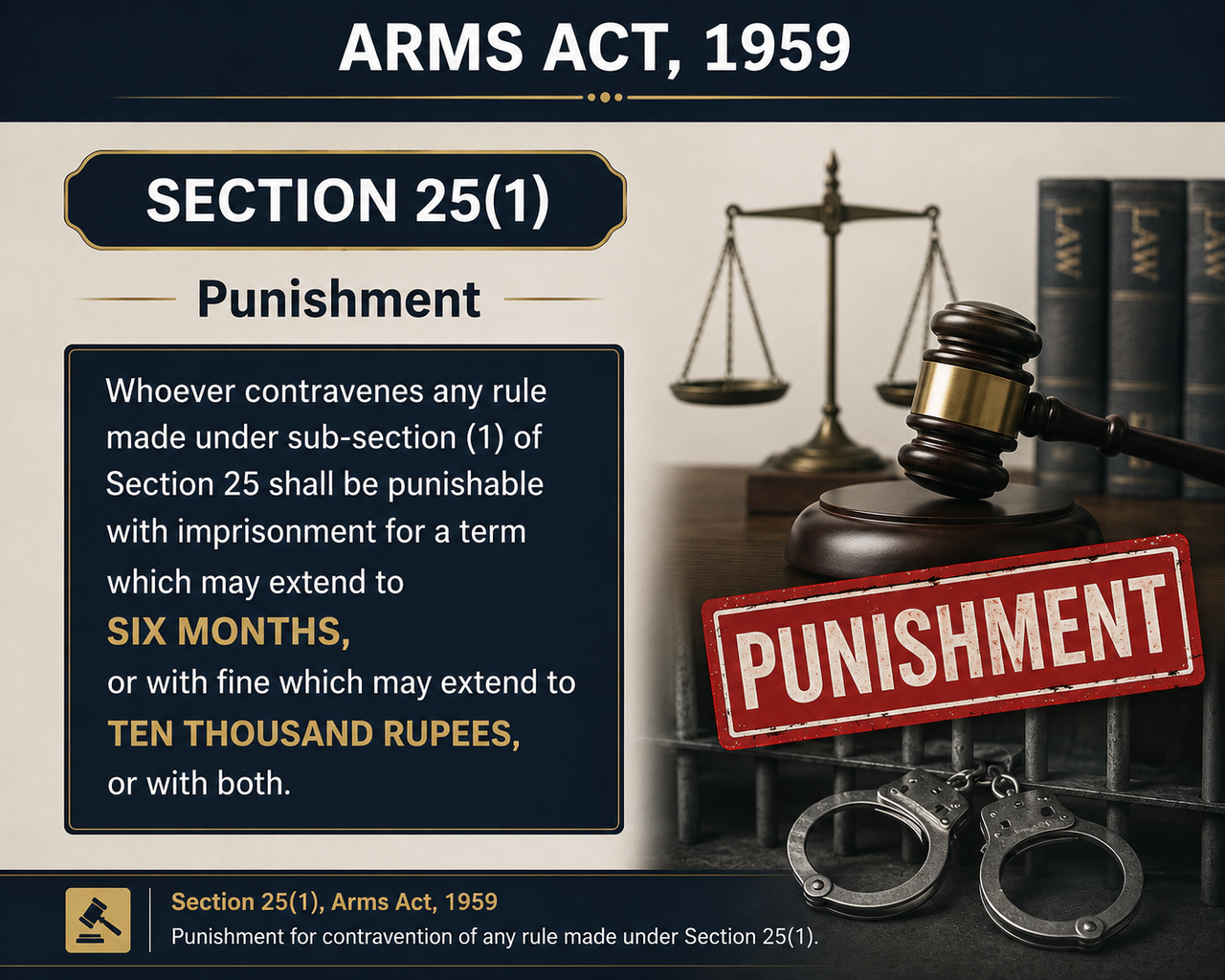
Any person that contravenes any provisions relating to licensing or regulation in the Arms Act as contemplated in section 25(1) shall be liable on conviction to a fine or to imprisonment for a period not exceeding five years, or to both such fine and punishment.
SECTION — 25(1)- In case of dealers being incorporated or registered in any manner, without obtaining a licence.
Among the offences in section 25(1) include:
Unauthorized possess of a firearm
Possession of ammunition without authorization.
Illegal acquisition of firearms.
Unauthorized manufacture of weapons.
Firearms trafficking
Unauthorised repair, testing or conversion of firearms
Conducting business as an arm dealer without a valid license.
It is meant to enforce regulation on weapons and curb weapon-related activities.
Punishment Under Section 25(1) of The Arms Act
However, depending on the specific clause and type of crime punishments differ.
For some section 25(1) offences, the penalty can be:
Your sentence (not less than 1 year but up to, 3 years and,
Fine, or
Both imprisonment and fine.
However, however severe the violation is, this punishment would be harsher under any other section of the Arms Act.
Various Scenarios Where Section 25(1) Comes Into Play
Unlicensed Firearm Possession
Someone is found offering to sell or unlawfully carrying arms without a valid licence.
Illegal Ammunition Possession
Someone has cartridges or ammunition without authorization.
Unauthorized Arms Business
An individual who sells or trades firearms without a license
Illegal Weapon Manufacturing
Workshop churns out firearms without government approval.
FIR and Investigation Process
When an offence is suspected:
Police register an FIR.
Weapons or ammunition are seized.
Witness statements are recorded.
Arms licenses are verified.
Forensic examination may be conducted.
Charge sheet is filed in front of court.
Bailability of the Section: (Come prepared to answer so that there is no confusion) — section 25(1) Bailable or non-bailable?
The types of bail are not based on the kind of case, but different categorizations depending on:
The specific offence alleged.
The type of weapon involved.
Criminal history of the accused.
Evidence collected by the police.
The court determines bail according to the particulars of each case.
Legal Defenses
Valid License
Lawful possession can be established by the accused with a valid arms license.
False Recovery
The claim that the gun was recovered is bit suspect.
Lack of Conscious Possession
Defense attorneys could claim the accused did not know the gun was there.
Procedural Irregularities
Court may dispute the search, seizure or investigation was done improperly
Role of a Criminal Lawyer
A lawyer can assist with:
Bail applications.
FIR defense.
Trial representation.
Examination of prosecution evidence.
Protection of legal rights.
Legal advice at the right time in Arms Act matter can make big difference.
Conclusion
The key penal provision dealing with illegal possession, acquisition, manufacture, sale, transfer and handling of firearms and ammunition is Section 25 (1) of the Arms Act, 1959. If found guilty, a person may face incarceration, fines or both. Those to whom proceedings under this section are initiated, must consult an Advocate and also know about their rights available under Indian Laws.
Need expert legal advice on this?
Don't navigate the legal system alone. Connect with a specialized advocate who can guide you through the specifics of your situation.