Advocate Gaurav Prashar
Legal Expert @ Find My Vakeel
Share Article
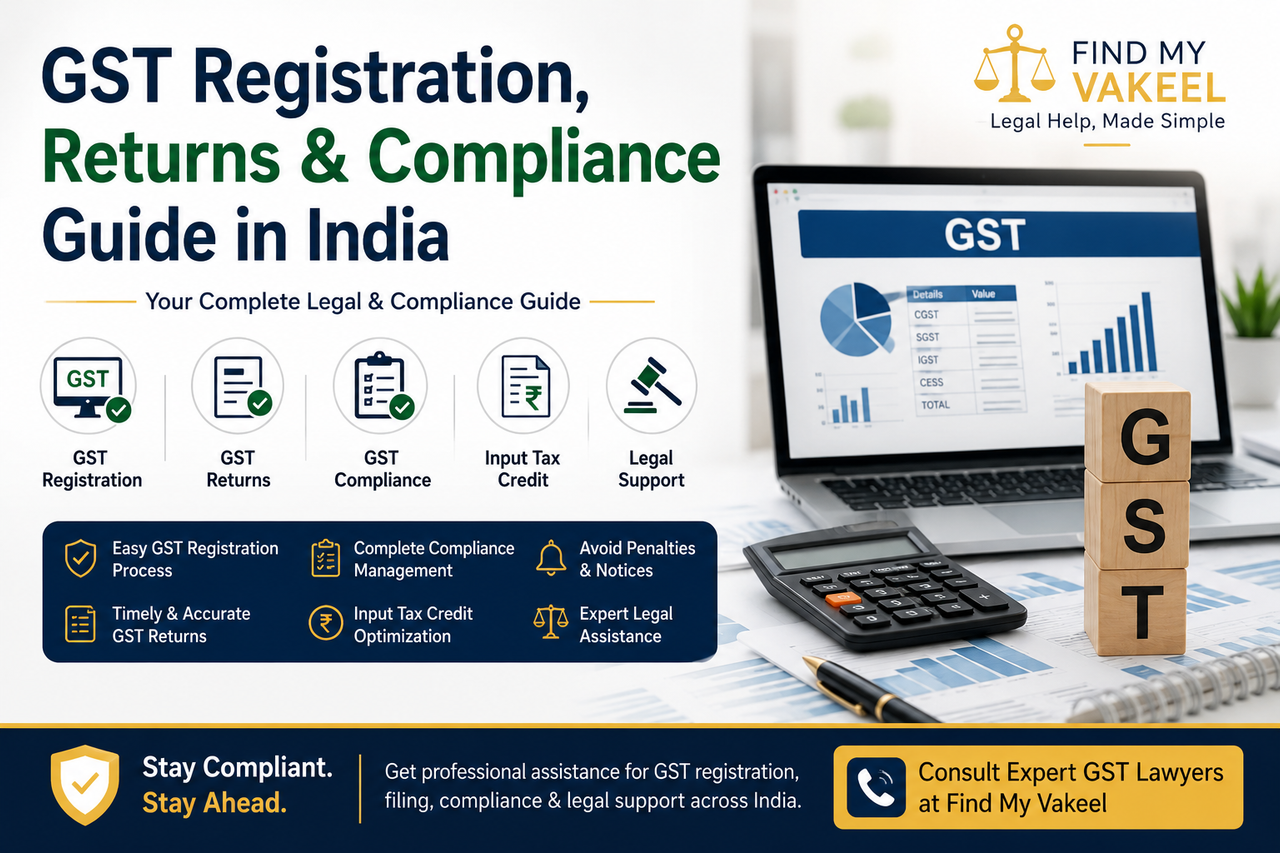
The Complete Guide to Goods and Services Tax (GST) in India for Businesses
The introduction of Goods and Services Tax (GST) is one of the largest tax reforms introduced in India. GST replaced several indirect taxes and streamlined these into a single – GST system in place of VAT, Service Tax, Excise Duty, Entry Tax etc. GST was introduced from 1st July 2017 with a aim to establish one tax across the nation.
GST is also important for businesses-related knowledge and startup/freelancer/service-providing companies to ensure their legal adherence and avoid getting penalized. GST affects the collection of sales, tax and return filing irrespective of whether you are selling goods/services.
What is GST?
April 2023 trained data GST which is (Goods and Services Tax) an indirect tax on the supply of products and services between states in India. It is a consumption-based tax that will be collected in the place of consumption not production level.
The GST is implemented in a value-added taxation method, where tax is levied at every level of the supply chain — but firms can claim Input Tax Credit (ITC) on taxes that were previously paid. It is useful in removing the effect of cascading taxes.
Types of GST in India
Central Goods and Services Tax (CGST)
CGST is levied by the Central Government on supplies of goods and services as a part of Union Territory (Union Territories Goods and Services Tax) for intra-State transactions.
SearchSGST (State Goods and Services Tax)
SGST is collected by the concerned State Govt. on intra-State transactions.
GST (Goods and Services Tax) international
IGST applies on inter-state transactions as well. IGST is collected by the Central Government, which then allocates a portion of it to the relevant states.
Key Features of GST
One nation, one tax structure.
Eliminates multiple indirect taxes.
Simplifies tax compliance.
Reduces tax-on-tax effect.
Promotes transparency in taxation.
Promotes e-filing and e-record keeping.
Reduces business friction across India
Benefits of GST for Businesses
Simplified Tax Structure
Businesses will no longer be required to manage multiple forms of indirect taxes under the purview of different authorities.
Input Tax Credit (ITC)
You claim credit for any GST paid on the purchases and expenses of running a business if you are registered as a business.
Better Compliance
Compliance has also become more convenient, with an online system for registration, return filing and payment.
Increased Market Reach
GST provides for simple interstate trade without cumbersome state level tax barriers.
Reduced Tax Burden
Cascading taxes have been eliminated, which decreases the overall cost of doing business.
GST Registration
GST registration is required for businesses exceeding the turnover limits set by law, or that perform certain taxable acts. Once registered the business gets a GST Identification Number (GSTIN).
A registered taxpayer must:
Collect GST from customers.
Issue GST-compliant invoices.
File GST returns regularly.
Maintain proper records and accounts.
Pay taxes to the government timely.
GST Returns
Return refers to a document containing details of sales, purchases and tax collected and paid by registered taxpayers under Goods and Services Tax (GST).
Common GST returns include:
Details of outward supplies: GSTR-1.
GSTR-3B — Summary return and payment of tax.
Annual Return – Filing for compliance on a yearly basis.
Not filing returns on time may also attract interest, late fees, and penalties.
Input Tax Credit (ITC)
Input Tax Credit allows to reduce the GST payable by businesses on goods and/or services used for business purposes by claiming credit of tax already paid at purchase level.
Examples include:
GST paid on office equipment.
GST paid on raw materials.
GST paid on professional services.
GST paid on business-related purchases.
ITC Benefit Can Be Claimed Only if You Have Proper Invoices and Compliance
GST Compliance Requirements
Businesses registered under GST must:
Maintain accurate records.
Generate tax invoices.
File GST returns on time.
Reconcile purchase and sales data.
Adhere to relevant e-invoicing and e-way bill requirements,
GST Issues Faced By Businesses
Although GST has simplified things, businesses may still find it useful to:
Complex filing requirements.
Frequent regulatory updates.
Input Tax Credit reconciliation issues.
Compliance management for multiple states.
Filing delays and mistakes in reporting penalties.
Importance of Legal Assistance in GST Related Matters
Any wrong step in compliance of GST such as GST disputes, notices, registration issues, and errors can result in heavy financial loss. An experienced GST lawyer or tax consultant can assist businesses:
Handle GST notices and assessments.
Resolve tax disputes.
Ensure proper compliance.
Maintenance of registration and return filing for GST.
Represent businesses before tax authorities.
Getting professional legal advice can help businesses to avoid making costly errors and staying legally compliant with GST laws.
Conclusion
GST is based on one of the big game changes to India's indirect taxation system by building a structure which is both national but transparent and inclusive. GST knowledge: It is the one of the most important areas for any business functioning in India. Maintaining proper GST compliance not only saves you a great deal from penalties but also ensures smoother functioning of your business and growth in the long run.
SEO Meta Title
Introduction of GST (Goods and Services Tax) in India – Complete Guide for Businesses
SEO Meta Description
GST in India |Everything you need to know about GST( Goods and Services Tax) Registration & Return Filing, Input tax credit, Compliance requirements, Benefits of GST for business & Legal help
Meta Keywords
Your data trained till 2023 October.
Need expert legal advice on this?
Don't navigate the legal system alone. Connect with a specialized advocate who can guide you through the specifics of your situation.